Kidney Disease Stages Chart: GFR Ranges, Albuminuria Levels and What Each Stage Means

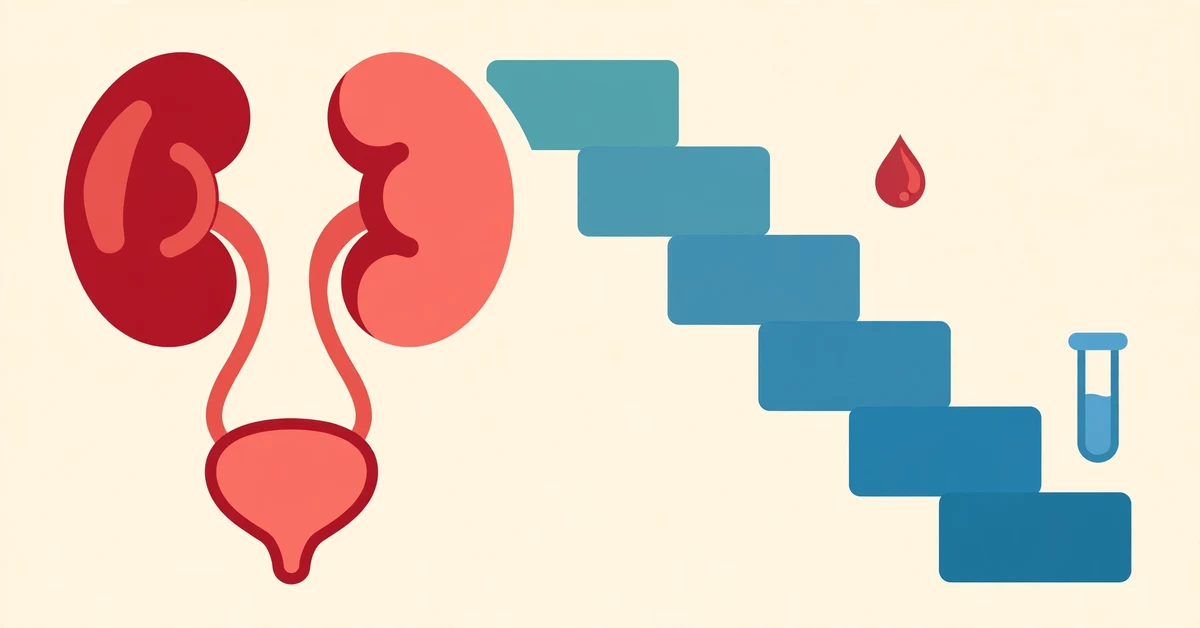
- The kidney disease stages chart (GFR stages G1–G5)
- What each stage means, stage by stage
- Stage 1 (G1): damage with normal filtration
- Stage 2 (G2): mild loss of function
- Stage 3a (G3a): mild to moderate loss
- Stage 3b (G3b): moderate to severe loss
- Stage 4 (G4): severe loss
- Stage 5 (G5): kidney failure
- The second axis: albuminuria stages A1–A3
- How a stage is confirmed: the 3-month rule
- eGFR and age: what is typical for your age?
- How often is each stage monitored?
- When should you see a kidney specialist (nephrologist)?
- Can progression be slowed?
- When the eGFR number can mislead
- Sources
Chronic kidney disease (CKD) is staged with two numbers, not one. The first is your eGFR – an estimate, from a blood creatinine test, of how much blood your kidneys filter each minute. It places you in one of five G stages, from G1 (eGFR 90 or above) to G5 (eGFR below 15, kidney failure). The second is your urine albumin-to-creatinine ratio (ACR), which sorts you into one of three A categories according to how much albumin – a blood protein – is leaking into your urine. The kidney disease stages chart below shows the GFR axis first, then the albuminuria axis that most charts leave out, and how the two combine. That second number matters: two people in the same GFR stage can have very different outlooks once albuminuria is counted.
Staging on this page follows the KDIGO classification used worldwide, as presented for patients by the National Kidney Foundation (NKF) and the National Institute of Diabetes and Digestive and Kidney Diseases (NIDDK).
The kidney disease stages chart (GFR stages G1–G5)
| Stage | eGFR (mL/min/1.73 m²) | Kidney function | What it means |
|---|---|---|---|
| Stage 1 (G1) | 90 or above | About 90–100% | Kidney damage is present – for example albumin in the urine, blood in the urine, or a structural problem on a scan – but filtration is normal or high. |
| Stage 2 (G2) | 60–89 | About 60–89% | Mild loss of kidney function, together with a sign of kidney damage such as albuminuria. |
| Stage 3a (G3a) | 45–59 | About 45–59% | Mild to moderate loss of function. Complications such as anemia and bone and mineral changes can begin here. |
| Stage 3b (G3b) | 30–44 | About 30–44% | Moderate to severe loss of function. Complications become more likely and monitoring steps up. |
| Stage 4 (G4) | 15–29 | About 15–29% | Severe loss of function. This is the stage to prepare, with a kidney specialist, for dialysis or transplant evaluation. |
| Stage 5 (G5) | Below 15 | Below 15% | Kidney failure. Dialysis or a kidney transplant is needed to replace kidney function and sustain life. |
One rule the chart alone cannot show: an eGFR of 60–89 by itself is not chronic kidney disease. Stages G1 and G2 only count as CKD when there is also a marker of kidney damage – most often albumin in the urine – or another abnormality lasting more than three months. An eGFR below 60, by contrast, indicates reduced kidney function in its own right once it has persisted for three months.
What each stage means, stage by stage
Stage 1 (G1): damage with normal filtration
The kidneys still filter at full capacity, but a test has found evidence of damage – albumin or blood in the urine, an abnormal biopsy, or a structural finding such as cysts. There are almost never symptoms. The job at this stage is detective work: find and treat the cause (diabetes and high blood pressure are the two most common), because this is when progression is easiest to prevent.
Stage 2 (G2): mild loss of function
Filtration has dipped slightly and a damage marker is present. Like stage 1, stage 2 is usually silent and is found on routine blood or urine tests rather than through symptoms. Blood pressure and blood sugar control, plus a yearly re-check of eGFR and urine ACR, are the typical plan.
Stage 3a (G3a): mild to moderate loss
Stage 3 is the most common stage and the point where many people are first told they have kidney disease. It is split into 3a and 3b because the outlook and monitoring differ. Most people in stage 3a still feel well, though tiredness is sometimes reported. The kidneys now clear waste less efficiently, so early complications – high blood pressure that is harder to control, anemia, and changes in calcium, phosphate and vitamin D handling – can start to appear and are worth screening for.
Stage 3b (G3b): moderate to severe loss
At 30–44, waste products and fluid are noticeably harder for the kidneys to manage. Complications such as anemia, metabolic acidosis (blood becoming too acidic) and bone and mineral disorder become more likely, medicines that are cleared by the kidneys may need dose adjustments, and monitoring becomes more frequent. Many people are referred to a nephrologist (kidney specialist) at this stage if they are not already seeing one.
Stage 4 (G4): severe loss
Symptoms become more common: swelling in the legs or around the eyes, marked fatigue, nausea and poor appetite, itching, muscle cramps and breathlessness from fluid build-up. Stage 4 is preparation time – learning about dialysis and transplant, protecting arm veins and, if dialysis is chosen, creating access ahead of time, updating vaccinations, and reviewing diet with a renal dietitian. Good preparation at this stage makes starting treatment far smoother than an emergency start.
Stage 5 (G5): kidney failure
Below an eGFR of 15 the kidneys can no longer keep up with the body’s needs. Symptoms can include persistent nausea and vomiting, severe swelling, breathlessness, confusion and extreme tiredness. Treatment is dialysis (hemodialysis or peritoneal dialysis) or a kidney transplant. Some people, particularly those who are older or have other serious illnesses, choose conservative care focused on comfort and symptom control instead – a decision made with the kidney team.
The second axis: albuminuria stages A1–A3
Filtration is only half the picture. Healthy kidneys keep albumin in the blood; damaged filters leak it into the urine. The urine albumin-to-creatinine ratio (ACR) measures that leak, and KDIGO grades it in three categories:
| Category | Urine ACR (mg/g) | Urine ACR (mg/mmol) | What it means |
|---|---|---|---|
| A1 | Below 30 | Below 3 | Normal to mildly increased. No significant albumin leak. |
| A2 | 30–300 | 3–30 | Moderately increased (older term: microalbuminuria). An early warning sign – often the first detectable sign of diabetic kidney damage. |
| A3 | Above 300 | Above 30 | Severely increased (older term: macroalbuminuria). Clear kidney damage, with a higher risk of progression and of heart and blood vessel disease. |
Doctors combine the two axes into a short code: the G stage plus the A category. Three worked examples show why both numbers matter:
- eGFR 52 + ACR 180 = stage G3a, category A2. Filtration is moderately reduced and there is a moderate albumin leak. Her risk is higher than the GFR stage alone suggests, so she is monitored more closely than someone at G3a with no albuminuria.
- eGFR 96 + ACR 412 = stage G1, category A3. His filtration looks “normal” on the GFR chart, yet he is leaking a large amount of albumin – definite kidney damage with a high risk of progression. A GFR-only chart would wrongly reassure him.
- eGFR 74 + ACR 12 on a single test = G2 numbers, A1 – but not yet CKD. With no albuminuria and no other damage marker, this does not meet the definition of chronic kidney disease unless the result persists for more than three months or another abnormality is found. Repeat testing comes first.
The urine ACR is the same test covered in depth in our guide to the microalbuminuria test, including what can temporarily raise it (exercise, fever, a urinary infection) and why a raised result is confirmed on repeat samples.
How a stage is confirmed: the 3-month rule
Kidney disease is only called chronic when the abnormality has been present for more than three months. That rule protects people from being labelled with a lifelong diagnosis after one bad week. Dehydration, an acute illness or infection, a heart failure flare, very hard exercise, or medicines such as NSAID painkillers can all push eGFR down temporarily; a sudden drop like this is called acute kidney injury (AKI), and kidney function often recovers once the cause is treated.
In practice, staging uses two tests together – a blood creatinine test (from which eGFR is calculated) and a urine ACR – repeated after an interval, usually around three months, before a stage is assigned. If your first result comes back low, expect a repeat rather than an instant diagnosis.
eGFR and age: what is typical for your age?
eGFR falls gradually with age even in people with healthy kidneys, which is why the same number can mean different things at 35 and at 85. The National Kidney Foundation lists these average eGFR values by age group:
| Age group | Average eGFR |
|---|---|
| 20–29 | 116 |
| 30–39 | 107 |
| 40–49 | 99 |
| 50–59 | 93 |
| 60–69 | 85 |
| 70+ | 75 |
Read this table carefully: these are population averages, not targets or “normal ranges” to aim for, and the stage cut-offs in the main chart do not change with age – an eGFR of 58 is stage G3a at any age. What changes is the context. A 35-year-old with an eGFR of 58 sits far below the average for their age and needs the cause found. An 85-year-old with the same value, stable over years and with no albuminuria, is closer to a typical ageing pattern and is less likely to progress to kidney failure. It works the same way as other age-read lab charts, such as the PSA level chart for seniors: the average drifts with age, but the action thresholds stay fixed – the trend over time and the urine result are what guide decisions.
How often is each stage monitored?
There is no single schedule that fits everyone – how often you are checked follows your combined G and A risk, how fast your numbers are changing, and your other conditions. Typical practice based on KDIGO guidance looks like this:
| Stage | eGFR + urine ACR checks (typical) | What else is usually checked |
|---|---|---|
| G1–G2 | About once a year | Blood pressure; blood sugar if you have diabetes; review of medicines that can strain the kidneys. |
| G3a | About 1–2 times a year | Potassium and bicarbonate; hemoglobin (anemia); calcium and phosphate. |
| G3b | About 2–3 times a year | The above, plus parathyroid hormone and vitamin D (bone and mineral health) as advised. |
| G4 | About 3 times a year | The above, plus dietitian input, vaccinations, and education about dialysis and transplant options. |
| G5 | About 3–4 times a year or more | Close specialist follow-up along the dialysis or transplant pathway, or symptom-focused conservative care. |
High albuminuria (A3), a falling trend, or uncontrolled blood pressure all move people to the more frequent end of these ranges. Your own doctor will set your interval – treat this table as a map of usual practice, not a personal prescription.
When should you see a kidney specialist (nephrologist)?
Many people with early-stage CKD are managed well by their primary care doctor. Referral to a nephrologist is typically advised when any of the following apply:
- eGFR persistently below 30 (stages G4–G5), or preparation for dialysis or transplant is needed.
- Urine ACR above 300 mg/g (category A3), especially if it is rising despite treatment.
- A rapid fall in eGFR – for example a sustained drop of more than 5 mL/min/1.73 m² per year, or slipping a whole G stage.
- Blood in the urine that is not explained by infection or another simple cause.
- High blood pressure that stays uncontrolled despite three or more medicines.
- A suspected inherited kidney disease, kidney damage from a body-wide (systemic) illness, recurrent kidney stones, or a structural kidney problem.
- Persistent abnormal potassium or acid levels, or anemia caused by kidney disease.
Seek medical care promptly at any stage for very low urine output, marked swelling, breathlessness, confusion, or severe nausea – these can signal a sudden worsening that needs same-day assessment.
Can progression be slowed?
A stage rarely moves backwards, but progression can often be slowed substantially – and the earlier it starts, the more it helps. Measures with good evidence behind them include:
- Controlling blood pressure, which is both a cause and a consequence of CKD; many people with CKD are given a target below 130/80 mmHg, set individually by their doctor.
- Managing blood sugar carefully if you have diabetes, the single most common cause of kidney failure.
- Kidney-protective medicines where prescribed – ACE inhibitors or ARBs for people with albuminuria, and SGLT2 inhibitors, which guidelines now recommend for many people with CKD with or without diabetes.
- Cutting back on salt and following any protein guidance from a dietitian, rather than self-prescribing a high- or low-protein diet.
- Avoiding NSAID painkillers (such as ibuprofen and diclofenac) unless your doctor says they are safe for you, and flagging your kidney function before scans that use contrast dye.
- Not smoking, keeping a healthy weight, and staying physically active, all of which also protect the heart – the biggest health risk in CKD is cardiovascular disease.
When the eGFR number can mislead
eGFR is an estimate, calculated from creatinine – a waste product of muscle – using the CKD-EPI 2021 equation, which no longer includes a race coefficient. Because it is built on creatinine, it is less accurate when muscle mass is far from average: bodybuilders and people with very high muscle mass can look worse than they are, while frail older adults, amputees and people with severe illness can look better than they are. Creatine supplements and a very high meat intake raise creatinine, and some medicines (such as trimethoprim) block its removal and nudge the number without any real change in kidney function.
When a decision hinges on the exact value, a second blood marker called cystatin C can be used to confirm the estimate. eGFR is also unreliable while creatinine is changing quickly, as in acute kidney injury – one more reason a single reading is never the whole story, and why doctors stage kidney disease on repeated tests, the urine result, and the trend over time.
Sources
- National Kidney Foundation – Stages of Chronic Kidney Disease (CKD)
- National Kidney Foundation – Your Kidney Numbers and What They Mean (eGFR booklet, including average eGFR by age)
- NIDDK – Chronic Kidney Disease Tests & Diagnosis
- NIDDK – Quick Reference on UACR & GFR
This article is for general information only and is not medical advice. Kidney disease staging requires repeated blood and urine tests interpreted by a clinician who knows your history. If you have been told your kidney function is reduced, discuss your stage, your trend and your monitoring plan with your own doctor.
Frequently Asked Questions
The five stages are based on eGFR: stage 1 is 90 or above (damage with normal filtration), stage 2 is 60–89, stage 3 is 30–59 (split into 3a at 45–59 and 3b at 30–44), stage 4 is 15–29, and stage 5 is below 15, which is kidney failure. A complete stage also includes the albuminuria category (A1–A3) from a urine ACR test.
An eGFR below 15 mL/min/1.73 m² is stage G5, kidney failure. At that point the kidneys can no longer sustain the body on their own, and treatment with dialysis or a kidney transplant is usually needed, although the exact timing is based on symptoms, blood tests and personal choice rather than the number alone.
The GFR stage itself rarely reverses, because lost filtering tissue does not regrow. However, progression can often be slowed or stabilised for years with blood pressure and blood sugar control and kidney-protective medicines, and albuminuria can genuinely fall with treatment. A sudden drop in kidney function (acute kidney injury) is different – it often recovers once the cause, such as dehydration or infection, is treated.
Stage 3 means a moderate reduction in kidney function and it should be taken seriously as a signal to act, not as a cause for panic. Most people with stage 3 – particularly stage 3a with no albuminuria – never progress to kidney failure, but their risk of heart and blood vessel disease is raised. Regular monitoring, blood pressure control and reviewing medicines matter more at this stage than any symptom, because there usually are none.
There is no single age-adjusted “normal”: the stage cut-offs are the same at every age, with below 60 for more than three months indicating reduced function. Average eGFR does fall with age, though – about 116 in the 20s, 99 in the 40s, 85 in the 60s and 75 over 70, according to the National Kidney Foundation. An average is not a target, so a value below your age-group average is a prompt to look for a cause, not a diagnosis by itself.
It is the combined KDIGO code for a person’s kidney status. G3a means an eGFR of 45–59 (mild to moderate loss of filtration), and A2 means a urine albumin-to-creatinine ratio of 30–300 mg/g (moderately increased albumin in the urine). Reading both parts together gives a better picture of risk than either number alone.
It depends on stage and risk. Typical practice is about once a year for stages G1–G2, one to three times a year across stage G3, about three times a year at G4, and three to four times a year or more at G5 – with blood tests for potassium, bicarbonate, hemoglobin and bone minerals added from stage 3 onward. Heavy albuminuria or a falling trend means more frequent checks. Your doctor sets your personal schedule.
Usually there are none. Stages 1 and 2, and much of stage 3, are typically silent and are found on blood and urine tests done for other reasons – which is why people with diabetes, high blood pressure or a family history are offered regular kidney checks. When symptoms do appear, usually in stages 4–5, they include swelling, fatigue, nausea, poor appetite, itching, muscle cramps and breathlessness.
Read Next

The 2-Year-Old Sleep Regression: What You Should Know

Biktarvy and Cost: What You Need to Know

Can You Eat Pumpkin or Pumpkin Seeds Raw?

When and How Should You End a Relationship with a Person Diagnosed with Bipolar Disorder?

Does Medicare Cover CPAP Machines? Coverage Rules and Costs Explained

8 Alternatives to Leg Extension Exercises
Related Posts
Bedsore Stages in Pictures: What Each Pressure Ulcer Stage Looks Like
Nov 9, 2026 • 6 min read
Cómo lograr un orgasmo anal: 35 consejos para ti y tu pareja
Aug 21, 2026 • 15 min read
6 Best Protein Powders for Weight Gain in 2025
Oct 2, 2026 • 27 min read
Does Medicare Cover Echocardiograms (ECG)?
Sep 11, 2026 • 11 min read
Cellulitis vs DVT: How to Tell a Skin Infection From a Blood Clot in Your Leg
Nov 10, 2026 • 30 min read