How Are Narcotics and Other Drugs Classified and Scheduled?

- One law, five boxes
- The three questions behind every placement
- The five schedules, side by side
- “Narcotic”: the word that confuses everyone
- Classification is not only about the law
- How a drug gets scheduled – or moved
- Federal law is the floor, not the ceiling
- The famous exceptions: alcohol, tobacco, and kratom
- What the schedule means for your own medicine
- Frequently asked questions
- Who decides which schedule a drug is in?
- Is alcohol a scheduled drug?
- Can a drug change schedules?
- Does Schedule I mean “most dangerous”?
- Why is marijuana Schedule I federally but legal in my state?
- Is kratom a controlled substance?
Pick up two prescriptions at the same pharmacy and you can have two very different experiences. One refill waits in a bag with your name on it. The other needs a fresh prescription from your doctor, a photo ID at the counter, and your signature in a logbook. Same pharmacist. Sometimes the same shelf. The difference comes down to a single Roman numeral set under federal law: the drug’s schedule.
That numeral decides how a medicine can be prescribed, refilled, stored, studied, and punished. It also produces some odd pairings. Cocaine and a common ADHD medicine share a legal category. The beer in your fridge sits outside the system entirely. This page explains how US drug classification works, who built it, and where it creaks.
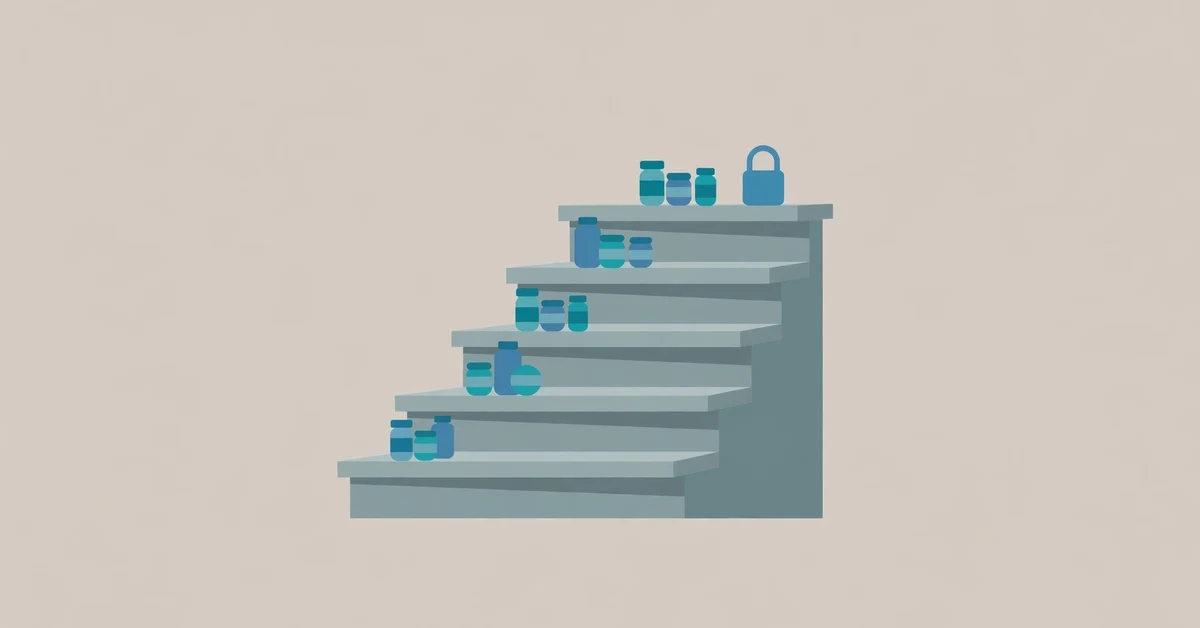
One law, five boxes
Before 1970, federal drug law was a patchwork of tax acts and one-off bans. Congress replaced it with the Controlled Substances Act (CSA), Title II of the Comprehensive Drug Abuse Prevention and Control Act of 1970. The CSA sorted every controlled drug into five schedules, numbered I through V, and created the framework the Drug Enforcement Administration (DEA) was set up to enforce in 1973.
On paper, scheduling power belongs to the Attorney General, who has delegated it to the DEA Administrator. In practice, the DEA does not grade the science alone. The Department of Health and Human Services (HHS), working through the Food and Drug Administration (FDA), evaluates the medical and scientific evidence, and its findings on those questions bind the DEA. Congress can also skip the process and schedule a drug directly by statute, as it did with anabolic steroids in 1990 and GHB in 2000.
The three questions behind every placement
Every scheduling decision answers three questions, and the CSA writes the answers into the definition of each schedule:
- How likely is this drug to be abused?
- Does it have a currently accepted medical use in the United States?
- How strong is the dependence risk – physical, psychological, or both?
The middle question does the heaviest lifting. Heroin and morphine are both powerful opioids with serious dependence risk. Morphine is a standard hospital medicine, so it sits in Schedule II. Heroin has no accepted medical use in the US, so it sits in Schedule I. The line between the top two schedules is less about danger than about whether doctors are allowed to use the drug at all.
The five schedules, side by side
Here’s the whole system in one table. The examples are the ones the DEA itself lists most often.
| Schedule | What the law requires | Familiar examples | What it means for prescriptions |
|---|---|---|---|
| I | High abuse potential, no currently accepted medical use, no accepted safety even under medical supervision | Heroin, LSD, MDMA (ecstasy), peyote, marijuana (at the federal level) | Cannot be prescribed or dispensed. Research only, under a special DEA license. |
| II | High abuse potential, an accepted medical use, and use may lead to severe physical or psychological dependence | Morphine, oxycodone, fentanyl, hydrocodone combinations, methadone, cocaine, methamphetamine, Adderall, Ritalin | No refills. A new prescription is required for every fill, with strict record-keeping. |
| III | Abuse potential below Schedule II; moderate to low physical dependence or high psychological dependence | Codeine products under 90 mg per dose (Tylenol with codeine), ketamine, anabolic steroids, testosterone, buprenorphine | Up to 5 refills within 6 months. |
| IV | Low potential for abuse and low risk of dependence compared with Schedule III | Xanax, Valium, Ativan, Klonopin, tramadol, Ambien | Up to 5 refills within 6 months; handled much like regular prescriptions, with records kept. |
| V | Lowest abuse potential among controlled drugs; preparations containing limited amounts of certain narcotics | Cough syrups with under 200 mg of codeine per 100 mL (Robitussin AC), Lomotil, Lyrica | Loosest rules. In some states, certain Schedule V products are sold from behind the counter without a prescription, with an ID and a logbook signature. |
Two details in that table surprise people. First, Schedule I is the only schedule that bans medical use outright; every other schedule is a medicine with rules attached. Second, the ranking is not a danger league table. Methamphetamine sits in Schedule II because it has an accepted medical use – it is sold, rarely, as Desoxyn for ADHD – not because anyone considers it safer than marijuana.
“Narcotic”: the word that confuses everyone

Ask a room of people what a narcotic is and you’ll get three different answers, because the word carries three meanings at once.
In medicine, a narcotic is an opioid: a drug derived from the opium poppy or built to act like one. Morphine, codeine, oxycodone, and fentanyl are narcotics in this sense. They dull pain, slow breathing, and carry a well-earned reputation for dependence.
In federal law, the word is older and messier. The CSA’s legal definition of “narcotic drug” covers opium, opiates, and their derivatives, and it also sweeps in coca leaves and cocaine – a stimulant that wakes people up rather than sedating them. Early 1900s statutes taxed and policed the two together, and the wording stuck. Police departments and news reports stretch the term further still, using “narcotics” for almost any illegal drug.
That’s why so many people end up asking whether Adderall is a narcotic, or whether Xanax is. Neither is one, in the medical sense or in ordinary use. Adderall is a Schedule II stimulant, and we walk through Adderall’s Schedule II status and why it is not a narcotic in a separate guide. Xanax is a Schedule IV benzodiazepine; our explainer on whether Xanax is a narcotic covers that one. The practical takeaway: when a label matters, ask for the schedule, not the slang.
Classification is not only about the law
Doctors and pharmacists sort drugs a different way, and it’s worth knowing the vocabulary because both systems appear on labels and in textbooks. A drug’s therapeutic class is what it treats: antihypertensives lower blood pressure, analgesics relieve pain. Its pharmacologic class is how it works: beta blockers block adrenaline receptors, SSRIs block serotonin reuptake. The World Health Organization’s ATC system codes every medicine by anatomy, therapy, and chemistry, and researchers worldwide use it to compare drug use across countries.
One drug lives in several systems at once. Oxycodone is an opioid (pharmacologic class), a pain treatment (therapeutic class), and a Schedule II controlled substance (legal class). The rest of this page stays with the legal system, because that’s the one that controls who can get the drug and on what terms.
How a drug gets scheduled – or moved
Scheduling is not a one-time verdict handed down in 1970. Drugs are added, moved, and occasionally removed, and the CSA sets an eight-factor test for the decision:
- Its actual or relative potential for abuse
- Scientific evidence of its pharmacological effect
- The state of current scientific knowledge about it
- Its history and current pattern of abuse
- The scope, duration, and significance of that abuse
- The risk, if any, to public health
- Its psychic or physiological dependence liability
- Whether it is an immediate precursor of a substance already controlled
A proceeding can start with a petition, and almost anyone can file one: a drug manufacturer, a medical society, the DEA itself, or a member of the public. The FDA reviews the science for HHS, the DEA publishes a proposed rule, the public comments, and a final rule follows. It’s slow by design.
There is a fast lane. If the DEA finds a substance is an imminent hazard to public safety, it can place it in Schedule I temporarily, for two years with a possible one-year extension, while the full review runs. That power mattered most for fentanyl copycats: chemists kept tweaking the fentanyl molecule just enough to dodge the list, so in 2018 the DEA scheduled the whole family of fentanyl-related substances at once. Congress later made that class-wide placement permanent in the HALT Fentanyl Act of 2025.
Marijuana shows the slow lane in action. In 2023, after an FDA review, HHS recommended moving marijuana to Schedule III. The DEA published a proposed rule in 2024 and collected public comments. As of late 2026 the change is still not final, and marijuana remains a Schedule I drug under federal law – whatever your state’s law says.
Federal law is the floor, not the ceiling
Every state runs its own controlled-substance schedules on top of the federal ones. Most mirror Washington closely, but states are free to be stricter, and pharmacists follow whichever rule is tighter. States cannot loosen federal law, which is why a dispensary can be legal under state rules and illegal under federal ones at the same time, and why marijuana businesses struggle with ordinary banking.
States also move on their own evidence. Gabapentin isn’t a controlled substance federally, but a growing list of states – Kentucky, Michigan, and Tennessee among them – have placed it in Schedule V after reports of misuse, often alongside opioids. A prescription that is routine in one state can need extra paperwork across the state line.
The famous exceptions: alcohol, tobacco, and kratom
The two deadliest recreational drugs in the country are not in any schedule. Alcohol and tobacco were left out of the CSA entirely, a carve-out that reflects history and politics rather than pharmacology. They are regulated under other laws instead: alcohol through tax and trade rules, tobacco through the FDA’s tobacco authority, granted in 2009.
Kratom sits in a grayer zone. The herbal product isn’t federally scheduled. The DEA announced plans to emergency-schedule it in 2016, then withdrew the proposal after public and congressional pushback, and the FDA continues to warn against its use. Several states ban or regulate it on their own. The lesson cuts both ways: absence from the schedules is not a safety stamp, and presence in them is not a simple danger ranking either.
What the schedule means for your own medicine

For most people, scheduling stops being abstract at the pharmacy counter. If your medicine is in Schedule II, expect no refills: your prescriber must issue a new prescription for each fill, will usually check your state’s prescription drug monitoring program (PDMP) first, and the pharmacy may ask for ID and refuse an early fill. Schedule III and IV medicines allow up to five refills in six months. Schedule V rules are the loosest of the controlled drugs.
Two habits keep patients out of trouble. Never share a controlled prescription, even with a spouse or a family member in pain; lending it isn’t just unwise – it’s illegal. And don’t let leftovers pile up in the bathroom cabinet. The DEA runs National Prescription Drug Take Back Day events and year-round collection sites, listed on the DEA website, and the FDA keeps a short “flush list” of high-risk medicines to flush when no take-back option is available. If you take a Schedule IV medicine such as Klonopin (clonazepam), its schedule is only half the story – what it is mixed with matters just as much, as our guide to Klonopin interactions explains. For a drug-by-drug reference, see our controlled substance list as well.
Frequently asked questions
Who decides which schedule a drug is in?
The DEA makes the final scheduling decision, using authority the CSA gives the Attorney General. It doesn’t decide alone: HHS and the FDA evaluate the medical and scientific evidence, and their findings on those questions bind the DEA. Congress can also place a drug in a schedule directly by passing a law.
Is alcohol a scheduled drug?
No. Alcohol and tobacco were excluded from the Controlled Substances Act when it was written, so neither appears in any schedule. They are regulated under separate laws instead – alcohol mainly through tax and trade rules, and tobacco through the FDA since 2009.
Can a drug change schedules?
Yes. Drugs move when the evidence or the politics changes, through a petition, an FDA and HHS scientific review, and DEA rulemaking. Hydrocodone combination products such as Vicodin moved from Schedule III to Schedule II in 2014 as overdose data mounted. Marijuana’s proposed move to Schedule III is the biggest live example.
Does Schedule I mean “most dangerous”?
Not exactly. Schedule I means high abuse potential plus no currently accepted medical use. Cocaine and methamphetamine sit in Schedule II because doctors have accepted uses for them, not because they are safer than the drugs in Schedule I. The schedules rank legal status first and danger only partly.
Why is marijuana Schedule I federally but legal in my state?
Because state law cannot override federal law. States may drop their own penalties and license dispensaries, but the CSA still applies, and under its criteria the federal government has not accepted a medical use for marijuana. A rescheduling proposal has been pending since 2024, so for now the two systems simply disagree.
Is kratom a controlled substance?
Not at the federal level. Kratom appears in no federal schedule, and a 2016 attempt to place it in Schedule I temporarily was withdrawn. Some states ban or regulate it themselves, and the FDA warns that it carries opioid-like risks, so treat “unscheduled” as a legal status, not a clean bill of health.
The schedules are a 1970s framework trying to keep up with modern chemistry, and reasonable people argue about where individual drugs sit in it. But the five numbers still run daily life: they decide what your doctor can phone in, what your pharmacist must log, and what a researcher may study. When a label or a headline confuses you, translate it back to the schedule – and when the medicine is yours, ask your pharmacist. They explain this system at the counter every day.
Sources: the Controlled Substances Act and published materials from the DEA, FDA, MedlinePlus, and SAMHSA.
Read Next

What Is Colloidal Silver, and Is It Safe?
Ringworm Pictures: What Ringworm Looks Like on Skin, Scalp and Nails

What’s the Benefit of Poppyseed Oil?

Everything You Should Know Before Getting a Fourchette Piercing

How to Reduce the Appearance of 'Man Boobs' with Exercise and Diet

5 Evidence-Based Ways Collagen May Improve Your Hair
Related Posts

What Is Social Media Addiction?
Aug 22, 2026 • 32 min read
Celebrities Who Have Struggled with Alcohol Addiction
Oct 2, 2026 • 22 min read
Can You Overdose on Xanax?
Sep 8, 2026 • 22 min read
Simple Daily Habits for Healthy Skin
Nov 20, 2026 • 24 min read
What Exactly Is a Tooth Piercing?
Sep 11, 2026 • 33 min read