Stabilize Your Knees with Step-Downs


Although squats are excellent for targeting the glutes and quadriceps, it’s equally crucial to care for your knees properly.
That’s where step-downs come in.
This exercise leans more toward rehabilitation than pure hypertrophy and can aid in stabilizing the knee joint. Because the hips, hamstrings, and quads collaborate to guide the kneecap through its range, strengthening and mobilizing all of these muscle groups helps keep the knee resilient and supple. That’s precisely the benefit this movement provides!
Duration: 5 sets, 20 repetitions (10 per side). If that feels like too much, begin with a set and rep scheme that suits your current level.
Instructions:
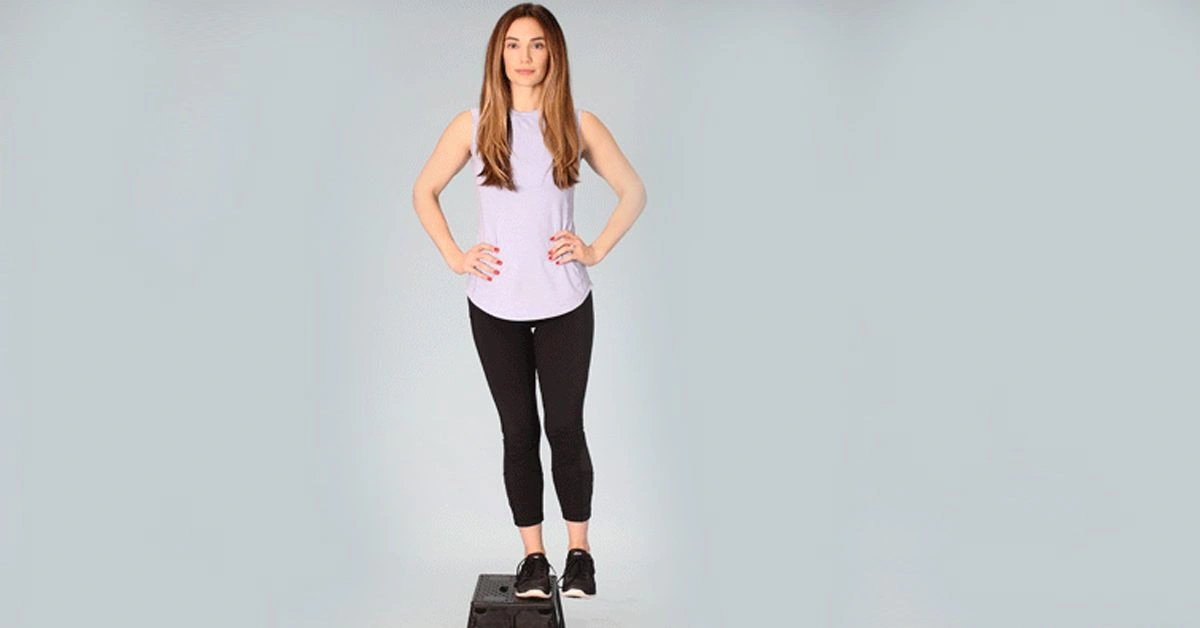
- Begin by standing with one foot planted on a step and the other foot hanging off the edge.
- Carefully lower the non-supporting leg down to the side of the step, gently touching the heel to the floor.
- Return to the starting position.
- Continue until you’ve completed the prescribed number of repetitions.
- Change legs and repeat.
Tomorrow: Progress to the wall.
Frequently Asked Questions
Step-downs are a controlled single-leg movement where you lower the non-supporting foot off a step to touch the floor, building knee stability. They are ideal for people rehabbing knee issues, athletes wanting better control, and anyone aiming to strengthen hips, hamstrings, and quads.
The article suggests 5 sets of 20 repetitions (10 per side). If that’s too challenging, start with fewer sets and reps and gradually increase as strength and control improve.
Begin with a low step height and fewer reps. Increase step height, add reps or sets, or move to a wall-supported progression as control improves. Always prioritize controlled movement over speed.
Step-downs can be part of rehabilitation but should only be performed with clearance from a healthcare provider or physical therapist, who can tailor intensity and progression to your recovery stage.
Avoid letting the knee collapse inward, using momentum, or rushing the descent. Keep hips level, move slowly, and focus on controlled alignment through the ankle, knee, and hip.



Related Posts

What Is Sweet Annie and What Are the Benefits?
Aug 19, 2026 • 36 min read
6 Reasons Working from Bed Isn't Doing You Any Favors
Oct 6, 2026 • 10 min read
Everything You Need to Know about Sensory Deprivation Tank Therapy
Aug 11, 2026 • 15 min read
A Review of Priority STD
Jul 30, 2026 • 21 min read
Top 10 Benefits of Sleeping Naked
Aug 27, 2026 • 3 min read