Heat Rash (Prickly Heat) Pictures: The 3 Types and How to Tell Them Apart

- How to tell it is heat rash: the quick checklist
- Miliaria crystallina: the clear “dewdrop” type
- Miliaria rubra: the red, prickly type in pictures
- Miliaria profunda: the deep, flesh-coloured type
- The three types of heat rash, side by side
- Heat rash by body area: what to look for in each place
- Heat rash in babies: what parents should know
- What else looks like heat rash?
- How to treat heat rash at home
- How long it lasts — and when heat rash turns into something worse
- What a photo cannot tell you
- When to see a doctor
- The bottom line
Heat rash — also called prickly heat or miliaria — is what happens when sweat ducts get blocked and sweat leaks into the skin instead of reaching the surface. The result is a crop of tiny bumps or blisters that itches, prickles and shows up exactly where skin gets hot and sweaty: the neck, upper chest, back, armpits, groin and under the breasts. It is very common in babies, and just as common in adults during heat waves, holidays in hot climates, fevers and heavy physical work.
The pictures in this guide are organised the way doctors actually separate heat rash: by its three types. How deep the sweat duct is blocked decides how the rash looks — clear water-drop blisters on the surface (miliaria crystallina), red itchy bumps a layer deeper (miliaria rubra, the classic prickly heat), or firm flesh-coloured bumps deep down (miliaria profunda). One caution before you start matching photos: as the NHS and Cleveland Clinic both note, heat rash is usually diagnosed from its appearance and the situation it appeared in — so use the photos to recognise the pattern, then check anything that does not behave as described below.
How to tell it is heat rash: the quick checklist
Whatever the type, heat rash tends to announce itself with the same short list of clues:
- It followed heat and sweat. The rash appears during or just after hot, humid weather, exercise, a fever, or time spent wrapped up in heavy clothing or bedding.
- It favours covered, sweaty skin. Neck, upper chest and back, armpits, elbow creases, under the breasts, the waistband line and the groin — places where sweat collects and clothing traps it.
- The spots are tiny and crowded. Pinhead-sized bumps or blisters packed closely together, rather than a few large, widely spaced spots.
- It prickles more than it hurts. A pricking, stinging itch is typical of the red type; pain is not a normal feature of simple heat rash, and its appearance is a warning sign (see the infection checklist below).
- It fades fast once you cool down. Moving to air conditioning, loosening clothing and letting the skin dry usually calms heat rash within a few days — a rash that keeps spreading despite cooling is probably something else.
Miliaria crystallina: the clear “dewdrop” type
Miliaria crystallina is the most superficial form: the sweat duct blocks right at the skin’s surface, so sweat collects in tiny blisters just under the outermost layer. In pictures it looks like a sprinkling of clear water droplets or dew on the skin — clusters of fragile, crystal-clear blisters about 1 to 2 mm across, with no redness, no swelling and usually no itch at all. The blisters are so delicate they often burst from the friction of clothing, and the area may peel with a fine, flaky scale as it settles.
This is the newborn type. It is seen most often in babies in the first weeks of life, whose sweat ducts are still maturing, and in anyone — child or adult — who has been sweating heavily with a fever. Because there is no inflammation, crystallina is also the fastest to go: once the skin is cool and dry, the blisters typically clear within about a day.
On different skin tones: the blisters themselves are clear on every skin tone, which makes crystallina the easiest type to miss in a photograph — and the hardest to see on brown or black skin, where there is no colour change to draw the eye. Look (and feel) for the tiny raised fluid bumps catching the light, especially across a newborn’s forehead, neck and upper trunk.
Miliaria rubra: the red, prickly type in pictures
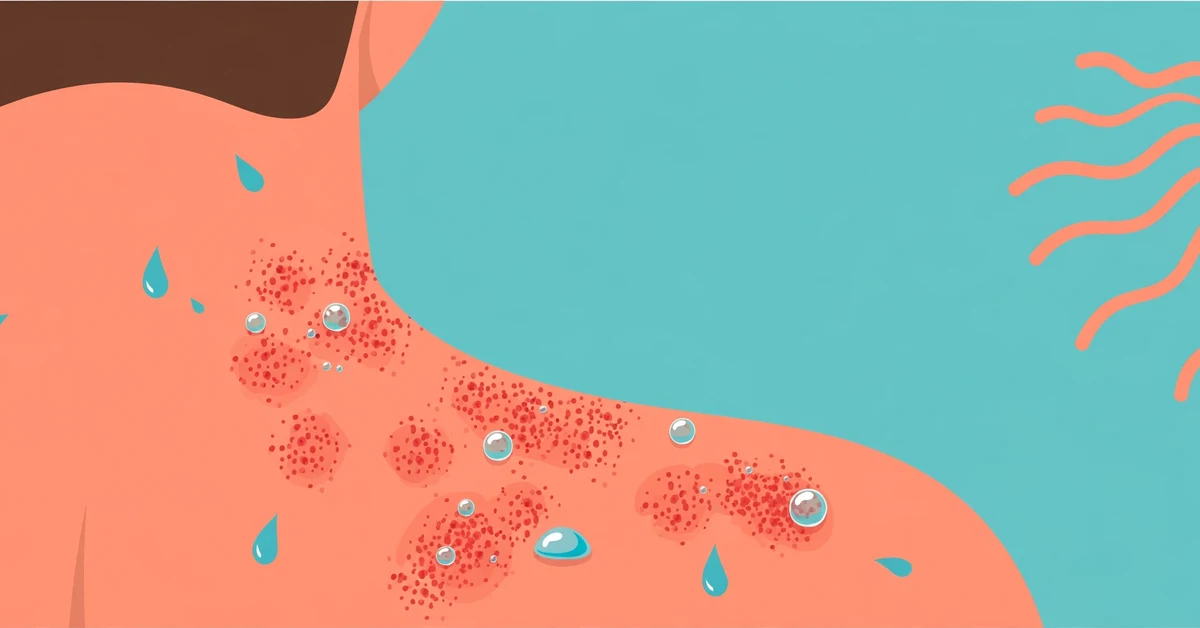
Miliaria rubra — prickly heat proper — is the most common form at every age. Here the duct blocks deeper in the epidermis, sweat leaks into the living skin layers, and the skin reacts with inflammation: crops of small red bumps and tiny blisters on a pink-red background, with the prickling, stinging itch that gives the condition its name. It flares in the neck and upper trunk, in skin folds, and anywhere clothing rubs sweaty skin.

In adults, rubra typically erupts after a few days in a hot, humid environment — the third day of a tropical holiday, a heat wave without air conditioning, or shifts worked in protective clothing. In babies it appears in the neck folds, armpits and nappy area when they are overdressed or the room is too warm. Episodes usually settle in 2 to 3 days once the skin is kept cool, and almost always within about a week; repeated episodes in the same spots are common while the hot weather lasts.

On different skin tones: on light skin the rubra patch is obviously red. On brown and black skin the same inflammation may show as darker brown, purple or grey tones, or the redness may be hard to see at all — the closely packed bumps, the prickling itch and the link to heat are the clues to trust, not the colour.
Miliaria profunda: the deep, flesh-coloured type
Miliaria profunda is the deepest and least common type, and there is no reliable free photograph of it — its look is distinctive enough to describe precisely. The blockage sits at or below the junction between epidermis and dermis, so instead of surface blisters it produces firm, flesh-coloured bumps about 1 to 3 mm across that look like gooseflesh (goosebumps) that will not go away. The bumps are usually on the trunk and limbs, they barely itch, and — the feature that matters — the affected skin sweats little or not at all, because the sweat cannot escape.
Profunda usually develops only after repeated episodes of miliaria rubra, most often in adults living or working in tropical heat. Because patches of skin lose the ability to sweat, it carries a risk the other two types do not: overheating. People with widespread profunda may notice they tolerate heat badly, tire quickly in hot weather, or develop symptoms of heat exhaustion — dizziness, nausea, headache, weakness — because part of their cooling system is offline. That risk, not the rash itself, is why profunda deserves a medical assessment rather than home treatment alone.
The three types of heat rash, side by side
| Feature | Miliaria crystallina | Miliaria rubra (prickly heat) | Miliaria profunda |
|---|---|---|---|
| Depth of blockage | At the skin surface | Mid-epidermis | At or below the epidermis–dermis junction |
| What it looks like | Clear, fragile blisters like water droplets, no redness | Small red bumps and tiny blisters on a flushed background | Firm, flesh-coloured bumps like permanent gooseflesh |
| How it feels | Usually nothing — no itch | Prickling, stinging itch | Little or no itch |
| Who gets it most | Newborns; anyone sweating with a fever | Babies and adults — the most common type overall | Adults in tropical heat, after repeated rubra |
| Typical sites | Forehead, neck, upper trunk | Neck, upper chest and back, folds, under clothing | Trunk and limbs |
| How long it lasts | About a day once the skin is cool and dry | Usually 2–3 days, up to about a week | Longer; recurs while heat exposure continues |
| Sweating in the area | Normal once blisters burst | Reduced while inflamed | Little or none — risk of overheating |
Heat rash by body area: what to look for in each place
Neck, upper chest and shoulders. The most photographed territory for rubra: dense small red bumps sweeping across the upper chest and up the neck, worst where a collar or strap traps sweat. In babies the neck folds themselves are the hot spot, because skin-on-skin contact holds the moisture in.

The back. Back heat rash typically appears after sleeping in a hot room or long drives and flights in warm weather — skin pressed against a mattress or seat cannot lose heat, so the rash maps the contact area. It is usually rubra: widespread small red bumps across the shoulder blades and lower back.

Face and scalp. Facial heat rash is most often crystallina in newborns (clear droplets across the forehead) and rubra along adults’ hairlines and foreheads under hats. It is short-lived once the head is uncovered and cool.

Skin folds: armpits, under the breasts, groin and the nappy area. Folds are warm, damp and airless, so rubra thrives there. The catch in folds is a look-alike: a sore, shiny, beefy-red rash in a fold with small spots spreading beyond its edge is more likely a fungal infection (intertrigo with candida) than heat rash — the comparison table below gives the deciding features. In babies, fold rash plus clear blisters on the trunk usually means the baby is simply too warm.
Legs and feet. Heat rash on the legs is less typical unless heavy clothing, boots or a cast trap sweat against the skin. Most itchy leg rashes turn out to be something else — bites, folliculitis, contact allergy or eczema — so if the legs are the main site, work through our guide to rashes on the lower legs before settling on heat rash.
Heat rash in babies: what parents should know
Babies get heat rash easily because their sweat ducts are immature and because adults understandably dress them warmly. The pattern to recognise: clear dewdrop blisters (crystallina) on a newborn’s forehead, neck and upper body in the first weeks of life, or red prickly bumps (rubra) in the neck folds, armpits and nappy area in an older baby during warm weather.
The fix is almost always environmental, not medical: move the baby somewhere cooler, remove a layer of clothing, dress them in loose cotton, and let the skin air-dry after a lukewarm bath. A useful rule of thumb is to dress a baby in roughly what you would find comfortable yourself, plus at most one extra layer — a baby whose neck and chest feel hot and sweaty to your touch is too warm, whatever the room thermometer says. Avoid heavy creams, oils and powders on the rash, which block the ducts further.
Babies do have one hard rule that overrides all of the above: a baby under 3 months old with a fever of 38°C (100.4°F) or higher needs prompt medical assessment, rash or no rash. Also get a baby checked quickly if the rash develops pus or yellow crusts, if the baby is feeding poorly or seems unusually sleepy, or if the rash does not start improving within a few days of keeping them cool.
What else looks like heat rash?
Several common conditions are confused with heat rash in photos. Each row gives the one feature that most reliably separates it:
| Condition | How it mimics heat rash | The deciding feature |
|---|---|---|
| Folliculitis | Small red bumps with tiny pus heads, itchy, in sweaty areas | Every bump is centred on a hair, often with a hair visibly in the middle; heat rash bumps sit between hairs. See our folliculitis pictures guide for the visual difference |
| Hives (urticaria) | Itchy red raised spots appearing quickly | Hives are raised wheals that come and go within hours and migrate around the body; each individual spot fades within about 24 hours. Heat rash stays put in the sweaty area for days. Our guide to hives medication covers treatment options |
| Contact allergy / irritation | Itchy red rash where something touched the skin | It maps the contact exactly — the shape of a plaster, a new cream, a waistband’s elastic — and is not triggered by heat; it also tends to blister or scale at the edges |
| Eczema | Itchy red patches in the folds (elbows, knees, neck) | Eczema is dry, scaly and long-running, and flares in the same places repeatedly over weeks to months; heat rash is a sudden crop of uniform tiny bumps after heat exposure |
| Chickenpox | Itchy blisters on the trunk and face | Chickenpox spots appear in crops at different stages at once (spots, blisters and crusts together), come with fever and feeling unwell, and spread over the whole body rather than staying in sweaty areas |
| Fungal infection (intertrigo / candida) | Red rash in skin folds — under breasts, armpits, groin | The fold itself is sore, shiny and moist with a well-defined edge and small “satellite” spots just beyond it; heat rash in folds is drier, bumpier and improves within days of cooling and air-drying |
How to treat heat rash at home
Heat rash is one of the few rashes where the treatment is mostly about removing the cause. The NHS advice, which matches the Mayo Clinic’s , is a simple ladder:
- Cool the skin down. Move into shade or air conditioning; a cool (not cold) shower or bath helps. This single step settles most cases.
- Dress loose and light. Loose cotton clothing, light bedding, and bare skin where possible; remove a layer from babies.
- Keep the skin clean and dry. Pat dry gently after washing rather than rubbing; let folds air-dry fully.
- Soothe the itch. Calamine lotion can calm prickling; an antihistamine tablet may help itching in adults and older children — ask a pharmacist about suitability and dosing, especially for children.
- Do not block the ducts further. Avoid thick creams, ointments, oils and talcum powder on the rash, and skip perfumed products while it settles.
- Drink enough fluids in hot weather, and ease off intense exercise until the rash clears.
Most heat rash improves noticeably within a few days of this routine. If it does not, the diagnosis — not just the treatment — needs a second look.
How long it lasts — and when heat rash turns into something worse
Timelines by type: crystallina clears in about a day once the skin is cool; rubra usually settles in 2 to 3 days and almost always within a week; profunda lingers and recurs for as long as repeated heat exposure continues. Two developments change the picture:
- Miliaria pustulosa. Sometimes rubra’s blisters fill with pus instead of clear fluid, producing small yellow-white pustules. This variant often involves staph bacteria and is a step on the road to a true skin infection — it should be assessed by a doctor rather than watched.
- Secondary bacterial infection. Scratched, broken heat rash can become infected. Treat any of the following as a hard stop on home care: pus or yellow crusts forming; redness or warmth spreading beyond the rash; increasing pain, swelling or tenderness; red streaks travelling from the area; swollen glands nearby; or fever. Those signs mean the skin needs medical treatment, usually antibiotics, promptly.
What a photo cannot tell you
Pictures are good at pattern-matching heat rash, but three things never show in a photograph. First, depth: crystallina and early rubra can look deceptively similar in a phone photo, yet they behave differently. Second, lost sweating: the real risk of profunda is skin that has quietly stopped sweating, which no picture reveals — it shows up as heat intolerance, not as a rash feature. Third, early infection: a rash can look like plain rubra hours before pus and spreading warmth declare an infection. If the behaviour of the rash contradicts the photo match — spreading despite cooling, becoming painful, or arriving with fever — believe the behaviour.
When to see a doctor
Get medical advice if: the rash is not improving after a few days of keeping the skin cool; it is widespread, blistering or pustular; there are any infection signs from the checklist above; the patient is a baby under 3 months with a fever; the rash keeps returning (which may point to profunda, or to a different diagnosis entirely); or someone with the rash develops heat-exhaustion symptoms — dizziness, nausea, headache, rapid heartbeat, feeling faint in the heat. People with a weakened immune system or diabetes should also have a spreading or infected-looking rash assessed promptly rather than watched at home.
The bottom line
Heat rash in pictures comes in three depths: clear dewdrop blisters with no redness (crystallina, the newborn and fever type, gone in about a day), red prickly bumps in sweaty covered skin (rubra, the common type, gone in a few days of cooling), and firm flesh-coloured gooseflesh-like bumps after repeated attacks (profunda, the type that can switch off sweating and needs a doctor’s input). Match the photo, but judge by the behaviour: a rash that fades as the skin cools is heat rash doing what heat rash does, while pus, spreading warmth, rising pain or fever means it has become something else. Cooling, loose cotton and time treat the great majority of cases — no cream works as well as simply letting the skin breathe.
Disclaimer: The information provided on this website is for educational and informational purposes only and does not constitute medical advice. Always consult with a qualified healthcare provider regarding any health concerns or before making any changes to your diet, medication, or lifestyle.
Frequently Asked Questions
Heat rash (miliaria) looks like a crop of tiny bumps or blisters in hot, sweaty, covered skin — the neck, upper chest and back, armpits, groin and under the breasts. The most common type, miliaria rubra, is small red bumps on a flushed background with a prickling itch. Miliaria crystallina looks like clear water droplets on the skin with no redness, and miliaria profunda looks like firm, flesh-coloured bumps resembling permanent gooseflesh.
Once the skin is kept cool and dry, miliaria crystallina usually clears within about a day, and miliaria rubra typically settles in 2 to 3 days and almost always within about a week. Miliaria profunda lasts longer and tends to recur while heat exposure continues. A rash that is not improving after a few days of cooling is probably not simple heat rash and should be checked.
No. Heat rash is caused by blocked sweat ducts, not by an infection, so it cannot spread from person to person or to other parts of the body by touch. The one exception to keep in mind: if heat rash becomes secondarily infected — pus, yellow crusts, spreading warmth and pain — the infection itself (usually staph bacteria) can be contagious, and that stage needs medical treatment.
Hives are raised, smooth wheals that appear suddenly, itch intensely, and move around: each individual spot fades within about 24 hours while new ones appear elsewhere. Heat rash is a fixed crop of tiny uniform bumps that stays in the hot, sweaty area where it started, is linked to heat or fever, and takes days to settle after cooling. Hives that come with lip or tongue swelling or breathing difficulty are an emergency.
Adults get heat rash frequently — miliaria rubra is common during heat waves, tropical travel, fevers, and in jobs involving heat or protective clothing, and miliaria profunda occurs almost exclusively in adults after repeated rubra episodes in hot climates. Babies are simply more prone to the crystallina and rubra types because their sweat ducts are immature and they are easily overdressed.
Cooling the skin is the treatment: move to shade or air conditioning, take a cool shower or bath, wear loose cotton, and let the skin air-dry. Calamine lotion can soothe prickling and an antihistamine may help itching. Avoid thick creams, ointments, oils and powders, which block sweat ducts further. Most cases improve within a few days; no cream speeds recovery as much as keeping the skin cool, clean and dry.
The bumps and blisters are the same, but the colour cues change. The redness of miliaria rubra may appear as darker brown, purple or grey tones on brown and black skin, or may be difficult to see at all; crystallina’s clear blisters show no colour change on any skin tone. Judge by the closely packed tiny bumps, the prickling itch, the sweaty covered location, and the link to heat rather than by redness.
See a doctor if the rash is not improving after a few days of keeping the skin cool, if it is widespread or blistering, or if you see infection signs — pus, yellow crusts, spreading warmth or redness, increasing pain or swelling, or fever. Babies under 3 months with a fever of 38°C (100.4°F) or higher always need prompt assessment, and anyone with widespread profunda-type rash who feels dizzy, nauseous or faint in the heat should be seen the same day.
Read Next
Tick Bite Pictures: What Tick Bites and Lyme Rashes Actually Look Like

Why Is My Sweat Salty? The Science Behind Sweat
Folliculitis Pictures: What Infected Hair Follicles Look Like on Each Body Area

How to Remove and Prevent Moths in Your Home
Cellulitis vs DVT: How to Tell a Skin Infection From a Blood Clot in Your Leg
Staph Infection Pictures: What Staph Looks Like and How to Tell It From Cellulitis
Related Posts

Do Tattoos Always Stretch? What to Know Before Getting Inked
Sep 23, 2026 • 17 min read
Chickenpox Stages in Pictures: The Rash Day by Day, From First Spots to Scabs
Nov 11, 2026 • 9 min read
Hernias by Picture
Sep 26, 2026 • 35 min read
Hand, Foot and Mouth Disease Pictures: What the Rash Looks Like at Each Stage
Nov 12, 2026 • 24 min read
Bedsore Stages in Pictures: What Each Pressure Ulcer Stage Looks Like
Nov 9, 2026 • 12 min read