How Long Does a Fracture Take to Heal? Timelines by Bone

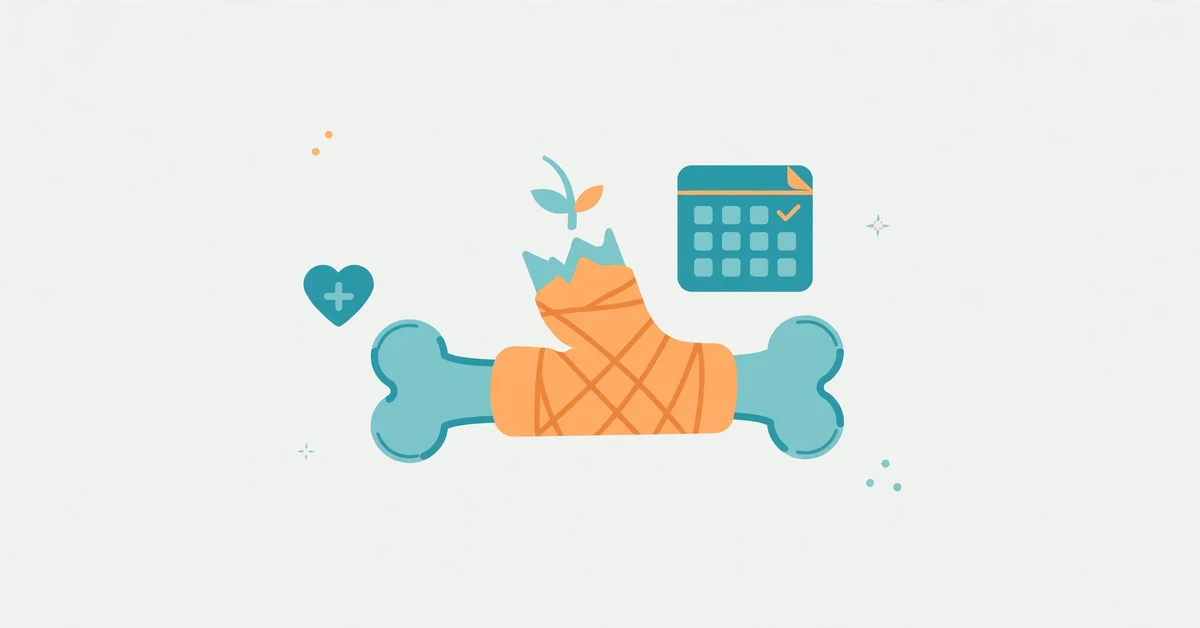
- How a broken bone heals: the four stages
- Stage 1: inflammation, days 1–7
- Stage 2: soft callus, weeks 1–3
- Stage 3: hard callus, weeks 3–12
- Stage 4: remodeling, months 3–12 and beyond
- Healing time by bone: the table
- Why some fractures heal slower than others
- Fracture healing-time estimator
- How long will my fracture take to heal?
- What helps healing, and what gets in the way
- Warning signs: when healing is not going to plan
- Children heal faster — and differently
- The bottom line on healing time
Six weeks. That is the number most people hear when they break a bone, and it is wrong often enough to cause real trouble. A broken finger can knit in three weeks. A broken shinbone can take six months. A broken hip in an older adult can take longer still, and the bone can look healed on an X-ray weeks before it is strong enough to trust with your full weight. The honest answer to “how long does a fracture take to heal” is a table, not a number — and this guide gives you that table, bone by bone, plus the four stages your body moves through, the things that speed healing up, the things that slow it down, and the warning signs that mean the plan needs a second look.
Most adult fractures join in about six to twelve weeks, according to Cleveland Clinic and MedlinePlus. That is the range for the bone itself to knit together. Getting full strength, motion, and confidence back takes longer — often three to six months after the cast or boot comes off, because the muscles have weakened and the joints have stiffened while the bone healed. Children heal faster than adults, often in half the time. Older adults, smokers, and people with diabetes or poor circulation heal slower. Keep those two clocks in mind as you read: the bone clock, and the full-recovery clock. They are not the same.
How a broken bone heals: the four stages
Bone healing is not one event but a sequence, and knowing the sequence explains almost everything that feels odd about recovery — including why an early X-ray can look unimpressive while you are actually healing well.
Stage 1: inflammation, days 1–7
The moment a bone breaks, blood vessels inside it tear and a clot forms around the break — a hematoma. That clot is not a mess to clean up; it is the scaffold the repair is built on. White blood cells arrive to clear dead tissue, and the area swells, bruises, and hurts. This is the stage where rest and immobilization matter most. Moving a fresh fracture can break the clot and restart the clock.
Stage 2: soft callus, weeks 1–3
Specialized cells lay down a soft, rubbery bridge of cartilage across the gap. It is called a soft callus, and it holds the broken ends together loosely. You cannot see it well on an X-ray yet, which is why a two-week X-ray can look like nothing has happened. It has — just not in a form X-rays show.
Stage 3: hard callus, weeks 3–12
The soft callus turns into hard bone as minerals are laid down. This is when X-rays start to show the break joining, and when casts and boots usually come off. The bone is joined, but it is not yet at full strength — think of it as a bridge open to light traffic, not heavy trucks.
Stage 4: remodeling, months 3–12 and beyond
Over months, the body reshapes the new bone, trimming the bulky callus back toward the bone’s original shape and laying new bone along the lines of stress. In children, remodeling can erase almost all trace of a break. In adults, a faint thickening often stays on the X-ray for life. Remodeling can continue for a year or more, which is why strength keeps improving long after the cast is gone.

Healing time by bone: the table
The table below gives typical adult healing times — the time for the bone to join solidly, not the time to full recovery — drawn from the AAOS, NHS, Cleveland Clinic, and orthopedic practice guidance. Every range assumes a simple, closed fracture in a healthy adult, treated as advised. Your own case can differ, and your doctor’s timeline beats any table.
| Bone | Typical healing time (adult) | What to know |
|---|---|---|
| Finger or toe | 3–6 weeks | Often needs only buddy-taping or a splint; the AAOS puts simple finger fractures at 3–4 weeks |
| Hand (metacarpal, e.g. boxer’s fracture) | 4–6 weeks | Simple cases heal in 2–3 weeks with a splint; surgery or rehab can stretch it to 4–6 weeks |
| Wrist (distal radius) | 6–8 weeks | The most common fracture at every age; about 6 weeks in a cast per the NHS, grip strength can take 6–12 months to fully return |
| Forearm (radius / ulna) | 6–10 weeks | Elbows stiffen fast, so movement is often encouraged as soon as it is allowed |
| Upper arm (humerus) | 8–12 weeks | Often heals in a sling without surgery; shoulder stiffness is the main rehab job |
| Collarbone (clavicle) | 6–12 weeks | Usually heals without surgery; a visible bump at the break is common and normal |
| Scaphoid (small wrist bone) | 6–12+ weeks | Poor blood supply; higher risk of failing to heal, so it is watched closely |
| Rib | About 6 weeks | Heals on its own; breathing exercises matter to prevent lung complications |
| Spine (vertebra) | 6–12 weeks | Depends heavily on the type of break and whether the spine is stable |
| Pelvis | 8–12 weeks | Stable breaks heal with rest; unstable breaks usually need surgery |
| Hip | 10–12 weeks, often longer | Almost always surgical in adults; full walking recovery commonly takes 3–6 months |
| Thighbone (femur) | 3–6 months | The strongest bone in the body; almost always fixed with a surgical rod in adults |
| Shinbone (tibia) | 4–6 months | Among the slowest healers; parts of the tibia have a thin blood supply |
| Ankle | 6–12 weeks | Stable breaks heal in a boot; unstable breaks may need plates and screws |
| Foot (metatarsal) | 4–8 weeks | Longer for some breaks of the fifth metatarsal, which has poor blood supply at its base |
| Stress fracture (hairline) | 6–8 weeks with rest | Heals only if the activity that caused it stops; keep running on it and it can become a full break |
Two bones in that table deserve a closer look, because they break the “six weeks” rule so badly. The tibia, your shinbone, is notorious: even uncomplicated breaks commonly take four to six months to unite solidly, partly because sections of the tibia have a thin blood supply and partly because it carries your full weight with every step. The scaphoid, a small bone at the base of the thumb, is the other slow healer — its blood supply enters from one end, so a break can cut off blood to part of the bone, and it sometimes needs three months in a cast or surgery to heal at all.
Why some fractures heal slower than others
Five factors do most of the work in deciding where you land in a range.
Age. Children heal fast — a child’s broken forearm can join in three to four weeks, where an adult’s takes six to eight — because a child’s bones are still growing and richly supplied with blood. Healing slows with age as blood supply and cell activity fall off. A hip fracture at 80 is a different recovery from a hip fracture at 40.
The break itself. A clean, simple break with the ends still lined up heals faster than a break in several pieces, an open fracture where the bone has pierced the skin, or a break that runs into a joint. Open fractures also carry a higher infection risk, which can delay healing further.
Blood supply. Bones with a rich blood supply, like the upper arm, heal well. Bones with a thin or one-ended supply — the scaphoid, the base of the fifth metatarsal, parts of the tibia — heal slowly and sometimes fail to heal at all, a condition called nonunion.
Smoking and health. Smoking is one of the strongest brakes on bone healing: nicotine narrows blood vessels, and smokers face a higher rate of delayed healing and nonunion, according to the AAOS. Diabetes, poor circulation, low vitamin D or calcium, and some medicines (including long-term steroids) slow healing too. Eating well matters more than most people think — bone repair needs protein, calcium, and vitamin D, and a body short on any of them repairs slowly.
How well the break is held still. A fracture that moves heals slowly or not at all. That is why casts, boots, plates, and rods exist, and why “it feels better, so I took the boot off” is the most common self-inflicted delay in fracture care. Follow the weight-bearing rules your doctor gave you, even on good days.

Fracture healing-time estimator
Pick the broken bone, your age group, and whether any healing-slowing factor applies. The estimator gives a typical range for the bone to join, based on the table above, adjusted for age and risk factors. It is a guide, not a medical opinion — your doctor’s timeline comes first.
How long will my fracture take to heal?
What helps healing, and what gets in the way
There is no food or supplement that will knit a bone in half the time, and any product that promises that is selling something. What the evidence does support is unglamorous: follow the immobilization plan, do not smoke, eat enough protein, keep vitamin D and calcium in range, and do the rehab exercises once you are cleared for them. The NHS advises that most people need around 700 mg of calcium a day from food, and that vitamin D matters most in the winter months when sunlight is scarce. Your doctor can check your vitamin D level if healing is slow.
Movement is a double-edged tool. Too much, too soon, and the break moves and healing stalls. Too little, for too long, and the joints stiffen and the muscles waste, which is why physical therapy starts the moment the bone is stable enough. The usual pattern is: rest and protect first, gentle motion second, strength third. Skipping the middle step is how people end up with a healed bone and a stiff, weak limb.
Weight-bearing is the other judgment call. Some fractures heal better with early, controlled loading — the bone responds to stress by laying down more bone — while others must stay completely unloaded for weeks. That call belongs to your surgeon or doctor, not to how the leg feels on a good morning.
Warning signs: when healing is not going to plan
Most fractures heal without drama, but a few signs mean you should call your doctor sooner than your next scheduled visit:
- Pain that gets worse after the first few days, instead of slowly easing, or pain that returns after it had settled.
- Swelling, redness, or warmth that increases rather than fades, or a fever — these can point to infection, especially after surgery or an open fracture.
- Numbness, tingling, or a limb that turns pale, blue, or cold — the cast may be too tight, or blood flow may be affected. This needs urgent care.
- A cast that feels loose, cracked, or wet through, or skin under the cast that itches badly or smells bad.
- You can move the broken part in a way you should not be able to, or you hear or feel a crack after a fall.
- No sign of healing on X-ray at 3 months — your doctor may call this delayed union, and at 6 to 9 months without healing it becomes nonunion, which may need surgery, bone stimulation, or a bone graft.
Children heal faster — and differently
A child’s broken bone is not just a faster version of an adult’s. Children’s bones have growth plates, the soft areas near the ends of long bones where growth happens, and a break through a growth plate needs careful watching — most heal well, but a small share can affect how the bone grows. Children’s bones also bend more than they break, producing greenstick fractures (bent and cracked on one side) and buckle fractures (crumpled on one side), which usually heal in three to four weeks in a cast. The other difference is remodeling: a child’s bone can straighten a crooked heal over months of growth in a way an adult’s cannot, which is why children’s fractures often need less exact alignment.
The bottom line on healing time
There is no single number for how long a fracture takes to heal, and anyone who gives you one without asking which bone is guessing. Fingers and toes: three to six weeks. Wrists and collarbones: six to eight, sometimes twelve. Hips, thighbones, and shinbones: three to six months. The bone joining is only the first half of recovery — strength, motion, and confidence take another few months, and that second half is where most of the work happens.
If you take one thing from this guide, make it this: the timeline your own doctor gives you, for your bone, your break, and your health, is the only one that matters. Use the table to understand it, use the estimator to set your expectations, and if the pain, swelling, or movement does not follow the pattern you were told to expect, call. A fracture that is healing well is a quiet one. A fracture that is not will tell you — if you know what to listen for.
Sources: Cleveland Clinic, “How Long Does a Broken Bone Take to Heal?”; MedlinePlus, “Fractures”; American Academy of Orthopaedic Surgeons (AAOS), OrthoInfo fracture guidance; NHS, “Broken wrist” and “Broken ankle” recovery guidance; South Shore Orthopedics, “How Long Does a Fracture Take to Heal?”
Frequently Asked Questions
Most adult fractures join in about 6 to 12 weeks, according to Cleveland Clinic and MedlinePlus. Small bones like fingers and toes heal in 3 to 6 weeks, wrists and collarbones in 6 to 8 weeks, and large weight-bearing bones like the thighbone and shinbone in 3 to 6 months. Full strength and motion usually take another 3 to 6 months after the cast comes off.
The shinbone (tibia) is among the slowest, commonly taking 4 to 6 months, because parts of it have a thin blood supply. The thighbone (femur) takes 3 to 6 months. The scaphoid, a small wrist bone, is also slow at 6 to 12 weeks or more, and has a higher risk of failing to heal.
Yes. A child’s broken forearm can join in 3 to 4 weeks where an adult’s takes 6 to 8, because children’s bones are still growing and richly supplied with blood. Children’s bones also remodel strongly, so a crooked heal can straighten over months of growth.
Smoking is one of the strongest brakes on healing, along with diabetes, poor circulation, low vitamin D or calcium, older age, and a break that is open, in several pieces, or into a joint. Moving the fracture or taking the cast or boot off early also delays healing.
Warning signs include pain that gets worse after the first few days, swelling or redness that increases, fever, numbness or a limb that turns pale or cold, and no sign of healing on X-ray at 3 months. At 6 to 9 months without healing, doctors call it nonunion, which may need surgery or a bone graft.
No food or supplement will knit a bone in half the time. What helps is following the immobilization plan, not smoking, eating enough protein, keeping vitamin D and calcium in range, and doing the rehab exercises once you are cleared for them. Early, controlled loading helps some fractures, but only when your doctor says so.




Related Posts
5 Hand Massagers for Pain and Stiffness Relief at Your Fingertips
Oct 1, 2026 • 28 min read
Best CBD Gummies for Pain: 4 Options If You Don’t Like Topicals
Sep 30, 2026 • 3 min read
What to Know When Choosing a PEMF Therapy Device for Home
Oct 4, 2026 • 18 min read
The 5 Best Broad-Spectrum CBD Products for 2025: Tried and Tested
Sep 27, 2026 • 11 min read
Hiya Vitamins Review By a Mom Who Is a Dietitian
Sep 25, 2026 • 3 min read