Rapeseed Oil vs Olive Oil: Is Rapeseed Just Canola by Another Name?

- Rapeseed oil vs canola oil: the name question, answered first
- Why erucic acid made rapeseed infamous — and what the rules say now
- What is actually on the shelf in the UK and EU
- Nutrition head-to-head: the USDA numbers
- ALA, vitamin E and the polyphenol gap
- Smoke points, stability and best uses
- Flavour and price
- Which is healthier? The evidence, graded honestly
- The bottom line
The short answer: the bottle labelled “rapeseed oil” in a UK or European supermarket and the bottle labelled “canola oil” in North America are, in almost every case, the same kind of oil — pressed from low-erucic rapeseed cultivars. Against olive oil, neither wins outright. Refined rapeseed oil is the cheaper, more neutral, higher-smoke-point workhorse for frying, roasting and baking. Extra virgin olive oil is the flavour oil, with a depth of taste and a body of long-term health evidence that rapeseed oil does not yet have. Most kitchens are best served by keeping both — and this guide explains why, starting with the name confusion that brings most readers here.
Rapeseed oil vs canola oil: the name question, answered first
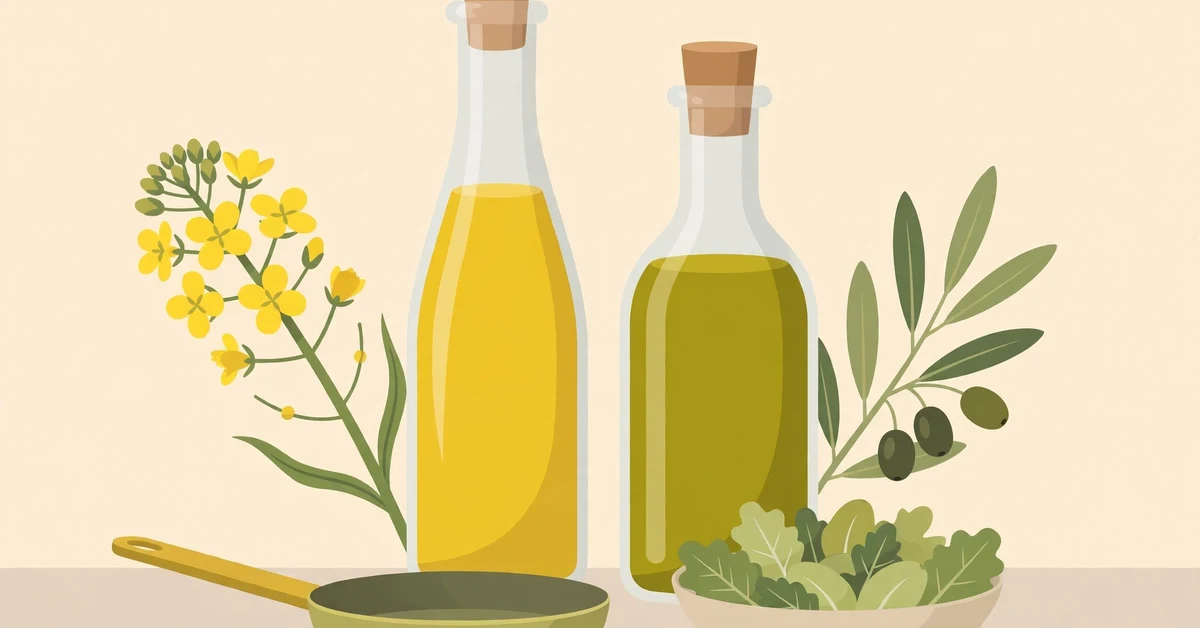
Rapeseed is the plant — Brassica napus, a member of the cabbage and mustard family, unmistakable in spring when fields turn bright yellow. Oil pressed from its seeds is, generically, rapeseed oil. “Canola” is narrower: it is a quality standard and cultivar family developed in Canada in the 1970s by traditional plant breeding, selecting rapeseed varieties that are low in two unwanted compounds — erucic acid in the oil and glucosinolates in the leftover meal. The word itself is a contraction of “Canadian oil, low acid.”

The standard is precise. Under the US regulation that recognises canola oil as safe for food use, the oil must come from low-erucic cultivars and contain no more than 2% erucic acid as a share of its fatty acids (21 CFR 184.1555 ). Canada and international food standards use the same 2% threshold. Traditional rapeseed varieties, by contrast, could produce oil in which erucic acid made up 20% to more than 50% of the fat — an oil that was directed to industrial uses such as lubricants and biodiesel, not to the kitchen.
Here is the practical consequence, and it is the point most comparison articles bury: food law does not let high-erucic rapeseed oil onto the food shelf. In Europe the oil is simply labelled “rapeseed oil,” because the low-erucic standard is assumed and enforced; in North America the same oil is labelled “canola” to distance it from the industrial product. So when a British recipe and an American recipe seem to call for different oils, they usually do not. If you want the full side-by-side of the two names, see our guide to rapeseed oil vs canola oil.
Why erucic acid made rapeseed infamous — and what the rules say now
The caution around rapeseed oil is not a modern internet myth; it has a real history. In feeding studies, animals given diets very high in erucic acid developed myocardial lipidosis — a build-up of fat droplets in heart muscle. The effect was dose-dependent and seen at intakes far above anything a modern food oil could deliver, but it was enough to push regulators and breeders to act. Breeding solved most of the problem in the 1970s; regulation locked the solution in.
Two numbers define the modern position. First, the European Union sets a maximum level for erucic acid (including erucic acid bound in fat) of 20 grams per kilogram — that is, 2% — in vegetable oils and fats placed on the market for the final consumer (Commission Regulation (EU) 2019/1870). Second, the European Food Safety Authority, reviewing the toxicology in 2016, set a tolerable daily intake of 7 milligrams of erucic acid per kilogram of body weight per day, noting that average consumers sit well below it, while high exposure was a concern mainly for infants fed certain formulas (EFSA, 2016). In plain terms: the oil on the shelf is a different product from the oil that earned the reputation, and the difference is measured and enforced, not assumed. Readers who want the safety debate itself — including the wider “seed oil” claims — can read our separate explainer on why people ask whether rapeseed oil is bad for you.
What is actually on the shelf in the UK and EU
“Rapeseed oil” on a European label covers three quite different products, and knowing which one you are holding matters more than the rapeseed-versus-olive question itself:

- Refined rapeseed oil, often labelled simply “vegetable oil.” In much of the UK, a generic bottle of “vegetable oil” is 100% refined rapeseed oil (check the small print). It is pale, neutral, cheap, and heat-tolerant — the default frying and baking oil of the British food industry, and the fairest like-for-like rival to refined olive oil.
- Refined rapeseed oil sold under its own name. The same style of oil with the seed declared: still neutral and inexpensive, sometimes with a slightly higher smoke point printed on the label.
- Cold-pressed (sometimes “extra virgin”) rapeseed oil. A premium, distinctly British and northern-European product: mechanically pressed without refining, golden in colour, with a mild nutty, slightly grassy flavour. It is marketed — fairly — as the local answer to extra virgin olive oil, and priced accordingly, typically closer to a mid-range olive oil than to the refined bottle. It keeps more of the seed’s vitamin E and flavour compounds, and it is the version meant for dressings as well as cooking.
Label-reading rules that actually help: “100% rapeseed” beats a blend if you want the fatty-acid profile below; “cold-pressed” tells you the oil was not refined and will taste of something; and a harvest or pressing date, where given, matters for the cold-pressed bottle for the same reason it matters for olive oil — these unrefined oils are freshest young.
Nutrition head-to-head: the USDA numbers
Both oils are pure fat, so both deliver about 884 kcal per 100 g and about 124 kcal per tablespoon (14 g). Everything interesting sits in how that fat is divided. The figures below are transcribed from USDA FoodData Central via its official API — “Oil, canola” (FDC 172336) as the reference entry for food-grade low-erucic rapeseed oil, and “Oil, olive, salad or cooking” (FDC 171413) :
| Per 100 g | Rapeseed (canola-type) oil | Olive oil |
|---|---|---|
| Energy | 884 kcal | 884 kcal |
| Total fat | 100 g | 100 g |
| Saturated fat | 7.4 g | 13.8 g |
| Monounsaturated fat | 63.3 g | 73.0 g |
| Polyunsaturated fat | 28.1 g | 10.5 g |
| Alpha-linolenic acid (omega-3 ALA) | 9.1 g | 0.8 g |
| Linoleic acid (omega-6) | 19.0 g | 9.8 g |
| Vitamin E (alpha-tocopherol) | 17.5 mg | 14.4 mg |
| Vitamin K | 71.3 mcg | 60.2 mcg |
Per tablespoon (14 g), the same pattern in kitchen units: rapeseed oil gives roughly 1.0 g saturated fat, 8.9 g monounsaturated fat, 3.9 g polyunsaturated fat, 1.3 g ALA, 2.4 mg vitamin E and 10.0 mcg vitamin K; olive oil gives roughly 1.9 g saturated, 10.2 g monounsaturated, 1.5 g polyunsaturated, 0.1 g ALA, 2.0 mg vitamin E and 8.4 mcg vitamin K.
Three honest readings of that table. First, rapeseed oil has about half the saturated fat of olive oil — a genuine advantage, and the lowest saturated-fat figure of any common culinary oil. Second, olive oil is the more monounsaturated oil (about 73% vs 63%), and monounsaturated fat is the component most consistently linked to favourable cholesterol changes when it replaces saturated fat. Third, rapeseed oil is not a one-note refined product nutritionally: it edges olive oil on both vitamin E and vitamin K in the USDA data, and its polyunsaturated fraction is where its distinctive nutrient lives — ALA.
ALA, vitamin E and the polyphenol gap
Rapeseed oil’s 9.1 g of alpha-linolenic acid per 100 g — roughly twelve times olive oil’s 0.8 g — is its strongest nutritional card, and it deserves a caveat in the same breath. ALA is an essential omega-3, but it is not the omega-3 of oily fish: the body converts ALA to EPA and DHA only to a limited extent, which is why the US National Institutes of Health advises that ALA should not be treated as a substitute for preformed EPA and DHA (NIH Office of Dietary Supplements ). Count rapeseed’s ALA as a useful contribution to total omega-3 intake — especially for people who eat no fish — not as fish oil in a bottle.

The antioxidant comparison runs the other way, and it is the one structural gap rapeseed oil cannot close. Extra virgin olive oil carries a family of polyphenols — oleocanthal, hydroxytyrosol, oleuropein and relatives — that give fresh oil its peppery, throat-catching bite and that feature throughout the olive-oil health literature. Rapeseed oil, refined or cold-pressed, contains vitamin E and other minor compounds but nothing equivalent to that polyphenol profile; and refining strips most minor compounds from either oil, which is why regular (refined) olive oil does not share extra virgin’s advantage either. If the polyphenols are the point, the oil has to be extra virgin and reasonably fresh.
Smoke points, stability and best uses
Smoke point figures vary by brand, grade and freshness, so treat the values below as working ranges, not constants: refined rapeseed oil is commonly cited around 220–238°C (about 430–460°F); refined (“pure” or “light”) olive oil around 210°C (410°F); extra virgin olive oil lower and more variable, roughly 160–207°C (320–405°F) depending on quality and free-fatty-acid level; cold-pressed rapeseed sits between its refined sibling and extra virgin olive oil. Two qualifications matter more than the ranking. Smoke point is not the same as stability: an oil’s resistance to oxidation during heating also depends on its fatty-acid make-up and antioxidant content, and reviews of deep-fat frying stress temperature and time control alongside oil choice (frying-science review, 2025 ). And in real kitchens, food is rarely cooked above about 190°C for long — a range both oils handle.
- Deep frying, searing, roast potatoes, Yorkshire puddings: refined rapeseed oil. High smoke point, neutral taste, and a price that makes using a generous amount painless.
- Everyday sauteing and oven roasting: either. Rapeseed if you do not want the oil to flavour the dish; olive oil if you do.
- Baking: refined rapeseed for neutral cakes, muffins and pastry work; olive oil where its flavour is an ingredient in its own right (focaccia, Mediterranean cakes).
- Dressings, dips and finishing: extra virgin olive oil for depth and pepper, or cold-pressed rapeseed for a milder, nutty, golden dressing — this is the one place the premium rapeseed bottle earns its price.
- Mayonnaise and aioli: rapeseed (refined or a refined/cold-pressed blend) if a strong olive note would overwhelm; many cooks split the difference.
Flavour and price
Flavour is where the two oils stop being substitutes. Refined rapeseed oil is engineered to disappear; cold-pressed rapeseed adds a gentle, nutty sweetness but stays quiet. Extra virgin olive oil is an ingredient with opinions — fruity, bitter and pungent in varying proportions — which is precisely why it is wasted when a recipe needs the oil to say nothing. On price, the ranking follows processing and geography: refined rapeseed is typically the cheapest quality oil on the shelf and often less than half the per-litre price of extra virgin olive oil; cold-pressed rapeseed closes much of that gap, selling at prices comparable to mid-range olive oil. For a UK or northern-European reader there is also a distance argument the Mediterranean cannot answer: rapeseed is grown and pressed locally, while olive oil is imported — a point in rapeseed’s favour that has nothing to do with nutrition.
Which is healthier? The evidence, graded honestly
On blood lipids, the two oils are close, and the trial data flatter rapeseed more than its reputation suggests. A 2024 umbrella review of the edible-oil literature found moderate-to-very-low-certainty evidence that canola-type rapeseed oil and virgin olive oil both reduce total and LDL cholesterol (umbrella review of edible vegetable oils, 2024 ), and a systematic review of head-to-head randomised trials comparing the two oils directly found canola marginally ahead on LDL and total cholesterol lowering. That is a short-term, surrogate-marker result — real, but narrow.
On long-term outcomes, olive oil is simply in a different league of evidence — because it has been studied that way and rapeseed has not. Within the PREDIMED trial cohort, higher olive oil intake, and extra virgin intake in particular, was associated with a lower risk of cardiovascular disease and mortality (Guasch-Ferre et al., 2014 ), and a systematic review and meta-analysis of cohort studies linked olive oil consumption to reduced all-cause and cardiovascular mortality and stroke risk (Schwingshackl and Hoffmann, 2014 ). No equivalent long-term outcome trial exists for rapeseed oil as a primary fat. That absence is not evidence of harm — rapeseed’s lipid profile predicts benefit, and it decisively beats butter and other saturated fats — but it does mean claims that rapeseed “beats” olive oil for health run ahead of the data, just as claims that it is dangerous do.
The graded verdict: for cholesterol markers over weeks, call it a draw with a slight rapeseed edge; for proven benefit over years, olive oil — specifically extra virgin — leads; for your health overall, what either oil replaces (butter, lard, repeated deep-fryer fat) matters more than the choice between them. Readers in the US who meet this comparison under its American name can also see our companion piece, canola vs olive oil, which takes the same oils from the North American shelf.
The bottom line
Rapeseed oil and canola oil are the same low-erucic oil wearing regional names, and the erucic-acid danger belongs to an industrial product that food law keeps off the shelf. Against olive oil, refined rapeseed wins on price, neutrality, smoke point and saturated fat, and brings a real ALA contribution; extra virgin olive oil wins on flavour, polyphenols and the depth of its long-term evidence. Buy a large, inexpensive bottle of refined rapeseed oil for the hob and a smaller, fresher bottle of extra virgin olive oil — or cold-pressed rapeseed — for the table, and you have taken the best of both rather than a compromise between them.
This article is general nutrition information, not medical advice. If you manage a condition such as cardiovascular disease or diabetes, discuss dietary fat choices with your own clinician or dietitian.
Frequently Asked Questions
Almost always, yes, on the food shelf. Canola is a standard for low-erucic rapeseed cultivars (no more than 2% erucic acid) developed in Canada in the 1970s. North America labels the oil “canola”; the UK and EU label the same grade of oil “rapeseed oil.” The rapeseed oil that is genuinely different is the industrial, high-erucic oil, which is not sold for food.
Food-grade rapeseed oil is held to strict limits: the EU caps erucic acid at 20 g per kg (2%) in vegetable oils sold to consumers, and EFSA set a tolerable daily intake of 7 mg per kg of body weight per day, with typical consumers well below it. The heart effects that created the concern came from animal studies of the old high-erucic oil at very high doses.
It depends on the measure. In short-term trials the two are close on cholesterol, with rapeseed/canola marginally ahead on LDL lowering in head-to-head reviews, helped by its lower saturated fat and its omega-3 ALA. For long-term outcomes, extra virgin olive oil has far stronger evidence, including large Mediterranean-diet studies. Both are far better choices than butter or other saturated fats.
Refined rapeseed oil is the practical frying choice: a smoke point commonly cited around 220-238 degrees C, a neutral flavour, and a low price. Extra virgin olive oil is better kept for lower-heat cooking and finishing, where its flavour and polyphenols survive. For ordinary sauteing and roasting, either oil works.
For cooking and baking, yes — swap them 1:1 by volume. Expect two differences: the dish will lose olive oil’s distinctive flavour, and refined rapeseed will tolerate higher heat. In raw uses such as dressings, refined rapeseed gives a much milder result; cold-pressed rapeseed oil is the closer like-for-like substitute for extra virgin olive oil.
It is rapeseed oil that is mechanically pressed and not refined: golden, mildly nutty, and sold in the UK and northern Europe as a premium local alternative to extra virgin olive oil. It keeps more vitamin E and flavour than the refined version. It is worth the premium for dressings and finishing; for high-heat frying, the cheaper refined oil performs just as well.

Related Posts
Spinach 101: Nutrition Facts and Health Benefits
Aug 25, 2026 • 4 min read
6 Nutritious Benefits of Eating Cantaloupe
Aug 29, 2026 • 13 min read
How Many Calories Are Burned on an Elliptical in 30 Minutes?
Aug 14, 2026 • 16 min read
10 Potential Health Benefits of Bee Pollen
Sep 11, 2026 • 33 min read
Raisins vs. Sultanas vs. Currants: What’s the Difference?
Aug 18, 2026 • 6 min read