Deep Vein Thrombosis Symptoms: Leg Signs, Silent Clots and Emergency Red Flags

- Deep Vein Thrombosis Symptoms in the Leg
- When DVT Has No Symptoms at All
- DVT vs Muscle Strain vs Cellulitis
- Pulmonary Embolism Red Flags: Call Emergency Services Now
- Who Is at Higher Risk of DVT
- How Doctors Check for DVT
- When to Seek Care, and How Fast
- Frequently Asked Questions
- What is usually the first sign of deep vein thrombosis?
- Can DVT go away on its own?
- How do I know if my calf pain is a blood clot or a pulled muscle?
- Does DVT always cause swelling?
- When should I call 911 for a possible blood clot?
- Who should be most careful after a long flight?
- References
It often starts with something small. You step off a long flight, or get up after a few days in bed with the flu, and one calf feels tight. By evening that leg looks puffier than the other, and the skin feels warm. You did not bang it on anything, yet the ache sits deep and does not ease when you rest. That pattern, one leg changing while the other stays normal, is the classic way deep vein thrombosis, or DVT, first shows itself.
DVT means a blood clot has formed in a deep vein, usually in the calf or thigh. Mayo Clinic lists the main signs as leg swelling, leg pain or cramping that often starts in the calf, a change in skin colour, and a feeling of warmth in the affected leg. Part of the clot can also break away and travel to the lungs. That complication, called a pulmonary embolism, is a medical emergency. If you have sudden breathlessness, sharp chest pain that worsens when you breathe in, coughing up blood, a rapid heartbeat, or you feel faint, call emergency services (911 in the United States) immediately. Do not drive yourself. Do not wait to see if it passes.
Suspected DVT in the leg also needs prompt care, on the same day, even when your breathing feels fine. Below: the leg symptoms, why about half of people notice nothing, DVT vs strain vs cellulitis, plus risk factors and tests.
Deep Vein Thrombosis Symptoms in the Leg
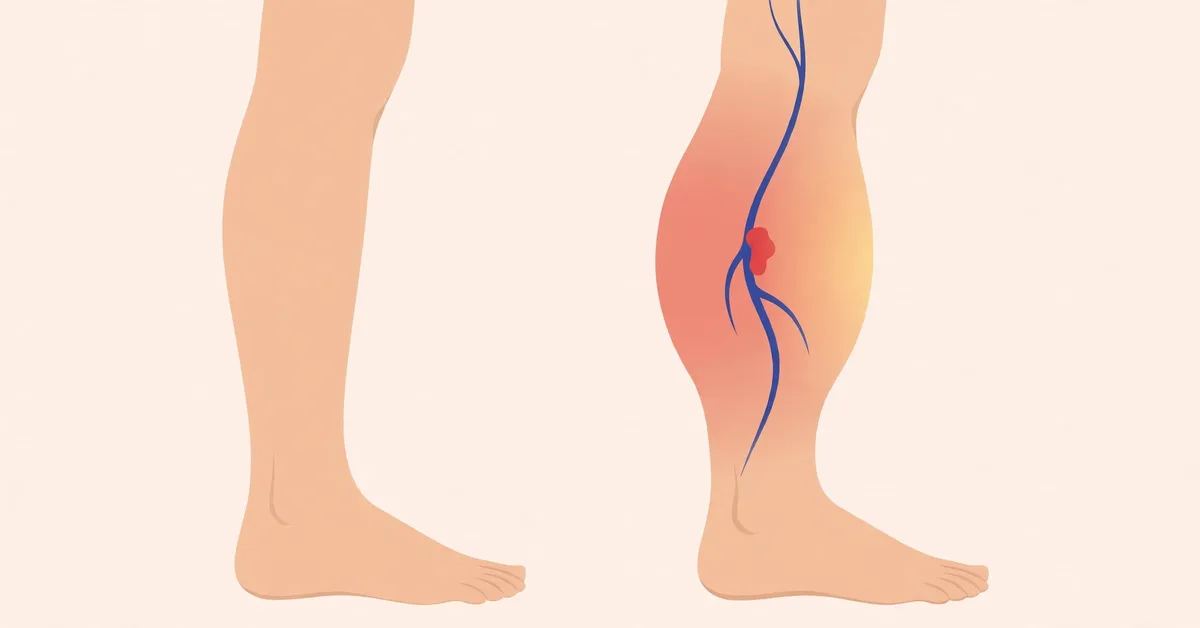
The symptoms gather around the clot, so they usually affect one leg, not both. Both legs swelling at once points more often toward fluid retention, heart or kidney problems, or a medicine side effect. One-sided change is the detail doctors listen for first.
Swelling in one leg. The calf, ankle, or whole leg swells because blood cannot drain past the clot at its normal speed. Shoes may feel tight on one side only. Swelling that appears over hours or a day or two, with no injury to explain it, deserves a same-day check.
Pain, cramping, or soreness. The pain often starts in the calf and can feel like a cramp or a pulled muscle, sitting deep rather than on the surface. Walking may worsen it, and it does not settle the way a simple cramp does after stretching. Some people describe heaviness or tightness instead.
Skin colour change and warmth. The leg may look red or purple, or darker than the other leg. On darker skin the change is harder to see, so compare warmth and size between the two legs. Run the back of your hand down both calves: one patch clearly warmer than the same spot on the other leg, paired with swelling or pain, is a strong reason to get checked that day. The NHS notes the skin around a painful area may feel warm to touch.
Visible veins and tenderness. Surface veins can look more prominent as blood finds side routes around the blockage, and the calf may feel tender when squeezed. UW Medicine adds deep muscle aching and, in some cases, a low-grade fever.

DVT can also form in an arm vein, usually after a central line or intense upper-body effort, with the same one-sided swelling, ache, warmth, and colour change. Our guide to blood clot symptoms covers clots elsewhere in the body.
When DVT Has No Symptoms at All
Here is the unsettling part. The Centers for Disease Control and Prevention (CDC) estimates that about half of people with DVT have no symptoms at all. The clot causes no swelling and no pain, and the first sign can be a pulmonary embolism when a piece travels to the lungs.
Silent DVT is more likely when the clot is small, sits low in the calf, or forms slowly enough that side veins take over the drainage. That is why doctors weigh risk situations, not just symptoms. After surgery, in hospital, or on a long flight, early walking, calf exercises, fluids, and, for higher-risk patients, prescribed blood thinners or compression stockings lower the odds. If you are in a high-risk window, such as the weeks after an operation or bed rest, treat any new one-sided leg change or breathing symptom as urgent, and mention your recent history the moment you speak to a clinician.
DVT vs Muscle Strain vs Cellulitis
Three problems cause most of the confusion here. A strained calf, a skin infection called cellulitis, and a DVT can all leave a leg sore and swollen, yet they need very different treatment. This table sums up the usual patterns. It cannot diagnose you; only an examination and, when needed, an ultrasound can do that.
| Feature | Deep vein thrombosis | Muscle strain | Cellulitis |
|---|---|---|---|
| Typical trigger | Long sitting, surgery, bed rest, pregnancy, cancer, hormones; sometimes none | A clear moment of injury, such as a sprint, a jump, or a sudden push-off | A cut, bite, or cracked skin that lets bacteria in |
| Swelling | One whole leg or calf swells, often without injury | Local swelling around the injured muscle | Swelling centred on a red, infected patch of skin |
| Pain pattern | Deep ache or cramp-like pain, often in the calf, worse when walking | Sharp pain at the moment of injury, then soreness that eases over days | Tenderness over the red area, often with a throbbing feel |
| Skin changes | Red, purple, or darker colour change; leg feels warm | Possible bruising a day or two later; skin temperature normal | Spreading redness, hot skin, sometimes blisters |
| Fever and feeling unwell | Uncommon; a low-grade fever can occur | No fever | Fever, chills, and feeling unwell are common |
| Course over 24 to 48 hours | Swelling and pain persist or grow | Steady improvement with rest | Redness spreads unless antibiotics are started |
A few rules of thumb help. A strain has a story: you felt it happen. Cellulitis has a doorway: broken skin, plus heat and often fever. DVT often has neither. It arrives quietly, in one leg, after stillness or another risk factor. Our guide to cellulitis vs DVT goes deeper on the skin infection side. If your symptoms do not fit clearly in the strain or cellulitis column, treat them as possible DVT and get assessed the same day.

Pulmonary Embolism Red Flags: Call Emergency Services Now
A pulmonary embolism happens when part of a clot breaks free and blocks a blood vessel in the lungs. It can happen hours or days after a DVT forms, and sometimes it is the first sign that a clot exists. This section is plain on purpose.
Call emergency services (911) immediately if you have any of the following:
- Sudden breathlessness, or shortness of breath that is getting worse
- Sharp chest pain that worsens when you breathe in, or chest pain when you cough
- Coughing up blood
- A rapid heartbeat, or a heartbeat that feels racing or pounding
- Feeling faint, dizzy, lightheaded, or actually fainting
- Rapid breathing that you cannot slow down
Do not wait and see. Do not drive yourself to hospital. Sit down, stay as still and calm as you can, and make the call. Tell the dispatcher you suspect a pulmonary embolism and describe your breathing symptoms first. Fast treatment with blood thinners, and in severe cases clot-dissolving drugs, saves lives. Our article on pulmonary embolism causes explains how these lung clots form.
Who Is at Higher Risk of DVT
Clots form when blood slows down, when the vein wall is damaged, or when the blood itself clots more easily. Mayo Clinic and the CDC list these main risk factors.
- Sitting or lying still for a long time. Long flights or drives, bed rest, a hospital stay, or a leg in a cast slow blood flow in the calves.
- Surgery or injury. Hip, knee, or abdominal operations and vein injuries raise risk for weeks afterwards.
- Age over 60. Risk climbs with age, though DVT can happen at any age.
- Pregnancy and the weeks after birth. The uterus presses on pelvic veins, and risk stays higher for up to six weeks after delivery.
- Hormone-based medicines. Combined birth control pills and hormone replacement therapy increase the blood tendency to clot.
- Cancer and cancer treatment. Some cancers and some chemotherapy drugs raise clotting risk.
- A previous DVT or pulmonary embolism, or a family history. Inherited conditions such as factor V Leiden make blood clot more easily.
- Being overweight, and smoking. Extra weight raises pressure in leg veins; smoking affects blood flow and clotting.
Risk factors stack. A long flight alone rarely causes a clot in a healthy young person. A long flight two weeks after knee surgery, in someone on a hormone pill whose parent had a DVT, is a different picture.
How Doctors Check for DVT
There is no reliable home test for DVT, and pressing on the calf proves nothing either way. MedlinePlus and Mayo Clinic describe the usual work-up as an examination plus one or more of the following.
Ultrasound scan. A duplex ultrasound is the standard first test. A probe on the skin shows blood flow and whether the vein squeezes closed under gentle pressure. A vein that does not compress often holds a clot. The test is painless and uses no radiation.
D-dimer blood test. D-dimer is a fragment released when a clot breaks down. A normal result in a low-risk person makes DVT unlikely. A raised result does not prove a clot, since surgery, pregnancy, infection, and injury also raise it, so it usually leads to an ultrasound.
Clinicians often use a checklist such as the Wells score to weigh symptoms and risk factors before testing. If a pulmonary embolism is suspected, a CT pulmonary angiogram of the chest is the usual test. Treatment for a confirmed DVT centres on anticoagulant medicines, or blood thinners, which stop the clot growing while the body clears it over weeks to months. The sooner a clot is found, the sooner that protection starts.
When to Seek Care, and How Fast
For suspected DVT, the rule is simple: same-day urgent medical assessment. Contact your doctor, an urgent care service, or an emergency department today if one leg has new swelling, deep calf pain, warmth, or colour change, especially after travel, surgery, illness, or bed rest. Do not start leftover blood thinners from someone else, and do not book a routine appointment for next week. Tell the service you suspect a blood clot.
For the lung symptoms listed above, sudden breathlessness, sharp chest pain that worsens when breathing in, coughing up blood, a rapid heartbeat, or feeling faint, skip the phone queue with your regular doctor and call emergency services (911) immediately. A pulmonary embolism can worsen fast, and minutes count.
If your symptoms turn out to be a strain, you have lost an afternoon. If they turn out to be a clot and you waited, the stakes are far higher. Being checked and wrong is always the better outcome.
Frequently Asked Questions
What is usually the first sign of deep vein thrombosis?
One-sided leg swelling and a deep calf ache are the most common first signs. The pain often feels like a cramp that will not release, and the leg may look redder or darker and feel warm. About half of people, though, notice nothing at all, per CDC estimates.
Can DVT go away on its own?
Small clots sometimes clear as the body breaks them down, but you cannot tell a safer clot from one that will grow or travel. Suspected DVT always needs a same-day assessment and, when confirmed, prescribed blood thinners. Waiting at home is not a safe plan.
How do I know if my calf pain is a blood clot or a pulled muscle?
A pulled muscle usually has a clear moment of injury and improves day by day. DVT pain often starts without injury, comes with one-sided swelling, warmth, or colour change, and follows a long flight, surgery, or bed rest. Because the two overlap, new calf pain with swelling needs an in-person check and often an ultrasound.
Does DVT always cause swelling?
No. Swelling is common but not universal. Some people have pain only, some have colour change or warmth, and about half have no symptoms at all. No swelling does not rule out a clot, which is why the overall pattern guides testing.
When should I call 911 for a possible blood clot?
Call emergency services (911) immediately for sudden breathlessness, sharp chest pain that worsens when you breathe in, coughing up blood, a rapid heartbeat, or feeling faint. Those are pulmonary embolism red flags. Leg-only symptoms need same-day urgent assessment rather than a 911 call, unless lung or faintness symptoms are also present.
Who should be most careful after a long flight?
People who have had a DVT or pulmonary embolism before, those recovering from surgery or injury, pregnant travellers, people with cancer, and anyone with a family history of clots. Walking the cabin, calf exercises, and fluids help. Ask your doctor before a long trip whether compression stockings or a preventive medicine make sense for you.
References
- Mayo Clinic. Deep vein thrombosis (DVT): Symptoms and causes.
- Centers for Disease Control and Prevention (CDC). Venous Thromboembolism (Blood Clots): Signs and Symptoms.
- NHS. Deep vein thrombosis (DVT): Symptoms and Causes.
- MedlinePlus. Deep venous thrombosis: Medical Encyclopedia.
- UW Medicine Health Library. Deep Vein Thrombosis (DVT).
Read Next
UTI Symptoms in the Elderly: Atypical Signs Families Often Miss
Blood Pressure Chart by Age: Average Readings, Healthy Targets and What Your Numbers Mean
Fever Temperature Chart: Normal, Low-Grade and High Fever Thresholds by Age
Can Yoga Improve Hair Growth and Thickness?

Yoga for Endometriosis: Try These Stretches to Relieve Pain
Atherosclerosis of the Aorta: Plaque in Your Body's Largest Artery
Related Posts
Hemoglobin Levels Chart: Normal Ranges by Age and Sex, Plus WHO Anemia Cutoffs
Nov 14, 2026 • 31 min read
Side Effects of Brixadi: What You Need to Know
Aug 28, 2026 • 13 min read
Headache Location Chart: What Pain in Each Part of Your Head Means
Nov 9, 2026 • 23 min read
How to Stop Muscle Spasms Quickly: Relief That Works in Minutes
Nov 11, 2026 • 20 min read
Abdominal Pain Location Chart: What the Location of Your Pain Can Tell You
Nov 9, 2026 • 10 min read