B12 and Iron Deficiency Nail Signs: Reading What Your Nails Are Telling You

- At a glance: the sign-by-sign table
- What do iron deficiency nails look like?
- What do B12 deficiency nails look like?
- Which nail changes are NOT a deficiency?
- Who is most at risk of iron or B12 deficiency?
- How is iron or B12 deficiency actually confirmed?
- How are these deficiencies treated — and how long until nails recover?
- When should nail changes be checked promptly?
- The bottom line
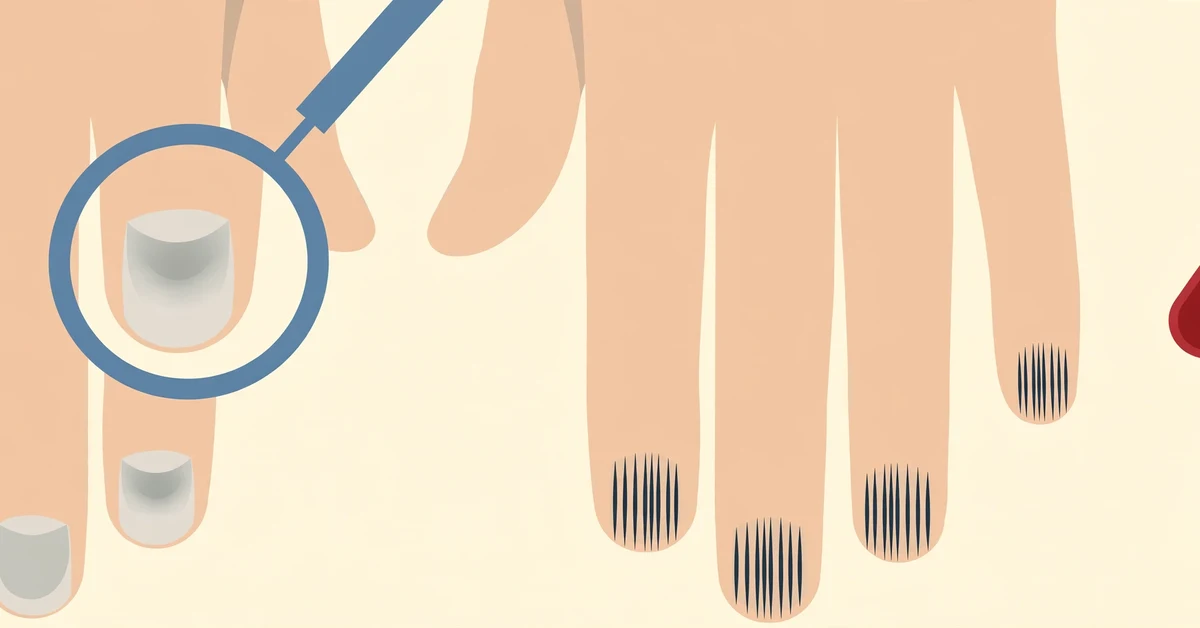
Your nails can be an early clue that iron or vitamin B12 is running low — but they point in different directions. Iron deficiency mainly changes the shape and strength of the nail: nails flatten, thin out and may scoop upward into spoon nails (koilonychia), the nail beds look pale, and the plate turns brittle with fine ridges. Vitamin B12 deficiency mainly changes the colour: brownish or blue-black streaks running lengthwise down the nail (longitudinal melanonychia), a diffuse bluish darkening, or an overall grey-blue tint. Neither pattern proves a deficiency on its own. Nails are a reason to test, never a diagnosis — only blood work can confirm low iron or low B12.
That distinction matters because the two deficiencies are treated differently, have different causes, and carry different risks if they are missed. This article works like a detective guide: what each deficiency actually does to nails, which look-alike nail changes have nothing to do with deficiency, who is most at risk, how deficiency is properly confirmed, and how long nails take to recover once treatment starts. For the broader question of which nutrients support nail growth in general, see our guide to vitamins for nails — this page is only about reading deficiency signs.
At a glance: the sign-by-sign table
Use this table as a starting point for a conversation with a clinician, not as a self-diagnosis tool. The same sign often has more than one possible cause, which is exactly why the third column matters.
| What you see | Linked deficiency | Other possible causes |
|---|---|---|
| Spoon-shaped nails — centre dips, edges lift, can hold a drop of water (koilonychia) | Iron deficiency (classic sign) | Iron overload (haemochromatosis), inherited trait, repeated solvent/wet work, thyroid disease, normal variant on toes in children |
| Pale or washed-out nail beds | Iron deficiency anaemia; also seen in B12-deficiency anaemia | Cold hands, poor circulation, other causes of anaemia (blood loss, chronic disease, folate deficiency) |
| Thin, brittle nails that split at the tip, with fine lengthwise ridges | Iron deficiency (long-standing); occasionally B12 deficiency | Ageing, repeated wetting and drying, detergents and removers, gel manicures, thyroid disease, psoriasis |
| Dark brown or black streaks running lengthwise (longitudinal melanonychia), on several nails | Vitamin B12 deficiency | Normal pigmentation in deeper skin tones, pregnancy, certain medicines, fungal infection, nail-matrix mole — and, on a single nail, melanoma (see red flags below) |
| Diffuse bluish or blue-grey darkening of the nails | Vitamin B12 deficiency | Low oxygen/circulation problems, certain medicines, normal variant in deeper skin tones |
| White spots on the plate | Rarely zinc deficiency — usually not a deficiency sign at all | Minor knocks and trauma to the nail matrix (by far the most common cause) |
| Thick, crumbly, yellow nails, often one or a few nails only | Not a typical deficiency sign | Fungal nail infection, psoriasis, repeated trauma, ageing |
| A groove running across the nail (Beau’s line) | Severe illness or malnutrition can pause nail growth, but this is non-specific | High fever, major illness, surgery, chemotherapy, injury — the groove dates the event, it does not name a nutrient |
One timing fact helps you read every sign in this table: fingernails grow roughly 3 mm a month, and the plate you see at your fingertip was built by the nail matrix weeks to months earlier. Nail changes therefore lag behind the deficiency that caused them — and they also lag behind recovery.
What do iron deficiency nails look like?
The signature iron sign is koilonychia, or spoon nails. It develops gradually: first the nail loses its normal curve and flattens, then the plate thins and softens, and finally the centre dips while the edges turn up, forming a shallow scoop that can hold a drop of water. Cleveland Clinic describes exactly this progression and notes that, most often, spoon nails are a sign of iron deficiency anaemia. The thumb and index finger usually show it first, and the change is typically symmetric — similar nails on both hands. MedlinePlus likewise lists spoon-shaped nails among the recognised signs of iron deficiency.

Spooning rarely arrives alone. Long-standing iron deficiency also produces pale nail beds — the tissue under the translucent plate loses its healthy pink because there is less haemoglobin in the blood beneath it — plus brittleness, splitting at the tip, and fine longitudinal ridging. The mechanism is straightforward: iron-dependent enzymes support the rapid cell division of the nail matrix, and iron is needed to make the haemoglobin that delivers oxygen to it. Starved of iron, the matrix builds a thinner, weaker plate that cannot hold its curve. Our iron deficiency nail health chart shows these changes side by side with normal nails.
How strong is the spoon-nail signal? It is specific but not sensitive. A clinical review in StatPearls estimates that only about 5.4% of people with iron deficiency develop koilonychia — so most people with low iron never get spoon nails, and normal-shaped nails do not rule deficiency out. When spooning does appear alongside fatigue, breathlessness on exertion, ice or non-food cravings (pica), restless legs, a sore or smooth tongue, cracks at the corners of the mouth, or increased hair shedding, the pattern becomes much more persuasive — and much more worth testing.
What do B12 deficiency nails look like?
B12 deficiency writes on the nail in pigment rather than shape. The best-documented change is melanonychia: brownish, blue-black, or grey longitudinal streaks running from the cuticle to the tip, a diffuse bluish darkening of the whole plate, or a net-like (reticulate) pattern of pigmentation. A peer-reviewed review of melanonychia in PMC explains that B12 deficiency produces this reversible pigmentation probably because low B12 lowers glutathione levels, which releases the brake on tyrosinase, the enzyme involved in melanin production — so the nail matrix lays down extra pigment. The change is reported more often in people with deeper skin tones, and it typically affects several nails rather than just one.

Two features make the B12 pattern distinctive. First, it is reversible: case reports consistently describe the dark streaks and bluish discoloration fading as B12 is replaced and new, normally pigmented nail grows out. Second, it rarely travels alone — B12 deficiency also causes a sore, smooth red tongue, tingling or numbness in the hands and feet, unsteadiness, and memory or mood changes. Those neurological companions are the reason B12 signs deserve prompt attention: nerve damage from a long-standing B12 deficiency does not always fully reverse, even after treatment. Because B12 is also required for red blood cell production, a severe deficiency can add anaemia signs — pale nail beds and fatigue — on top of the pigment changes. The NIH Office of Dietary Supplements B12 fact sheet covers the deficiency picture in full.
Which nail changes are NOT a deficiency?
Most nail changes seen in everyday life have nothing to do with iron or B12, and treating them as deficiency signs leads people to supplement the wrong thing for months. The common look-alikes:
- Fungal nail infection — thickened, crumbly, yellow-brown nails that lift from the bed, usually starting in one or a few toenails. This is an infection to treat, not a nutrient to replace. DermNet’s nail disorders overview sets out how fungal disease differs from systemic nail signs.
- Nail psoriasis — small pits in the plate, yellow-red “oil drop” patches, separation of the nail from the bed, and crumbling. Psoriasis can occasionally mimic spooning, which is one reason spoon nails still need a proper workup.
- Trauma — a single changed nail is usually a knocked nail. White spots are almost always minor matrix knocks, and a single Beau’s line follows an illness, injury, or period of severe stress that briefly paused nail growth.
- Ageing and wet work — fine vertical ridges increase naturally with age, and brittleness is most often caused by repeated wetting and drying, detergents, solvents, removers, and manicures. Brittleness becomes a deficiency clue mainly when it is new, affects all twenty nails, and arrives with other symptoms.
- Iron overload — counterintuitively, the StatPearls review reports koilonychia in a large share of people with haemochromatosis, the inherited condition in which iron accumulates. Spoon nails can therefore mean too little iron or too much — another reason never to start iron on the basis of nails alone.
Who is most at risk of iron or B12 deficiency?
The risk profiles are quite different, and knowing yours sharpens what a nail sign might mean. Iron deficiency is usually about loss or demand: heavy menstrual bleeding is the most common route in younger women; slow gastrointestinal blood loss (from ulcers, regular anti-inflammatory use, or bowel disease) is the key route in men and older adults and always needs an explanation; pregnancy and frequent blood donation raise demand; and coeliac disease or other malabsorption, or a very low-iron diet, reduce what comes in. The NIH iron fact sheet details these groups and intake needs.
B12 deficiency is usually about intake or absorption. People eating a vegan diet without fortified foods or a supplement are at risk because B12 comes almost entirely from animal foods and fortified products. Absorption problems dominate in older adults: atrophic gastritis and pernicious anaemia (an autoimmune loss of intrinsic factor, the protein needed to absorb B12 — see our explainer on the intrinsic factor antibody test), stomach or bowel surgery including bariatric surgery, Crohn’s disease and coeliac disease, and long-term use of acid-suppressing medicines (proton pump inhibitors) or metformin, both of which lower B12 absorption over time.
How is iron or B12 deficiency actually confirmed?
With blood tests — full stop. A nail can raise the question; it can never answer it. For suspected iron deficiency, the standard pair is a complete blood count (CBC), which shows whether anaemia is present and whether red cells have become small (microcytic, the iron pattern), and ferritin, the marker of stored iron. Ferritin matters because stores fall before haemoglobin does, so iron deficiency can be real and worth treating while the blood count still looks almost normal — MedlinePlus’s ferritin test page explains what the result reflects. One caution clinicians keep in mind: ferritin also rises with inflammation, so it is interpreted alongside the rest of the picture.

For suspected B12 deficiency, the first test is serum B12, read alongside the CBC — B12-deficiency anaemia tends to push red cells in the opposite direction, making them larger (macrocytic). Serum B12 has a grey zone: levels can look borderline while tissues are genuinely short, which is why clinicians add methylmalonic acid (MMA), and sometimes homocysteine, when the B12 result and the symptoms disagree. MMA rises when B12 is functionally low, so it helps settle borderline cases. We deliberately give no cut-off numbers here: reference ranges differ between laboratories and are interpreted with your symptoms and blood count, which is a clinician’s judgement, not a nail chart’s. If deficiency is confirmed, the second half of the workup is finding why — unexplained iron loss in an adult, or B12 malabsorption, points to something upstream that matters more than the number itself. Home screening kits can flag low ferritin, as our guide to the anemia test at home explains, but a positive screen still needs laboratory confirmation.
How are these deficiencies treated — and how long until nails recover?
The principle is simple: treat the deficiency and its cause; the nail follows. Confirmed iron deficiency is corrected with iron — dietary changes alone rarely rebuild empty stores once anaemia has developed — and the source of loss is addressed, whether that is heavy periods, a stomach or bowel problem, or donation frequency. Confirmed B12 deficiency is corrected with B12, orally at high dose or by injection when absorption is the problem, and the cause (diet, pernicious anaemia, a medicine that can be reviewed) is dealt with in parallel. Do not self-start iron because your nails look spooned: iron taken without a documented deficiency can accumulate and cause harm, and months spent supplementing the wrong nutrient delay the real diagnosis.
Set expectations by the growth clock. Blood values typically start improving within weeks of correct treatment, but the damaged plate already on your fingers cannot repair itself — it has to grow out and be replaced. Fingernails generally normalise over about 4 to 6 months; Cleveland Clinic advises that spoon nails can take 6 to 18 months to fully resolve, and toenails are slower still, because they grow more slowly. B12 pigmentation fades the same way, from the cuticle outward, as new nail replaces the darkened plate. If nails are not improving at all once blood levels have been corrected for several months, that is worth raising again — it suggests the nail change had a different cause, or a second one.
When should nail changes be checked promptly?
Most deficiency-pattern nail changes warrant a routine appointment and a blood draw, not alarm. Move faster in these situations:
- A new dark streak on a single nail, especially if it is widening, has uneven colour, or the pigment spreads onto the skin at the base of the nail. A single-nail dark streak can be a nail-matrix mole or, rarely, melanoma — it is not a vitamin sign and needs in-person assessment.
- Nail changes with neurological symptoms — tingling, numbness, unsteadiness, or memory changes — because B12 deficiency becomes harder to reverse the longer it runs.
- Spoon or pale nails with significant anaemia symptoms: breathlessness at rest, chest pain, fainting, a racing heart, or trouble swallowing (the last of these, with iron deficiency, is a recognised combination that needs evaluation).
- Rapid change in many nails at once, nail pain, swelling, or separation with inflammation — patterns that suggest infection, psoriasis, or another active disease rather than a slowly developing deficiency.
The bottom line
Read your nails like a detective, not a fortune-teller. Spooning, pallor, and brittle ridging point toward iron; dark longitudinal streaks and bluish darkening point toward B12; thick yellow crumbling, pitting, single-nail changes, and ordinary white spots usually point somewhere else entirely. The sign earns you a blood test — CBC and ferritin for the iron question, serum B12 with MMA when needed for the B12 question — and treatment of whatever the tests confirm, plus its cause. Give corrected nails months, not weeks, to grow out. If you want the general nutrition picture alongside this signs guide, our article on vitamins for nails covers the nutrients that support normal nail growth.
Disclaimer: The information provided on this website is for educational and informational purposes only and does not constitute medical advice. Nail changes cannot diagnose a nutrient deficiency; always consult a qualified healthcare provider for testing and before making any changes to your diet, medication, or supplement use.
Frequently Asked Questions
No. Nail signs can raise the suspicion — spoon nails and pale beds for iron, dark longitudinal streaks or bluish darkening for B12 — but every one of these signs has other causes, and most people with a deficiency never develop the classic nail changes. Only blood tests (CBC and ferritin for iron; serum B12, with MMA if the result is borderline) can confirm a deficiency.
Spoon nails (koilonychia) are most often a sign of iron deficiency anaemia, and they develop gradually: the nail flattens, thins, then scoops upward enough to hold a drop of water. But they are not always iron deficiency — they can be inherited, caused by repeated solvent or wet work, appear as a normal toenail variant in children, and are also reported in haemochromatosis, where iron is too high rather than too low. That is why spoon nails call for a CBC and ferritin test rather than iron supplements on guesswork.
B12 deficiency is thought to lower glutathione levels, which removes a brake on tyrosinase, the enzyme involved in melanin production. The nail matrix then deposits extra pigment, producing brownish or blue-black longitudinal streaks, a diffuse bluish darkening, or a net-like pattern — most visibly in people with deeper skin tones. The pigmentation is reversible: it fades as B12 is replaced and new nail grows out.
For iron: a complete blood count (which shows anaemia and small red cells) plus ferritin, the marker of stored iron — ferritin falls before anaemia appears, so it catches deficiency earlier. For B12: serum B12 read with the blood count (B12 anaemia makes red cells larger), plus methylmalonic acid (MMA) when the B12 result is borderline, because MMA rises when tissues are functionally short of B12. If a deficiency is confirmed, testing also looks for its cause, such as blood loss or malabsorption.
Longer than most people expect, because the damaged nail plate cannot repair itself — it must grow out. Blood levels usually start improving within weeks, but fingernails typically take about 4 to 6 months to normalise, spoon nails can take 6 to 18 months to fully resolve, and toenails are slower still. B12-related dark streaks fade from the cuticle outward over the same growth cycle.
When it appears on a single nail. B12-related pigmentation usually affects several nails symmetrically, but a new dark streak on one nail — especially one that is widening, uneven in colour, or spreading pigment onto the skin at the nail base — can be a nail-matrix mole or, rarely, melanoma. That pattern is not a deficiency sign and should be assessed in person promptly.





Related Posts

All About Xarelto
Oct 5, 2026 • 5 min read
Is It Serosanguinous or Another Type of Wound Drainage?
Sep 4, 2026 • 12 min read
Best At-Home Iron Test to Check for Iron Deficiency
Aug 18, 2026 • 23 min read
4 Herbs for Sickle Cell Anemia
Aug 20, 2026 • 9 min read
What Blood Tests Are Used to Diagnose Anemia?
Aug 31, 2026 • 33 min read