AI Mental Health Tools vs. Professional Therapy
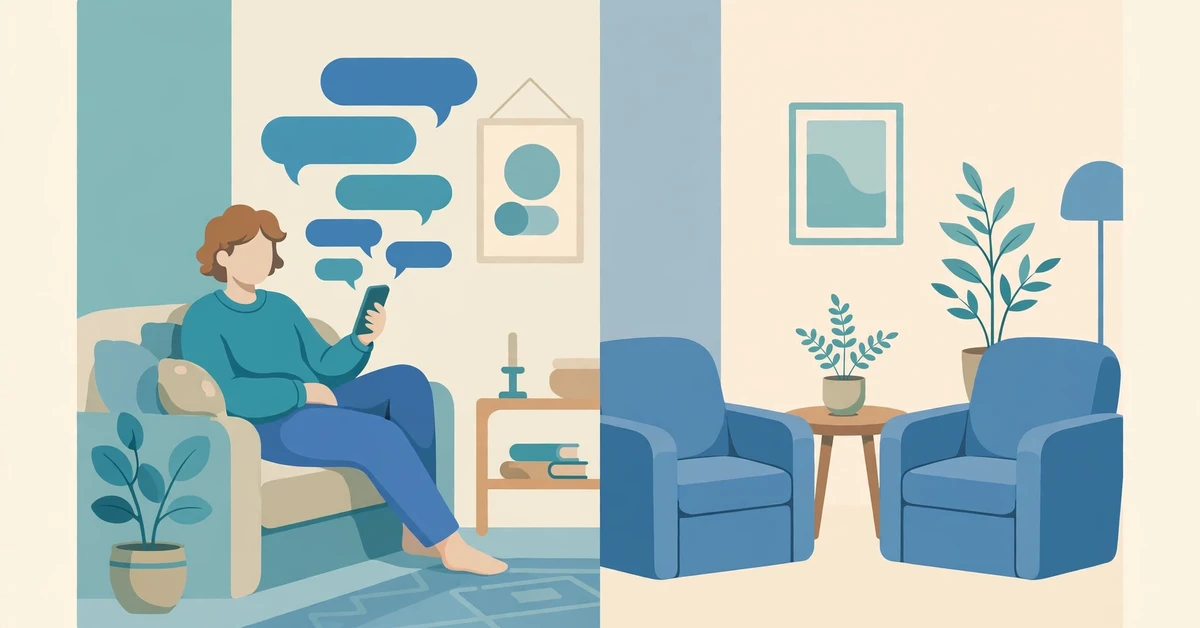
“Can talking to an AI chatbot about how I’m feeling help, or do I need a real therapist?” If you’ve wondered that, you’re not alone. Emotional support is one of the most common reasons people use AI chatbots, according to a 2025 health advisory from the American Psychological Association (APA). And it makes sense to feel unsure about whether a chatbot counts as getting help.
So here’s the short answer. Some AI tools can help with everyday stress and with practicing coping skills. But they can’t replace a licensed professional, especially when your symptoms are serious or you’re worried about your safety. The useful question is which kind of support fits what you’re dealing with right now.
Two Kinds of AI Mental Health Tools
“AI mental health tool” can mean two quite different things.
The first is an app built for mental health. Many of these apps guide you through exercises from cognitive behavioral therapy (CBT), such as writing down an anxious thought and checking it against the facts. Some follow conversations scripted by experts. Others use generative AI, the technology that lets a chatbot write its own replies.
The second is a general-purpose chatbot, the kind people use to draft an email or plan a week of dinners. Their makers didn’t design them for mental health care.
The difference matters when you read about research, because a study of one kind tells you little about the other.
What the Research Says
The strongest evidence so far comes from tools built for mental health. A 2023 review pooled 15 randomized trials of AI chatbots and found that the chatbots reduced symptoms of depression and distress, on average, but didn’t improve people’s overall well-being.
In 2025, researchers at Dartmouth published the first randomized trial of a generative AI chatbot built to treat clinical symptoms. The trial enrolled 210 adults with depression, anxiety or a high risk of an eating disorder. People who used the chatbot had larger drops in symptoms than people on a waiting list, after four weeks of use and again at eight weeks.
These results are encouraging, but they have limits. The Dartmouth trial compared the chatbot with no treatment, not with therapy, and it followed people for two months. Even for tools built for mental health, large, high-quality trials are still missing, and studies of general-purpose chatbots can’t yet support firm conclusions, the APA advisory says.
The Risks and Limits of AI Tools
The most serious limit appears in a crisis. You can’t count on these tools to handle a crisis safely, and relying on an app alone during a mental health emergency can be dangerous, the APA warns. Even in the Dartmouth trial, study staff had to step in 15 times over safety concerns, including expressions of suicidal thoughts, and correct 13 inappropriate responses.
A team from Stanford and other universities tested the kind of large AI models behind popular chatbots against standards drawn from therapy guides. The models showed stigma toward people with some mental health conditions and sometimes encouraged a person’s delusional thinking. Newer, larger models had the same problems.
Part of the trouble is that many chatbots are designed to agree with you, which can reinforce unhelpful thinking. For people with anxiety or OCD, constant reassurance from a chatbot may strengthen the urge to keep seeking it. A therapist supports you and also challenges a belief when it’s making things worse.
What a Therapist Can Do That an App Cannot
The relationship between you and your therapist matters. Across 295 studies covering more than 30,000 patients, therapy tended to go better when the client and therapist had a stronger working relationship.
A therapist also notices what you don’t type, such as a long pause before you answer a hard question. That fuller picture lets a therapist diagnose what’s going on and refer you for medication or more intensive care when you need it. Most chatbots work mainly from the words you type or say, and they can’t diagnose or treat a psychological disorder. Nor are they bound by a professional code of ethics or regulated by a state licensing board, as licensed therapists are.
How to Decide Which Kind of Support You Need
This table is a rough guide, not a diagnosis.
|
IF THIS SOUNDS LIKE YOU |
WHERE TO START |
|
Everyday stress or low moods that come and go, and you’re still sleeping and working as usual |
An app built for mental health, used to practice coping skills |
|
You’re on a waiting list for therapy |
An app can help you practice skills while you wait. Keep your place on the list. |
|
You’re in therapy and find it hard to do exercises between sessions |
An AI tool your therapist knows you’re using |
|
Symptoms that last for weeks or get in the way of work, sleep or relationships |
A licensed therapist or your primary care doctor |
|
A history of trauma, an eating disorder, bipolar disorder, psychosis or substance use |
A mental health professional. Use any app only as an add-on your clinician agrees with. |
|
Thoughts of harming yourself, or you feel unsafe |
Call or text 988 now. Call 911 if you’re in immediate danger. |
Pay attention to how you use any chatbot, too. The APA lists signs that someone may be relying on one too much:
- You’d rather talk to the chatbot than to the people in your life
- You hide how much you use it
- You spend more time with it than you mean to
- Using it starts to interfere with your work or daily life
If any of these sound familiar, you haven’t done anything wrong. It’s a sign that talking to a professional could help.
Using an AI Tool Alongside Therapy
For many people, the answer is both. The APA says these tools may be appropriate as a supportive add-on to ongoing therapy, though not as a substitute, and it recommends telling your therapist which ones you use. That way, your therapist can spot advice that doesn’t fit your treatment plan.
Early evidence for this pairing looks promising. In one observational study of 244 people in group therapy based on CBT in the UK, people who chose to use an AI tool for their between-session exercises attended more sessions, dropped out less often and were more likely to recover than people who used standard worksheets.
Before you share anything personal with an app, check how it handles your data. HealthEH’s guide to mental health app privacy lists what to look for.
The Bottom Line
An AI tool built for mental health can help you practice coping skills, whether you’re between therapy appointments or waiting for your first one. But it can’t assess you or keep you safe in a crisis. If you’ve used a chatbot for a few weeks and feel the same or worse, book an appointment with a therapist or your primary care doctor.
If you’re in crisis or thinking about harming yourself, call or text 988 to reach the 988 Suicide & Crisis Lifeline in the U.S. If you’re in immediate danger, call 911.
Read Next
Staph Infection Pictures: What Staph Looks Like and How to Tell It From Cellulitis
Hiya Vitamins Review By a Mom Who Is a Dietitian
Guide to Baby Wearing: Benefits, Safety Tips, and How To
6 Foam Roller Exercises for Your Back
Ringworm Pictures: What Ringworm Looks Like on Skin, Scalp and Nails

What Is Acerola Cherry?
Related Posts
Mental Health App Privacy: How to Check an App Before You Sign Up
Nov 16, 2026 • 34 min read
Midlife Crisis or Midlife Myth? What to Know About Going ‘Over the Hill’
Sep 22, 2026 • 28 min read
Therapy for Burnout When You Are Still Performing Well
Nov 9, 2026 • 17 min read
5 Ways to Reduce Stress-Related Tension in Your Neck and Shoulders
Sep 23, 2026 • 3 min read
When and How Should You End a Relationship with a Person Diagnosed with Bipolar Disorder?
Sep 2, 2026 • 30 min read