8 Ankle Stretches to Try at Home

Feeling tight or achy? A well-timed stretch might be exactly what you need. If ankle stiffness or discomfort is an issue, several stretches can provide relief. Spending a few minutes daily on mobility and strength can reduce pain and expand your range of motion.
If you’re recovering from an injury, talk with your doctor before beginning any new routine. Rest could be recommended, or you may have particular guidance to follow while healing.
Warming up first is important. Do 5 to 10 minutes of light cardio, such as walking or using a stationary bike, before stretching.
Pay attention to any sharp or worsening pain while you stretch. Mild soreness is normal at times, but significant pain should be discussed with your healthcare provider.
1. Ankle circles

Ankle circles are great for improving joint mobility. You can perform them seated or lying down:
- Begin by rotating your ankle slowly in a circular motion to the left, then to the right.
- You may prefer tracing the alphabet with your foot, leading with the big toe.
- Keep movements small and isolate the motion to your foot and ankle rather than your whole leg.
For circles, try doing 10 rotations each way per foot. If using the alphabet method, perform 2 sets on each foot.
2. Achilles stretch

The Achilles stretch resembles a typical calf stretch:
- Stand near a wall or sturdy support, such as a chair, with your hands placed at about eye level.
- Step your left foot back behind your right foot.
- Keep the left heel down and bend your right knee until you sense a stretch in the left lower leg.
- To emphasize the Achilles tendon, bend the back knee slightly.
Hold for 15 to 30 seconds and repeat 2–4 times per leg.
3. Towel stretch

To perform this stretch:
- Sit on the floor with both legs extended straight ahead.
- Loop a towel around the toes of one or both feet.
- Gently pull the towel toward you until you feel a stretch across the soles and the back of the lower legs.
Hold for 30 seconds and repeat 3 times. This is also a useful stretch if you’re addressing plantar tightness.
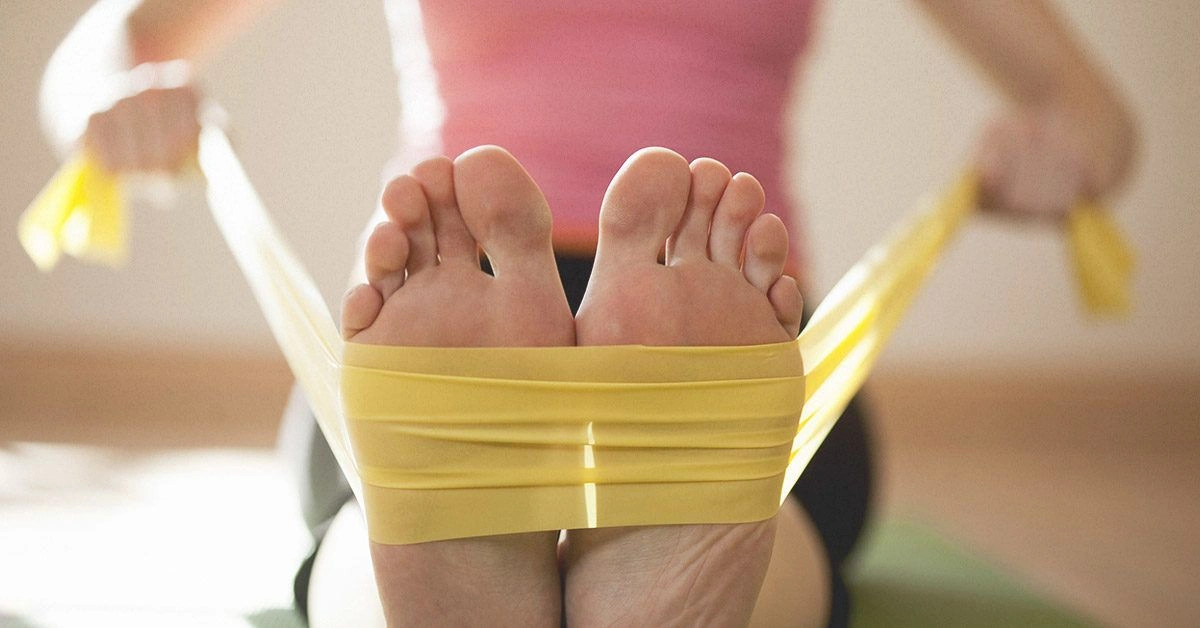
4. Band stretch

A resistance band or strap can intensify many stretches. Like the towel stretch, it helps you get a deeper stretch safely.
To perform an inward band stretch:
- Sit and place the band around your left foot.
- Grasp both ends of the band firmly with your hands.
- Slowly rotate your ankle inward so the sole faces toward the right.
- Pull upward on the right side of the band to increase the stretch.
- Repeat on the opposite side.
To perform an outward band stretch:
- Sit with the band around your left foot.
- Hold both ends of the band securely.
- Slowly turn your ankle outward so the sole faces left.
- Pull upward on the left side of the band to deepen the stretch.
- Repeat on the other side.
Hold each variation for 30 seconds and do 3 repetitions.
5. Standing calf stretch

To increase tension, try this stretch from a standing position:
- Stand facing a wall or sturdy object with one foot placed about 12 inches in front of the other.
- Flex your toes upward.
- Lean forward slowly until you feel the stretch in the back of the lower leg.
Maintain the stretch for 30 seconds, then switch sides. Perform 3 sets altogether.
6. Standing soleus stretch

The soleus, a deep calf muscle, commonly becomes tight in athletes. To stretch it:
- Stand several feet from a wall or another stable support, facing it.
- Place one leg behind you with the heel flat on the ground.
- Bring the other leg forward toward the support.
- Turn the foot of the back leg slightly inward toward the front foot.
- Bend the front knee slightly into the support until you sense a stretch in the back leg.
Hold for 30 seconds and repeat 3 times.
7. Cross leg ankle stretch

To try this stretch:
- Sit in a relaxed position and cross your left leg over your right knee.
- Use your hands to cradle the right foot.
- With your right hand, gently press the toes and ankle of the left foot downward, as if pointing the toes.
- You should feel the stretch across the front of the ankle and the top of the foot.
Hold for 30 seconds and then repeat on the other side.
8. Chair Pose

Yoga poses can also help mobilize the ankles. Chair Pose (utkatasana) is accessible to most practitioners:
- Stand tall in mountain pose. Inhale and lift both arms overhead with palms facing in.
- Exhale and bend both knees slightly, working toward bringing your thighs parallel to the floor.
- Your torso should form roughly a right angle with the tops of your thighs.
Hold the posture for 30 seconds up to one minute. To release, inhale and straighten your legs.
The bottom line
Always check with your physician before beginning new stretches or exercises, particularly after an injury or surgery.
If you’ve recently been hurt or operated on, you might follow a focused strengthening and stretching plan for four to six weeks. Your provider will likely give you specific routines and recommendations for your recovery.
Otherwise, consistent ankle stretching can help improve mobility and reduce stiffness and soreness. Aim to stretch regularly, ideally three to five days per week.
You can also consult your physician or a physical therapist about additional ways to enhance ankle strength and flexibility. A trained specialist can ensure you’re performing these movements with correct form. Proper technique matters.
For complementary mobility work, consider incorporating targeted lat stretches, general stretches, or specific shin splint stretches into your routine where appropriate.
Frequently Asked Questions
Begin with gentle moves like ankle circles, towel stretches, and seated band stretches. These are low-impact and help improve range of motion before progressing to standing variations.
Aim for 3–5 days per week, holding each stretch for about 30 seconds and repeating 2–4 times. Adjust frequency based on comfort and any guidance from your healthcare provider.
Regular stretching can reduce stiffness and improve mobility, which may lessen some types of ankle pain. If pain is sharp or persistent, consult a medical professional before continuing.
Yes. Do 5–10 minutes of light cardio like walking or cycling to increase blood flow before stretching, which helps reduce injury risk and improves effectiveness.
Not always. After an injury or surgery, check with your doctor or physical therapist for a tailored plan. They may recommend rest or specific rehab exercises rather than generic stretches.






Related Posts

Why Are Blisters Forming Between My Toes and How Do I Treat Them?
Jul 31, 2026 • 23 min read
What to Do When Your Shoes Are Too Tight
Aug 12, 2026 • 15 min read
7 Stretches for Shin Splints
Sep 15, 2026 • 18 min read
Who Should Consider Getting Peroneal Tendon Surgery?
Aug 9, 2026 • 29 min read
7 Ways to Remove Dead Skin from Your Feet
Sep 10, 2026 • 14 min read