Benefits of Taking Vitamins Every Day: Who Actually Needs a Daily Supplement?

- What does the evidence actually say about taking vitamins every day?
- What does “insufficient evidence” actually mean?
- Who genuinely benefits from taking vitamins every day?
- Who does not benefit — and who can be harmed?
- Is a multivitamin better than targeted single nutrients?
- How can you close nutrient gaps with food first?
- If you do take a daily vitamin, how should you choose one?
- Should you take vitamins every day? A decision checklist
- The bottom line
For most healthy adults who eat a reasonably varied diet, taking vitamins every day has not been shown to prevent heart disease, cancer, or early death. That is the honest answer, and it comes from the largest trials and guideline reviews available — not from supplement marketing. A daily vitamin can still be the right choice for specific people at specific life stages, because correcting a real nutrient gap is very different from taking a pill “just in case.” This article separates those two situations: what the evidence actually shows for the daily vitamin habit, who genuinely benefits, where daily pills can hurt, and how to decide for yourself with a simple checklist.
A “daily vitamin” in this article means a multivitamin or a routine daily supplement taken by a generally healthy adult to stay healthy or prevent disease. It does not mean a supplement prescribed to treat a diagnosed deficiency, which is medical care, not a wellness habit. That distinction matters, because almost every confusion about benefits of taking vitamins every day comes from mixing the two together.
What does the evidence actually say about taking vitamins every day?
The most useful summary comes from the U.S. Preventive Services Task Force (USPSTF). In its 2022 recommendation on vitamin, mineral, and multivitamin supplementation to prevent cardiovascular disease and cancer, the Task Force concluded that the current evidence is insufficient to assess the balance of benefits and harms of multivitamins for preventing cardiovascular disease or cancer in healthy, non-pregnant adults. It reached the same “insufficient evidence” conclusion for most single and paired nutrients. For two supplements it went further and recommended against use for this purpose: beta-carotene and vitamin E.

The large trials behind that conclusion tell a consistent story. The Physicians’ Health Study II followed more than 14,000 male physicians for over a decade. A daily multivitamin produced a modest reduction in total cancer and in cataracts, but no protective effect against cardiovascular disease. The COSMOS trial enrolled more than 20,000 older adults and likewise found that a daily multivitamin did not protect against cardiovascular disease or cancer. An analysis pooling three large U.S. cohorts — more than 390,000 participants in total — found that daily multivitamin use did not decrease the risk of death. Harvard Health’s summary of this evidence puts it plainly: most studies find no benefit from multivitamins in protecting the heart, and the case for the brain is narrower than headlines suggest.
There is one genuinely interesting exception. In COSMOS sub-studies focused on cognition — COSMOS-Mind, COSMOS-Web, and COSMOS-Clinic — older adults taking a daily multivitamin showed modest improvements in memory and global cognition compared with placebo. That finding deserves follow-up, and it may matter most for older adults whose diets are limited. It does not turn a multivitamin into a proven dementia prevention tool, and it does not change the overall verdict for younger, well-nourished adults. If a headline claims daily vitamins “prevent” heart disease, cancer, or memory loss for everyone, it is claiming more than the trials found.
What does “insufficient evidence” actually mean?
This phrase is widely misunderstood, so it is worth slowing down. “Insufficient evidence” does not mean researchers proved multivitamins are useless. It also does not mean they work but officials are being cautious. It means that, after reviewing the available studies, experts could not determine whether the benefits outweigh the harms for the specific job in question — preventing cardiovascular disease or cancer in healthy adults who are not pregnant and do not have a known deficiency.
Three different verdicts are possible in guideline language, and they should not be blurred. “Recommended” means the evidence shows benefit clearly enough to advise routine use — folic acid before and during early pregnancy is the classic supplement example. “Insufficient evidence” means the honest answer is “we do not know enough to advise for or against.” “Recommended against” means the evidence points toward harm or no benefit with real risk — which is where beta-carotene and vitamin E landed for disease prevention. When you read any claim about daily vitamins, ask which of those three buckets it belongs in. Marketing copy almost never tells you.
The NIH Office of Dietary Supplements fact sheet on multivitamin/mineral supplements adds a practical point the trials support: there is no standard multivitamin formula. Each manufacturer chooses the ingredients and amounts, so “a multivitamin” in one trial is not identical to the bottle on your shelf. That is another reason broad promises are unreliable — the product category itself is not one consistent thing.
Who genuinely benefits from taking vitamins every day?
Daily supplements help most when there is a specific gap, a higher need, or an absorption problem. In those situations the benefit is not vague “wellness” — it is preventing or correcting a defined shortfall.
People who are pregnant or could become pregnant. Folic acid is the clearest case in all of supplement science. The NIH Office of Dietary Supplements folate fact sheet explains that getting enough folate before conception and in early pregnancy helps prevent major birth defects of the baby’s brain and spine. This is why folic acid is the one supplement guideline bodies actively recommend for people who could become pregnant, and why prenatal care should be discussed with a clinician rather than improvised from a general multivitamin.
Vegans and people who eat few animal foods. Vitamin B12 is found mainly in animal products, so a fully plant-based diet without fortified foods or a supplement can lead to deficiency over time. B12 deficiency can cause anemia and nerve problems that become serious if missed. Our guide to vitamin B12 foods covers dietary sources, but for a strict vegan the reliable answer is usually a fortified food or a B12 supplement — a targeted nutrient, not necessarily a large multivitamin.
Older adults. With age, the stomach often produces less acid, which makes it harder to absorb B12 from food. The NIH B12 fact sheet notes that the B12 in supplements and fortified foods is absorbed more easily in this situation. Older adults are also a group where vitamin D and calcium intake, bone health, and overall dietary variety deserve a specific conversation with a clinician — again, targeted questions beat a generic pill.
People with confirmed vitamin D deficiency or very limited sun and dietary intake. Vitamin D helps the body absorb calcium and maintain bones. The NIH vitamin D fact sheet describes who is at risk of getting too little, including people with limited sun exposure, darker skin, and conditions that limit fat absorption. The sensible sequence is test, then treat a confirmed low level at a clinician-guided dose — not permanent high-dose supplementation based on a guess.
People on restricted diets or with absorption conditions. Very low-calorie diets, eating disorders in recovery under medical care, bariatric surgery, celiac disease, Crohn’s disease, and long-term use of certain medicines (for example metformin or acid-suppressing drugs, which can lower B12) can all create real gaps. People following a ketogenic pattern face a similar planning question, which is why our overview of supplements on a keto diet stresses clinician input. In these situations a daily supplement may be part of a monitored plan — the key word is monitored.
Who does not benefit — and who can be harmed?
| Group | Daily vitamin verdict | Why |
|---|---|---|
| Healthy adult, varied diet, no deficiency | Unlikely to help prevent major disease | USPSTF: insufficient evidence for CVD/cancer prevention; large cohorts show no mortality benefit |
| Pregnant or could become pregnant | Yes — folic acid specifically | Prevents major neural tube birth defects when taken before and in early pregnancy |
| Vegan / very low animal-food intake | Yes — B12 specifically | B12 is mainly in animal foods; deficiency risks anemia and nerve damage |
| Adults over 50 | Often — B12, and vitamin D if low | Food-bound B12 absorption falls with age; bone health needs rise |
| Confirmed deficiency or malabsorption | Yes — targeted, monitored | Treating a measured shortfall is medical care with a defined goal |
| People who smoke or were exposed to asbestos | Avoid beta-carotene supplements | USPSTF recommends against beta-carotene for prevention; trials linked it to higher lung cancer risk in smokers |
| Anyone taking megadoses “just in case” | Can be harmed | Fat-soluble vitamins accumulate; excess can cause toxicity and interact with medicines |
The harm side is not theoretical. Vitamins A, D, E, and K are fat-soluble: the body stores them instead of flushing out the excess the way it handles most water-soluble vitamins. Stacking a multivitamin on top of single-nutrient products and fortified foods can push total intake well past what any label in isolation suggests. High-dose vitamin A can damage the liver and harm a developing baby. Too much vitamin D can raise blood calcium. Vitamin E at high doses has been linked to bleeding risk. None of this means a standard multivitamin at around 100% of the Daily Value is dangerous for most adults — the NIH notes such products are generally low-risk — but it does mean “more” is not “safer” or “better.”
Interactions are the second harm channel. Vitamin K can reduce the effectiveness of warfarin. Iron and calcium can interfere with the absorption of certain medicines if taken at the same time. High-dose antioxidant supplements can interact with some cancer treatments. The rule is simple and often broken: tell your doctor and pharmacist about every supplement you take, including gummies and “natural” products. If you want the single-nutrient picture for comparison, our keeper guide to vitamin C benefits shows how different the evidence looks when one nutrient is judged on its own terms.
Is a multivitamin better than targeted single nutrients?
Usually, no — targeted wins when a specific gap is known. A multivitamin spreads small amounts of many nutrients, which is a reasonable low-dose safety net for someone whose diet is inconsistent, but it is a blunt tool for a specific problem. If the issue is B12 absorption after 50, a B12 supplement or fortified food addresses it directly. If the issue is folate before pregnancy, the dose and timing of folic acid matter, and a random multivitamin may not match prenatal guidance. If the issue is vitamin D, a blood level tells you whether you need anything at all.
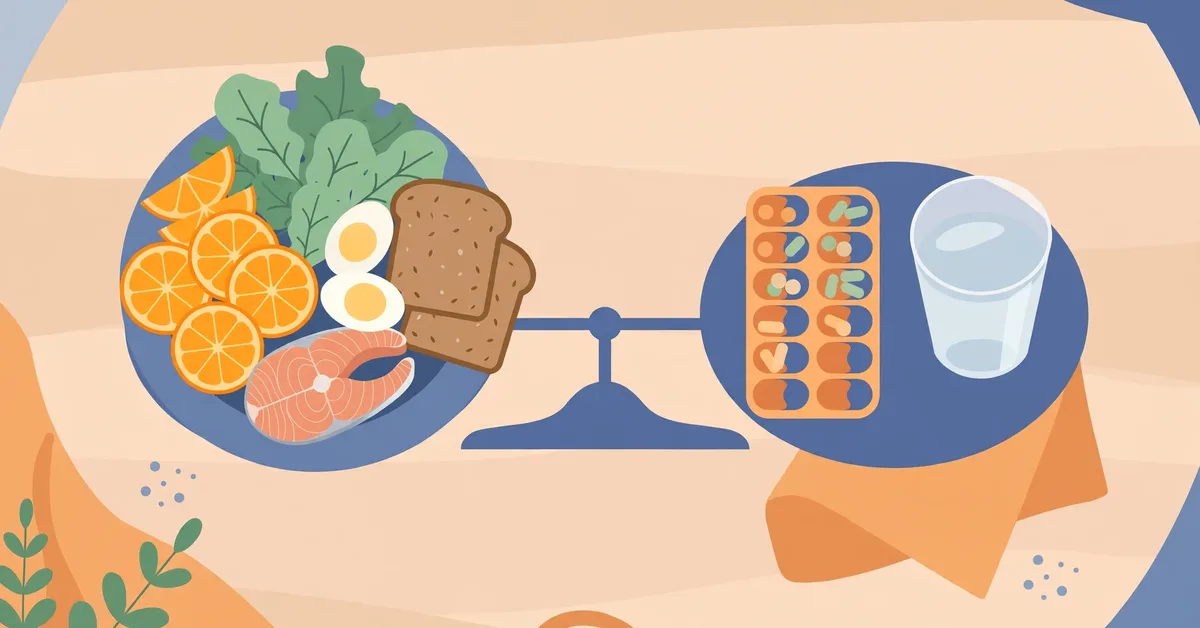
The NIH consumer fact sheet on multivitamin/mineral supplements makes the food point explicitly: multivitamins cannot take the place of eating a variety of foods, because foods provide fiber and other beneficial components that a pill does not contain. That is not a slogan. Dietary patterns rich in vegetables, fruit, whole grains, legumes, fish, and dairy or fortified alternatives have outcome evidence behind them that no multivitamin trial has matched. A pill can fill a gap in that pattern; it cannot replace the pattern.
How can you close nutrient gaps with food first?
Start with the gaps that are actually common, not with a shopping list of pills. Many adults fall short on vitamin D, calcium, potassium, magnesium, and fiber, and many eat less variety than they think. Practical food-first moves include: a serving of oily fish or fortified dairy (or a fortified alternative) for vitamin D and calcium; leafy greens, beans, and lentils for folate, magnesium, and potassium; eggs, dairy, meat, or fortified nutritional yeast for B12; nuts, seeds, and whole grains for vitamin E and magnesium; and a daily rotation of colorful fruit and vegetables so no single nutrient depends on one food. None of this requires perfection. The goal is a pattern varied enough that a supplement, if you use one, is genuinely a backup rather than the plan.

Give a food change a few weeks and notice what is measurable: Are you actually eating the foods? Did a blood test move? Are symptoms you attributed to “low vitamins” still present? Fatigue, poor concentration, and low mood have many causes — sleep, thyroid problems, anemia, depression, and medication effects among them — and a vitamin pill will not fix a cause it does not address. Testing before supplementing, when a deficiency is plausible, saves both money and diagnostic confusion.
If you do take a daily vitamin, how should you choose one?
Keep the dose boring. Choose a product that provides around 100% of the Daily Value for most nutrients rather than several hundred or thousand percent. Check that you are not doubling up: add together what your multivitamin, single supplements, protein products, and fortified drinks each contribute, especially for vitamins A, D, and E and for iron, which adults without a diagnosed need should not take casually. Look for independent verification — a USP Verified mark or NSF testing — because supplements are not approved by the FDA for safety and effectiveness before marketing the way prescription drugs are. Treat disease claims on a label (“prevents heart disease,” “boosts immunity against illness”) as a red flag, not a feature. Finally, count the cost honestly: a year of daily pills that fills no real gap is money that would have bought a great deal of nutrient-dense food.
Should you take vitamins every day? A decision checklist
Answer these five questions before you buy, renew, or increase any daily supplement:
- What gap am I trying to fill? If you cannot name the nutrient, the life stage, or the test result, pause.
- Am I in a group with a known higher need? Pregnancy-capable (folate), vegan (B12), over 50 (B12, vitamin D awareness), restricted diet, malabsorption, or a relevant medicine — if none applies, expected benefit is low.
- Could food close this gap in two to four weeks? If yes, try food first and reassess.
- Does anything I take interact with my medicines or duplicate another product? Check with a pharmacist, especially for vitamin K, iron, calcium, and high-dose antioxidants.
- What is my stop rule? Decide in advance: a retest date, a symptom to monitor, or a review with your clinician in three to six months. A supplement with no goal and no end point is just a subscription.
If your answers point to a specific nutrient, take the specific nutrient at a sensible dose and monitor it. If they point to no gap at all, the evidence-based choice is to skip the daily pill without guilt, eat as varied a diet as you realistically can, and put your effort into the habits with proven payoff — not smoking, regular activity, sleep, and keeping blood pressure, cholesterol, and blood sugar in range with your clinician’s help.
The bottom line
The benefits of taking vitamins every day are real but narrow: they belong mainly to people filling a defined gap — folic acid around pregnancy, B12 for vegans and many older adults, vitamin D for confirmed deficiency, and monitored supplementation for restricted diets and absorption problems. For the average healthy adult, large trials and the USPSTF do not show that a daily multivitamin prevents heart disease, cancer, or early death, and megadoses can cause harm. Food first, targeted supplements second, and a checklist before any daily habit — that order respects both the evidence and your wallet.
Disclaimer: The information provided on this website is for educational and informational purposes only and does not constitute medical advice. Always consult with a qualified healthcare provider regarding any health concerns or before making any changes to your diet, medication, or lifestyle.
Frequently Asked Questions
For most healthy adults who eat a varied diet, no. Large trials and the USPSTF found insufficient evidence that a daily multivitamin prevents cardiovascular disease or cancer, and pooled cohort data showed no mortality benefit. A daily vitamin is most useful when it fills a specific gap, such as folic acid around pregnancy or B12 on a vegan diet.
In 2022 the USPSTF concluded that evidence is insufficient to assess the balance of benefits and harms of multivitamins for preventing cardiovascular disease or cancer in healthy, non-pregnant adults. It recommended against beta-carotene and vitamin E for that purpose. Insufficient evidence means experts could not determine benefit versus harm — it is neither a recommendation for nor proof of uselessness.
People who could become pregnant (folic acid), vegans and people eating few animal foods (vitamin B12), many adults over 50 (B12, and vitamin D if levels are low), people with a confirmed deficiency, and people with restricted diets or absorption conditions such as celiac disease, Crohn’s disease, or after bariatric surgery — ideally with clinician monitoring.
Yes, at high doses or in the wrong situation. Fat-soluble vitamins A, D, E, and K are stored in the body and can accumulate, especially when a multivitamin is stacked with single supplements and fortified foods. Beta-carotene supplements increased lung cancer risk in smokers in trials, and supplements such as vitamin K, iron, and calcium can interact with medicines. Standard doses near 100% of the Daily Value are generally low-risk for most adults.
A targeted single nutrient is usually better when a specific gap is known — for example B12 for a vegan or folic acid before pregnancy — because the dose and purpose are clear. A standard multivitamin is a blunt, low-dose safety net for an inconsistent diet. Neither replaces a varied diet, which provides fiber and other beneficial components a pill does not contain.
Choose a product near 100% of the Daily Value rather than a megadose formula, check for independent verification such as USP Verified or NSF testing, add up duplicate nutrients across all your products, avoid labels promising disease prevention, and set a review or retest date so the habit has a goal and a stop rule.





Related Posts

5 Best Vitamin B Complex Supplements for 2025, According to Our Dietitians
Oct 2, 2026 • 29 min read
Protein Powders: A Doctor's No-Hype Look at the Evidence
Nov 12, 2026 • 26 min read
Folic Acid vs. Folate — What’s the Difference?
Aug 17, 2026 • 23 min read
What Are Deer Antler Supplements? Health Effects and Safety
Aug 15, 2026 • 21 min read
Does Tribulus Terrestris Really Work? An Evidence-Based Look
Sep 2, 2026 • 27 min read