How Long After Drinking Is It Safe to Drive?


Not to sound like a public service announcement, but mixing alcohol and driving is a bad idea.
Alcohol interferes with your ability to drive in many ways.
Most importantly, alcohol:
- clouds your judgement
- considerably slows your reaction time
- makes it difficult to concentrate on the road
- impairs control over the vehicle and speed
- lowers coordination
- reduces your capacity to follow moving objects
How long do these impairments last? What if you’ve had “just a few” and feel fine? What if you sense a mild buzz but believe you’re under the legal limit? Here’s what you need to understand.
Understanding the general timeline
Rates of alcohol metabolism vary substantially between individuals and situations. As a broad rule, your liver can process roughly 1 ounce of distilled spirit per hour, which equals about one standard drink.
Remember that alcoholic drinks differ in strength. Some beverages contain substantially more alcohol than others.
Also, what you call one drink may actually be more (sometimes a lot more) than a standard drink’s worth of alcohol.
A simple timeline
Below are some typical estimates for how long it takes the body to metabolize common drinks:
- A small shot of spirits: 1 hour
- A pint of beer: 2 hours
- A large glass of wine: 3 hours
Clearly, the more you drink, the longer it will take your body to clear the alcohol. That means a higher concentration of alcohol in your bloodstream (more on that shortly).
Factors that influence how quickly alcohol is processed include:
- Age. Slower circulation and reduced muscle mass with age change how alcohol is distributed, metabolized, and removed from the body.
- Biological sex. For various physiological reasons, women process alcohol differently than men and often experience stronger effects, even at similar sizes. Lower body water, hormonal differences, and reduced amounts of certain liver enzymes are contributing factors.
- Body weight. Heavier people have more body volume for alcohol to disperse into. If you weigh notably less than a friend, your blood alcohol concentration will be higher after consuming the same amount.
- Food (empty vs. full stomach). Alcohol is absorbed through the stomach lining. Having food in your stomach slows gastric emptying and reduces absorption. Drinking on an empty stomach speeds absorption and leads to a higher blood alcohol level.
- Other substances and medications. Some prescription drugs and recreational substances alter alcohol metabolism and change how alcohol affects you. (In any case, you shouldn’t consider driving after using any of those.)
- Drinking speed. When you slam shots or chug drinks, you don’t give your liver time to metabolize the alcohol, so the impairment lasts longer.
What about blood alcohol concentration?
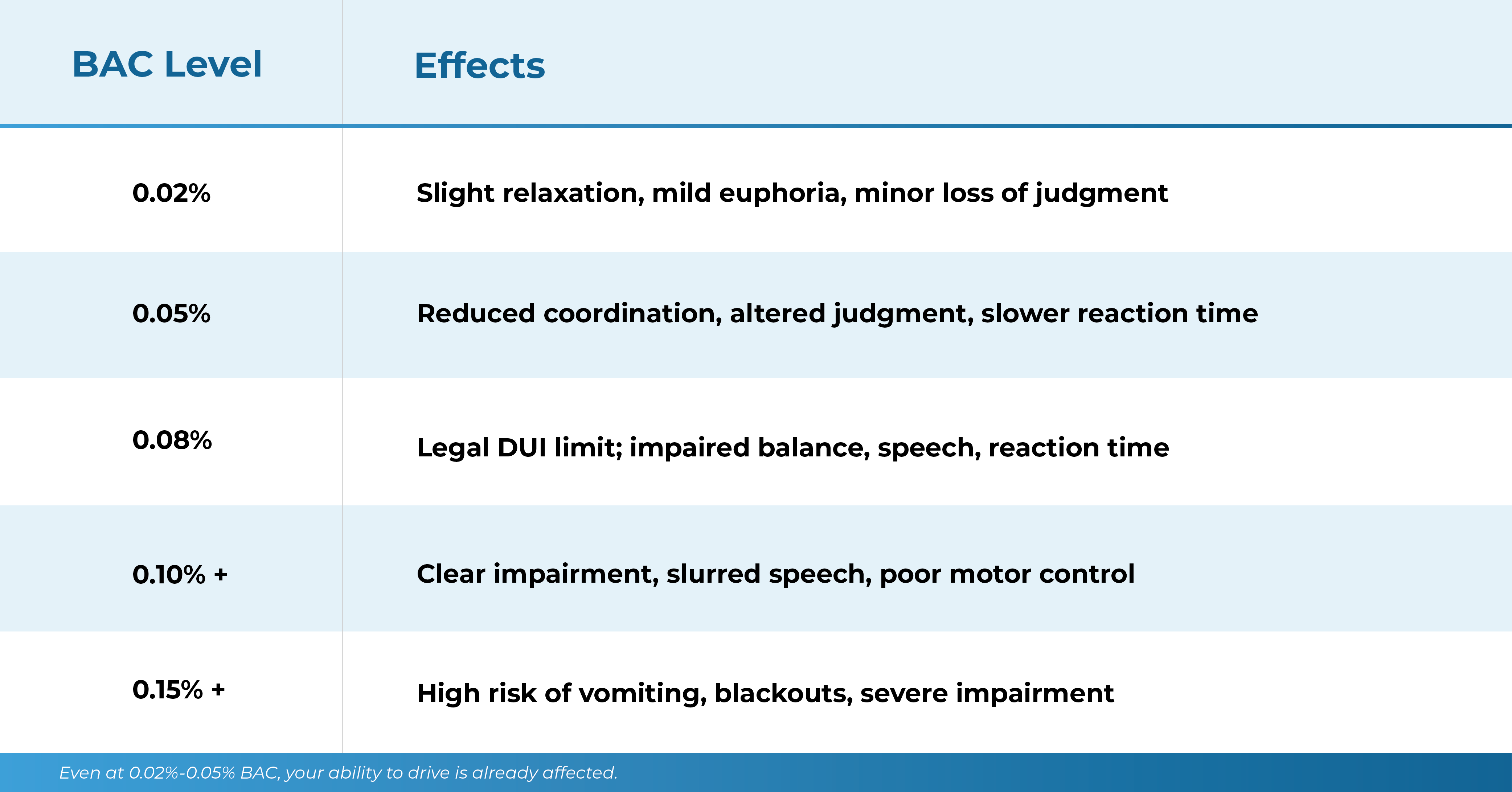
Blood alcohol concentration (BAC) influences not only how intoxicated you feel but also whether you’re legally too impaired to operate a vehicle.
BAC measures the amount of alcohol in the blood relative to the amount of water in the blood.
In the United States, a BAC of 0.08 grams per deciliter (g/dL) or higher is considered over the legal limit. Still, don’t use that number as your only guide to deciding whether to drive.
For one, 0.08 g/dL is actually higher than the 0.05 g/dL limit many European countries use.
Also, your driving performance can be compromised even well below the legal threshold, which could still get you into legal trouble.
Indeed, the National Highway Traffic Safety Administration reported that in 2018, 1,878 people died in alcohol-related collisions involving drivers with BACs under the legal limit in the United States.
Can I perform a sobriety check on myself?
If you came here hoping for a reliable way to tell whether you’re sober enough to drive, there’s bad news.
There’s no dependable method to self-assess your fitness to drive after drinking, even with a polished app on your phone.
Alcohol impairs judgement, so you’re not in a good position to judge your driving ability — or anyone else’s — after consuming alcohol.

A personal breathalyzer can show your BAC, but it only provides a number. (Keep in mind that a legal BAC reading doesn’t automatically mean it’s safe for you to drive.)
Because alcohol affects people differently, some may manage to drive safely at the legal limit while many others cannot.
The safest course is to avoid driving after drinking.
Is there any way to sober up faster?
How do you sober up quickly? You can’t. Sorry.
The web is full of tips and supposed cures for sobering up fast, but none are supported by solid scientific evidence.
The only thing that reduces your BAC is time, and the length of time required depends on the individual and the situation.
Your best options are to wait it out or prevent your BAC from rising too high to begin with.
The following strategies can help limit alcohol’s impact on your ability to drive the next time you drink:
- Decide on a drink limit before you start drinking.
- Give your body time to process alcohol by sipping (not gulping) and alternating alcoholic beverages with nonalcoholic ones.
- Choose drinks with lower alcohol percentages.
- Eat before drinking and snack while you drink.
The takeaway
If you’re unsure whether it’s safe to drive, play it safe and don’t drive.
With someone dying in a drunk-driving crash about every 50 minutes in the United States, the wisest move is to avoid getting behind the wheel after drinking.
Plan your ride home before you start drinking, use a rideshare or taxi, or give yourself time to sleep it off before you try to drive. If you’re wondering about how alcohol affects timing and when it kicks in, see how long does it take for alcohol to kick in.
Frequently Asked Questions
On average, the body processes roughly one standard drink per hour, but this varies by weight, sex, age, food, medications, and drinking speed.
No. Alcohol impairs judgment, so feeling “fine” is not a reliable indicator of fitness to drive and can lead to dangerous decisions.
No. Driving ability can be impaired well below legal limits; legal BAC is not the same as being safe to drive.
No. Nothing reliably speeds alcohol elimination — only time reduces your BAC. Food, rest, and hydration don’t lower BAC quickly.
Do not drive. Use a rideshare, taxi, public transit, or sleep it off. Plan alternatives before drinking to avoid risk.
Read Next
Fatty Upper Pubic Area (FUPA) Weight Loss and Medical Treatment

Rexulti (Brexpiprazole) Overview
What Are the Purported Benefits and Uses of PanAway Essential Oil?

10 Ways to Boost Serotonin Naturally and Without Medication

Does Having High Blood Pressure Cause Nosebleeds?

7 Easy Ways to Stretch Tight Glutes
Related Posts
All About Aristada
Oct 6, 2026 • 35 min read
Is It Possible to Be ‘Too Wet’? Is This Really a Turn-Off?
Sep 16, 2026 • 8 min read
What Is the Webster Method?
Aug 13, 2026 • 34 min read
Habba Syndrome: What It Is and What to Do About It
Aug 21, 2026 • 17 min read
Everything You Need to Know About Robotripping
Aug 8, 2026 • 30 min read