Measles Rash Pictures: What the Rash Looks Like Day by Day

- What does a measles rash look like?
- Measles rash day by day: the full timeline
- Koplik spots: the sign that comes before the rash
- Day 1–2: the rash starts on the face and moves down
- Day 3: the rash covers the whole body
- Day 4 and after: the rash fades — and leaves its mark
- How we chose the photos in this guide
- Measles rash vs other rashes: how to tell them apart
- Measles rash on darker skin
- How long is measles contagious?
- When to call a doctor: red flags with a measles rash
- What to do at home while the rash runs its course
- Can the measles rash be prevented?
- The bottom line
If you are searching for measles rash pictures, you probably want to answer one question fast: does this rash look like measles? The short answer is that a measles rash has a very specific pattern. It starts as flat red spots on the face, near the hairline, and then spreads downward — neck, trunk, arms, legs, feet — over about three days. The spots are a mix of flat red patches and small raised bumps, and as they spread they often merge into larger blotchy areas. One or two days before the rash appears, tiny white spots called Koplik spots show up inside the cheeks. That combination — head-to-toe spread, merging blotches, and Koplik spots — is what sets measles apart from almost every other childhood rash.
Why this matters now: measles is back in the United States in a big way. The CDC reported 5,182 confirmed cases in 2026 as of November 5, 2026 — the highest annual total since 1991, and more than double the 2,289 cases reported in all of 2025. Ninety-six percent of the 2026 cases were linked to outbreaks. Most cases are in people who were not vaccinated. The pictures and day-by-day guide below use CDC photographs and clinical descriptions, so you can compare what you see against the real thing.
What does a measles rash look like?
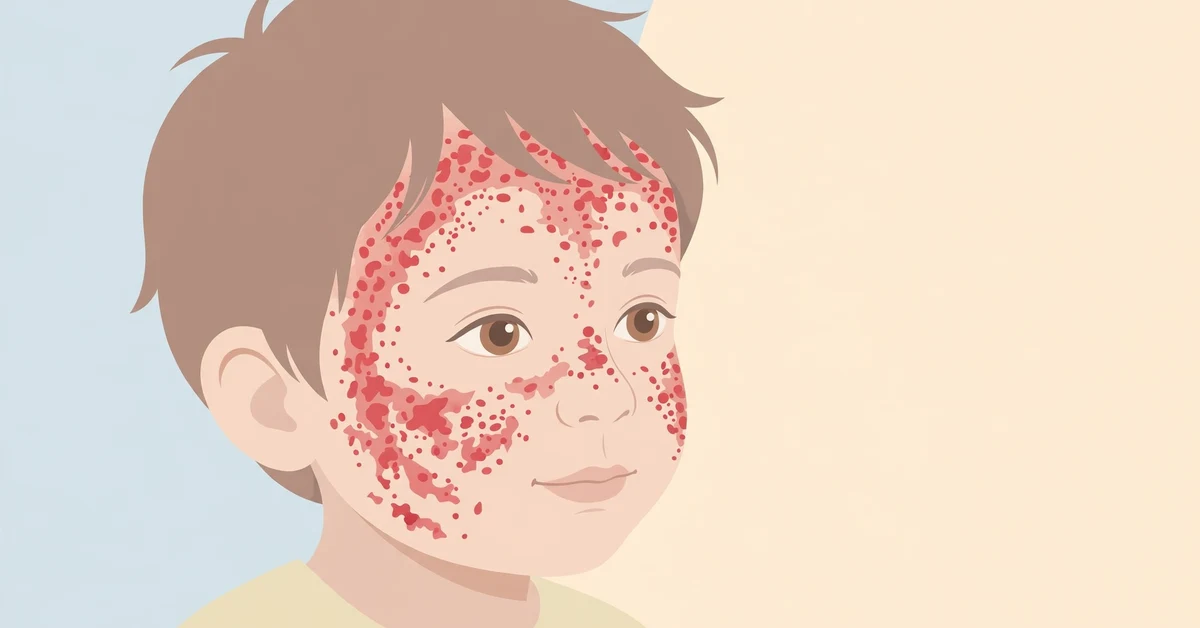
Doctors describe the measles rash as maculopapular. That is two words in one: macules are flat, discolored areas of skin, and papules are small raised bumps, both smaller than about 1 cm. On a measles patient you see both at once — flat red spots with small bumps sitting on top of them. The background skin between the spots stays its normal color at first. As the rash spreads, the individual spots merge, especially on the face and upper chest, and the skin can look almost solidly red.
Three details help you recognize it:
- It starts on the face. The first spots appear on the face at the hairline, and behind the ears. A rash that starts on the trunk and moves outward is less typical of measles.
- It moves from head to toe. Face first, then neck, trunk, arms, and finally legs and feet, over roughly three days. A rash that appears everywhere at once does not follow the measles pattern.
- It fades in the same order it appeared. The face clears first, then the trunk, then the legs. As it fades it often leaves brownish marks and a fine, flaky peeling that can last a week or more.
The rash itself usually does not hurt, though it can itch. What makes a child look and feel ill is everything that comes with it: a high fever that often peaks above 104°F (40°C) just as the rash appears, a hacking cough, a runny nose, and red, watery eyes. The CDC calls the cough, runny nose, and red eyes the “three Cs” — cough, coryza, and conjunctivitis. A child with measles usually looks miserable in a way that a child with a mild viral rash does not.
Measles rash day by day: the full timeline
Measles does not start with a rash. It starts with about 7 to 14 days of nothing at all after exposure — the incubation period — and then a flu-like illness that lasts 2 to 4 days before any spots appear. The table below is the whole course in one place. Under it, the photographs show what each stage actually looks like.
| Stage | When | What you see |
|---|---|---|
| Exposure, no symptoms | Days 0–14 | No symptoms. Symptoms usually begin 7 to 14 days after infection. |
| Prodrome (flu-like illness) | 2–4 days | High fever, cough, runny nose, red watery eyes. Fever often climbs above 104°F. |
| Koplik spots | 1–2 days before the rash | Tiny white spots on a red background inside the cheeks — the earliest sign, and one of the most specific. |
| Rash day 1 | 3–5 days after symptoms start | Flat red spots on the face at the hairline, behind the ears, and on the neck. |
| Rash day 2 | 24 hours later | Spreads to the trunk and upper arms. Spots begin to merge on the face and chest. |
| Rash day 3 | 48 hours later | Reaches the legs and feet. The rash is now all over the body; fever is still high. |
| Fading | Rash days 4–6 | Fades in the same order it appeared — face first. Fever falls. Brownish marks and fine peeling can follow for up to 7–10 days. |
Koplik spots: the sign that comes before the rash
Koplik spots are the most useful early clue in measles, and the one most photo galleries show badly or skip entirely. They are tiny white or blue-white spots, like grains of salt, sitting on a red background on the inside of the cheeks. They usually appear 1 to 2 days before the skin rash, around the second or third day of the illness, and they fade once the rash is out. Spots like these do not occur in rubella, scarlet fever, roseola, or chickenpox — which is why doctors treat them as a strong sign of measles even before any skin rash appears.
To check for them, look inside the cheek in good light, opposite the back teeth. They are small and easy to miss, and a child who feels awful may not cooperate — but if you can see them alongside a high fever, cough, and red eyes, treat the illness as measles until a doctor says otherwise.

Day 1–2: the rash starts on the face and moves down
On the first day of the rash, the spots are mostly on the face and neck: flat red spots at the hairline, around the ears, and down the sides of the neck. The fever, already high for two or three days, often spikes again as the rash comes out — usually the sickest day. By the second day the rash has spread to the trunk and upper arms, and the spots on the face and chest start to run together into larger red patches.
That downward march is the single most recognizable feature of measles. Rubella also spreads downward, but its rash is finer, its fever is low, and it has no Koplik spots. Scarlet fever spreads too, but it feels like sandpaper and comes with a strawberry-red tongue. A rash that is already everywhere on day one, or started on the hands and feet, is unlikely to be measles.
Day 3: the rash covers the whole body
By the third day the rash has usually reached the legs and feet, so it covers the body from head to toe. The spots are at their most merged on the face and upper body, and the skin can look almost uniformly red there. The photographs below are both from the third day of the rash — the first shows the classic red blotchy pattern across the back, the second a closer view of the skin itself, where you can see flat red areas with small raised bumps on top.


Day 4 and after: the rash fades — and leaves its mark
From the fourth day the rash begins to fade, in the same order it appeared: the face clears first, then the trunk, then the legs. The fever usually falls as the rash fades. The photograph below shows a classic day-4 rash — still widespread, but already starting to lose its bright red color on the face.

After the redness goes, the skin often keeps a brownish stain where the rash was, and a fine, bran-like peeling can follow for up to 7 to 10 days. The brown marks fade on their own over the following weeks. Peeling and brown marks are normal parts of healing — they do not mean the illness is getting worse, as long as the fever is down and the child is drinking and alert.
How we chose the photos in this guide
Every photograph here is a public-domain image from the CDC’s Public Health Image Library, captioned with the day of the illness it shows: Koplik spots before the rash, the day-3 rash on the back and up close, and the day-4 rash across the whole body. No stock photos, no illustrations standing in for real cases. The one diagram — the contagious-period chart below — is shared under a Creative Commons license and credited under it. If a photo and your rash do not line up, trust the timeline and the fever pattern more than any single picture: measles is diagnosed by the whole course of the illness, not by one spot.
Measles rash vs other rashes: how to tell them apart
Many childhood rashes look red and blotchy at a glance. What separates them is the pattern: where the rash starts, how fast it spreads, what the fever is doing, and what else is happening in the mouth and eyes. Use the table below as a first check — it does not replace a doctor, but it tells you which possibilities fit and which do not.
| Rash | What it looks like | The clue that separates it from measles |
|---|---|---|
| Measles | Red blotchy spots, flat and raised, starting on the face and spreading head to toe over ~3 days | Koplik spots inside the cheeks + high fever with cough and red eyes |
| Rubella (German measles) | Fine pink rash, face first then down, spares palms and soles | Low-grade fever, no Koplik spots, much milder illness; dangerous in pregnancy |
| Scarlet fever | Red rash that feels like sandpaper, worse in skin folds; strawberry-red tongue | Sandpaper texture + sore throat + strawberry tongue; caused by strep bacteria, treated with antibiotics |
| Roseola | Pink spots on the trunk after a high fever suddenly breaks | Rash appears as the fever falls — the opposite order from measles; usually in children under 2 |
| Chickenpox | Itchy blisters in crops — spots, blisters, and scabs all present at once | Fluid-filled blisters that itch intensely; measles spots are flat or solid bumps, not blisters. See our chickenpox stages pictures for comparison. |
| Shingles | Painful blistery band on one side of the body or face | Stays on one side and does not cross the midline; burning pain comes first. See our shingles pictures. |
| Drug rash | Widespread red, often itchy rash | Starts days after a new medicine; no Koplik spots, no 3 Cs; stop the drug only on a doctor’s advice |
| Heat rash | Clusters of small red bumps in sweaty or folded areas | No fever, no cough, no mouth spots; appears in heat and fades as the skin cools |
Two cautions. First, a single photo can mislead: lighting, skin tone, and the day of the illness all change how a rash photographs. Second, some rashes need same-day care for other reasons — purple spots that do not fade when pressed, blisters with yellow crusts, or a rash with a stiff neck and light sensitivity. When in doubt, call a doctor rather than spending another hour comparing pictures.
Measles rash on darker skin
On darker skin, the redness of a measles rash can be much harder to see — and most photo galleries, including the CDC’s, show mainly lighter skin. That does not mean the rash is absent; look for different signs instead:
- Texture over color. Run a hand lightly over the skin. The raised bumps of a measles rash can be felt even when the redness is faint, and the skin may feel rougher or slightly swollen where the rash is.
- The pattern, not the shade. The head-to-toe spread and the merging blotches still apply. Look at the face and neck first, then compare with the trunk and legs.
- The rest of the illness. High fever, cough, red eyes, and Koplik spots do not depend on skin tone. If those are present with any rash, the measles pattern fits regardless of how red the spots look.
- Photograph in good light. Take a dated photo each day in daylight, from the same angle. A series of photos shows the spread and the fading far better than one picture, and it gives your doctor or health department a timeline to work from.
For other rashes on the legs and feet, and for what different rash patterns look like across skin tones, see our guide to pictures of skin rashes on the lower legs.
How long is measles contagious?
Measles is one of the most contagious diseases known — it spreads through the air when an infected person coughs or sneezes, and the virus can linger in the air for up to two hours after they leave a room. A person with measles is contagious from about 4 days before the rash appears until 4 days after the rash shows up. That is the cruel part: people spread it for days before anyone can see a rash.

The CDC advises staying home from school or work until at least 4 days after the rash first appears — in practice, that means returning on the fifth day after the rash starts. The same rule applies to siblings and close contacts who are not immune: they should stay home too and call their doctor or health department rather than turning up at a clinic unannounced. If you think someone has measles, call ahead before going anywhere for care, so the clinic can keep them out of a shared waiting room. About 9 in 10 people who are not immune and come into close contact with a measles patient will catch it.
When to call a doctor: red flags with a measles rash
Most measles cases get better at home in about a week, but measles is not a mild illness. In the United States, about 1 in 5 unvaccinated people who get measles needs hospital care, about 1 in 1,000 develops swelling of the brain (encephalitis), and 1 to 3 in 1,000 die. Pneumonia is the most common cause of measles-related death in children. Call a doctor the same day if you see a rash that fits the measles pattern, and seek urgent care for any of these:
- Trouble breathing, fast breathing, or a cough that keeps getting worse
- Signs of dehydration: very little urine, dry mouth, dizziness, or a baby with a sunken soft spot
- Extreme sleepiness, confusion, difficulty waking, or a seizure
- Fever above 104°F (40°C) that does not come down with fever medicine
- A rash that turns purple, blisters, or peels in sheets, or skin that is very painful to touch
- Red eyes that become swollen shut or sensitive to light
- The patient is pregnant, has a weak immune system, or is under 12 months old
Call your local health department as well. Measles is a reportable disease in the United States, and the health department will tell you who needs testing and who needs a vaccine or protective antibodies after exposure — especially important for babies under 12 months, pregnant people, and people with weak immune systems, who cannot simply be vaccinated after the fact.
What to do at home while the rash runs its course
There is no medicine that kills the measles virus. Care at home is about keeping the fever down, keeping fluids up, and watching for complications:
- Fever and pain: acetaminophen (Tylenol) or ibuprofen (Advil, Motrin) as directed for the child’s age and weight. Never give aspirin to a child or teenager with a viral illness — it is linked to Reye’s syndrome, a rare but serious condition.
- Fluids: small, frequent sips of water, oral rehydration drinks, or popsicles. The fever and the illness make dehydration the most common problem at home.
- Rest and dim light: the eyes are sore and light-sensitive, so keep the room dim and screens off.
- Skin care: lukewarm baths, plain moisturizer, and short nails help with itching. Avoid harsh soaps and scrubbing.
- Vitamin A: in hospitals, children with measles are sometimes given vitamin A — the American Academy of Pediatrics recommends it for hospitalized children, because it can lower the risk of severe disease. It is a hospital treatment, not something to dose at home.
- Isolation: keep the patient in one room, away from anyone who is not immune, and follow the 4-day-after-rash rule above.
Can the measles rash be prevented?
Yes — with the MMR vaccine, which covers measles, mumps, and rubella. One dose is about 93% effective against measles, and two doses are about 97% effective, according to the CDC. Children in the United States normally get the first dose at 12 to 15 months and the second at 4 to 6 years. Adults who are not sure of their immunity can have a blood test, or simply get a dose — there is no harm in an extra MMR dose for most adults, and your doctor can advise.
After an exposure, vaccination within 72 hours can still prevent the illness or make it milder, and immune globulin can help babies, pregnant people, and people with weak immune systems — but both need to happen fast, which is another reason to call a doctor the same day you suspect measles.
The bottom line
A measles rash is a red, blotchy, flat-and-raised rash that starts on the face at the hairline and spreads from head to toe over about three days, then fades in the same order — usually with Koplik spots inside the cheeks one or two days before it appears, and a high fever with cough and red eyes alongside. No photo on its own can confirm measles, but a photo series matched against that timeline, plus the fever pattern, gets you most of the way there. With 5,182 confirmed US cases in 2026 as of early November — the most since 1991 — the rash is something more parents will see in real life. If the pattern fits, call a doctor and your health department the same day, keep the patient isolated, and check vaccination records for everyone in the household.
Medical disclaimer: This article is for general information only and is not medical advice. It cannot diagnose measles or any other condition. If you think you or your child may have measles, contact a doctor or your local health department promptly. In an emergency, call 911.
Sources: CDC — Signs and Symptoms of Measles ; CDC — Photos of Measles ; CDC — Measles Cases and Outbreaks (2026 data) ; MedlinePlus — Measles ; StatPearls (NCBI) — Measles ; HealthyChildren.org (AAP) — Measles.
Frequently Asked Questions
On the first day, the rash is flat red spots on the face at the hairline, behind the ears, and on the sides of the neck. The spots are small at first and the fever is usually at its highest — often above 104°F (40°C). By the second day the rash spreads to the trunk and upper arms.
The rash itself usually lasts 4 to 7 days. It spreads from head to toe over about 3 days, then fades in the same order it appeared over the next 2 to 3 days. Brownish marks and fine peeling can linger for up to 7 to 10 days after the redness is gone.
Koplik spots are tiny white or blue-white spots on a red background inside the cheeks. They appear 1 to 2 days before the measles skin rash and are one of the most specific signs of measles — they do not occur in rubella, scarlet fever, roseola, or chickenpox.
A person with measles is contagious from about 4 days before the rash appears until 4 days after the rash shows up. The CDC advises staying home from school or work until at least 4 days after the rash first appears — in practice, returning on the fifth day after the rash starts.
It can itch, but itching is usually mild. The rash itself does not hurt. Lukewarm baths, plain moisturizer, and short nails help. A very itchy blistery rash is more typical of chickenpox than measles.
Rubella (German measles) causes a finer pink rash that also starts on the face and spreads down, but the fever is low-grade, there are no Koplik spots, and the illness is much milder. Measles brings a high fever, cough, red eyes, and Koplik spots. Rubella is most dangerous in pregnancy.
Yes. Adults who were never vaccinated or never had measles can catch it, and adults often get sicker than children — they are more likely to be hospitalized. Adults unsure of their immunity can get a blood test or an MMR dose; the CDC notes one dose is about 93% effective and two doses about 97% effective.
Call your doctor and your local health department the same day — do not walk into a clinic waiting room unannounced, because measles spreads through the air. Take a dated photo of the rash each day and note when the fever started. Keep the child isolated at home until at least 4 days after the rash first appears.
Read Next
Staph Infection Pictures: What Staph Looks Like and How to Tell It From Cellulitis

Impetigo Pictures: What Impetigo Looks Like on the Face and Body
Hand, Foot and Mouth Disease Pictures: What the Rash Looks Like at Each Stage
Hives in Pictures: What Urticaria Looks Like on Real Skin
Heat Rash (Prickly Heat) Pictures: The 3 Types and How to Tell Them Apart

Hernias by Picture
Related Posts
Folliculitis Pictures: What Infected Hair Follicles Look Like on Each Body Area
Nov 10, 2026 • 27 min read
What Causes Peau D’Orange?
Aug 23, 2026 • 28 min read
Chickenpox Stages in Pictures: The Rash Day by Day, From First Spots to Scabs
Nov 11, 2026 • 15 min read
Tick Bite Pictures: What Tick Bites and Lyme Rashes Actually Look Like
Nov 11, 2026 • 24 min read
Why Is My Sweat Salty? The Science Behind Sweat
Aug 27, 2026 • 23 min read