Stretches and Exercises to Help Ease SI (Sacroiliac) Joint Pain

Moves such as the knee-to-chest and trunk rotation stretches can ease discomfort from the sacroiliac (SI) joint. A physical therapist can also prescribe specific exercises to fortify the surrounding muscles.
It’s estimated that about 25% of lower back pain instances are linked to irritation of the SI joint.
Certain stretches and exercises may reduce SI joint pain by loosening tight muscles that increase strain on these joints. Tightness in muscles around the back, hips, buttocks, thighs, and core can all play a role in SI joint discomfort.
What are SI joints?
You have an SI joint on each side of the lower spine. Specifically, these joints sit where the flat bone at the base of the spine (the sacrum) connects with the ilium, or hip bone.
SI joint irritation commonly presents as pain in the lower back, buttocks, or down the legs.
There are several causes of SI joint pain, including :
- injury
- osteoarthritis
- sudden or repetitive heavy lifting
- ankylosing spondylitis
- SI joint dysfunction
SI joint pain is also frequently seen during pregnancy because the body produces higher levels of the hormone relaxin. Relaxin makes joints more flexible to allow the pelvis to widen for childbirth.
Although pregnancy commonly contributes to SI pain, the mechanism here is hypermobility — or “excess motion.” In that situation, stretching might not be helpful and could worsen symptoms.
Stretches and exercises for SI joint pain
Loosening the muscles around your SI joint with stretching can help relieve tension. That may reduce lower back tightness and make movement easier and less painful.
Try to devote a few minutes each day to stretching. Even performing a couple of stretches once or twice daily can be beneficial.
If your SI joint pain persists despite gentle stretching, consider consulting a physical therapist.
Stretching and exercise safety
If any stretch or exercise triggers sharp pain, numbness, or tingling, stop immediately and seek medical evaluation for your SI joint pain.
Stretches may produce mild discomfort, but they should never cause significant pain.
It’s advisable to talk with a healthcare provider before beginning a new exercise plan if you have existing conditions such as a herniated disc or osteoporosis.
1. Knee-to-chest stretch
The knee-to-chest stretch helps lengthen the hip muscles. If you can’t reach your knee, loop a strap or band behind it to assist.

To perform this stretch:
- Lie on a mat or other comfortable surface.
- Hold your left knee and draw it toward your chest until you feel a stretch in the back of your leg.
- Hold for up to a minute, then switch sides.
2. Knees-to-chest stretch
The double knee-to-chest stretch can ease SI joint discomfort by releasing tension in the lower back, hamstrings, and hips.
If reaching is difficult, try using a strap behind your knees for assistance.

To perform this stretch:
- Lie on your back on a comfortable surface.
- Cradle both knees and pull them toward your chest as far as possible while keeping your back on the floor.
- Hold for up to a minute.
3. Figure-4 stretch
The figure-4 stretch addresses multiple muscle groups at once. You’ll typically feel it in the outer hip and glutes. Use a strap if reaching your knee is challenging.

To perform this stretch:
- Lie on your back with knees bent and feet flat on the floor.
- Place your right ankle just above your left knee.
- If possible, lift your left leg and gently draw it toward your chest until you feel a stretch.
- Hold for up to a minute, then repeat on the opposite side.
4. Trunk rotation stretch
Trunk rotations stretch the muscles along the sides of your core. Only rotate as far as feels comfortable and stop if you encounter sharp pain, numbness, or tingling.

To perform this stretch:
- Lie on the floor with feet flat and arms extended out to the sides in a T-shape. Keep knees together and pointed upward.
- With your shoulders pressed to the floor and knees together, lower both knees to one side as far as is comfortable.
- Repeat on the other side and perform about 10 rotations per side.
5. Quad stretch
The quad stretch targets the quadriceps at the front of your thigh. Don’t force your heel to your buttocks if it’s uncomfortable; bring it only as close as is comfortable.
You can hold a chair or wall for balance if needed.

To perform this stretch:
- Stand upright. Use a chair or wall if you need support for balance.
- Reach back and hold your left ankle, drawing your foot toward your butt with the knee pointing down.
- Hold for up to a minute, then switch sides.
6. Adductor squeeze
The adductor squeeze is an exercise rather than a stretch. It gently works the muscles near the SI joint to reduce stiffness.
You’ll need a small ball such as a Pilates ball or a similarly sized object.
Do 2 to 3 sets of about 10 repetitions per set.

To perform this exercise:
- Lean back supported on your elbows with knees bent about 90 degrees. Place a ball between your knees.
- Squeeze the ball as firmly as is comfortable and hold for about 3 seconds.
- Release and repeat for 10 reps.
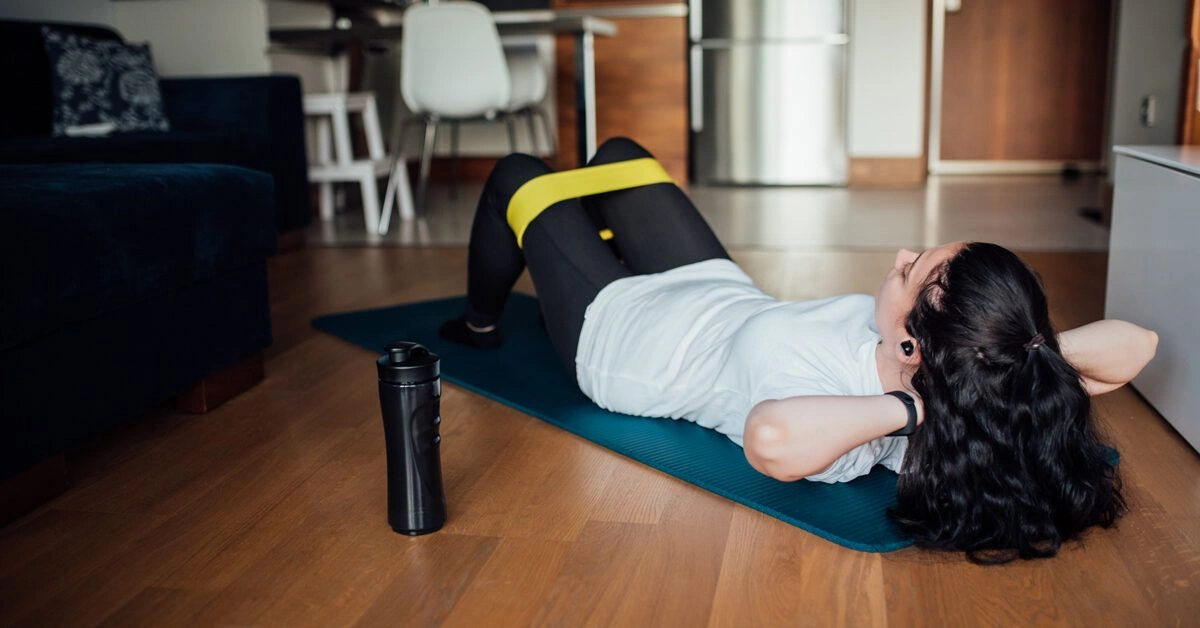
7. Band abduction
This movement is an exercise rather than a stretch and can help decrease stiffness around the SI joint.
Use a loop resistance band—choose a lighter band that won’t strain your lower back.
Perform 2 to 3 sets of 10 repetitions.

To perform this exercise:
- Lie on your back with knees bent to about 90 degrees and feet flat on the floor. Place a band around your knees.
- Press your knees outward apart and pause briefly.
- Return and repeat for 10 reps.
What else can help?
Alongside regular stretching, these habits can also lessen or prevent SI joint pain.
- Limit prolonged sitting: Sitting too long can stiffen your back and worsen SI joint pain. Aim to stand, move, stretch, or take a short walk every 50 to 60 minutes.
- Adjust your sitting posture: Sit so your hips are level and your sit bones are in contact with the chair to avoid straining SI ligaments. Keep knees slightly apart and avoid crossing legs. Often the SI joint fares better when hips sit slightly above the knees to preserve the natural lumbar curve.
- Strengthen your glutes:Evidence indicates that strengthening the gluteal muscles can help those with persistent SI joint pain and weak glutes.
- Alternate heat and cold: To manage pain and boost circulation, try switching between heat and ice for 15–20 minutes at a time.
- Consider physical therapy if symptoms persist: A physical therapist can build a tailored program to help control SI joint pain.
When to get medical help
Some SI joint issues require evaluation and treatment by a physician.
If your SI joint pain is severe or worsening — whether at rest or with activity — consult an orthopedist. These specialists evaluate and treat conditions affecting bones, joints, and muscles.
They may order imaging to view internal structures and guide further treatments such as targeted physical therapy or medications.
Takeaway
Stretching the muscles around the SI joint can help ease pain by relieving lower back tension.
When stretching, err on the side of gentleness rather than force. Overly aggressive stretching can tighten muscles and aggravate symptoms.
For chronic SI joint pain, a physical therapist can design a personalized stretching and strengthening plan to address your needs.
Frequently Asked Questions
Begin with gentle moves such as knee-to-chest, knees-to-chest, and figure-4 stretches. These target hips, glutes, and lower back without excessive strain.
Try a few minutes daily or perform selected stretches once or twice a day. Consistency matters more than duration; stop if sharp pain occurs.
Yes — if your SI joint pain is due to hypermobility (excessive movement), stretching may increase instability and worsen symptoms. Stop stretches that cause sharp pain and consult a professional.
Seek medical help if pain is severe, worsening, or accompanied by numbness or tingling. A physical therapist can tailor exercises and address underlying causes.
Yes. Strengthening exercises like adductor squeezes, band abduction, and targeted glute strengthening can reduce stiffness and support the SI joint.






Related Posts

Pregnancy Rib Pain: Causes, Prevention, Remedies
Sep 19, 2026 • 17 min read
12 Spinal Decompression Exercises for All Skill Levels
Sep 21, 2026 • 34 min read
6 Foam Roller Exercises for Your Back
Sep 16, 2026 • 32 min read
10 Back Exercises with Bands to Counteract Work-from-Home Posture
Sep 14, 2026 • 17 min read
The 9 Best Couches for Good Posture and a Healthy Back
Sep 30, 2026 • 30 min read