What Does a Positive TB Test Look Like? Photos, Sizes, and What It Means

- What a Positive TB Skin Test Looks Like
- The One Mistake Almost Everyone Makes: Measuring the Redness
- What a Negative TB Test Looks Like
- How the Test Is Read and Measured
- How Big Does the Bump Have to Be? The 5, 10, and 15 mm Cutoffs
- Read Your Own TB Skin Test: Interactive Checker
- What Does a Positive TB Blood Test Look Like?
- Positive Does Not Mean You Have Active TB
- False Positives and False Negatives
- What Happens Next After a Positive TB Test
- When to Call Your Doctor Sooner
- The Bottom Line
Two days after the tiny needle prick in your forearm, you roll up your sleeve and stare at the spot. There is something there — a patch of red skin, maybe a bump, maybe just your imagination. Is that a positive TB test? Or is that just what a needle mark looks like after two days? If you have ever stood in a bathroom mirror poking at your own arm and Googling photos, you are not alone. This is one of the most searched questions about tuberculosis testing, and the answer is more specific than most people expect.
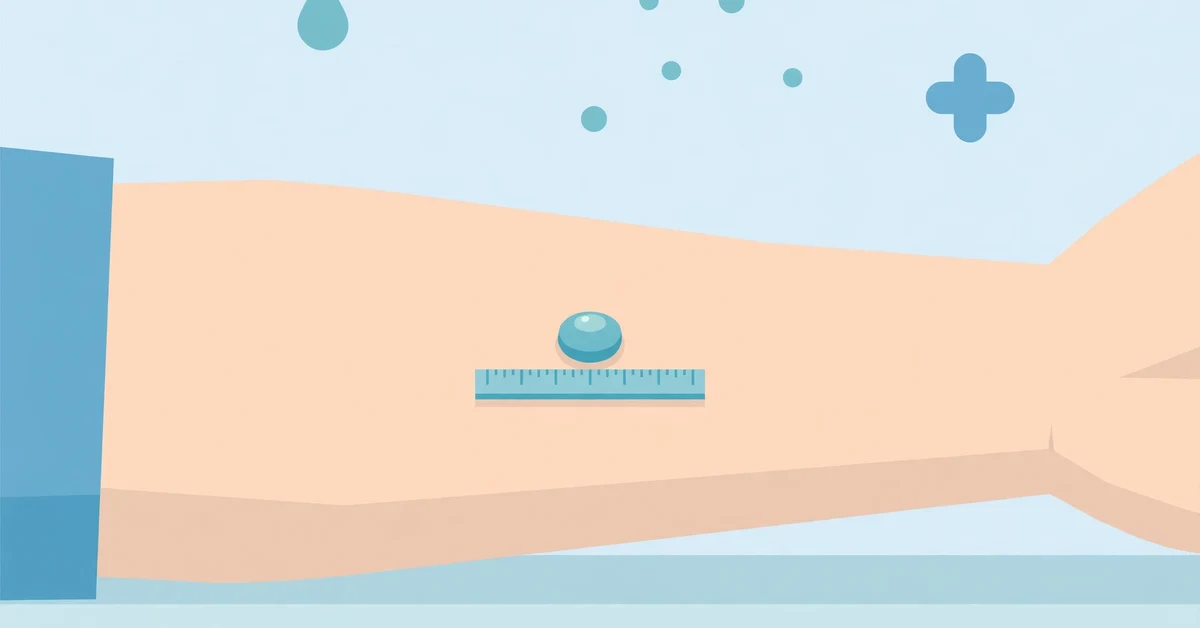
A positive TB skin test does not look like a rash. It does not look like a bruise. It looks like a firm, raised bump — and the size of that bump, measured in millimeters, is what decides the result. Redness does not count. Itching does not count. Only the hard, raised part matters, and only a trained health worker should read it.
What a Positive TB Skin Test Looks Like
The test most people mean when they ask this question is the tuberculin skin test, also called the Mantoux test or PPD test. A clinician injects a tiny amount of tuberculin — a protein extract from the TB bacterium — just under the skin of your inner forearm. The injection itself leaves a small, pale, raised bump called a wheal, about 6 to 10 millimeters wide, which fades within minutes.
Then you wait. You come back 48 to 72 hours later, and a trained reader examines the spot. If your immune system has met TB bacteria before, it reacts at the injection site. That reaction is called induration: a firm, raised area of skin that you can feel with a fingertip, a bit like a small, hard button pressed just under the surface.
- A firm, raised bump. The skin over the injection site is visibly raised and feels hard or dense when you press it gently. It is usually round or oval, with edges you can trace with a fingertip.
- Often red, but not always. The area may be pink or red, warm, or mildly itchy. Some positive reactions are barely red at all — the bump is pale or close to your normal skin tone.
- Sometimes dramatic. A strongly positive reaction can be large, swollen, and sore, and in rare cases it blisters. A blister is a sign of a very strong immune reaction, not a sign that you are contagious, but show it to the reader promptly.

The photo above is a real positive test, photographed by the CDC. Notice that the reaction is a distinct, raised patch — not a faint smudge of redness. That raised quality is the whole point. When a clinician reads your test, they are not judging how red your arm looks. They are feeling for that hard, raised area and measuring it.
The One Mistake Almost Everyone Makes: Measuring the Redness
If there is a single thing to take away from this article, it is this: redness does not count. The medical term for redness is erythema, and the CDC is explicit that erythema should not be measured. Only induration — the firm, raised swelling — is measured.
That trips people up for a good reason. A red patch can look alarming and can spread well beyond the bump. But redness alone, even a wide patch of angry-looking red skin with no raised bump underneath, is generally not a positive result. On the flip side, a firm bump with almost no redness can be positive. The two things simply do not track each other.
This is also why you should not try to read your own test. Feeling the edges of an induration takes practice, and the difference between a 4 mm bump and a 6 mm bump can change the result for someone in a high-risk group.
What a Negative TB Test Looks Like
A negative skin test is visually boring, which is exactly what you want. When you return for the reading, you might see a tiny dot where the needle went in, or a faint pink mark. There is no raised, firm bump to measure. The induration is either completely absent — recorded as 0 mm — or too small to cross the threshold for your risk group.
That does not always mean you have never met TB bacteria. A negative result usually means no infection, but the test can miss an infection that is very recent (less than 8 to 10 weeks old), or one in a person whose immune system cannot mount a strong skin reaction — for example, someone with advanced HIV or on high-dose steroids. If your doctor still suspects TB, they may order a blood test or repeat the skin test later.
How the Test Is Read and Measured
The reading happens 48 to 72 hours after the injection. The reader looks at your forearm in good light, then runs a fingertip across the site to feel for the induration. They mark the widest edges of the firm area with a pen, then measure between the marks with a small millimeter ruler, straight across your forearm.
A few details of the reading are worth knowing:
- Timing matters. Read too early and the reaction may not have peaked. Read too late — after about 72 hours — and it may already be fading. If you miss the window, the test usually has to be repeated.
- The measurement is across the forearm, not along it, and it is the diameter of the induration in millimeters.
- Do not scratch, cover, or press the site before the reading. Scratching can cause swelling that muddies the result, and a bandage or tight sleeve can irritate the spot.
How Big Does the Bump Have to Be? The 5, 10, and 15 mm Cutoffs
There is no single number that separates positive from negative for everyone. The CDC uses three cutoffs, and which one applies to you depends on your risk of TB infection and of becoming seriously ill if infected. A smaller bump counts as positive in someone at higher risk.
| Induration size | Counts as positive for |
|---|---|
| 5 mm or more | People living with HIV; recent close contacts of active TB cases; people with old, healed TB on chest X-ray; organ transplant recipients and others on immune-suppressing medicines. |
| 10 mm or more | People who arrived in the past 5 years from a country where TB is common; people who inject drugs; residents and workers in hospitals, nursing homes, prisons, or shelters; TB lab workers; people with diabetes or kidney failure; children under 4. |
| 15 mm or more | People with no known risk factors for TB. |
So a 7 mm bump is positive for a nurse who works on a TB ward and for someone whose partner was just diagnosed with active TB — but it is negative for a healthy adult with no risk factors, who needs 15 mm. Same arm, same bump, different answer. That is why the reader always asks about your history before calling the result. According to the CDC, a positive skin test means your body has been infected with TB bacteria at some point. It does not, on its own, tell you whether the infection is latent or active — that takes more testing.
Read Your Own TB Skin Test: Interactive Checker
Use this checker to get a rough idea of what your reading might mean. Enter the induration size your clinician measured — the firm bump in millimeters, not the redness — and pick the risk group that fits you best. This is an educational guide only. It does not replace the official reading by your health worker.
What Does a Positive TB Blood Test Look Like?
Not every TB test leaves a mark on your arm. The blood test — an interferon-gamma release assay, or IGRA, sold as QuantiFERON-TB Gold Plus or T-SPOT.TB — works differently. A sample of your blood goes to a lab, where technicians check whether your immune cells react to TB proteins. There is nothing to look at on your body, and no bump to measure. On a lab report, a positive IGRA appears as a plain line of text: “Positive”, sometimes with a number. For QuantiFERON, 0.35 IU/mL or higher is generally positive. For T-SPOT.TB, 8 or more spots is usually positive. An “Indeterminate” result means the test did not work properly and should be repeated.
Blood tests have one practical edge over skin tests: they are not affected by the BCG vaccine. If you received BCG as a child — common in many countries outside the United States — a skin test can come back positive from the vaccine alone, while a blood test will not. That is why the CDC notes that IGRAs are often preferred for people who have had BCG. If you want the backstory on that vaccine, our guide to the tuberculosis vaccine and its surprising second career in cancer care explains where BCG comes from and why it still matters.
Positive Does Not Mean You Have Active TB
This is the part that worries people most, and it deserves to be said plainly: a positive TB test most often means latent TB infection, not active TB disease. Latent infection means TB bacteria are in your body but asleep. You feel fine, you have no symptoms, and you cannot spread TB to anyone else. The CDC estimates that about 13 million people in the United States live with latent TB infection, and most will never develop active disease.
Active TB disease is a different story. The bacteria are awake and multiplying, usually in the lungs, and the person can feel ill and can spread the infection through coughing. Signs include a cough lasting three weeks or more, coughing up blood or mucus, chest pain, unexplained weight loss, fever, and night sweats. A persistent low-grade fever that lingers for weeks, especially with night sweats, is one symptom doctors take seriously when TB is on the list of suspects. Only further testing can tell latent infection apart from active disease.
False Positives and False Negatives
TB tests are good, but they are not perfect. A false positive means the test says positive when there is no TB infection. The most common cause is the BCG vaccine, which can keep skin tests positive for years after vaccination. Infection with nontuberculous mycobacteria — harmless cousins of the TB bacterium found in soil and water — can also cause a small positive reaction. That is one reason a low-risk person needs a full 15 mm before the result counts.
A false negative means the test says negative when infection is present. This can happen when the infection is very recent and the immune response has not developed yet, when the test is read too early or too late, or when the immune system is too weak to react — advanced HIV, high-dose steroids, chemotherapy, or severe malnutrition can all blunt the reaction. In those situations, a doctor may order a blood test or repeat the test later.
What Happens Next After a Positive TB Test
A positive result sets off a short chain of routine follow-up steps.
- A medical history and symptom check. Your clinician will ask about cough, fever, night sweats, weight loss, and any recent contact with someone who has TB.
- A chest X-ray. This is usually the next step. A normal X-ray with a positive skin test generally points to latent TB infection. An abnormal X-ray raises the question of active disease.
- Sputum tests, if active TB is suspected. If you have a cough, the lab examines mucus samples for TB bacteria. This is the test that confirms active, contagious TB.
- Treatment for latent TB, if that is the finding. Treating latent infection stops it from waking up later. Modern regimens are much shorter than the old nine months of daily pills — the CDC notes that some courses now run as little as 12 weekly doses or 3 to 4 months.
- Treatment for active TB, if that is the finding. Active TB is treated with a combination of antibiotics, usually for at least six months. It is curable, and people generally stop being contagious within a few weeks of starting treatment.
When to Call Your Doctor Sooner
Most skin test reactions settle down on their own within a week. But call your clinician promptly if you notice blistering or broken skin at the test site, swelling that spreads well beyond the injection area, or signs of infection such as pus or red streaks running up your arm. A fever, trouble breathing, or a widespread rash after the test is rare but needs urgent care.
The Bottom Line
A positive TB skin test looks like a firm, raised bump on your forearm two to three days after the injection — not a red patch, not an itch, and not the needle mark itself. The bump is measured in millimeters, and whether it counts as positive depends on your risk: 5 mm, 10 mm, or 15 mm. A positive result usually means latent TB infection, not active disease, and it leads to a chest X-ray and a conversation about preventive treatment. If your arm is doing something that worries you, keep the reading appointment, let a trained worker measure the bump, and ask every question you have. That is what the appointment is for.
Sources: Centers for Disease Control and Prevention (CDC), “Tuberculin Skin Testing” fact sheet and “Testing for Tuberculosis” guidance; National Health Service (NHS), “The Mantoux test: Administration, reading and interpretation”; Mayo Clinic, “Tuberculosis — Diagnosis and treatment”; MedlinePlus, “TB skin test”.
Disclaimer: This article is for educational purposes only and does not constitute medical advice. Always consult a qualified healthcare provider about your test results or symptoms.
Frequently Asked Questions
A positive TB skin test looks like a firm, raised bump called an induration at the injection site on your forearm, usually appearing 48 to 72 hours after the test. It may be red and mildly itchy, but the redness does not count toward the result. Only the hard, raised part is measured, and the size that counts as positive depends on your risk group: 5 mm, 10 mm, or 15 mm.
No. Redness alone, even a wide red patch with no raised bump underneath, is generally not a positive result. The CDC states that only induration, the firm raised swelling, should be measured. Redness without induration does not count, and a firm bump with almost no redness can still be positive.
A negative TB skin test looks like almost nothing: a tiny dot where the needle went in, or a faint pink mark, with no raised, firm bump to measure. The result is recorded as 0 mm when no induration can be felt. A negative result usually means no TB infection, though it can occasionally miss a very recent infection or one in a person with a weakened immune system.
It depends on your risk. An induration of 5 mm or more is positive for people at highest risk, including people living with HIV, close contacts of someone with active TB, and organ transplant recipients. Ten mm or more is positive for people at higher risk, such as healthcare workers and recent arrivals from countries where TB is common. Fifteen mm or more is positive for people with no known risk factors.
Usually not. A positive TB test most often means latent TB infection, where the bacteria are asleep in your body, you have no symptoms, and you cannot spread TB to others. Active TB disease is diagnosed only with further tests, usually a chest X-ray and sputum tests, and it causes symptoms such as a cough lasting three weeks or more, fever, night sweats, and weight loss.
A positive TB blood test has nothing visible on your body. The result appears as text on a lab report, usually the word Positive, sometimes with a number. For the QuantiFERON test, a value of 0.35 IU/mL or higher is generally positive. For the T-SPOT.TB test, 8 or more spots is usually positive. Blood tests are not affected by the BCG vaccine, unlike skin tests.
Read Next
Is Pneumonia Contagious? How It Spreads and How Long You're Contagious

Will It Fit? What to Check Before Buying Home-Care Equipment

Side Effects of Brixadi: What You Need to Know

Everything You Need to Know About Fever Blister Remedies, Causes, and More

The 10 Best Cooling Vests for Multiple Sclerosis (MS)
All About Xarelto
Related Posts

Sleep Apnea ICD-10 Codes: What G47.33, G47.31, and G47.37 Mean — and What Medicare Requires for CPAP
Nov 15, 2026 • 27 min read
Is Bronchitis Contagious?
Nov 23, 2026 • 34 min read
Smoker's Cough: Everything You Need to Know
Sep 13, 2026 • 20 min read
What is Decannulation of a Tracheostomy?
Sep 6, 2026 • 11 min read
SpO2 Levels Chart: Normal Oxygen Levels, Danger Zones and What to Do
Nov 12, 2026 • 16 min read