Hives in Pictures: What Urticaria Looks Like on Real Skin

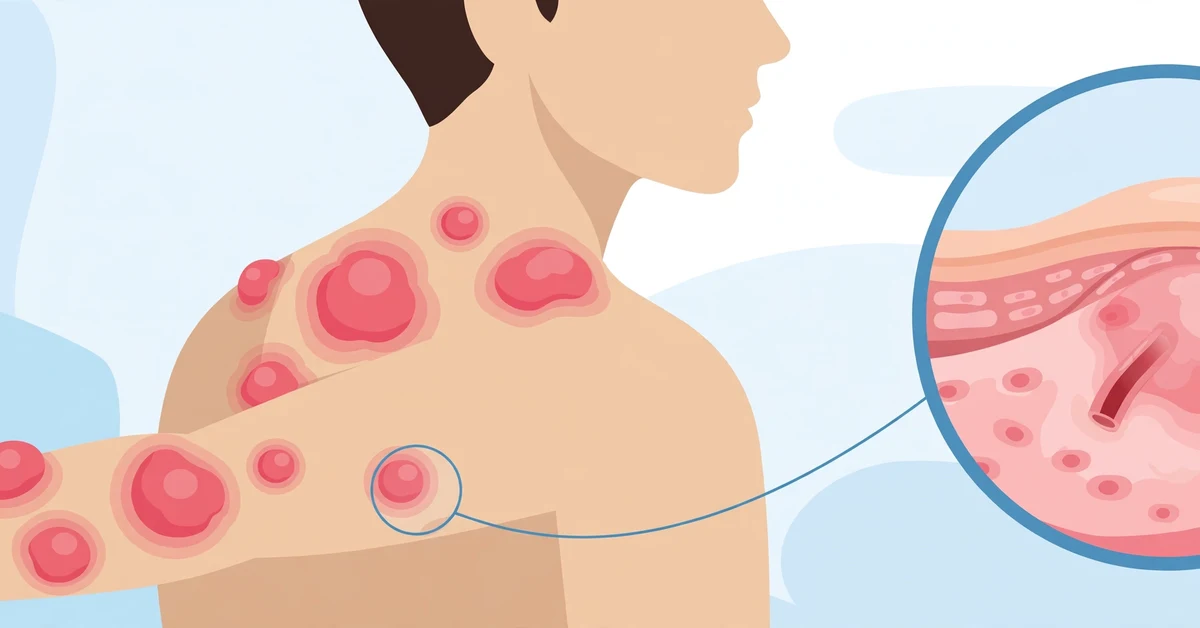
- What do hives look like?
- Hives pictures: classic wheals
- Hives on the face, lips, and eyelids: watch for angioedema
- Hives on the body, arms, and legs
- Dermatographism: hives you can “write” on the skin
- What hives look like on darker skin tones
- Acute vs chronic urticaria
- Common triggers of hives
- When hives are an emergency
- Hives vs bug bites vs other rashes
- How hives are treated
- The bottom line
Welts that appear out of nowhere, itch intensely, and then vanish a few hours later are the classic calling card of hives — known medically as urticaria. Because hives change shape, size, and location so quickly, the patch on your arm in the morning may look nothing like your skin by lunchtime. That is exactly why people search for hives pictures: to compare what is on their own skin with what hives actually look like.
This guide walks through real clinical photos of hives — classic wheals, hives on the face, the deeper swelling of the lips and eyelids called angioedema, scratch-induced wheals, tiny heat-triggered hives, and hives on darker skin tones, where they can be surprisingly easy to miss. Under each photo we point out the features dermatologists look for, so you can compare with more confidence. Pictures cannot diagnose you, but they can help you decide what to do next — and when to get urgent care.
What do hives look like?
The individual lesion of hives is called a wheal: a raised, smooth area of swollen skin that sits above the surface, usually with a paler center and a pink or red rim. Wheals are caused by histamine and other chemicals released in the skin, which make tiny blood vessels leak fluid into the surrounding tissue. That leaked fluid is what lifts the skin — and what makes hives behave so differently from most other rashes.
When you look at the photos in this guide, check for these six features:
- Shape and size: Wheals can be round, oval, ring-shaped, or completely irregular. They range from a few millimeters across to wide patches, and neighboring wheals often merge into one large, map-like plaque.
- Color: On lighter skin, wheals are usually pink or red with a paler middle. On brown or black skin they may be skin-colored, slightly lighter or darker than the surrounding skin, or have a violet-grey tint — the raised texture is often easier to see than any color change (see the darker-skin section below).
- Blanching: Press a wheal firmly with a fingertip for a few seconds. A hive turns white or pale where you pressed, then flushes back as blood returns. This blanching is a hallmark of hives.
- Itch: Hives are usually intensely itchy, and may also burn or sting. Pain is less typical — a spot that hurts more than it itches deserves a closer look.
- Short-lived: A single wheal almost always fades within 24 hours, often within 1–3 hours, and leaves the skin looking completely normal — no scale, crust, or mark. New wheals may keep appearing elsewhere while old ones fade.
- Movement: Because individual wheals come and go, the overall pattern shifts and “migrates” over hours. A rash that sits in exactly the same spots, unchanged, for days is less likely to be simple hives.
A quick at-home check: note the outline of one wheal (you can lightly mark the edge with a pen) and look again in a few hours. If that exact wheal has faded while new ones have appeared nearby, that coming-and-going behavior strongly suggests urticaria. If one single spot stays put for more than 24 hours, is painful, or leaves a bruise-like stain behind, it may be something else — such as urticarial vasculitis — and should be examined by a doctor.
Hives pictures: classic wheals
The photo below shows the textbook appearance of hives on an arm: many round and oval wheals of different sizes scattered over the skin. Notice how some wheals are small and separate while others have merged into bigger patches, and how each one is raised with a fairly smooth surface — there is no flaking, crusting, or broken skin.

Wheals do not always stay separate. When a strong reaction is underway, dozens of them can run together into a single large, swollen plaque, like the one in the next photo. Large plaques can look alarming, but size alone does not make hives dangerous — what matters most is whether there is swelling of the lips, tongue, or throat, or any trouble breathing (see the emergency section below).

Hives on the face, lips, and eyelids: watch for angioedema
Hives can appear on the face just as they do elsewhere — raised wheals on the cheeks, forehead, or around the eyes, as in the photo below. Facial hives on their own are usually managed like hives anywhere else, but the face is also where a deeper, more concerning type of swelling shows up.

That deeper swelling is called angioedema. While a wheal is swelling in the surface layers of the skin, angioedema is swelling in the deeper layers, and it favors the lips, tongue, eyelids, hands, feet, and genitals. It often feels tight, heavy, or burning rather than itchy, and it can take 24–72 hours to go down. Roughly 4 in 10 people who get hives also experience angioedema at some point.

Angioedema around the eyes, like the swelling in the photo, looks dramatic but is mainly uncomfortable. Angioedema of the lips, tongue, or throat is different: it can narrow the airway and becomes an emergency, especially if it develops quickly after a food, medication, or insect sting. Treat any swelling in the mouth or throat — or any swelling paired with breathing difficulty, wheezing, or dizziness — as an emergency (see below).
Hives on the body, arms, and legs
Hives can break out anywhere there is skin: the trunk, back, arms, legs, palms, and soles. Widespread outbreaks often follow the pattern in this photo of a back — wheals scattered over a large area, with longer streaks where the skin was rubbed or scratched. Pressure from tight waistbands, bra straps, and bag straps is a common trigger for wheals along those lines.

Not all hives are large. Cholinergic urticaria, triggered by a rise in body temperature — exercise, hot showers, spicy food, or stress — produces crowds of tiny pinpoint wheals, each only 1–3 millimeters wide, usually surrounded by a wider patch of redness. They typically appear on the trunk, neck, and arms and fade within about an hour of cooling down. The close-up below shows this fine, speckled pattern.

Dermatographism: hives you can “write” on the skin
In dermatographism (also called dermographism or “skin writing”), firmly stroking or scratching the skin raises a wheal exactly along the line that was touched, within a few minutes. The effect is so precise that shapes — even a small flower, as in this photo — can be drawn on the skin. The raised lines usually fade within about 30 minutes.

Dermatographism is the most common of the physical (inducible) urticarias. For most people it is a nuisance rather than a danger — itching after toweling off, wheals under tight clothing seams — and it is managed the same way as other hives, mainly with antihistamines and gentler handling of the skin.
What hives look like on darker skin tones
Most hives photos online show red wheals on light skin, which leaves many people with brown or black skin unsure whether their rash matches. On darker skin, the redness of hives is much less visible. Wheals may look skin-colored, slightly lighter or darker than the surrounding skin, or faintly violet or grey, and the surrounding “flare” of redness may not show at all.
The two panels below show the same child’s neck and jaw area during a hives episode (panel a) and as it settles (panel b). Look at the raised, slightly swollen texture rather than the color — that bumpy, lifted surface, together with itch and the way the spots shift and fade within hours, is what gives hives away on darker skin.

Three practical tips if you have darker skin: (1) run a fingertip over the area — hives feel raised and slightly firm even when you can barely see them; (2) try the blanching check, since a pressed wheal still turns paler than the skin around it; and (3) expect temporary darker marks after wheals fade — this post-inflammatory pigmentation is common on brown and black skin and usually fades over weeks, unlike the wheals themselves, which leave no mark. The NHS hives guide also notes that hives can be harder to recognize on brown and black skin, which is one reason the itch-and-movement pattern matters so much.
Acute vs chronic urticaria
Doctors split hives into two groups by how long the outbreaks keep happening — not by how long one wheal lasts (a single wheal stays under 24 hours in both types):
- Acute urticaria (under 6 weeks): the most common pattern. Outbreaks come and go over days or a few weeks, often after an infection, a new food, or a new medication, and then stop. A specific trigger can be found in roughly half of cases.
- Chronic urticaria (6 weeks or longer): wheals appear on most days for six weeks or more, sometimes for months or years. Contrary to what many people assume, chronic hives are usually not caused by an allergy — in most cases no external trigger is found, and the process is thought to be autoimmune. The physical urticarias, such as dermatographism, cold urticaria, and cholinergic urticaria, also fall in this group when they persist.
If wheals keep appearing for more than six weeks, see a doctor even if they are “only” itchy. Chronic urticaria has its own treatment ladder, and a clinician may check blood tests — including thyroid function — to look for associated conditions.
Common triggers of hives
Anything that prompts mast cells in the skin to release histamine can set off hives. The most common triggers include:
- Foods: peanuts and tree nuts, shellfish and fish, eggs, milk, wheat, and soy are frequent culprits in acute allergic hives.
- Medications: antibiotics such as penicillin, painkillers in the NSAID family (ibuprofen, aspirin, naproxen), and some blood-pressure medicines. ACE inhibitors are a well-known cause of angioedema in particular.
- Infections: viral illnesses (including common colds), strep throat, and other infections are a very common trigger, especially in children — often more common than food allergy.
- Insect stings and bites, latex, and things that touch the skin such as certain plants, cosmetics, or animal dander.
- Physical triggers: pressure, scratching, cold, heat, sunlight, water, vibration, and exercise.
- Stress, alcohol, and lack of sleep rarely cause hives on their own but can make outbreaks worse.
Keeping a simple diary of what you ate, took, and did in the few hours before each outbreak can help you and your doctor spot a pattern. MedlinePlus offers a good plain-language overview of causes and testing.
When hives are an emergency
Call emergency services (911 in the US) or go to the emergency department immediately if hives or swelling come with any of the following — these can be signs of anaphylaxis, a severe, life-threatening allergic reaction:
- Swelling of the lips, tongue, mouth, or throat
- Trouble breathing, wheezing, or a tight chest
- A hoarse voice or difficulty swallowing
- Dizziness, fainting, confusion, or a feeling of doom
- Severe stomach cramps, vomiting, or diarrhea
- Hives spreading rapidly over the whole body soon after a food, medication, or sting
If you carry an epinephrine auto-injector (such as an EpiPen), use it first and then call for emergency help — do not wait to see whether symptoms improve, and do not rely on an antihistamine to treat anaphylaxis. Antihistamines work too slowly for a reaction that involves the airway or circulation. The American College of Allergy, Asthma & Immunology explains the warning signs in more detail.
Short of an emergency, book a prompt appointment if a single spot stays in the same place for more than 24 hours, is painful or leaves a bruise-like mark (possible urticarial vasculitis), if swelling keeps returning without wheals, or if outbreaks continue beyond six weeks.
Hives vs bug bites vs other rashes
Several skin problems are mistaken for hives, and the treatments differ, so it is worth comparing the details:
| Feature | Hives | Bug bites | Contact dermatitis | Heat rash | Ringworm |
|---|---|---|---|---|---|
| How long one spot lasts | Under 24 hours, then gone without a trace | Days in the same spot | Days to weeks in the same area | Days while skin stays hot/sweaty | Weeks, slowly spreading |
| Does it move? | Yes — fades in one place, appears in another | No — fixed where the bite happened | No — limited to what touched the skin | No — in sweat-prone areas | No — one or a few expanding rings |
| Center | Smooth, pale center; blanches white when pressed | Often a central puncture dot or tiny blister | May be dry, cracked, or weepy | Tiny clear or red pinpoints | Clearer center with a scaly, raised edge |
| Surface | Smooth and swollen, no scale | Firm bump, sometimes a scab | Dry, flaky, or blistered | Prickly, sandpaper-like | Scaly ring |
| Main sensation | Intense itch, sometimes burning | Itch, sometimes pain if infected | Itch or burning | Prickling and itch | Mild itch |
The single most useful question is: does each individual spot disappear within a day and pop up somewhere new? If yes, hives are likely. If your spots are fixed, dotted in the center, or clustered where you slept, bites are the better bet — our guide to hives vs bug bites walks through that comparison with more detail. And if the rash is mainly on your legs, our photo guide to skin rashes on the lower legs covers the look-alikes that appear there, from cellulitis to contact dermatitis.
How hives are treated
Most mild outbreaks settle on their own, and treatment focuses on calming the itch and shortening the episode:
- Second-generation antihistamines — cetirizine, loratadine, or fexofenadine — are the first-line treatment for hives. They block histamine, are non-drowsy for most people, and can be taken daily while outbreaks continue. Older antihistamines such as diphenhydramine cause drowsiness and are usually reserved for short-term nighttime use.
- Avoid your triggers where you know them, and be careful with NSAID painkillers during an outbreak, since they can worsen hives in some people.
- Soothe the skin: cool compresses, lukewarm (not hot) baths with colloidal oatmeal, loose cotton clothing, and not scratching all help. Hot showers and harsh soaps tend to flare things up.
- If standard antihistamines are not enough, a doctor may increase the dose, add a short course of corticosteroids for a severe flare, or — for chronic hives that do not respond — prescribe treatments such as omalizumab. This step-up approach is why persistent hives are worth a medical visit rather than months of self-treatment.
For a fuller breakdown of doses, options, and what to expect from each medication, see our guide to hives medication.
The bottom line
Hives are raised, itchy wheals that blanch when pressed, change shape, and disappear from each spot within 24 hours while new ones appear elsewhere. On darker skin they may show mainly as raised, skin-colored swelling rather than redness, so texture, itch, and movement are your best clues. Swelling of the lips, tongue, or throat — or hives with any breathing difficulty — is an emergency that needs epinephrine and immediate medical help. Otherwise, antihistamines, trigger avoidance, and gentle skin care handle most outbreaks, and any hives that keep coming back beyond six weeks deserve a workup for chronic urticaria.
This article is for general information only and is not medical advice. Skin conditions can look very similar in photos; if you are unsure what you have, if symptoms are severe, or if swelling involves your mouth or throat, seek medical care promptly.
Frequently Asked Questions
Hives are raised, smooth wheals that are pink or red on lighter skin and skin-colored, lighter, darker, or violet-tinted on darker skin. They range from a few millimeters to large merged patches, itch intensely, turn pale when pressed (blanching), and each individual wheal disappears within 24 hours while new ones appear elsewhere.
The key difference is movement: each hive fades from its spot within 24 hours and new wheals appear in other places, while a bug bite stays fixed in one spot for days and often has a central puncture dot or tiny blister. Hives are also smooth and blanch white when pressed; bites are firmer and do not move.
Yes. On brown or black skin the redness of hives is often barely visible, so wheals appear skin-colored or slightly lighter, darker, or grey-violet. Look for the raised, swollen texture, the itch, blanching when pressed, and the way spots shift and fade within hours. Temporary darker marks can remain after wheals fade and usually clear over weeks.
A single wheal typically lasts less than 24 hours — often just 1 to 3 hours — and leaves the skin looking completely normal. However, an outbreak can keep producing new wheals for days or weeks. Outbreaks that continue for six weeks or longer are classed as chronic urticaria and should be evaluated by a doctor.
Hives become an emergency when they come with swelling of the lips, tongue, or throat, trouble breathing, wheezing, difficulty swallowing, dizziness or fainting, or severe stomach cramps and vomiting — these are signs of anaphylaxis. Use an epinephrine auto-injector if you have one and call emergency services immediately; do not wait to see if antihistamines work.
No. Hives themselves cannot spread from person to person by touch or any other contact — they are your own immune system’s reaction in the skin. However, some triggers, such as a viral infection, can be passed to others, and that person could then develop hives of their own.
Dermatographism, or ‘skin writing,’ is a type of physical urticaria in which stroking or scratching the skin raises an itchy wheal exactly along the line touched, within a few minutes. The marks usually fade within about 30 minutes. It is the most common physical urticaria and is typically managed with antihistamines.
Read Next
Heat Rash (Prickly Heat) Pictures: The 3 Types and How to Tell Them Apart
MRSA Pictures: What MRSA Looks Like and When It Becomes Dangerous

The 10 Best Silicone-Free Shampoos

What Causes Peau D’Orange?
Chickenpox Stages in Pictures: The Rash Day by Day, From First Spots to Scabs
Shingles Stages in Pictures: A Day-by-Day Guide From First Tingling to Healed Skin
Related Posts
Folliculitis Pictures: What Infected Hair Follicles Look Like on Each Body Area
Nov 10, 2026 • 29 min read
Hidradenitis Suppurativa Pictures: What Each Hurley Stage Looks Like
Nov 13, 2026 • 26 min read
6 Natural Treatments for Shingles
Sep 8, 2026 • 15 min read
Hand, Foot and Mouth Disease Pictures: What the Rash Looks Like at Each Stage
Nov 12, 2026 • 36 min read
Staph Infection Pictures: What Staph Looks Like and How to Tell It From Cellulitis
Nov 8, 2026 • 22 min read