Appendix Location: Which Side Is Your Appendix On?

- Where Exactly Is the Appendix?
- Finding It on Your Own Body: McBurney’s Point
- Appendix Location in Males vs Females
- When the Appendix Isn’t Where the Textbook Says
- What Does the Appendix Do?
- Appendicitis Pain Location: Why the Pain Moves
- Appendix Pain vs Other Right-Side Pain
- Red Flags: When Right-Side Pain Is an Emergency
- Frequently Asked Questions
- Is your appendix on the right or left side?
- Where exactly is the appendix located in females?
- Where is the appendix located in males?
- How do I know if the pain is my appendix or just gas?
- Can appendix pain be on the left side?
- Can you live without your appendix?
- References
It usually starts with a phone glowing in the dark.
Two in the morning. A dull ache low on your right side that was barely there at dinner is now very much there, and you are typing the question half the internet seems to ask at exactly this hour: what side is your appendix on?
Here is the short answer. Your appendix is on your right side, low in your belly, roughly level with your right hip bone. If the pain sits there, it deserves respect.
Now the honest part, before we go any further: most pain in the lower right belly is not appendicitis. Gas does it. Constipation does it. A pulled muscle from yesterday’s workout does it, and in women an unhappy ovary does it all the time. Appendicitis is the cause you cannot afford to miss, though, and it follows a pattern the others usually don’t. This page gives you the exact location, a way to find it on your own body, and the pattern that separates an appendix problem from everything else that aches in the same neighborhood.
Where Exactly Is the Appendix?
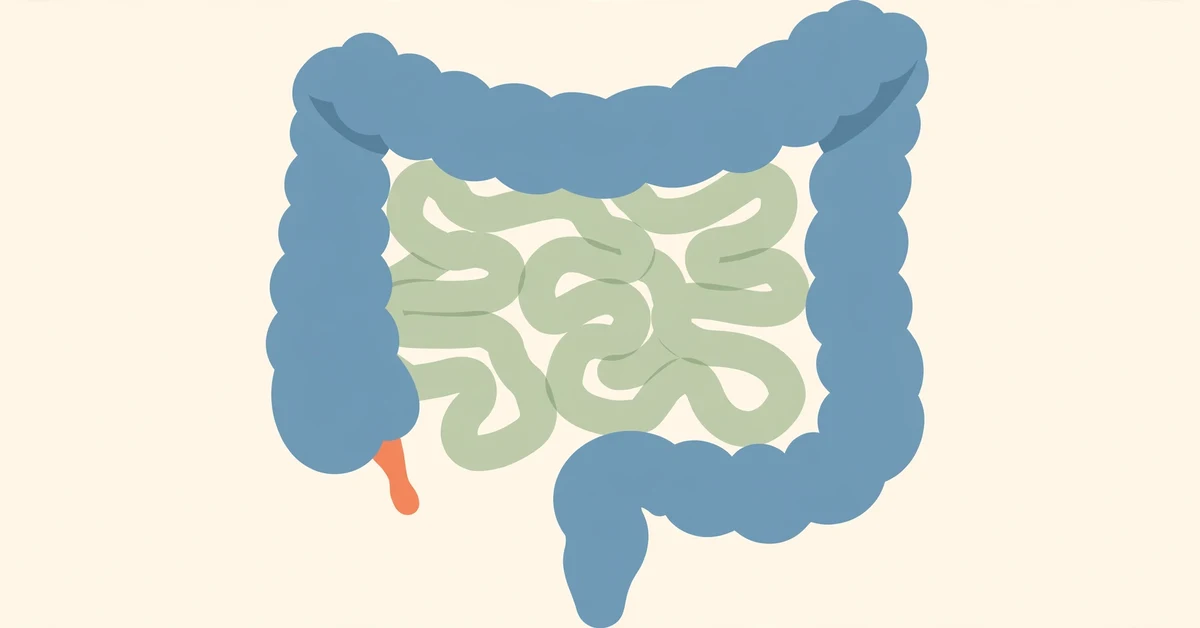
The appendix is a thin, finger-shaped pouch, about 3 to 4 inches long – roughly your middle finger. It hangs off the cecum, the pouch at the very start of your large intestine, in the part of the belly doctors call the right iliac fossa. Picture the spot where your small intestine hands over to your large intestine. That handover happens low on your right side, and the appendix dangles from it.
Its base barely moves. In almost everyone, the base of the appendix sits about 2 cm below the valve where the small intestine empties into the colon, in the lower right quadrant of the abdomen. The tip is another story. It can point down, curl behind the cecum, or dip into the pelvis – and that wandering tip explains a lot of confusing pain stories further down this page.

One more thing to know: the appendix is not buried deep. It sits just behind the front wall of your belly, which is why tenderness there shows up so early when it becomes inflamed – and why a doctor pressing on that exact spot learns so much.
Finding It on Your Own Body: McBurney’s Point
Surgeons have used the same surface landmark for well over a century. It is called McBurney’s point, and you can find yours in about ten seconds.
Find the bony bump at the front of your right hip, the one your waistband sits on. Now draw an imaginary line from that bump to your belly button. McBurney’s point sits about a third of the way along that line as you travel from the hip toward the navel. Press gently there. On a healthy belly, that spot feels like everywhere else.

Now for the part the textbooks underplay. McBurney’s point is a neighborhood, not an address. In one CT-based study, the appendix sat exactly under that point in only about 4% of patients, and in most people it sits a little lower than the classic line suggests. So use the point the way doctors actually use it: as the center of the area to watch, not a bullseye. Pain and tenderness anywhere in that lower right patch count.
Appendix Location in Males vs Females
Men and women keep their appendix in exactly the same place. Same side, same quadrant, same landmark. Anatomy does not move it by sex.
What changes is the company it keeps. In women, the right ovary and fallopian tube sit close by, and an ovarian cyst, a twisted ovary, or an ectopic pregnancy can produce pain that feels almost identical to appendicitis. That is why emergency doctors routinely ask women with lower right pain about their cycle and run a pregnancy test. It is not a lack of belief. It is the neighborhood.
Pregnancy moves the appendix for real. As the uterus grows, it pushes the cecum – and the appendix riding on it – upward and outward. Early on, appendix pain still shows up in the usual lower right spot. By the third trimester it can appear up near the right ribs or along the right flank, which is one reason appendicitis gets missed in pregnant women. Mayo Clinic describes the same shift: in pregnancy, the pain may seem to come from the upper belly, because the appendix sits higher.
When the Appendix Isn’t Where the Textbook Says
The base of your appendix is fixed. The tip is free to point where it likes, and it likes variety. In a CT study of more than 1,500 people, about a quarter of appendixes curled up behind the cecum, about a fifth pointed straight down, and roughly one in six dropped into the pelvis. Each position writes a different pain story:
- Retrocecal (behind the cecum) – the most common variant. Shielded by the colon, it can cause a duller ache that feels like it comes from the back or flank, and it is easier to miss on examination.
- Pelvic – the tip hangs over the pelvic brim, close to the bladder and rectum. Expect pain low in the pelvis, an urge to urinate, or diarrhea rather than a classic right-sided ache.
- Subcecal and post-ileal – pointing down below the cecum, or tucked behind the small intestine. These tend to produce vaguer, slower-building symptoms.

And then there is the genuine left-sided appendix. About 1 in 10,000 people are born with situs inversus, a full mirror image of the internal organs – heart on the right, appendix on the left. Intestinal malrotation can also leave the appendix on the left, or in the middle. If you already know your organs are flipped, tell every doctor who ever examines your belly. It can save hours.
What Does the Appendix Do?
For most of the last century, the honest answer was “nothing, as far as we can tell.” That answer has changed.
The appendix is packed with immune tissue, and Cleveland Clinic describes it as a safe house for helpful gut bacteria: a quiet reservoir where good microbes sit out a bout of diarrhea or a course of antibiotics, then repopulate the colon afterward. It seems to do its busiest work early in life, while the immune system is still learning.
Useful is not the same as essential. Large numbers of people have their appendix removed every year and live completely normal lives; the rest of the gut takes over. Think of it as a helpful backup system – nice to have, not something your body cannot manage without.
Appendicitis Pain Location: Why the Pain Moves
If you remember one section of this page, make it this one. Appendicitis pain usually moves, and the move is the message.
It starts as a vague, dull ache around your belly button. You cannot point to it with one finger; it is more of a general wrongness in the middle of your belly. That is because the early inflammation sends its signal along nerves the midgut shares with the skin around the navel. Your brain files the pain in the wrong drawer.
Over the next several hours – often somewhere between 4 and 24 – the inflammation reaches the lining of the abdominal wall, and the picture sharpens. The pain settles into the lower right, near McBurney’s point, and now you can point with one finger. It hurts to cough. It hurts over speed bumps. Most people would rather lie very still, often with their knees drawn up, than walk to the bathroom.
The supporting cast matters too. Appetite goes first – a person with early appendicitis usually cannot face food. Nausea tends to arrive after the pain, not before it, which helps separate appendicitis from a stomach bug, where vomiting usually leads. A low fever, around 99 to 100.4 degrees F (37.2 to 38 degrees C), is common. A high fever early on can mean the appendix has already burst.
One pattern deserves its own warning. If severe pain suddenly eases off, that is not always good news. A ruptured appendix can briefly relieve the pressure inside it, buying an hour or two of deceptive calm before a much worse, whole-belly pain takes over as infection spreads. Sudden relief followed by feeling worse overall is an emergency, not a recovery.
Appendix Pain vs Other Right-Side Pain
The lower right belly is crowded, and several of its residents can imitate appendicitis. This table covers the look-alikes doctors weigh up most often:
| Condition | Where it hurts | How it feels | Other clues |
|---|---|---|---|
| Appendicitis | Lower right belly; starts near the navel and moves down | Builds steadily over hours; sharp; worse with coughing, walking or bumps in the road | Appetite disappears; nausea arrives after the pain; low fever |
| Gallbladder problem | Upper right, tucked under the ribs; can spread to the right shoulder or back | Steady ache or waves of pain, often after a fatty meal | Nausea; pain linked to eating; fever if the gallbladder becomes infected |
| Kidney stone | Side and flank; wraps from the back around to the groin | Severe waves of pain; you cannot sit still with it | Blood in the urine; urge to urinate; nausea |
| Ovarian cyst or twisted ovary | Lower pelvis, right or left | Cyst: a dull, heavy ache. Twisted ovary: sudden and severe | Often linked to the menstrual cycle; a twisted ovary often brings vomiting and needs urgent care |
| Gas, constipation or a pulled muscle | Anywhere; often moves around | Crampy and shifting; eases after passing gas or a bowel movement; muscle pain follows a strain | Bloating; no fever; appetite usually normal |
Notice the thread running through it. Appendicitis is the one that builds steadily in one spot, steals your appetite, and punishes movement. Pain that wanders, arrives in waves, or fades after you pass gas is usually something else. But “usually” is doing heavy lifting in that sentence, and the red flags below overrule it.
Red Flags: When Right-Side Pain Is an Emergency
Skip the wait-and-see approach and get emergency care now if you have:
- Pain in the lower right belly that keeps building over several hours, especially with a fever
- Pain that wakes you from sleep, or pain you cannot get comfortable with
- A belly that feels rigid, board-like, or exquisitely tender to a light touch
- Severe pain that suddenly eases, then comes back worse
- Repeated vomiting, or pain alongside faintness or dizziness
- Right-sided abdominal pain during pregnancy
While you wait: don’t eat or drink, in case surgery is needed. Skip laxatives and enemas – the NHS advises against them when appendicitis is suspected, because stimulating the bowel can raise the risk of the appendix bursting. And don’t try to drive yourself if the pain is severe. Appendicitis is very treatable, especially early. Nearly all of the danger comes from delay.
Frequently Asked Questions
Is your appendix on the right or left side?
On the right, in the lower part of your belly, for the overwhelming majority of people. The rare exceptions are people born with situs inversus, whose organs are mirror-flipped, and some people with intestinal malrotation. If your organs are not flipped, your appendix is on the right.
Where exactly is the appendix located in females?
In exactly the same place as in males: the lower right abdomen, hanging off the cecum near the right hip bone. The difference is what sits nearby – the right ovary and fallopian tube – which is why ovarian problems so often imitate appendicitis in women. During pregnancy the appendix is pushed upward, so by the third trimester it may sit closer to the right ribs.
Where is the appendix located in males?
Low on the right side of the abdomen, at the start of the large intestine. The quickest way to find the spot is McBurney’s point: about a third of the way along a line from the front of your right hip bone to your belly button. In men there are fewer look-alike conditions in that spot, so new, building pain there is taken seriously quickly.
How do I know if the pain is my appendix or just gas?
Gas pain moves around, comes and goes, and usually eases after you pass gas or use the bathroom; your appetite is normally fine and there is no fever. Appendix pain parks itself in the lower right, builds steadily over hours, kills your appetite, and hurts when you move or cough. If you cannot tell, get checked – doctors would far rather rule appendicitis out than meet it late.
Can appendix pain be on the left side?
Rarely. Early appendicitis pain is felt around the belly button, not the left, and true left-sided appendix pain basically requires a left-sided appendix, as in situs inversus. Most left-sided belly pain has other causes, such as diverticulitis, a kidney stone, or constipation. Severe left-sided pain still deserves same-day medical care – just don’t assume it is your appendix.
Can you live without your appendix?
Yes, completely. The appendix helps the immune system and shelters helpful gut bacteria, but the rest of the gut compensates after it is removed. People who have had an appendectomy eat, digest, and fight infections normally. It is a helpful organ, not an essential one.
References
This article is general information only and is not medical advice. If you have severe or worsening abdominal pain, seek medical care promptly. Sources used for this article:
- NHS – Appendicitis: nhs.uk/conditions/appendicitis
- MedlinePlus – Appendicitis: medlineplus.gov/appendicitis.html
- Mayo Clinic – Appendicitis: Symptoms and Causes: mayoclinic.org
- Cleveland Clinic – Appendix: What Side It’s Located On & Function: my.clevelandclinic.org






Related Posts

How SNL Comedian Kenan Thompson Manages GERD Symptoms After Diagnosis
Sep 26, 2026 • 28 min read
Right Hemicolectomy Recovery: Week-by-Week Timeline and What to Eat After Surgery
Nov 13, 2026 • 14 min read
How Long Does It Really Take to Sober Up?
Aug 23, 2026 • 26 min read
Proteolytic Enzymes: How They Work, Benefits and Sources
Sep 13, 2026 • 32 min read
GERD ICD-10 Codes: K21.9, K21.00, and K21.01 — and How to Choose the Right One
Nov 12, 2026 • 23 min read