Broccoli Sprouts: Benefits, Nutrition, Sulforaphane and Safety

- What Broccoli Sprouts Actually Are
- Sulforaphane, Explained Simply
- Nutrition in a Small Handful
- Broccoli Sprouts vs Mature Broccoli
- What the Research Actually Shows
- Cancer: promising in the lab, unproven in people
- Brain health: early signals only
- Gut health: the most practical human data
- Heart, blood sugar, and inflammation
- The Food Safety Warning You Should Not Skip
- How to Eat Broccoli Sprouts
- Growing Them at Home, Safely
- Side Effects and Who Should Be Careful
- Frequently Asked Questions
- How much broccoli sprouts should you eat a day?
- Are broccoli sprouts better than mature broccoli?
- Do broccoli sprouts prevent cancer?
- Should you eat broccoli sprouts raw or cooked?
- Can you grow broccoli sprouts at home?
- What do broccoli sprouts taste like?
- Are broccoli sprout supplements the same as fresh sprouts?
- How should you store broccoli sprouts?
- References
A small handful changes a plain sandwich fast. The crunch is fresh, the taste is peppery like radish, and the portion looks too small to matter. Then you learn what is packed inside those thin stems. Broccoli sprouts are popular for one compound above all others, and its story is more interesting, and more limited, than most headlines suggest.
This guide covers what they contain, what the research can and cannot tell you, and the part many short articles rush past: raw sprouts carry a real food safety risk, and some people should eat them cooked.
What Broccoli Sprouts Actually Are
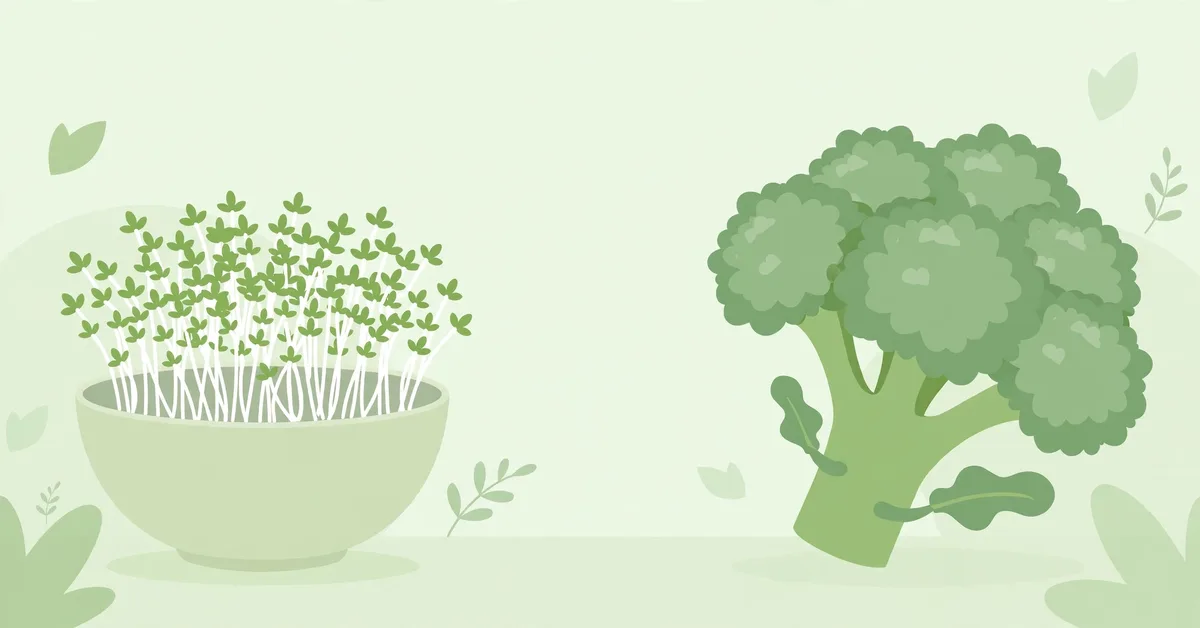
Broccoli sprouts are young broccoli plants, harvested just 3 to 5 days after the seeds germinate. Each sprout has a thin white stem, two tiny green leaves, and part of the seed still attached. They look a lot like alfalfa sprouts, which is why the two often sit side by side in shops.
They belong to the cruciferous family, with mature broccoli, cauliflower, Brussels sprouts, and kale. If you eat kale for its nutrients, sprouts share that background, at a much earlier stage.
Interest took off in 1997, when Johns Hopkins researchers reported that very young sprouts held far more glucoraphanin than the mature vegetable. Demand for seed spiked, and sprouts moved into regular supermarkets. You can buy them fresh, grow them in a jar, or buy powder and capsules. Fresh sprouts are the form used in most food studies.

Sulforaphane, Explained Simply
Sulforaphane gets most of the attention, yet fresh sprouts do not contain much of it ready-made. They contain glucoraphanin, a precursor compound stored inside the plant cells. A second player does the conversion. When you chew, chop, or crush the sprouts, you break those cells open and bring glucoraphanin into contact with an enzyme called myrosinase. That contact creates sulforaphane.
How you eat them matters. Chewing well helps. Chopping and letting sprouts sit for a few minutes also helps, since the conversion needs time. Hard cooking works against it, because heat damages myrosinase. Light cooking is a middle path, and the safety section explains the trade-off.
In lab work, sulforaphane switches on pathways that make antioxidant and detox enzymes. That is why scientists keep studying it. A lab effect is a starting point, though. It is not proof that eating sprouts prevents a disease in people.
Nutrition in a Small Handful
Healthline, drawing on the International Sprout Growers Association, reports that a 3-ounce (85-gram) serving provides about 35 calories, 5 grams of carbohydrate, 4 grams of fiber, 2 grams of protein, and 0.5 grams of fat, plus about 60 percent of the Daily Value for vitamin C and 10 percent for vitamin A. WebMD lists vitamin C, vitamin A, calcium, and iron as main nutrients. Exact numbers vary by brand, so treat labels as a guide.
The fiber is high for the calories, and the vitamin C is strong for a green vegetable eaten raw, since vitamin C drops with heat and storage. For other strong sources, our guide to vitamin C foods puts sprouts in wider context.
Broccoli Sprouts vs Mature Broccoli
People often ask which one is better. They do different jobs well. Mature broccoli is a hearty vegetable you can serve in large portions. Sprouts give you far more glucoraphanin in a tiny raw portion, but raw use brings the safety concern covered later.

| Feature | Broccoli sprouts | Mature broccoli |
|---|---|---|
| Sulforaphane potential | Very high. About 10 to 100 times more glucoraphanin per weight, per Healthline and WebMD | Lower per weight, but still a good source, especially when chopped and lightly cooked |
| Calories | About 35 calories per 3 ounces (85 grams) | Similar per weight, about 35 calories per 3 ounces cooked |
| How eaten | Usually raw in salads, sandwiches, and wraps, or lightly cooked | Usually cooked: steamed, roasted, stir-fried, or in soups |
| Taste and texture | Crisp, fresh, mild to peppery, similar to radish | Earthy and slightly bitter, soft when cooked |
| Food safety | Higher risk raw. Warm, damp growing conditions also suit bacteria | Low risk in normal home cooking |
| Best use | Small daily handful for crunch and glucoraphanin | Regular cooked vegetable in larger portions |
Eat the wider family too, not just sprouts. Cooked cabbage, for example, brings fiber and vitamin K in a cheap, filling form with none of the raw sprout risk.
What the Research Actually Shows
The early science is interesting, the human evidence is still thin, and no major health body recommends sprouts as a treatment for any condition. The table grades the main claims as the evidence stands now.
| Claimed benefit | Evidence level | What that means |
|---|---|---|
| Cancer | Lab and animal studies, plus small early human work. No proof of prevention in people | Sulforaphane affected cancer cells and detox enzymes in test tubes and animals. That does not show that eating sprouts prevents cancer in humans. |
| Brain and mental health | Mostly animal studies, with a few small human trials | One small 18-week trial in 29 adults with autism reported some behavioral gains. Results for memory, stroke, and other brain conditions rest mainly on animal work. |
| Gut health and H. pylori | Small human studies | A 16-week study in 50 people found lower H. pylori infection markers and less stomach inflammation with daily sprouts. Larger trials are still needed. |
| Heart health and blood sugar | Small human studies and animal work | Some small trials saw shifts in cholesterol, triglycerides, or insulin measures. Effects are modest and not yet settled. |
| Inflammation | Small human trials | A few trials reported lower inflammation markers after weeks of daily sprouts or powder. Sample sizes were small. |
Cancer: promising in the lab, unproven in people
Test-tube and animal studies, summarized by Healthline and WebMD, show sulforaphane can slow tumor growth in lab settings and raise detox enzymes in the liver. No large human trial has shown that eating sprouts prevents or treats cancer. Wikipedia, summarizing the literature, puts it plainly: there is basic research on sulforaphane, but no high-quality evidence for its effect against human diseases. Selling sprouts as a cancer treatment goes well past the evidence.
Brain health: early signals only
Animal studies suggest sulforaphane may protect brain cells from oxidative stress, linked to memory loss and diseases such as Alzheimer disease and Parkinson disease. Human data are sparse. The best-known result is that small autism trial, with 29 adults over 18 weeks. One small trial cannot settle a question. Researchers treat it as a reason for bigger studies, not a final answer.
Gut health: the most practical human data
The gut claims rest on slightly firmer ground, though studies are still small. In a 16-week study of 50 people with H. pylori gastritis, about 70 grams of sprouts a day lowered infection markers and stomach inflammation, as Healthline reports. For the broader picture, our overview of gut health covers habits with stronger support, such as fiber and varied plant foods. Sprouts are not a treatment for ulcers or gastritis.
Heart, blood sugar, and inflammation
Small trials and animal studies point to modest shifts in triglycerides, LDL cholesterol, and insulin sensitivity. A few trials also reported drops in inflammation markers after weeks of daily sprouts. Each study was small, often short, and sometimes used extracts rather than fresh sprouts. Read these as early signals, not reasons to change medication or skip proven steps such as exercise.
The Food Safety Warning You Should Not Skip
This is the section to read before your first raw handful. Sprouts grow in warm, damp conditions. Bacteria thrive in those same conditions. Healthline, citing the U.S. Food and Drug Administration (FDA) and the Centers for Disease Control and Prevention (CDC), notes that sprouts can carry Salmonella, E. coli, and Listeria monocytogenes. WebMD reports the same risk and notes that testing of sprout crops has found salmonella, listeria, and other pathogens.
Contamination can start with the seed itself. Washing helps and you should always wash sprouts well, but it cannot guarantee safety, because bacteria can sit where water does not reach. That is why official advice goes further for higher-risk groups.
The FDA advises that pregnant people, older adults, young children, and anyone with a weakened immune system should avoid raw sprouts and eat them only when cooked thoroughly. Cooking sprouts until steaming hot kills the bacteria of concern. For everyone else, the safer habits are simple: buy sprouts that look fresh and smell clean, keep them refrigerated, check the use-by date, wash your hands and the sprouts before use, and throw away any tub that smells off or feels slimy.
Food poisoning from sprouts can cause fever, diarrhea, and stomach cramps. Most healthy adults recover, but listeria in pregnancy and weak immunity can be severe. Cooked sprouts in a stir-fry or soup give higher-risk readers the food without the raw risk, even if cooking lowers the sulforaphane yield a bit.
How to Eat Broccoli Sprouts
A handful, roughly half a cup to a cup, is a typical serving. Studies often used 30 to 70 grams a day. There is no official target, so treat those amounts as reference points, not prescriptions.
- Salads and slaws. Scatter a handful over the top just before serving so the crunch stays.
- Sandwiches and wraps. Use sprouts in place of, or alongside, lettuce for a peppery bite.
- Smoothies. Blend a small handful with fruit and greens. The flavor fades, though chewing is lost, so blend well to break the cells open.
- Stir-fries and soups. Add at the end, or cook fully if you are in a higher-risk group.
To get more sulforaphane, chew well or chop the sprouts and wait a few minutes before eating. Some cooks add mustard seed powder to cooked cruciferous vegetables, since mustard seeds contain active myrosinase. That trick is optional.
Growing Them at Home, Safely
Home sprouting is cheap and takes under a week. Use seeds sold for sprouting, a clean jar with a mesh lid, and fresh water. Soak overnight, drain, then rinse and drain twice a day for 3 to 5 days. Keep the jar tilted so water runs off. Wash hands, jar, and lid with hot soapy water first. If a batch smells sour or looks slimy, throw it out. Growing your own does not remove the bacterial risk, so higher-risk groups should cook home-grown sprouts too.
Side Effects and Who Should Be Careful
For most healthy adults, normal food amounts are well tolerated. Gas and mild stomach upset are the most common complaints. Start small if sprouts are new to you.
Two cautions deserve a mention. Sprouts contain isothiocyanates, which can affect iodine uptake at very high intakes. Healthline notes that studies of other Brassica vegetables found typical servings unlikely to harm thyroid function. Anyone with a thyroid condition planning large daily amounts should ask their clinician. Sulforaphane may also interact with some medicines, including furosemide, verapamil, and ketoprofen, per Healthline. Extracts are far more concentrated than food, so check before making them a daily habit.
Frequently Asked Questions
How much broccoli sprouts should you eat a day?
There is no official daily amount. Studies often used 30 to 70 grams a day. Start with half a cup and see how your stomach responds.
Are broccoli sprouts better than mature broccoli?
They are stronger in one area and weaker in others. Sprouts hold 10 to 100 times more glucoraphanin per weight, but mature broccoli is easier to cook safely, eat in large portions, and use in hot meals. Eating both covers more ground than picking a winner.
Do broccoli sprouts prevent cancer?
No food has been shown to do that, and sprouts are no exception. Lab and animal studies on sulforaphane look promising, but there is no high-quality human evidence that eating broccoli sprouts prevents or treats cancer.
Should you eat broccoli sprouts raw or cooked?
Raw sprouts keep the most myrosinase, so they yield the most sulforaphane. Raw use also carries the highest bacterial risk. The FDA advises pregnant people, older adults, young children, and people with weak immunity to eat sprouts only when cooked thoroughly.
Can you grow broccoli sprouts at home?
Yes. Sprouting seeds in a clean jar with twice-daily rinsing takes 3 to 5 days. Clean equipment and fresh water matter, and home growing does not remove the food safety risk, so higher-risk groups should still cook them.
What do broccoli sprouts taste like?
Fresh, crisp, and mild to peppery, with a bite like radish. The soft crunch is often the main reason people add them to salads and sandwiches.
Are broccoli sprout supplements the same as fresh sprouts?
No. Powders and capsules vary widely, and some lack active myrosinase, which the body needs to form sulforaphane from glucoraphanin. Fresh sprouts are the form used in most food studies. Supplements are also more concentrated, so check with a clinician if you take medication.
How should you store broccoli sprouts?
Keep them refrigerated in a sealed container lined with a dry paper towel. Use within a few days, and discard any that smell off or feel slimy.
References
- Healthline – What Are Broccoli Sprouts? Nutrients, Benefits, and Recipes
- WebMD – Broccoli Sprouts: Health Benefits, Nutrients, Serving Suggestions, and More
- U.S. Food and Drug Administration (FDA) – Sprout safety guidance for consumers
- Centers for Disease Control and Prevention (CDC) – Sprouts and foodborne illness
- Johns Hopkins – Research on glucoraphanin and sulforaphane in broccoli sprouts (Fahey and colleagues, 1997)
- International Sprout Growers Association – Nutrition figures for broccoli sprouts
- Wikipedia – Broccoli sprouts (summary of evidence quality for sulforaphane)




Related Posts

Virectin Review: Does It Really Work?
Sep 28, 2026 • 29 min read
Will It Fit? What to Check Before Buying Home-Care Equipment
Nov 15, 2026 • 29 min read
6 Reasons Working from Bed Isn't Doing You Any Favors
Oct 6, 2026 • 32 min read
Stretches to Do at Work Every Day
Sep 21, 2026 • 33 min read
Stabilize Your Knees with Step-Downs
Sep 24, 2026 • 12 min read