
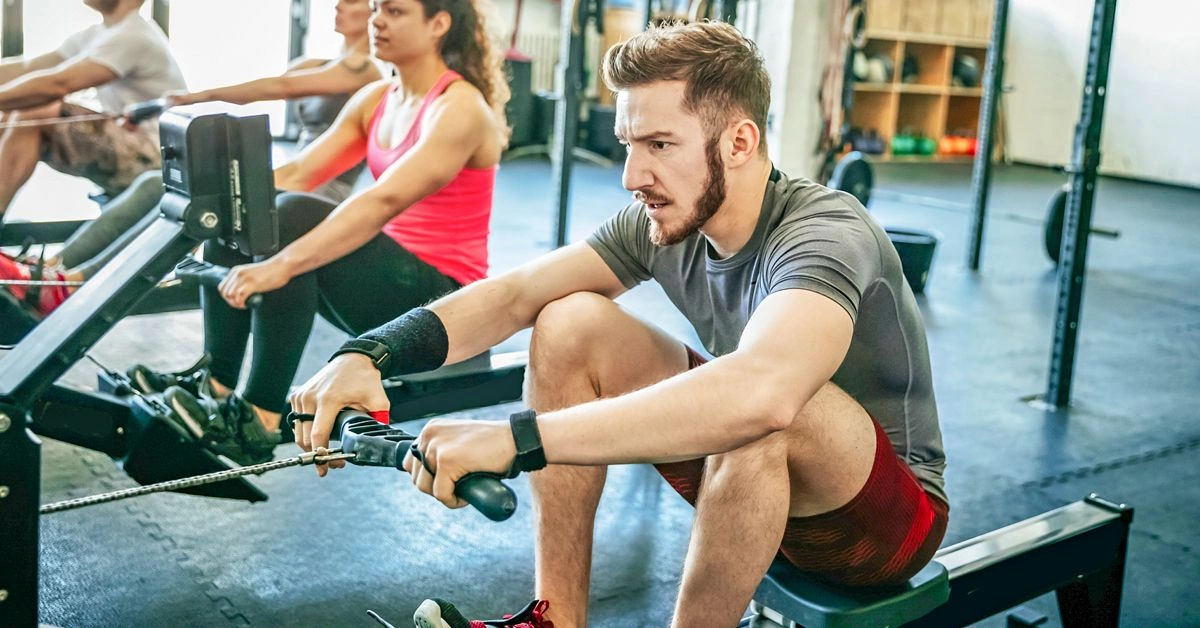
Seated rows are excellent for building upper-body strength. A stronger upper body enhances posture, shields your shoulders, and lowers your chance of injury.
If your goal is to develop upper-body power, the seated row is a top choice. This strength exercise primarily targets the back and the upper arms.
The movement involves pulling a weighted handle on a seated row apparatus. You can also perform it using a seated cable row station or by pulling a resistance band.

Which muscles do seated rows use?
Seated rows engage multiple muscles in the back and arms. Key muscles worked include:
- latissimus dorsi (middle and lower back)
- rhomboids (between the shoulder blades)
- trapezius (upper back, neck, and shoulder area)
- biceps brachii (front of the upper arm)
During the seated row, the lats and rhomboids act as the primary movers. The traps and biceps assist the motion by supporting the lats and rhomboids.
How to do a standard seated row
Seated rows are commonly performed on a seated row machine or a cable row station; the steps for each are largely the same.
Before you begin, set the seat and chest pad so your shoulders sit level with the machine handles.
Then:
- Sit tall on the bench and place your feet on the floor or footrests, knees slightly bent. Reach forward to grasp the handle or cable. Retract and depress your shoulders. Engage your core.
- Exhale as you bend your elbows to draw the handle or cable toward you, keeping elbows close to your sides and your spine neutral. Hold the contracted position for 1 second.
- Inhale and slowly extend your arms, taking a 3-count on the return.
- Perform one set of 12 to 15 repetitions.
How to do a wide-grip seated row
Seated rows are often performed with a narrow grip, but using a wider grip shifts emphasis onto smaller upper-back and shoulder muscles rather than the lats. These include the:
- middle trapezius (upper back between the shoulder blades)
- rhomboids (between the shoulder blades)
- posterior deltoids (rear portion of the shoulder)
For this variation, use a seated cable row station with a straight-bar attachment. Grab the bar with your hands slightly wider than shoulder-width and perform the row in the same manner as the standard version.
How to do a seated row with a resistance band
If you lack gym equipment, you can replicate seated rows with a resistance band.
This alternative targets the lats and rhomboids similarly to the machine-based seated row.
To perform a seated row using a resistance band:
- Sit on the floor with your legs together and extended in front of you, knees slightly bent. Loop the band around the soles of your feet and hold the ends with palms facing inward. Tighten your core.
- Exhale and pull the band until your hands reach over your thighs, keeping elbows close to your sides and maintaining a neutral spine. Pause for one second.
- Inhale and slowly straighten your arms, counting to three on the return.
- Complete a set of 12 to 15 reps.
Begin with a light-resistance band. As you progress, step up to a thicker band.
Wrapping the band around your hands can also make the exercise more challenging.
Common mistakes to avoid
Like any exercise, the seated row needs proper technique to be safe and effective.
Avoid these frequent errors. If you’re unsure about your form, consult a certified trainer for personalized guidance.
- Elbows flaring out. Keep your elbows close to your torso during the pull (except for the wide-grip variation). Letting elbows flare outward shifts work to the biceps instead of the lats and rhomboids.
- Shoulder shrugging. Pull with your shoulders pulled back and down. Shrugging toward your ears places excessive load on the traps.
- Rounded spine. Maintain a neutral back throughout. Engage your abs to avoid rounding or over-arching the spine.
- Torso swinging. Don’t move your torso to generate momentum; that reduces tension on the target muscles. Bracing your core helps keep the torso stable.
- Fast, jerky reps. Perform controlled, steady repetitions to properly recruit the muscles. Avoid rapid, uncontrolled movements.
- Partial range of motion. Use a full range of motion for maximum benefit. Cutting the movement short may let you lift more weight but won’t effectively work the muscles.
- Locked knees. Keep a slight bend in the knees to avoid unnecessary joint stress.
Modifications to try
Altering your seated row technique is a useful way to vary the stimulus and adapt the exercise to your fitness level.
Make it easier
Use a lighter load and fewer reps. Once you can perform the movement flawlessly, gradually add weight or increase repetitions.
Make it harder
If the standard seated row becomes too easy, try these progressions for an added challenge:
- Move the chest pad. On a seated row machine, distance the chest pad from your torso. This forces your trunk to work harder to remain stable.
- Single-arm rows. Sit at a cable row station with one foot on the floor and the other on the plate. Pull the cable with one arm down the side of your body.
- Increase the pause. At the peak of the pull, hold for 3 to 5 seconds to intensify the contraction.
- Slow the return. Extending the eccentric phase will also boost the exercise’s difficulty.
Safety tips
To reduce injury risk, always perform seated rows with sound form and controlled movement. Key points include:
- keeping a slight bend in the knees
- maintaining a stable back
- keeping the spine aligned
- tucking the elbows in
- moving deliberately and slowly
Begin with a conservative weight. Lifting too heavy can cause damage to the back or shoulders.
If you have current or prior back, shoulder, or arm injuries, consult your physician or a physical therapist before attempting seated rows. A qualified trainer can demonstrate safer alternatives to target the same muscle groups.
You should only sense a mild stretch at the start position. If you experience sharp or persistent pain, stop immediately.



















Leave a Reply
You must be logged in to post a comment.