Treatment for Nerve Damage After Tooth Extraction: Symptoms, Recovery Timeline and When Specialist Care Is Time-Sensitive

- First, a quick check: this is not dry socket
- Which nerves are at risk, and what each one feels like
- Why it happens: three grades of nerve injury
- How recovery typically unfolds — and over what timeline
- What proper evaluation looks like
- Conservative management: what helps while the nerve heals
- Medications: what is used, and what they can realistically do
- Low-level laser therapy: promising, not proven
- The time-sensitive part: specialist and microsurgical evaluation
- Red flags: get seen promptly if you notice these
- The bottom line
If feeling has not come back to your lower lip, chin or tongue after a tooth extraction — especially a lower wisdom tooth — the problem is usually an injured sensory nerve, not slow socket healing. Most of these injuries are bruises or stretches to the nerve and improve on their own over weeks to months. But treatment for nerve damage after tooth extraction is really about three things: knowing which nerve was affected, tracking whether sensation is returning, and getting referred to a specialist early if it is not — because the window in which surgical repair works best does not stay open indefinitely.

This article covers inferior alveolar nerve and lingual nerve injury after tooth extraction: the symptoms, how recovery typically unfolds, what conservative care and medication can and cannot do, and when microsurgical evaluation becomes time-sensitive. Timelines are hedged to the published literature, and no outcome is promised — recovery varies a great deal with the type of injury.
First, a quick check: this is not dry socket
Dry socket and nerve injury are different complications that are easy to confuse, because both follow an extraction. Dry socket (alveolar osteitis) is a socket problem: the blood clot is lost, bone is exposed, and the dominant symptom is intense, radiating pain starting a few days after surgery, often with a bad taste or odour. Its care is about dressings and pain control — see our guide to home remedies for dry socket if that picture matches yours.
Nerve injury is a sensation problem. The socket itself may heal perfectly while feeling in the lip, chin or tongue stays altered. If your main complaint is numbness, tingling, burning or changed taste rather than socket pain, keep reading — and mention the altered sensation to your dentist explicitly, because it changes what follow-up you need.
Which nerves are at risk, and what each one feels like
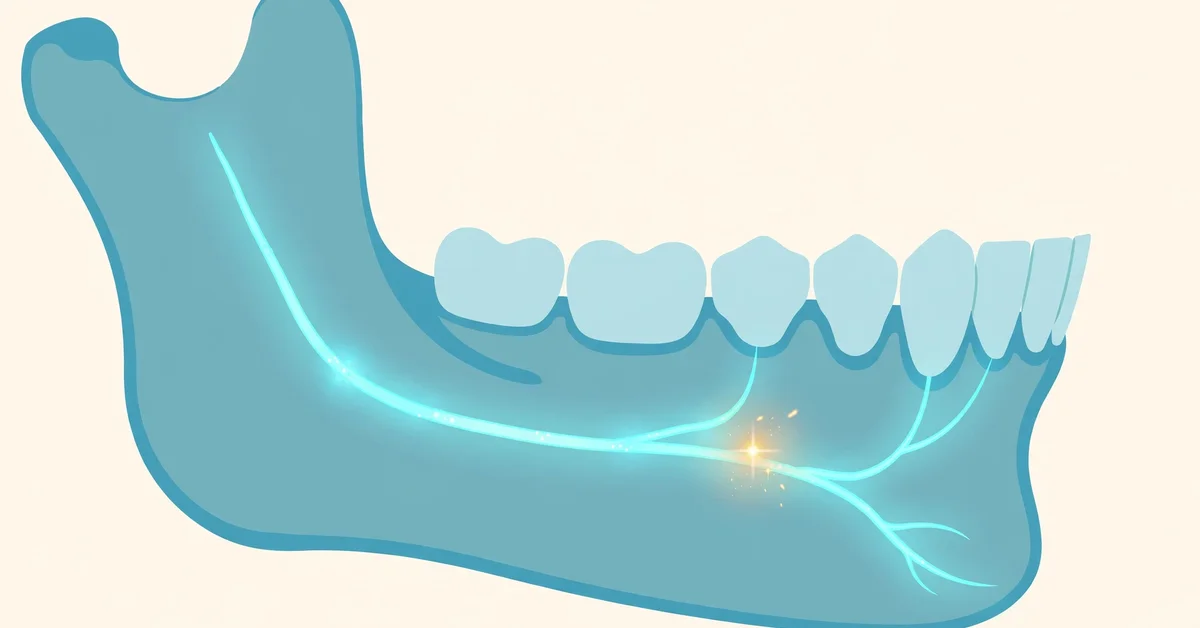
Two branches of the trigeminal nerve sit close to the roots of the lower back teeth, which is why most post-extraction nerve injuries follow lower wisdom tooth removal. A 2019 review of third molar surgery-related trigeminal nerve injury in the Journal of the Korean Association of Oral and Maxillofacial Surgeons reported inferior alveolar nerve (IAN) sensory deficit in roughly 0.2% to 8.4% of cases across studies, and lingual nerve (LN) deficit in roughly 0.1% to 22%, with permanent injury far less common than temporary injury (Leung, 2019, PMC ). The wide ranges reflect different study methods, not a precise personal risk.

| Nerve | Where it runs | Typical symptoms when injured |
|---|---|---|
| Inferior alveolar nerve (IAN) | Through a bony canal inside the lower jaw, exiting near the chin | Numbness or tingling of the lower lip and chin on one side; altered feeling in the lower teeth and gum on that side |
| Lingual nerve (LN) | Through the soft tissue on the inner side of the jaw, beside the tongue | Numbness or tingling of the front two-thirds of the tongue on one side; burning; changed taste, because taste fibres travel with it |
Symptoms doctors group under altered sensation include numbness (anaesthesia), pins-and-needles (paraesthesia), and unpleasant or painful abnormal sensation (dysaesthesia) — for example burning, electric-shock jolts, or pain from light touch. Functional effects matter too: biting your lip or cheek without noticing, drooling, food pooling on the numb side, slurred speech when the tongue is involved, and trouble telling food temperature. If food or liquid keeps escaping from a wisdom tooth socket while it heals, that is a separate, common nuisance covered in our article on food stuck in a wisdom tooth hole — it is not itself a nerve symptom.
Why it happens: three grades of nerve injury
The grade of injury explains most of the difference in recovery time, and it is why honest timelines are ranges rather than dates:
- Neuropraxia — the nerve is bruised, stretched or compressed by swelling, but its fibres stay intact. Signals are blocked temporarily. This is the most common pattern after extraction and the one most likely to recover fully as swelling settles.
- Axonotmesis — the inner fibres are damaged but the outer sheath survives, so fibres can regrow along the existing pathway. Recovery is slower — regrowth is gradual — and may be incomplete.
- Neurotmesis — the nerve is partly or completely cut. Spontaneous recovery is unlikely to be useful, and this is the pattern where surgical repair is mainly considered.
At the first follow-up visit, nobody can reliably tell you which grade you have. That is exactly why management starts with careful documentation and scheduled re-testing rather than instant answers: the pattern of change over the first weeks is itself the diagnostic information.
How recovery typically unfolds — and over what timeline
Reviews of inferior alveolar and lingual nerve injury describe a consistent overall pattern: nerve regeneration typically takes from several weeks to about six months for compression and less severe crush-type injuries, and the fastest improvement usually happens in the first three months. A 2024 systematic review of low-level laser therapy and microsurgery likewise notes that management in the first three months is usually observation, precisely because the potential for spontaneous recovery in that period is high (Systematic review, 2024, PMC ). Residual deficits have been documented beyond a year, however, and the same 2019 review stresses that with current treatments full recovery is not commonly achievable in moderate-to-severe injuries (Leung, 2019, PMC ).
In practical terms, recovery rarely feels like a switch flipping back on. A typical sequence is:
- Days 1–7: numbness from the anaesthetic should wear off within hours. Altered sensation that is still present the next day, and unchanged after a week, should be reported and recorded.
- Weeks 2–6: the numb area may start to shrink from the edges; tingling or heightened sensitivity often appears as fibres recover. Any clear, steady improvement is a favourable sign.
- Months 2–3: many bruise-type injuries have improved substantially by now. No measurable improvement at all by around three months is a reason to escalate, not to keep waiting passively.
- Months 3–6: slower continued gains are still possible, especially after fibre regrowth. Deficits that persist at six months are less likely to resolve fully on their own, though late improvement is described.
Age matters: older patients have a higher risk of incomplete recovery in the literature, which is one more reason follow-up should be active rather than occasional.
What proper evaluation looks like
If altered sensation persists, ask what the follow-up plan is. A thorough evaluation usually includes:

- A sensory map: the clinician marks the exact boundary of the numb or altered area (often on a diagram or photograph) so change can be measured at each visit rather than guessed.
- Neurosensory testing: simple chairside tests such as light touch, pin-prick, two-point discrimination and temperature or taste testing, repeated over time.
- Review of the surgery and imaging: how close the roots were to the nerve canal on the pre-operative X-ray or CBCT, and what happened during surgery, help judge the likely mechanism of injury.
- A referral decision with a date on it: not “come back if it doesn’t improve,” but a defined checkpoint at which a specialist referral happens if recovery has stalled.
Conservative management: what helps while the nerve heals
For the majority of injuries — the bruise-and-stretch pattern — treatment is supportive while the nerve recovers:
- Time and monitoring are the core treatment, with scheduled sensory re-testing rather than a single check.
- Protect the numb area. Chew slowly on the other side, check food and drink temperature with the unaffected side, and be careful with hot items — a numb lip or tongue burns without warning you.
- Keep the socket and mouth clean as your surgeon directed, so infection or inflammation does not add pressure around the nerve.
- Track your own symptoms in a dated note — area involved, type of sensation, anything improving. Bring it to appointments; it makes the trend objective.
- Avoid re-injury: postpone elective dental work in the affected area until your clinician advises it.
Medications: what is used, and what they can realistically do
No medication has been shown to regrow a damaged trigeminal nerve. What medicines do is reduce inflammation early on and control neuropathic symptoms while healing happens. The classes below are the ones documented in the literature; all are clinician-directed, and this article deliberately gives no doses.
- Corticosteroids (acute phase): tapering courses of agents such as prednisolone or dexamethasone are commonly used soon after injury to control inflammation and limit secondary nerve injury, as summarised in a 2025 review of post-traumatic trigeminal neuropathy (Post-traumatic trigeminal neuropathy, 2025, PMC ). This is a decision for the treating clinician in the early days, not something to start on your own weeks later.
- Gabapentinoids (gabapentin, pregabalin): a mainstay class for chronic neuropathic pain such as burning or shooting pain, per the same review.
- Tricyclic antidepressants (for example amitriptyline): used at pain-directed doses for neuropathic pain, and also listed among the mainstay options in the literature.
- SNRIs (such as duloxetine or venlafaxine): included in standard neuropathic-pain guidance that the trigeminal literature follows for painful post-traumatic neuropathy.
- Topical options: local anaesthetic preparations and capsaicin have been described for localised relief in some reports.
- Ordinary painkillers: NSAIDs such as ibuprofen help ordinary post-surgical pain and swelling, but they do little for true neuropathic pain — one reason burning, tingling pain that “painkillers don’t touch” should be reported as a nerve symptom, not endured.
Low-level laser therapy: promising, not proven
Low-level laser therapy (photobiomodulation) is offered by some specialists to support neurosensory recovery. The 2024 systematic review found positive subjective and objective outcomes and noted efficacy signals even when treatment began more than six months after injury — unusual among the options. The same review is clear that the evidence base is still small: larger randomised trials with longer follow-up and blinding are needed before it can be called established (Systematic review, 2024, PMC ). It is reasonable to ask a specialist about it; it is not a substitute for timely referral.
The time-sensitive part: specialist and microsurgical evaluation
This is the section the calendar matters most in. Surgical repair — decompression, neurolysis (freeing the nerve), direct repair (neurorrhaphy), or grafting — is the most promising treatment for moderate-to-severe injuries, but outcomes depend on timing. A 2025 systematic review of repair strategies for iatrogenic inferior alveolar nerve injury found better recovery with early intervention overall (within about 12 months), with notably better chances of functional sensory recovery when suitable surgery was performed within roughly the first two months, while also stressing that results vary by injury type and technique (Nerve repair strategies review, 2025, PMC ). Classic microsurgical series placed the best repair window at around three to six months after injury. Set against that, the first roughly three months are usually observation, because so many injuries recover on their own in that window.
The practical takeaway threads those facts together:
- Do not wait six months in silence to “see if it comes back.” Be seen, mapped and tested early.
- If there is complete numbness with no improvement, a known or suspected transection, or worsening painful symptoms, ask for referral to an oral and maxillofacial surgeon with nerve-repair experience within the first weeks, so the specialist — not the calendar — decides whether to watch or to operate, and when.
- Referral is an evaluation, not a commitment to surgery. Its value is that it keeps every option open while timing still allows them.
Red flags: get seen promptly if you notice these
- Numbness that is total and completely unchanged after the first few weeks
- Burning or electric-shock pain that is getting worse rather than better
- New or increasing swelling, fever, discharge or a worsening bad taste — possible infection, which needs its own urgent care
- Altered sensation spreading, or appearing on the other side
- Drooling, repeated lip or tongue biting, or difficulty eating, drinking or speaking because of the numbness
- Low mood or anxiety that is building around persistent symptoms — reviews list chronic pain and depression among the long-term effects of trigeminal nerve injury, and support is part of treatment
The bottom line
Nerve damage after tooth extraction usually means a bruised or stretched inferior alveolar or lingual nerve, and most such injuries improve over weeks to months — fastest in the first three months, with recovery sometimes continuing to six months or beyond. There is no home remedy and no tablet that regenerates the nerve; what changes outcomes is documentation, scheduled re-testing, honest symptom control, and early specialist referral when recovery stalls, because microsurgical options are time-sensitive. If sensation in your lip, chin or tongue is still altered, say so at your next visit — and if there is no follow-up plan, ask for one.
Disclaimer: The information provided on this website is for educational and informational purposes only and does not constitute medical advice. Always consult with a qualified healthcare provider regarding any health concerns or before making any changes to your diet, medication, or lifestyle.
Frequently Asked Questions
It depends on the grade of injury. Bruised or stretched nerves (neuropraxia) often improve over weeks, and reviews describe regeneration typically taking several weeks to about six months for compression and less severe crush injuries, with the fastest gains in the first three months. More severe injuries recover more slowly, may recover incompletely, and deficits persisting at six months are less likely to resolve fully on their own.
Numbness, tingling or altered feeling in the lower lip and chin on one side, sometimes with changed sensation in the lower teeth and gum on that side. Some people instead develop burning or electric-shock pain. Lingual nerve injury affects the tongue instead, and can change taste on the front two-thirds of the tongue.
No medication has been shown to regrow the nerve. Corticosteroids are commonly used in the acute phase to control inflammation, and gabapentinoids, tricyclic antidepressants and SNRIs are used to control neuropathic pain such as burning or shooting pain while healing happens. These are clinician-directed treatments for symptoms and inflammation, not cures.
Ask for referral early if numbness is complete and unchanged, if a cut nerve is suspected, if painful symptoms are worsening, or if there is no measurable improvement by around three months. Surgical repair outcomes are time-sensitive — reviews report better results with earlier intervention — so the referral should happen in the first weeks, even though the first three months are often a period of observation.
No. Dry socket is a socket-healing problem whose main symptom is intense radiating pain a few days after surgery, often with visible bone and a bad taste. Nerve injury is a sensation problem — numbness, tingling, burning or changed taste — and the socket may heal normally. They need different follow-up.
A 2024 systematic review found promising results for low-level laser therapy, including signals of benefit even when started more than six months after inferior alveolar or lingual nerve injury. But the trials are small, and the review calls for larger blinded randomised trials. It is an option to discuss with a specialist, not a proven fix.
Read Next

Apretude Injection Price: What You Need to Know

Is It Possible to Encourage Facial Hair Growth?

The 10 Best Low Carb and Keto-Friendly Protein Powders
How to Clean Invisalign: Do’s, Don’ts, and Best Practices

What to Know When Choosing a PEMF Therapy Device for Home

Mental Health App Privacy: How to Check an App Before You Sign Up
Related Posts

Veneers vs. Lumineers: What’s the Difference?
Sep 11, 2026 • 24 min read
Everything You Need to Know About Mini Dental Implants
Aug 24, 2026 • 9 min read
How Does Drinking Soda Affect Your Dental Health?
Aug 26, 2026 • 3 min read
The 9 Best Mouthwashes For Whitening, Cavities, Gums, Breath, and More
Sep 16, 2026 • 22 min read
What Exactly Is a Tooth Piercing?
Sep 11, 2026 • 10 min read