Side Effects of Castor Oil in the Belly Button: Real Skin Risks and a Claim-by-Claim Myth Check

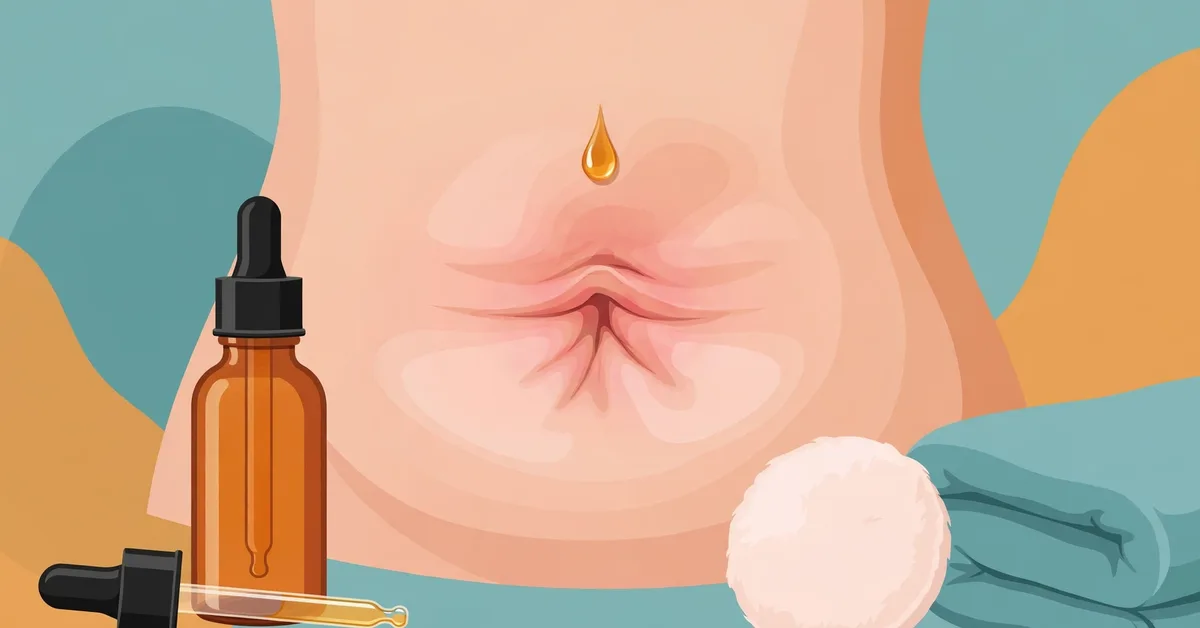
- At a glance: plausible skin risks vs invented benefits
- Why the navel is a particularly unforgiving place to pool oil
- Side effect 1: irritant contact dermatitis — the most likely problem
- Side effect 2: allergic contact dermatitis — less common, later, and itchier
- Side effect 3: infection risk — real conditions, not a scare story
- Side effect 4: the overnight routine itself — occlusion, staining and false reassurance
- Who should skip it altogether
- If your navel reacts: what to do, in order
- The myth check: navel pulling and the Pechoti method, claim by claim
- Claim: the Pechoti gland behind the navel absorbs oil into the body
- Claim: oil in the navel detoxifies the body and the liver
- Claim: it improves digestion, bloating and constipation
- Claim: it improves fertility and eases period pain or endometriosis
- Claim: it balances hormones
- Claim: it melts belly fat and causes weight loss
- Claim: it improves sleep
- Why the navel is not an absorption gateway — in one paragraph
- Pregnancy: separating the oral evidence from the topical claim
- If you still want to try it: the least-risk version
- The bottom line
The side effects of applying castor oil in the belly button are almost entirely skin effects — and that is exactly the point. A few drops of a thick oil pooled in a deep, moist skin fold can irritate the skin, trigger irritant or allergic contact dermatitis in susceptible people, make the navel harder to keep clean and dry, and stain skin, clothing and bedding. What it has not been shown to do is the long list of internal effects viral videos promise: it does not detoxify your liver, fix your digestion, balance hormones, improve fertility or melt belly fat. In an adult, the belly button is a healed scar, not an absorption gateway to your organs. This page is the safety file for the practice: first, what can actually go wrong and how to recognise it; second, a claim-by-claim myth check of the “navel pulling” or Pechoti method; and finally, the least-risk way to handle the oil if you still want to try it. For the practice itself — what navel pulling is and where it comes from — see our main guide to castor oil in the belly button.
At a glance: plausible skin risks vs invented benefits
Most confusion around this trend comes from mixing two very different lists. The first list is short, local and plausible: things an oil can do to skin it touches for hours. The second list is long, internal and unsupported: things an oil would have to travel through the body to do, with no demonstrated route and no clinical trial behind it.

| Claim or effect | Verdict | Why |
|---|---|---|
| Red, itchy, burning skin in or around the navel | Plausible and documented for castor oil on skin | Castor oil can cause irritant and allergic contact dermatitis; the navel traps it against skin for hours |
| Moisture, odour and a harder-to-clean navel | Plausible | The navel is a fold that already collects sweat, lint and dead skin; pooled oil adds occlusion |
| Infection in an unclean, broken or pierced navel | Possible in the wrong conditions | Oil does not create infection by itself, but broken skin plus a moist, unclean fold raises the risk |
| Detox, digestion, fertility, hormone and fat-loss effects | Not supported by evidence | No Pechoti gland, no open route from the adult navel to organs, and no clinical trials of navel application for these outcomes |
| Softer, less dry skin where the oil touches | Plausible, and modest | Castor oil is an occlusive moisturiser — a surface effect, not a treatment for anything underneath |
There is no reliable percentage for how often navel application causes a reaction, because the practice has not been studied that way. Be wary of any source that quotes a precise reaction rate for it. What the dermatology literature does document is castor oil itself as a contact allergen in cosmetics: a narrative review of castor oil in dermatology notes that it is generally well tolerated but that contact dermatitis has been reported, and case reports describe allergic contact dermatitis confirmed by patch testing with castor oil “as is” (Use of Castor Oil in Dermatology, PMC ).
Why the navel is a particularly unforgiving place to pool oil
On flat skin — an arm, a cheek — excess oil spreads, transfers to clothing and partly wears off. The navel does none of that. Especially in a deep “innie,” the navel is a narrow, folded pocket. Sweat, shed skin cells, clothing lint and ordinary skin bacteria and yeast collect there even in people who wash regularly. It stays warmer and damper than surrounding skin, and it is easy to miss when drying after a shower.
Now add the viral routine: fill the pocket with a viscous oil, sometimes pack it with cotton, cover it, and leave it overnight. That is prolonged occlusion of a moist fold — the same basic setup dermatologists warn about with any product, because occlusion increases contact time, softens and over-hydrates the outer skin layer, and makes the area harder to clean and dry afterwards. None of this means a reaction is inevitable. Many people will do this and notice nothing but an oily navel. It does mean that if your skin is going to object to castor oil anywhere, a sealed navel gives it the best possible opportunity — and that “I used it on my arm with no problem” does not fully predict the navel.
Side effect 1: irritant contact dermatitis — the most likely problem
Irritant contact dermatitis is direct skin irritation, not an allergy. It does not require prior sensitisation and can happen on first use if contact is long or the skin barrier is already stressed. DermNet describes irritant contact dermatitis as a reaction to direct chemical or physical injury to the skin, with redness, burning or stinging, dryness and soreness at the contact site (DermNet: Irritant contact dermatitis).

In the navel, expect some combination of redness confined to where the oil sat, burning or stinging rather than pure itch, tenderness when clothing rubs, and afterwards dry, flaky or slightly raw skin in the fold. Prolonged or repeated application, oil left under a cover overnight, scrubbing the navel hard to “clean it out,” and layering fragranced products or essential oils over the top all push in the wrong direction. So does applying the oil to skin that is already red, cracked or sore — at that point you are no longer testing a cosmetic on healthy skin, you are occluding a damaged barrier.
The usual course is reassuring: stop the oil, wash gently, dry carefully, and uncomplicated irritation settles over days. What should change your mind is progression — spreading redness, swelling, blistering, weeping, or pain that increases instead of fading. Those features point away from simple irritation.
Side effect 2: allergic contact dermatitis — less common, later, and itchier
Allergic contact dermatitis is an immune reaction. It requires sensitisation first, which is why a person can use a product several times without trouble and then react — earlier uneventful use does not rule allergy out. DermNet notes that allergic contact dermatitis is a delayed hypersensitivity reaction, typically appearing a day or more after contact, dominated by itch, and sometimes spreading a little beyond the exact contact area (DermNet: Allergic contact dermatitis and DermNet: Contact dermatitis).
Castor oil belongs on the list of possible allergens, without exaggeration in either direction. Allergic contact dermatitis to castor oil and to its derivatives has been reported in the medical literature, usually from cosmetics such as lip products and deodorants, with ricinoleic acid — the main fatty acid in castor oil — identified as the likely sensitiser. At the same time, the dermatology review literature describes these reactions as uncommon. The honest summary is: documented, real, not common, and impossible to rule out in advance for any individual. That is precisely the situation patch testing exists for. A dermatologist’s patch test applies small amounts of suspected allergens under chambers on the back for about 48 hours, with readings over the following days; it is a different and far more informative procedure than dabbing oil on your wrist at home, although a home trial on a small patch of skin is still a sensible first screen before putting any new product in a skin fold overnight (see the American Academy of Dermatology’s guidance on testing skin care products).
If a navel rash is intensely itchy, appears a day or two after application, includes small blisters, or keeps returning whenever you use the oil, stop and treat allergy as a live possibility rather than pushing through with “detox reactions” — a phrase with no medical meaning for a rash. A rash is information, not progress.
Side effect 3: infection risk — real conditions, not a scare story
Castor oil does not infect a healthy navel. Infection needs an opening and an opportunity, and the honest risk discussion is about when those are present:
- An unclean navel. A fold already carrying a build-up of debris and moisture is a worse starting point than a clean, dry one. Adding oil without cleaning first seals in whatever is already there.
- Broken or inflamed skin. A crack, a rash you are already scratching, eczema in the fold, or skin broken by aggressive cleaning gives bacteria and yeast a way in that intact skin denies them.
- A healing or irritated piercing. A navel piercing is a wound channel through the fold. Oil does not belong in or around a healing piercing, and a piercing that is already red, swollen or draining needs assessment, not oil.
- Recent surgery or a non-healed scar. Do not apply cosmetic oils to surgical wounds or scars unless your surgical team has said to.
- Diabetes or a weakened immune system. Skin infections can progress faster and matter more. The threshold for getting a red, painful navel looked at should be lower, not higher.
Learn the difference in feel between irritation and infection. Irritation stays where the oil was, burns or itches, and improves once you stop. Infection tends to spread: expanding redness and warmth, increasing pain or swelling, yellow or foul-smelling discharge, a bad odour that washing does not fix, and sometimes fever. Those signs — in the navel as anywhere else — are a reason to seek medical care promptly rather than to add more oil, antiseptic cocktails or home remedies. Adding oil to an infected or possibly infected navel can also obscure what a clinician needs to see.
Side effect 4: the overnight routine itself — occlusion, staining and false reassurance
Three smaller problems attach to how the trend is practised rather than to the oil alone. First, prolonged occlusion: the longer any potential irritant or allergen sits sealed against skin, the greater the exposure. Overnight application is not a stronger version of a benefit — there is no demonstrated benefit to strengthen — it is simply a longer exposure to the risk side of the ledger. Second, staining and residue: castor oil is thick and slow to wash out of a deep fold, and it stains clothing and bedding readily; residue left behind day after day is itself a hygiene problem. Third, and most important, delayed care: the most consequential side effect of navel pulling is not dermatological at all. Bloating that is new and persistent, pelvic pain, a change in bowel habit, or trouble conceiving are symptoms with real causes and real evaluations. Weeks spent oiling a navel instead of getting them checked is a cost no skin reaction needs to occur for you to pay.

Who should skip it altogether
- Anyone whose navel is currently red, itchy, sore, weeping, draining or bad-smelling — get the skin problem identified first.
- Anyone with a healing navel piercing, a recent abdominal operation, or an unhealed scar in the area.
- Anyone with known allergy to castor oil or a history of allergic contact dermatitis to cosmetics — or with eczema affecting the navel fold.
- Anyone who is pregnant and considering castor oil in any form for contractions or labour — see the pregnancy section below; this needs a maternity clinician, not a viral routine.
- Anyone mainly hoping to treat a persistent digestive, pelvic or fertility problem — the oil cannot do that job, and the symptom deserves its own work-up.
If your navel reacts: what to do, in order
- Stop the oil. Do not reapply “one more night to check.”
- Wash gently with mild soap and lukewarm water, rinse well, and pat — do not scrub — the fold completely dry.
- Leave it alone. Do not layer essential oils, antiseptics, steroid creams you happen to have, or a different viral remedy over a fresh reaction unless a clinician advises it; you will lose track of what is helping or harming.
- Watch for 48–72 hours. Simple irritation should be clearly improving. Photographing the area once a day is a practical way to judge spread.
- Seek care promptly for spreading redness, warmth, swelling, increasing pain, discharge, fever, blistering, swelling of surrounding skin, or trouble breathing or lip/tongue swelling after any product — the last two are urgent.
- If it keeps happening, ask about patch testing. Identifying a castor oil allergy properly is more useful than guessing product by product for years.
The myth check: navel pulling and the Pechoti method, claim by claim
The practice is usually presented as one bundle — oil the navel, improve everything. Unbundled, each claim fails or survives on its own evidence. The shared root claim comes first, because most of the others depend on it.
Claim: the Pechoti gland behind the navel absorbs oil into the body
Verdict: no such structure is recognised in human anatomy. The “Pechoti gland” (also spelled Pichoti) does not appear in anatomical references, and no gland sits behind the adult navel distributing substances to organs. What is actually there is scar tissue. Before birth, the umbilical cord carried blood between the placenta and the baby through one vein and two arteries; after the cord is cut, those vessels close and remodel into ligaments. The adult navel is skin and scar over the abdominal wall — sealed, not open. Traditional Ayurvedic practice does treat the navel (nabhi) as an important centre, and that tradition is the honest origin of navel oiling; but a traditional framework is not evidence of a gland, and the gland claim should not be repeated as anatomy.
Claim: oil in the navel detoxifies the body and the liver
Verdict: unsupported. Detoxification is performed continuously by your liver and kidneys; a “detox” claim has to name a substance and show the method removes it, and no study shows navel oiling removing anything. The National Center for Complementary and Integrative Health notes that detox and cleanse programmes are not supported by convincing evidence and can carry risks of their own (NCCIH: Detoxes and cleanses ). Dark residue on a cloth after navel oiling is oil mixed with lint, sweat and shed skin — which is what you would expect from cleaning any skin fold, and is not a toxin leaving your liver.
Claim: it improves digestion, bloating and constipation
Verdict: unsupported for navel application; the real laxative effect belongs to a different route. Castor oil’s one established medical use is as an oral stimulant laxative for occasional constipation. Taken by mouth, intestinal lipases break it down and release ricinoleic acid, which activates prostaglandin EP3 receptors in intestinal smooth muscle and increases contractions — a mechanism demonstrated for the oral route (Tunaru et al., PNAS, via PMC ; StatPearls: Castor Oil, NCBI Bookshelf ). Oil sitting on skin does not meet intestinal lipases, does not reach those receptors in any demonstrated amount, and inherits none of that evidence. If oiling sessions feel soothing, the plausible contributors are the ones that come free with the ritual: lying down, warmth, and gentle abdominal massage, which can feel relaxing whether or not oil is involved. Small, older research on abdominal castor oil packs for constipation is sometimes quoted here; a pack study is not a navel study, and it does not establish the drops-in-the-belly-button routine. Note also that the oral route has its own real downsides — cramping, diarrhoea and dehydration — which we cover separately in drinking castor oil: benefits and risks. “The topical version did nothing, so I will drink it” is not a safe escalation.
Claim: it improves fertility and eases period pain or endometriosis
Verdict: unsupported, and this is where delay costs most. No clinical study shows navel-applied castor oil improving fertility, ovulation, ovarian cysts or endometriosis. Fertility has identifiable, often treatable causes on both partners’ sides, and endometriosis is a medical condition with its own diagnostic pathway; both lose time to an oil ritual. Warmth over the lower abdomen can feel comforting during period pain — a hot water bottle does that without oil in a skin fold — but comfort is not treatment, and new, worsening or one-sided pelvic pain needs evaluation.
Claim: it balances hormones
Verdict: too vague to be true, and unsupported in any specific form. “Hormone balance” names no hormone, no condition and no measurable change. There is no evidence that oil on the navel alters any hormone level, and no plausible route by which it would. If you have symptoms you attribute to hormones — irregular cycles, acne, hair changes, fatigue — a blood test and a clinician will tell you more in one visit than months of navel oiling.
Claim: it melts belly fat and causes weight loss
Verdict: unsupported. No topical oil breaks down adipose tissue through intact skin, and no trial shows weight or waist change from navel application. A stomach that looks flatter the next morning after a night of oiling, a smaller dinner and a bowel movement is showing ordinary day-to-day variation in bloating and gut contents, not fat loss.
Claim: it improves sleep
Verdict: the ritual may be relaxing; the oil has no demonstrated sleep effect. A quiet, screen-free bedtime routine can genuinely help you wind down. That benefit belongs to the routine and would survive swapping the oil for any other calm ritual — which is a fine reason to keep a routine you enjoy, as long as your skin tolerates it and you do not credit the oil with treating insomnia.
Why the navel is not an absorption gateway — in one paragraph
Skin does absorb some substances; that is true, and it is also not enough. Medicated patches work because a specific drug, at a specific dose, in an engineered delivery system, was tested for that exact route. An oil in the navel has none of that: no demonstrated dose reaching the bloodstream, no target organ, no trial. Ordinary skin absorption of an oil is a local, surface-level event — which is why the plausible effects of this practice are all skin effects (moisturising where it touches; dermatitis where it irritates) and the implausible ones are all organ effects. If a claim requires the oil to reach your liver, ovaries or intestines, the burden of proof is on the claim, and so far it has not been met.
Pregnancy: separating the oral evidence from the topical claim
Pregnancy deserves precision, because sloppy versions of this warning cut both ways. The documented uterine effect belongs to oral castor oil: swallowed ricinoleic acid can stimulate uterine as well as intestinal smooth muscle, which is why oral castor oil has a long, risky history of use to try to induce labour and why clinicians advise against self-using it. There is no evidence that oil placed in the navel produces that effect — repeating the oral warning as if it were proven for navel application would be inventing a risk. The correct advice is simpler and covers both: do not use castor oil by any route to try to start labour or treat pregnancy symptoms, and ask your maternity clinician before adding topical routines in pregnancy, especially over broken or irritated skin. Honesty about what is proven for which route is what makes the real warnings believable.
If you still want to try it: the least-risk version
- Make the goal skin care, not treatment. If the aim is softer skin around the navel, a plain fragrance-free moisturiser does the same job with a wider safety record.
- Start clean and dry. Wash the navel gently, rinse, and dry the fold completely before any application — never oil over a dirty, damp or irritated fold.
- Screen first. Try a small amount on a small patch of skin (for example the inner forearm) once daily for several days and watch for itch, redness or swelling before using it in the navel — following the approach the AAD recommends for new skin products. A clear screen lowers risk; it does not guarantee the occluded navel will agree.
- Use little, briefly, uncovered. A drop or two on the surrounding skin for a short period is a smaller exposure than a filled, cotton-packed, overnight-sealed navel. There is no evidence-based “healing schedule,” and more time is not more benefit.
- Keep it plain. Choose a product intended for skin use, check the full ingredient list, and do not add essential oils or fragrance — extra ingredients are extra allergen candidates. “Cold-pressed” or “organic” on a label says nothing about whether your skin will tolerate it.
- Stop at the first reaction and follow the response steps above. Do not rotate through brands hoping one will not cause the same dermatitis.
- Keep routes separate. Skin use is not a rehearsal for drinking it, and the face is its own risk picture again — see castor oil on the face overnight: side effects before assuming what suits one area suits another.
The bottom line
The side effects of applying castor oil in the belly button are local, dermatological and manageable for most people — irritation, possible allergy, a harder-to-clean moist fold, and a small infection risk when the skin is broken, pierced or unclean — provided you stop at the first sign of trouble. The benefits claimed for the practice are a different category of statement: detox, digestion, fertility, hormone and fat-loss effects require an absorption gateway that adult anatomy does not provide, through a gland that has never been found, supported by trials that have never been run. Enjoy a calm bedtime ritual if you like one. Just do not ask a few drops of oil in a scar to do a liver’s, an ovary’s or an intestine’s job — and do not let it postpone care for a symptom that deserves a real answer.
This article is educational information from the HealthEH Team and is not medical advice. It does not replace evaluation by your own clinician or dermatologist, especially for a spreading rash, signs of infection, persistent digestive or pelvic symptoms, fertility concerns, or any use in pregnancy.
Frequently Asked Questions
Yes. The most likely side effect is skin irritation (irritant contact dermatitis) where the oil sits, and allergic contact dermatitis to castor oil is also documented in the dermatology literature, though uncommon. A rash that is intensely itchy, appears a day or two after use, blisters, or returns every time you apply the oil should be treated as a possible allergy — stop using it and consider patch testing.
Irritation stays where the oil was applied, burns or itches, and starts improving within a few days of stopping. Infection tends to spread: expanding redness and warmth, increasing pain or swelling, yellow or foul-smelling discharge, an odour that washing does not fix, or fever. Those signs need prompt medical care rather than more oil or home remedies.
No structure by that name is recognised in human anatomy. The adult belly button is healed scar tissue; the umbilical vein and arteries from before birth closed and became ligaments. There is no gland behind the navel that absorbs oils and distributes them to organs, which is why claims built on Pechoti absorption have no anatomical basis.
There is no clinical evidence that it does any of these. Detoxification is done by your liver and kidneys, castor oil’s proven laxative effect only occurs when it is swallowed and broken down in the intestine, and no study shows navel application affecting fertility. Gentle massage, warmth and a relaxing ritual may feel soothing, but that is not the oil treating an internal organ.
The documented risk of uterine contractions belongs to oral castor oil, which should never be used to try to start labour. There is no evidence that oil placed in the navel has that effect — but the safe course is still to ask your maternity clinician before using castor oil in any form during pregnancy, and never to use it on broken or irritated skin.
Stop using it, wash the area gently with mild soap and water, pat the fold completely dry, and do not layer other products over the reaction. Simple irritation should clearly improve within 48–72 hours. Seek care promptly for spreading redness, warmth, swelling, discharge, increasing pain, blistering or fever, and urgently for any swelling of the lips or tongue or trouble breathing.
Overnight, covered application is the highest-exposure version of the practice: prolonged occlusion of a moist skin fold increases contact time with a possible irritant or allergen, with no demonstrated extra benefit. If you use castor oil on the skin at all, a small amount, briefly and uncovered, on clean, dry, unbroken skin is the lower-risk approach — and stop at the first sign of a reaction.
Read Next





Related Posts

White Specks in Stool
Aug 28, 2026 • 32 min read
Why You Get Hiccups When Drinking (And How to Stop Them)
Sep 23, 2026 • 29 min read
How SNL Comedian Kenan Thompson Manages GERD Symptoms After Diagnosis
Sep 26, 2026 • 17 min read
Proteolytic Enzymes: How They Work, Benefits and Sources
Sep 13, 2026 • 12 min read
Retroperitoneal Inflammation
Sep 12, 2026 • 22 min read