Egg Vitamin Chart: The Vitamins in a Whole Egg, Yolk vs White

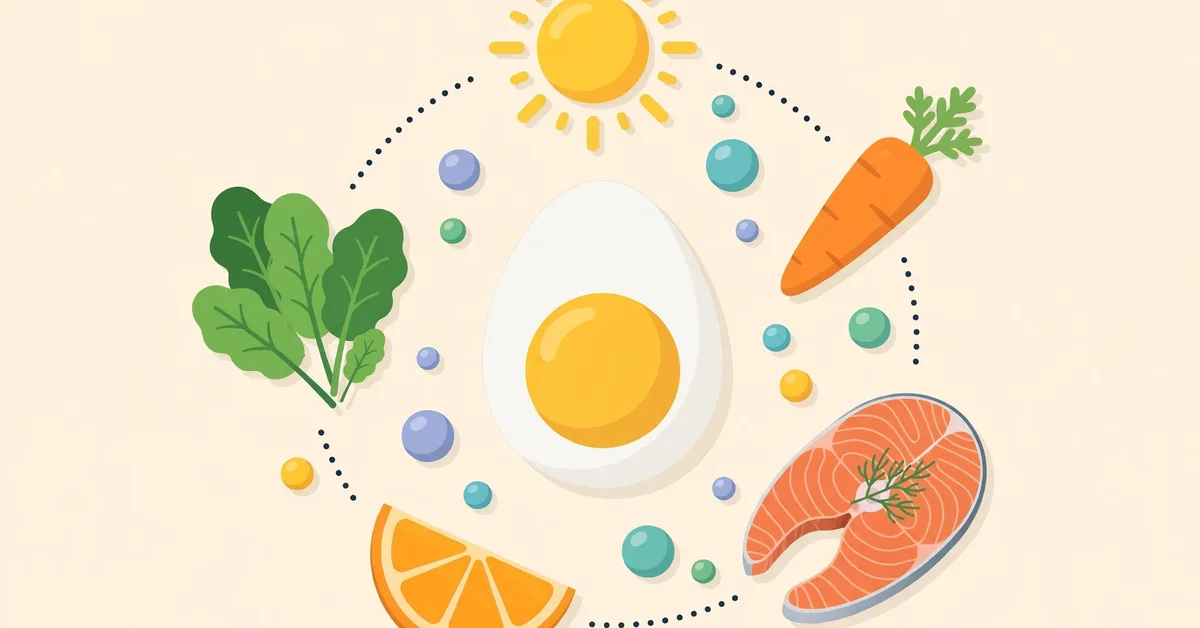
One large egg contains 12 of the 13 recognised vitamins — everything except vitamin C — plus choline, a vitamin-like nutrient most people get too little of. But those vitamins are not spread evenly through the egg: almost all of them sit in the yolk, while the white is essentially protein and water with a single B vitamin to its name. The chart below puts the whole picture on one page: every vitamin in a whole egg, per egg and per 100 grams, with its share of the daily value, where in the egg it lives, what cooking does to it, and how the egg stacks up against other common vitamin sources.
All values come from the US Department of Agriculture’s FoodData Central database (USDA FDC), the reference dataset behind most nutrition labels. The headline entry is Egg, whole, raw, fresh (FDC ID 171287); per-egg figures are that entry scaled to one large egg of 50 grams, the standard USDA reference size. Percent daily values (%DV) use the US Food and Drug Administration’s reference values for adults.

The egg vitamin chart: every vitamin in one large egg
| Vitamin | Per 1 large egg (50 g) | Per 100 g | %DV per egg | Where it sits |
|---|---|---|---|---|
| Vitamin A (RAE) | 80 mcg | 160 mcg | 9% | Yolk only |
| Vitamin D (D2 + D3) | 1.0 mcg (41 IU) | 2.0 mcg | 5% | Yolk only |
| Vitamin E | 0.5 mg | 1.05 mg | 4% | Yolk only |
| Vitamin K | 0.2 mcg | 0.3 mcg | 0% | Yolk only |
| Vitamin C | 0 mg | 0 mg | 0% | Absent |
| Thiamin (B1) | 0.02 mg | 0.04 mg | 2% | Mostly yolk |
| Riboflavin (B2) | 0.23 mg | 0.46 mg | 18% | Split — white holds more |
| Niacin (B3) | 0.04 mg | 0.08 mg | 0% | Split — white holds slightly more |
| Pantothenic acid (B5) | 0.77 mg | 1.53 mg | 15% | Mostly yolk |
| Vitamin B6 | 0.09 mg | 0.17 mg | 5% | Mostly yolk |
| Folate (B9) | 24 mcg | 47 mcg | 6% | Almost all yolk |
| Vitamin B12 | 0.45 mcg | 0.89 mcg | 19% | Almost all yolk |
| Biotin (B7)* | ~10 mcg | ~20 mcg | ~20% of the UK NRV | Yolk |
| Choline (vitamin-like) | 147 mg | 294 mg | 27% | Almost all yolk |
*Biotin is the one row the USDA SR Legacy egg entries do not report. The biotin figures are from the British Egg Industry Council’s Egg Info tables, which draw on McCance and Widdow’s The Composition of Foods — the UK reference dataset — for a medium egg; treat them as close estimates, not USDA values. Choline is not officially a vitamin, but it is an essential nutrient with a daily value, and eggs are one of its richest common sources, so it belongs on this chart. One egg also provides about 6.3 g of protein, 72 calories and 15.4 mcg of selenium (28% DV), a mineral in which the egg punches well above its size.
Read the chart by its right-hand column and a pattern jumps out: an egg is really two foods in one shell. The yolk is the vitamin store. The white is a protein delivery system. The next section proves that with the USDA’s own separate entries for yolk and white.
Yolk vs white: where each vitamin actually lives
USDA FoodData Central analyses the yolk and the white as separate foods — Egg, yolk, raw, fresh (FDC ID 172184) and Egg, white, raw, fresh (FDC ID 172183). Put side by side per 100 grams, the split is stark:

| Vitamin (per 100 g) | Egg yolk | Egg white | Verdict |
|---|---|---|---|
| Vitamin A (RAE) | 381 mcg | 0 mcg | 100% yolk |
| Vitamin D | 5.4 mcg | 0 mcg | 100% yolk |
| Vitamin E | 2.58 mg | 0 mg | 100% yolk |
| Vitamin K | 0.7 mcg | 0 mcg | 100% yolk |
| Thiamin (B1) | 0.18 mg | 0.004 mg | Yolk, by a wide margin |
| Riboflavin (B2) | 0.53 mg | 0.44 mg | Close — and per piece, the white wins |
| Niacin (B3) | 0.02 mg | 0.11 mg | White holds more (both amounts are tiny) |
| Pantothenic acid (B5) | 2.99 mg | 0.19 mg | Yolk |
| Vitamin B6 | 0.35 mg | 0.005 mg | Yolk |
| Folate (B9) | 146 mcg | 4 mcg | Yolk |
| Vitamin B12 | 1.95 mcg | 0.09 mcg | Yolk |
| Choline | 820 mg | 1.1 mg | Yolk, almost entirely |
| Lutein + zeaxanthin | 1,094 mcg | 0 mcg | Yolk — these give it its colour |
| Selenium (mineral) | 56 mcg | 20 mcg | Both — the white’s one strong mineral |
Why does the yolk hold everything? Because the yolk is the food supply the hen packed for a developing chick: it contains all of the egg’s fat, and the fat-soluble vitamins A, D, E and K can only exist dissolved in that fat. A fat-free white physically cannot store them. The water-soluble B vitamins mostly follow the yolk too, because that is where the living tissue would have grown.
Scaled to the pieces you actually crack — one yolk of about 17 g and one white of about 33 g — the picture sharpens further. The yolk alone delivers roughly 65 mcg of vitamin A, 0.9 mcg of vitamin D, 0.33 mcg of B12, 25 mcg of folate and about 139 mg of choline. The white’s one genuine vitamin contribution is riboflavin: at about 0.15 mg per white, it actually supplies more B2 than the yolk’s 0.09 mg, because the white is twice the yolk’s weight and nearly as concentrated in B2. That makes riboflavin the exception that proves the rule — and it is why our separate deep dive into egg whites nutrition still finds one vitamin worth crediting to the white, even though the white’s real job is its 3.6 g of fat-free protein.
The practical consequence is simple: every time a yolk goes in the bin, the egg’s entire supply of vitamins A, D, E and K, almost all of its B12, folate and choline, and its eye-health carotenoids lutein and zeaxanthin go with it. What remains is an excellent protein food — but calling it the nutritious half of the egg gets the chart exactly backwards.
The standouts, the honest gaps, and the one missing vitamin
Choline is the egg’s headline act. At 147 mg per egg (27% DV), few everyday foods come close per serving, and choline matters for liver function, cell membranes and the neurotransmitter acetylcholine. It is also the nutrient people most consistently under-consume, which makes the yolk’s 820 mg per 100 g genuinely valuable rather than a chart curiosity.
B12 and riboflavin are the strong B vitamins. One egg covers about 19% of the day’s B12 and 18% of its riboflavin — meaningful for a 72-calorie food, and part of why eggs appear on most lists of vitamin B12 foods despite meat and fish ranking higher per 100 g. Pantothenic acid (15% DV) and folate (6% DV) contribute usefully; thiamin, B6 and niacin are present but small.
Vitamin D is real but modest. Eggs are one of the very few foods that naturally contain vitamin D at all, which earns them outsized attention — but one egg provides about 1.0 mcg, roughly 5% of the 20 mcg daily value. The NHS vitamin D guidance makes the same point from the other direction: food alone rarely covers vitamin D needs, which come mainly from sunlight and, where advised, supplements. Enjoy the egg’s contribution; do not mistake it for a vitamin D strategy.
Vitamin C is the missing vitamin — the answer is zero. Hens do not store ascorbic acid in eggs, so a whole egg contains 0 mg of vitamin C however it is cooked. If you are checking this chart because you want to cover your bases with breakfast, pair the eggs with a vitamin C food — our explainer on whether eggs contain vitamin C covers why the gap exists and what it means for iron absorption from the yolk. Vitamin K is the other near-zero: at 0.3 mcg per 100 g, eggs are not a meaningful K source.
One more honest caveat: these are reference values for a standard large egg. A yolk’s vitamin content shifts with the hen’s diet — vitamin D and vitamin A in particular rise when feed is enriched, which is why some cartons legitimately advertise higher vitamin D eggs — and egg size changes the per-egg column while leaving the per-100 g column intact. If you are counting precisely, weigh your eggs or use the per-100 g column.
What two eggs a day actually cover
Most people who eat eggs daily eat two, so here is the chart’s bottom line doubled: two large eggs provide about 294 mg of choline (about 53% DV), 0.9 mcg of vitamin B12 (about 37% DV), 0.46 mg of riboflavin (about 35% DV), 160 mcg of vitamin A (about 18% DV), 1.5 mg of pantothenic acid (about 31% DV), 48 mcg of folate (about 12% DV), 2.0 mcg of vitamin D (about 10% DV) and 30.8 mcg of selenium (about 56% DV) — inside roughly 144 calories and 12.6 g of protein. That is a serious contribution to the B-complex and choline from a single cheap food, and simultaneously a clear map of what eggs will never cover for you: vitamin C (0%), vitamin K (about 1%) and the bulk of your vitamin D and folate. For the calorie side of the same calculation, see our breakdown of calories in an egg by size and cooking method.
How cooking changes the chart
Cooking does not wipe the chart clean — but the USDA’s separate cooked entries let us compare methods honestly instead of guessing. Values per 100 g, from FDC entries for hard-boiled (173424), poached (172186), scrambled (172187) and fried (173423) egg against the raw baseline (171287):
| Per 100 g | Raw | Hard-boiled | Poached | Scrambled | Fried |
|---|---|---|---|---|---|
| Vitamin A (mcg RAE) | 160 | 149 | 160 | 161 | 219 |
| Vitamin D (mcg) | 2.0 | 2.2 | 2.0 | 1.8 | 2.2 |
| Vitamin B12 (mcg) | 0.89 | 1.11 | 0.71 | 0.76 | 0.97 |
| Folate (mcg) | 47 | 44 | 35 | 36 | 51 |
| Riboflavin (mg) | 0.46 | 0.51 | 0.39 | 0.38 | 0.50 |
| Choline (mg) | 294 | 294 | 234 | 221 | 317 |
Read those differences carefully, because most of them are not destruction. These are different analysed samples, and cooking moves water and fat, which moves every per-100 g number: a fried egg loses water and gains cooking fat, concentrating some nutrients (vitamin A reads higher) while a poached egg takes up water and reads lower for folate, B12 and choline. Scrambled eggs are typically analysed with added milk and fat, diluting the egg itself. What the table does support is narrower and more useful: the fat-soluble vitamins A and D survive every common cooking method essentially intact, and no method zeroes out any vitamin. The water-soluble B vitamins are the more heat- and water-sensitive group, so the gentle habits still hold — avoid prolonged high heat and hard overcooking, do not boil eggs for far longer than needed, and remember that cooking the white properly also matters for protein quality and food safety, a balance our egg-white guide covers in depth. Raw eggs, for the record, are not a vitamin shortcut: the chart values are similar, and raw white contains avidin, a protein that binds biotin until heat disables it.
Egg vs other vitamin sources: where the egg wins and loses
A chart is only useful in context, so here is the egg (per 100 g, FDC 171287) against three familiar foods on the vitamins each is known for — wild Atlantic salmon (FDC 173686), raw spinach (FDC 168462) and navel oranges (FDC 746771), all USDA values per 100 g:
| Per 100 g | Whole egg | Salmon | Spinach | Orange |
|---|---|---|---|---|
| Vitamin B12 | 0.89 mcg | 3.18 mcg | 0 mcg | 0 mcg |
| Vitamin A (RAE) | 160 mcg | 12 mcg | 469 mcg | — |
| Vitamin C | 0 mg | 0 mg | 28.1 mg | 59.1 mg |
| Folate | 47 mcg | 25 mcg | 194 mcg | 25 mcg |
| Vitamin K | 0.3 mcg | — | 482.9 mcg | 0 mcg |
| Choline | 294 mg | — | 19.3 mg | — |
| Selenium | 30.7 mcg | 36.5 mcg | 1.0 mcg | 0 mcg |
The pattern is the real lesson of this chart. Salmon beats the egg decisively on B12; spinach beats it on A, folate and K by multiples and adds the vitamin C eggs lack entirely; an orange is a vitamin C food in a way no egg can be. The egg’s win is breadth in a tiny package: it is the only food on this table that contributes B12, choline, vitamin D, vitamin A and selenium all at once, in a 50-gram serving that costs very little and cooks in minutes. Nutrition charts reward specialists for single nutrients and generalists for covering gaps — the egg is a generalist, and the yolk is where the generalising happens. UK reference data compiled by Egg Info tells the same story with European reference values, including the biotin row used in the main chart above.
The bottom line
Keep the yolk and you keep the vitamins: a whole large egg delivers 12 of the 13 vitamins plus 27% of your daily choline, with its strongest showings in B12 (19% DV), riboflavin (18% DV) and pantothenic acid (15% DV) — and essentially all of it rides in 17 grams of yolk. Eat only the white and the chart collapses to riboflavin, selenium and protein. Cook eggs however you enjoy them; the vitamins survive ordinary cooking, with gentle methods best for the B group. Then cover the egg’s genuine gaps — vitamin C, vitamin K, and most of your vitamin D and folate — with the vegetables, fruit and daylight the chart shows it cannot replace.
This article is general nutrition information based on USDA reference data and is not medical or dietary advice for any individual. Nutrient values vary with egg size, hen diet and cooking method. If you have a diagnosed deficiency or a condition affected by diet, consult a qualified healthcare professional or registered dietitian.
Frequently Asked Questions
A whole large egg contains 12 of the 13 recognised vitamins: A, D, E and K, plus thiamin (B1), riboflavin (B2), niacin (B3), pantothenic acid (B5), B6, folate (B9), B12 and biotin (B7) — along with 147 mg of choline, a vitamin-like essential nutrient. The only vitamin entirely absent is vitamin C, which USDA FoodData Central lists at 0 mg for whole egg.
Almost all of them. USDA data for yolk and white analysed separately show the yolk holds 100% of the egg’s vitamins A, D, E and K and the large majority of its B12, folate, B6, pantothenic acid and choline, because it contains all of the egg’s fat. The white’s one real vitamin contribution is riboflavin (B2) — per piece, a white actually provides slightly more B2 than a yolk — plus a share of the egg’s selenium.
One large egg provides about 1.0 mcg of vitamin D (41 IU), roughly 5% of the 20 mcg daily value, all of it in the yolk. Eggs are one of the few foods that naturally contain vitamin D, but the amount is modest — food alone rarely covers vitamin D needs, which depend mainly on sunlight and, where advised, supplements.
No. Comparing USDA entries per 100 g, hard-boiled, poached, scrambled and fried eggs all retain their vitamin A and D almost fully, and no cooking method removes any vitamin entirely. The B vitamins are the more sensitive group — poached and scrambled entries read somewhat lower for folate, B12 and choline, largely because of water uptake and added ingredients — so gentle cooking without prolonged high heat is the best habit, and it also makes egg protein more digestible and the white safe to eat.
One large egg provides about 0.45 mcg of vitamin B12, roughly 19% of the 2.4 mcg daily value, so eggs alone would take about five eggs to cover a full day’s B12. In practice eggs work as one contributor among several: fish such as salmon provides about 3.18 mcg per 100 g, and meat and dairy add more, so two eggs at breakfast cover a useful share without being your only source.
Hens do not deposit ascorbic acid (vitamin C) into eggs, so a whole egg contains 0 mg of it in every USDA entry, raw or cooked. That is the egg’s one genuine vitamin gap, along with near-zero vitamin K. Pairing eggs with vitamin C foods such as peppers, citrus or tomatoes covers the gap — and the vitamin C also helps your body absorb the iron present in the yolk.


Related Posts
Can You Eat Pumpkin or Pumpkin Seeds Raw?
Sep 1, 2026 • 15 min read
10 Potential Health Benefits of Bee Pollen
Sep 11, 2026 • 17 min read
Asking for a Friend: Are ‘Hangover Shakes’ Normal?
Sep 25, 2026 • 6 min read
Refined vs. Unrefined Coconut Oil: What’s the Difference?
Sep 6, 2026 • 3 min read
6 Best Protein Powders for Weight Gain in 2025
Oct 2, 2026 • 9 min read