CBD Patches for Pain: How Transdermal Patches Work and What the Evidence Shows

- What is a CBD patch, exactly?
- How do CBD patches work?
- Matrix vs reservoir patches — why does the construction matter?
- Should you put the patch where it hurts?
- CBD patches vs CBD creams — which suits whom?
- What does the evidence actually show about CBD patches for pain?
- How do you read a CBD patch label?
- How do you use a CBD patch well?
- What are the risks and side effects?
- Could a CBD patch irritate your skin?
- Can CBD interact with medicines if it comes through the skin?
- Could a CBD patch affect a drug test?
- When should pain not just be patched over?
- The bottom line
Direct answer: A CBD patch is a small adhesive patch worn on the skin for many hours at a time. A true transdermal CBD patch is designed to move cannabidiol (CBD) through the skin and into the bloodstream slowly, rather than acting only where it is rubbed on like a cream. That design is why people consider CBD patches for pain that is present all day: one patch, no reapplying, no smell, and no measuring drops. The honest limit is just as important. There is no large human trial showing that a CBD patch relieves pain, most CBD products are not approved by the U.S. Food and Drug Administration (FDA) to treat pain, and much of what is said about patches is extrapolated from animal work, from studies of other CBD formats, and from how other transdermal medicines behave. A patch is a delivery format worth understanding — it is not a proven treatment.
This guide covers only the patch format: how matrix and reservoir patches are built, how long they are worn, who they suit better than a cream, how to read a patch label, and the safety points that matter more for a patch than for a cream — drug interactions, trace THC and drug testing, and skin irritation. If you want a tested roundup of creams instead, see our guide to the best CBD cream for pain.
What is a CBD patch, exactly?
A CBD patch looks like a plaster or a nicotine patch: a backing layer, a layer that holds the CBD, and an adhesive that keeps it against the skin until you peel it off. Manufacturers describe wear times that vary widely between products — commonly somewhere in the range of 8 to 24 hours, with some products marketed for considerably longer multi-day wear. There is no standard patch, which is the first thing to understand before comparing brands. Two patches that look identical can differ in how much CBD they contain, how they release it, what else is in them, and how long they are meant to stay on.

It also helps to separate two products that are often sold under the same name. Some patches are essentially topical patches: they are intended to act mainly in the skin and tissue under and around the patch, much like a cream held in place. Others are transdermal patches: they are formulated, usually with ingredients called permeation enhancers, with the explicit aim of getting CBD across the skin barrier and into the circulation. Reviews of cannabinoid delivery systems make this distinction central, because the skin is designed to keep most substances out; see the peer-reviewed review Cannabinoids and Pain: New Insights From Old Molecules . A label that says only “patch” does not tell you which of the two you are buying.
How do CBD patches work?
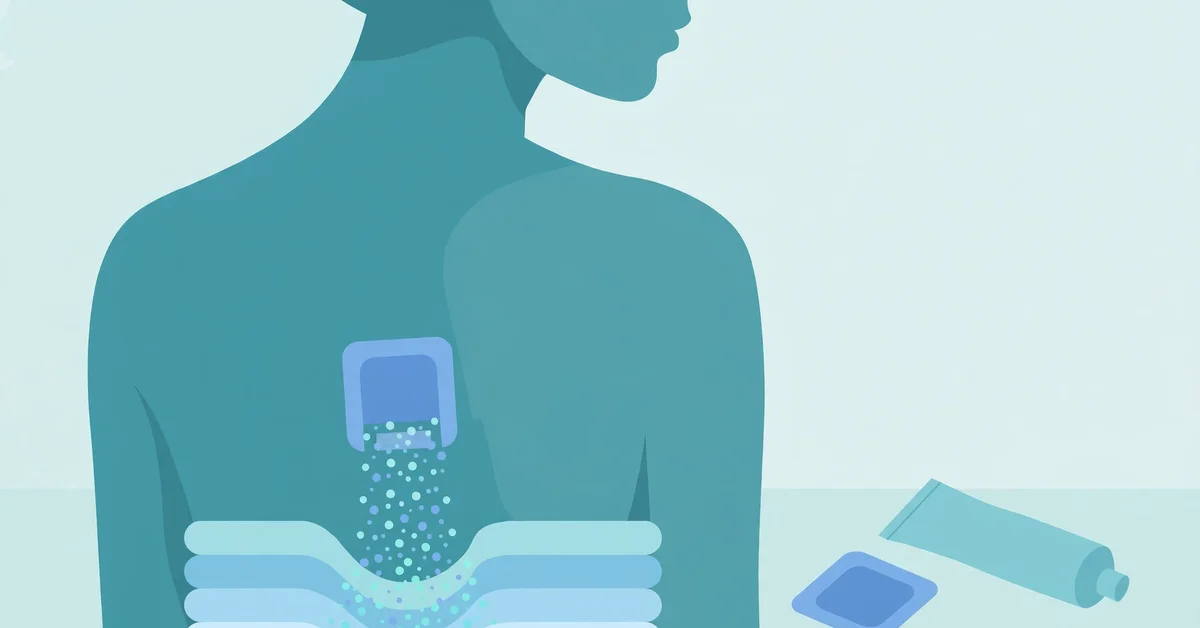
The outer layer of skin, the stratum corneum, is the main barrier. CBD is lipophilic — it dissolves in fat rather than water — which helps it move through the fatty pathways between skin cells, but the movement is still slow. Once a patch is on, CBD moves by diffusion from where its concentration is high, in the patch, to where it is lower, in the skin. From the deeper skin layer, the dermis, small blood vessels can pick it up. Because this route does not go through the digestive system, it avoids the breakdown that happens when CBD is swallowed and passes through the liver first, an effect usually called first-pass metabolism.

That is the mechanism. What it does not give you is a trustworthy number. Search results often quote precise absorption or bioavailability percentages and multipliers for patches. Those figures generally come from a specific experimental formulation, an animal study, or a manufacturer’s own material — not from head-to-head human testing of the patch on a shop shelf. Very few patch makers publish pharmacokinetic data showing how much CBD from their patch actually reaches the blood, and how fast. Treat any exact percentage on a sales page as a marketing claim, not a measured fact about that product. The National Center for Complementary and Integrative Health (NCCIH) overview of cannabis and cannabinoids is a useful reality check on how limited the human evidence still is for most non-prescription uses.
Matrix vs reservoir patches — why does the construction matter?
Almost no consumer guide explains this, and it affects everyday use.
Matrix patches hold the CBD mixed through the adhesive layer itself. The whole patch is the reservoir, so release is governed by that layer. Some manufacturers of matrix-style patches say the patch may be cut to make it smaller — but only follow that instruction if the maker of your patch states it in writing, because cutting also changes the dose in ways the label does not describe.
Reservoir patches hold the CBD in a separate compartment behind a membrane that controls how fast it leaves. That membrane is the metering device. A reservoir patch should never be cut: cutting it can damage the membrane and release the contents faster than intended. If a patch leaks, is torn, or will not stay flat, do not tape it down and carry on — remove it, wash the skin, and replace it according to the product instructions.
In practice, most CBD patch packaging does not state which design it uses. That absence is itself information: a company that cannot tell you how its patch controls release has not given you a way to judge its central claim.
Should you put the patch where it hurts?
Marketing usually says yes. Transdermal logic says it is more complicated, and both ideas appear in the same articles without anyone separating them.
For a topical-style patch, placement near the sore area is the whole point, in the same way you rub a cream onto a knee. For a true transdermal patch, the patch is trying to deliver CBD into the bloodstream, so placement is mainly about adhesion and absorption conditions: clean, dry, intact skin; a relatively flat area that will not be rubbed constantly by clothing or straps; and, in many product instructions, a softer area of skin rather than a bony or very hairy one. Common sites named in guides and product instructions include the inner wrist or forearm, the shoulder, the upper back, the lower back, and the thigh.
So do not judge a transdermal patch by whether you can stick it exactly on the painful point. Judge it by whether it stays on, stays comfortable, and is worn for its full stated time on skin that is not broken, sunburned, shaved that day, or already irritated.
CBD patches vs CBD creams — which suits whom?
A cream and a patch are not two strengths of the same thing. They are different routines with different strengths, which is why our CBD cream roundup and this patch guide do not substitute for each other.
| Question | CBD patch | CBD cream |
|---|---|---|
| How is it used? | Stick on once and wear for the stated hours; no reapplying during that time | Rubbed in by hand, usually reapplied during the day as directed |
| Where is it meant to act? | Transdermal patches aim through the skin toward the bloodstream; topical patches aim locally | Mainly in the skin and tissue where it is applied |
| Best routine fit | All-day, discreet wear under clothing; people who dislike smell, taste, or repeated dosing | A named sore spot you want to massage; people who like immediate cooling or warming sensations from other ingredients |
| Coverage | One small fixed area of skin at a time | Can cover a large area such as a whole back or both knees |
| Dose control | Fixed by the patch; you cannot easily take a little more or less mid-wear | Amount per use is flexible, but also easy to apply inconsistently |
| Main nuisance | Adhesive irritation, patch lifting, cost per day of wear | Mess, scent, reapplying, greasy hands or clothing |
| Safety emphasis | Systemic delivery makes drug interactions and THC content more relevant | Local use, though interactions and label quality still matter |
In short: choose a patch when the deciding factor is set-and-forget, discreet, all-day wear. Choose a cream when the deciding factor is one sore spot, massage, sensory feedback, and flexible amounts. Neither choice is evidence that the format relieves pain — it is a choice about delivery and habit. For a broader discussion of amounts, our CBD dosage guide explains why there is no established standard dose for products like these.
What does the evidence actually show about CBD patches for pain?
Keep three layers separate, because most pages blur them into one confident claim.
Layer 1 — patches in humans. There is no large, well-controlled human trial establishing that a CBD patch reduces pain. Patch-specific human pharmacokinetic and outcome data are scarce, and expert commentators in the consumer press have made exactly this point: transdermal delivery is a proven route for some medicines, but that does not prove a given CBD patch is absorbed as claimed.
Layer 2 — transdermal and topical CBD in animals and small studies. The study most often cited is a rat model of arthritis in which a transdermal CBD gel reduced joint swelling and pain-related behaviours; the full text is available as transdermal cannabidiol in a rat model of arthritis . That is preclinical evidence — encouraging for researchers, not a result in people wearing a commercial patch. Small human studies of topical CBD oils and creams for particular pain types exist, with mixed findings, and a cream or oil study is not a patch study: the formulation, the amount delivered, and the contact time all differ.
Layer 3 — CBD for pain more generally. A systematic review of the clinical and preclinical evidence for CBD in pain treatment likewise concludes that the clinical evidence is limited and that more studies of isolated CBD are needed, even where preclinical results look promising. Even if oral or other CBD formats eventually show a clear benefit for a specific condition, a patch maker still has to show that its patch delivers enough CBD, steadily, to be comparable.
The fair conclusion is narrow: patches are a plausible, convenient delivery method with a thin direct evidence base. Anyone who reports benefit may be responding to CBD, to other ingredients in the patch, to expectation, to rest, or to the natural course of the pain — and current studies cannot separate those for commercial patches.
How do you read a CBD patch label?
Use this checklist before you pay for any patch. It is built from the quality criteria regulators and independent reviewers repeat most often.
- Milligrams per patch — not per pack. A box that advertises a large total may contain many low-strength patches. The number that describes one wearing session is the mg in a single patch.
- Wear time. Mg per patch means little without the hours it is meant to be worn over. A patch worn for 8 hours and one worn for 24 hours are different dosing schedules, even at the same mg.
- Release claim. If a brand claims a rate per hour or a total amount delivered through skin, look for the data behind it. Most labels state what the patch contains, not what your body absorbs.
- Spectrum. Isolate means CBD only. Broad spectrum means other hemp compounds with THC removed as far as the process allows. Full spectrum means the full extract, including trace THC within the applicable legal limit. Our explainer on CBD vs THC covers the underlying difference.
- Other active ingredients. Some pain patches also contain ingredients such as lidocaine or menthol. If a patch contains a recognised numbing or cooling drug, any numbing you feel cannot sensibly be credited to CBD alone — and you must also follow that ingredient’s own warnings and maximum-use instructions.
- Certificate of analysis (COA). Look for a current, batch-specific COA from an independent laboratory confirming cannabinoid content and screening for contaminants. The FDA consumer update on cannabis and CBD products warns that many products are marketed without FDA approval and that testing has found products that do not contain the CBD levels their labels claim.
- Warnings on the box. A responsible label states who should not use it, whether it can be cut, what to do about irritation, and how to dispose of a used patch. Vague wellness language with no warnings is a reason to walk away.
How do you use a CBD patch well?
Follow the specific product’s instructions first; within that, the routine most instructions share is simple. Wash and dry the skin, and avoid applying lotion to the site first, because creams can stop a patch sticking. Press the patch down firmly, especially at the edges. Note the time you applied it and remove it when its stated wear time is up — longer is not automatically better, and wearing two patches at once is not a shortcut unless the label explicitly allows it.
Rotate sites rather than reusing the same patch of skin every day, and give irritated skin a rest. Ask the manufacturer whether the patch can be worn while showering, swimming, or exercising, because water and sweat resistance varies and is often overstated in summaries of a product. Keep used patches folded adhesive-side in and out of reach of children and pets: a used patch can still contain CBD and other ingredients.
Two cautions deserve emphasis. First, heat: for transdermal systems generally, external heat over a patch — a heating pad, a very hot bath, or prolonged heat on the site — can change how fast contents are released, so do not add heat over a patch unless the instructions say you may. Second, timing: a slow-release patch is not a fast-acting rescue format. If a product or a review promises instant relief from the CBD in a patch, that claim does not fit how transdermal delivery works; any instant sensation is far more likely to come from a cooling or numbing co-ingredient.
What are the risks and side effects?
Could a CBD patch irritate your skin?
Yes, and this is the most immediate patch-specific risk. Redness, itching, and contact dermatitis can come from the adhesive, from permeation enhancers, from other ingredients, or simply from sweat trapped under an occlusive patch worn for many hours. Remove the patch if you develop a spreading rash, blistering, swelling, or burning, wash the area, and do not reapply that product to the same site. Do a cautious first use on a small, less sensitive area if you have a history of reacting to plasters or adhesives, and never place a patch on broken, infected, sunburned, or eczematous skin.
Can CBD interact with medicines if it comes through the skin?
It can, and this point is underplayed for patches. CBD can affect liver enzymes that process many medicines — the same enzyme system involved in the well-known “grapefruit warning” on some prescriptions. The FDA consumer update linked above lists drug interaction potential among its central concerns, and NCCIH likewise advises discussing cannabinoid products with a clinician, especially in pregnancy, while breastfeeding, and alongside other medicines. A cream acting locally presents a different exposure picture from a patch designed to reach the bloodstream: the more systemic the format, the more seriously the interaction question should be taken. If you take a blood thinner, a sedative, an anti-seizure medicine, or any prescription with a grapefruit warning, ask a doctor or pharmacist before using a transdermal CBD patch — do not simply assume that “natural” or “through the skin” means “cannot interact”. CBD in general can also cause effects such as sleepiness, changes in appetite, and gastrointestinal upset, mainly documented at oral doses; whether a given patch produces comparable exposure is, again, usually unmeasured.
Could a CBD patch affect a drug test?
Possibly, and no honest guide should promise otherwise. CBD itself is not what standard drug tests screen for — they screen for THC metabolites — but a full-spectrum patch contains trace THC, labels in this market have been shown to be inaccurate, and a systemic format worn for many hours is not the place to gamble a job, a licence, or a sporting eligibility. The cautious route is an isolate or broad-spectrum patch backed by a current batch COA showing THC results — and even that is risk reduction, not a guarantee. See our explainer on how long CBD stays in your system for the wider testing context. If a drug test matters to you, the only zero-risk option is not using the product.
When should pain not just be patched over?
Do not use any patch as a reason to delay assessment. Seek medical care promptly for pain after a significant injury, pain with weakness, numbness, or loss of bladder or bowel control, pain with fever or unexplained weight loss, a hot swollen joint, chest pain, or pain that is new, rapidly worsening, or not improving. Persistent pain deserves a diagnosis, not only a delivery format.
The bottom line
CBD patches for pain are best understood as a convenience format with an unproven payload: discreet, hands-free, all-day wear with no reapplying — and, so far, no large human trial showing the patch itself relieves pain. If you try one, choose it the way you would judge any transdermal product: mg per patch and stated wear time, a clear spectrum type, no unexplained co-ingredients, a current batch COA, and a label that tells you whether it can be cut and when to stop. Check interactions before you start, take the THC and drug-test caveat seriously with full-spectrum products, and stop for skin reactions. If what you actually want is a cream you rub into one sore spot, use the cream guide instead — the patch’s advantages only matter if all-day, set-and-forget wear is what your routine needs.
Medical disclaimer: This article is for general information only and is not medical advice. CBD products other than the prescription drug Epidiolex are not FDA-approved to treat pain, and the evidence discussed here does not establish that any CBD patch diagnoses, treats, cures, or prevents any condition. Talk with a qualified healthcare professional about your pain, your medicines, and whether any CBD product is appropriate for you, and seek urgent care for the warning symptoms described above.
Frequently Asked Questions
No large human trial has shown that a CBD patch relieves pain. The direct patch evidence is thin: the most-cited transdermal study was a CBD gel in rats with arthritis, and human work mostly concerns other formats such as oils and creams. A patch is a plausible, convenient delivery method, but benefit from a commercial patch is not established.
It depends entirely on the product. Manufacturers commonly state wear times in the range of 8 to 24 hours, and some products are marketed for longer multi-day wear. There is no standard patch, so follow the wear time printed on your product, note when you applied it, and do not assume wearing it longer or wearing two at once is better.
For a topical-style patch, placement near the sore area is the point. For a true transdermal patch, which aims to deliver CBD into the bloodstream, placement is mainly about adhesion and absorption: clean, dry, intact, relatively flat skin. Judge a transdermal patch by whether it stays on comfortably for its full stated time, not by whether it sits exactly on the painful point.
A matrix patch holds CBD mixed through its adhesive layer. A reservoir patch holds CBD in a separate compartment behind a rate-controlling membrane. A reservoir patch should never be cut, because cutting can damage the membrane and release contents faster than intended. Only cut any patch if its own manufacturer explicitly says you may.
Possibly. Drug tests screen for THC metabolites, not CBD, but full-spectrum patches contain trace THC and CBD product labels have been shown to be inaccurate. An isolate or broad-spectrum patch with a current batch certificate of analysis reduces the risk but cannot guarantee a negative test. If testing matters, not using the product is the only zero-risk option.
Ask a doctor or pharmacist first. CBD can affect liver enzymes that process many medicines, including some with a grapefruit warning, blood thinners, sedatives, and anti-seizure medicines. Because a transdermal patch is designed to reach the bloodstream, interactions are more relevant for patches than for a purely local cream.
Redness, itching, and contact dermatitis can come from the adhesive, permeation enhancers, other ingredients, or sweat trapped under a patch worn for many hours. Remove the patch for a spreading rash, blistering, swelling, or burning, wash the area, rotate sites, and never apply a patch to broken, sunburned, or eczematous skin.
Read Next

How to Get Perky Breasts Without Surgery

What Are the Different Types of Hairlines for Women and Men?
10 of the Best Devices for People with Epilepsy
Knee Replacement Recovery Timeline: What to Expect Week by Week

6 Best Protein Powders for Weight Gain in 2025

Yoga for Endometriosis: Try These Stretches to Relieve Pain
Related Posts
Best CBD Gummies for Pain: 4 Options If You Don’t Like Topicals
Sep 30, 2026 • 5 min read
5 Hand Massagers for Pain and Stiffness Relief at Your Fingertips
Oct 1, 2026 • 12 min read
Natural Pain Relievers
Sep 4, 2026 • 26 min read
Is It Safe to Mix Naproxen and Acetaminophen?
Aug 18, 2026 • 31 min read
What to Know When Choosing a PEMF Therapy Device for Home
Oct 4, 2026 • 34 min read