Urgent Care vs ER: How to Decide Where to Go

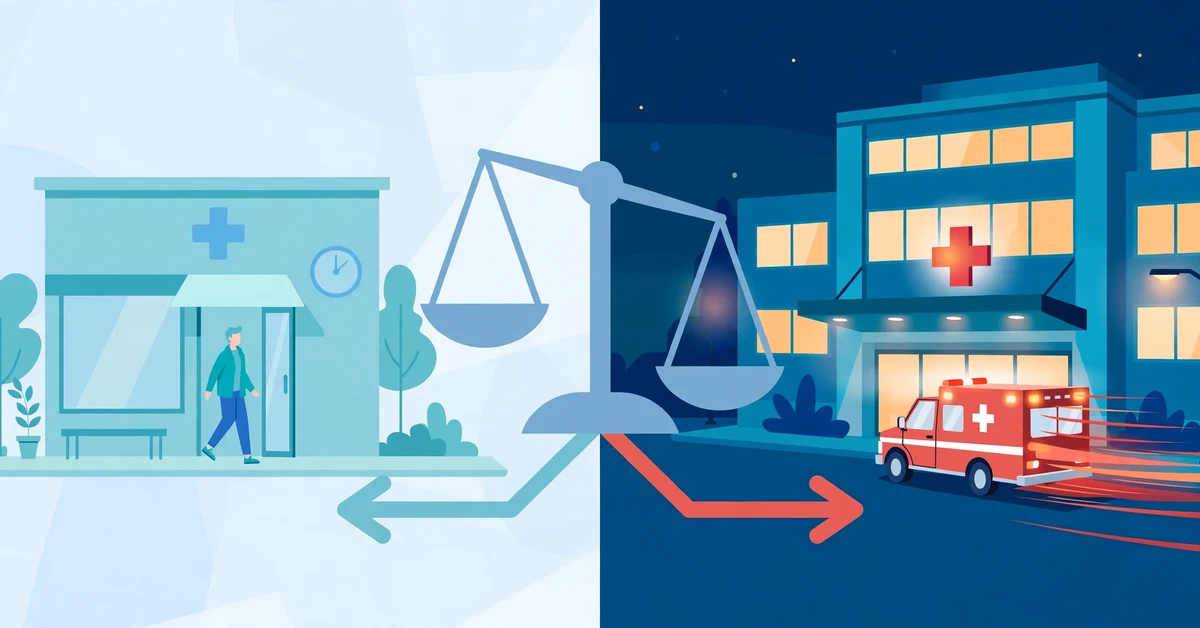
It’s 9 p.m. Your child is burning up, your ankle is swelling after a misstep on the stairs, or a strange pressure has settled in your chest. Two doors are open to you: urgent care and the emergency room. Choosing the wrong one costs you — sometimes money, sometimes hours, and occasionally something far more serious. This guide gives you a fast rule for the dangerous cases, a side-by-side comparison of what each place can actually do, and a condition-by-condition table so you can decide in seconds.
The 10-second rule: when it is the ER, no debate
Before you compare anything, ask one question: could this kill me, cost me a limb, or cost me my sight in the next few hours? If the answer is yes — or even maybe — stop reading, call 911 or go straight to the emergency room. Urgent care clinics are not built for these situations, and every minute spent there first is a minute of treatment lost.
Call 911 or go to the ER immediately for:
- Chest pain, pressure, squeezing or tightness — with or without pain spreading to the arm, jaw, neck or back, sweating, nausea or shortness of breath
- Signs of stroke — remember FAST: Face drooping, Arm (or leg) weakness, Speech difficulty, Time to call 911
- Trouble breathing, gasping, blue lips, or being unable to speak a full sentence
- Bleeding that does not stop after 10 minutes of firm pressure, or blood loss that soaks through bandages
- Loss of consciousness, a seizure, or sudden confusion or inability to wake someone
- A sudden “worst headache of my life,” or a head injury with vomiting, confusion or passing out
- Signs of a severe allergic reaction: swelling of the lips, tongue or throat, hoarseness, wheezing, dizziness
- Suspected poisoning or overdose, especially if the person is drowsy, vomiting repeatedly or breathing abnormally
- Severe burns, a bone sticking out of the skin, or any major trauma such as a car crash or a fall from height
- Thoughts of harming yourself or someone else — call 911 or the 988 Suicide and Crisis Lifeline
Do not drive yourself with any of these symptoms. Paramedics can start treatment in the ambulance — an ECG for chest pain, stroke alerts to the hospital — and a patient who arrives by ambulance with a true emergency is taken straight in. If you are genuinely unsure whether something is serious, default to the ER. An unnecessary ER visit costs money; a skipped one can cost far more.
The real difference: what each place can actually do
Urgent care and the ER are not two sizes of the same thing. An emergency department is a hospital’s front door, connected to operating rooms, intensive care units, blood banks and on-call specialists, and it is legally required to evaluate everyone who walks in. An urgent care center is an expanded doctor’s office: faster and cheaper for everyday problems, but with a hard ceiling on what it can handle. When a problem exceeds that ceiling, urgent care staff stabilize you and send you to the ER by ambulance — and you will typically be billed for both visits.
| Urgent care | Emergency room (ER) | |
|---|---|---|
| Best for | Illnesses and injuries that need care today but are not life-threatening | Life-, limb- or sight-threatening conditions and serious injuries |
| Hours | Extended hours, commonly about 8 a.m.–8 p.m., some to 10 p.m.; varies by location | Open 24 hours a day, 7 days a week, including holidays |
| Who treats you | Physicians, nurse practitioners and physician assistants | Emergency physicians and nurses, with surgeons and specialists on call |
| Imaging | X-ray at most locations; ultrasound at some; CT and MRI rarely on site | X-ray, CT, MRI, ultrasound and angiography, around the clock |
| Lab tests | Rapid tests for flu, strep, COVID-19 and urine infections; pregnancy tests; limited blood work, with some samples sent out | Full laboratory on site, including cardiac enzymes, blood cultures and a blood bank for transfusions |
| IV treatment | IV fluids and some IV medicines at many locations | Full IV therapy: fluids, antibiotics, cardiac drugs, blood transfusions |
| Surgery | No operating rooms; minor procedures only (stitches, splinting, drainage of small abscesses) | Emergency surgery available 24/7, plus ICU admission |
| Heart attack & stroke care | Can recognize and transfer — cannot deliver clot-busting drugs or catheter treatment | Clot-busting medication, catheterization lab, stroke teams |
| Hospital admission | No — transfers you if you need a hospital bed | Yes — admits directly to the hospital |
| How you are seen | Mostly first come, first served; online check-in at many chains | Triage by severity: the sickest patients go first, minor cases wait |
| Typical wait | About 15–45 minutes to be seen; most visits finish within an hour | Low-acuity patients often wait 2 hours or more, because emergencies arriving after you go ahead of you |
That last row explains most of the frustration people feel in ER waiting rooms. An ER does not run on a queue; it runs on triage. A sprained ankle that arrives at 7 p.m. will keep being bumped by heart attacks, strokes and car crashes arriving at 7:05. The same ankle at urgent care is usually X-rayed, wrapped and sent home before an ER patient has finished registering.
Condition by condition: where should you go?
Use this table for the specific problem in front of you. When a row says ER, do not negotiate with it — and when symptoms are getting worse fast, upgrade your choice one level.
| Condition or symptom | Go to | Why / notes |
|---|---|---|
| Chest pain or pressure | ER — call 911 | Only an ECG and cardiac blood tests can rule out a heart attack. Where the pain sits can offer clues (see our chest pain location chart), but no chart makes chest pain safe to sit on. Never drive yourself. |
| Stroke signs (face droop, arm weakness, slurred speech) | ER — call 911 | Clot-busting treatment has a window of a few hours. Note the time symptoms started — the team will ask. |
| Severe bleeding | ER — call 911 | Bleeding that won’t stop after 10 minutes of firm pressure, spurting blood, or bleeding with dizziness or paleness. Keep pressure on and do not remove soaked bandages — add more on top. |
| Broken bones | ER if bone is visible, the limb looks deformed, or fingers/toes beyond the break are pale, blue or numb. Urgent care for a suspected simple fracture. | Most urgent care clinics X-ray and splint straightforward fractures. Breaks needing surgery, or in the hip, spine, pelvis or face, belong in the ER. |
| Fever — baby under 3 months | ER, now | Any temperature of 100.4°F (38°C) or higher in an infant under 3 months is an emergency until proven otherwise; young infants cannot localize infections and can deteriorate fast. |
| Fever — baby 3–6 months | ER or same-day pediatric care | Especially at 102°F (38.9°C) or higher, or if the baby is unusually sleepy, feeding poorly or hard to console. |
| Fever — older children and adults | Urgent care in most cases | Go to the ER instead if fever comes with a stiff neck, a rash that does not fade when pressed, confusion, severe headache, breathing difficulty or signs of dehydration. |
| Head injury | ER if there was any loss of consciousness, repeated vomiting, worsening headache, confusion, a seizure, unequal pupils, or clear fluid from the nose or ears. Urgent care for a mild bump when the person is alert and acting normally. | Take a lower threshold if the injured person takes blood thinners, is elderly, or was in a high-speed crash — internal bleeding can be delayed. |
| Abdominal pain | ER if pain is sudden and severe, the belly is rigid, there is vomiting of blood, black or bloody stools, or pain during pregnancy. Urgent care for mild stomach ache or a stomach bug. | Right-lower abdominal pain with fever can be appendicitis — that is an ER evaluation, not a wait-and-see. |
| Urinary tract infection (UTI) | Urgent care (telehealth often works too) | Burning urination and frequency without fever is usually handled quickly at urgent care. Add fever, back/flank pain, vomiting or shaking chills and it may be a kidney infection — be seen the same day; with high fever or feeling very unwell, choose the ER. Men, pregnant women and people with recurrent UTIs should see a doctor rather than using a walk-in telehealth script alone. |
| Sprains and strains | Urgent care | On-site X-ray rules out a fracture; treatment is a brace or splint, ice, elevation and pain relief. ER if the joint looks deformed or you cannot move or feel the limb beyond it. |
| Allergic reaction | Urgent care for mild hives, itching or hay-fever-type symptoms. ER — call 911 for swelling of lips, tongue or throat, hoarseness, wheeze, trouble breathing, widespread hives with dizziness or vomiting. | If an epinephrine auto-injector (EpiPen) is used, an ER visit still follows — reactions can rebound as the medicine wears off. |
| Cuts and wounds | Urgent care for most cuts needing stitches. ER for deep or gaping wounds, wounds that won’t stop bleeding, bites to the face or hands, or anything with numbness. | Stitches work best within roughly 6–12 hours. Bring your tetanus vaccination history if you know it. |
| Vomiting and diarrhea | Urgent care for most cases. ER if there is blood, severe abdominal pain, or dehydration — very little urine, dry mouth, dizziness on standing. | Small children and older adults dehydrate fastest; lower your threshold for them. |
| Eye problems | ER for chemical splashes (rinse with clean water for 15–20 minutes on the way), sudden vision loss, or an injury to the eye. Urgent care for pink eye and minor irritation. | Sight is on the 10-second-rule list: when vision itself is threatened, it is always the ER. |
| Cold, flu, sore throat, ear pain, sinus pressure | Urgent care | Rapid strep and flu tests on site. Choose the ER only if breathing becomes difficult or a very ill person cannot stay awake or keep fluids down. |
One pattern runs through the whole table: the same symptom changes category with its severity and with who has it. A fever is an errand in a healthy 30-year-old and an emergency in a 6-week-old. A twisted ankle is urgent care; a twisted ankle with a foot turning blue is the ER. When your case falls between rows, choose the higher level of care.
What it costs: urgent care vs ER
For the same minor problem, the ER is typically five to ten times more expensive than urgent care — a gap documented repeatedly in US pricing research, including a Health Affairs study that found hospital emergency departments charging several times more than urgent care centers for identical low-acuity conditions. Research published in Academic Emergency Medicine estimated that 13–27% of all ER visits could have been handled safely at urgent care instead. The ranges below are typical US figures reported across insurers and healthcare pricing analyses; your actual bill depends on your location, your plan and what tests are done.
| Urgent care | Emergency room | |
|---|---|---|
| Basic visit, no insurance | About $100–$250 (simple visits often $100–$200; add roughly $50–$150 if labs or an X-ray are needed) | About $1,000–$2,500 for a minor condition; overall ER visits commonly average $1,500–$3,000, and serious emergencies run far higher |
| Typical copay with insurance | About $25–$75, usually the whole visit cost covered by that copay plus any test fees | About $150–$350 or more — and the copay is often only the start, with coinsurance and deductible applied to the rest |
| Example: strep throat, uninsured | Roughly $100–$175 including the rapid test | Roughly $800–$1,500 for the same test and prescription |
| Example: sprained ankle, uninsured | Roughly $150–$250 including an X-ray | Roughly $1,000–$2,200 including imaging |
| Billing style | Usually one bill; many chains post self-pay prices up front | Separate facility fee, physician fee, and per-test charges — often arriving as several bills |
Beware the facility fee. Simply walking into an ER triggers a facility charge, graded from level 1 to level 5 by complexity, before any test or treatment is added. That fee is why a 20-minute visit for an earache can produce a four-figure bill, and it does not exist at urgent care. Two protections are worth knowing: first, under US federal law (EMTALA), a hospital ER must give you a medical screening exam and stabilizing treatment for an emergency regardless of your insurance or ability to pay — never let fear of cost delay care for a true emergency. Second, emergency care is generally covered at in-network rates even at out-of-network hospitals under the No Surprises Act. What is not protected is choosing the ER for a non-emergency: your insurer can treat that as an expensive preference, and the bill will reflect it.
Finally, factor in the double-payment trap. If you start at urgent care with a problem that turns out to need a hospital — a “simple” fracture that needs surgery, abdominal pain that turns out to be appendicitis — you pay for the urgent care visit and the ER visit, and lose the transfer time. If your symptoms match the red-flag list at the top of this page, skip the first stop.
When neither is right: your other options
Sometimes the correct answer is neither building. Four alternatives handle a large share of everyday problems:
- Your primary care doctor (PCP). The cheapest option and the only one that knows your history. Many practices hold same-day slots if you call early. Anything ongoing — blood pressure, repeat infections, a pain that keeps coming back — belongs here, not in repeat urgent care visits. If you do not have a PCP, our annual physical exam checklist by age shows what a first check-up should cover.
- Telehealth. Good for rashes, pink eye, sinus symptoms, uncomplicated UTIs, medication questions and “is this worth going in for?” A clinician on a screen cannot listen to lungs, test for strep or X-ray an ankle, so telehealth works as a first filter, not a full substitute.
- Your insurer’s 24/7 nurse advice line. The number is on the back of most insurance cards. Nurses use structured protocols to tell you whether to go in now, go in tomorrow, or stay home — a genuinely useful tiebreaker at 2 a.m.
- Poison Control: 1-800-222-1222. Free, confidential and staffed around the clock by toxicology experts. Call after a medication mistake, a swallowed household product or a double dose — in many cases they can manage the situation safely at home and will tell you clearly if you need the ER. If the person has collapsed, is having a seizure or is not breathing normally, call 911 instead.
And keep the roles straight: 911 is for emergencies in progress — it sends help to you. The ER is where ambulances go. Going to urgent care first “to ask” during a possible heart attack or stroke is the one choice this guide exists to prevent.
What to bring, and what happens when you arrive
A little preparation shortens any visit. Bring a photo ID, your insurance card, a list of your medications and allergies (a phone photo of your pill bottles works), and, for children, their vaccination record. For cuts, know when your last tetanus shot was. For anything time-sensitive — stroke symptoms, chest pain, a head injury — note the time symptoms began; clinicians will ask, and treatment decisions depend on it.
At urgent care, you check in, have your vital signs taken, see a clinician, and get tests like an X-ray or rapid strep test done on the spot. Most visits finish within the hour, and you leave with a prescription or a clear plan. If the clinician finds something beyond the clinic’s scope, they will arrange transfer — usually by ambulance — and send your records ahead.
At the ER, the first step is triage: a nurse assesses how urgent your problem is and assigns a priority level. Life-threatening cases go straight back; everyone else registers and waits — which is why a minor problem can wait hours while the department handles emergencies arriving after you. Expect tests to be staged (blood work and imaging may happen before you see the physician), and know that the federal screening guarantee described above means you will be evaluated even without insurance. What the ER will not do is move you up the line for a minor complaint because you arrived first.
The bottom line
Run every problem through three questions, in this order. First: could this threaten life, limb or sight? If yes, call 911 or go to the ER. Second: does it need attention today but look stable and familiar — an infection, a sprain, a fever in an older child or adult? That is urgent care: faster, and typically a tenth of the ER’s price. Third: can it safely wait, or be answered remotely? Then your doctor, telehealth, a nurse line or Poison Control will serve you better than either waiting room. The expensive mistake is using the ER for urgent care problems; the dangerous mistake is using urgent care for ER problems. When in real doubt between the two, choose the ER — that is what it is there for.
This article is general information about how urgent care centers and emergency departments differ in the United States; it is not medical advice and cannot judge your specific symptoms. If you believe you are experiencing a medical emergency, call 911 or go to your nearest emergency room now rather than finishing this page.
Frequently Asked Questions
Yes, substantially. A basic urgent care visit without insurance typically costs about $100–$250, while an ER visit for the same minor condition commonly runs $1,000–$2,500 or more, largely because the ER adds a facility fee plus separate charges for each test. With insurance, urgent care copays are usually $25–$75 compared with $150–$350 or more for the ER, before coinsurance.
Most urgent care centers offer on-site X-rays, stitches, splinting and rapid tests for flu, strep, COVID-19 and urine infections, plus basic blood work. What they generally lack is CT and MRI scanners, a full hospital laboratory and a blood bank. If your problem is likely to need those, the ER is the better first stop.
No. Chest pain or pressure is an emergency until a heart attack has been ruled out with an ECG and cardiac blood tests, which urgent care cannot complete. Call 911 rather than driving anywhere yourself — paramedics can perform an ECG in the ambulance and alert the hospital.
Usually, yes. Urgent care bills for the evaluation it performed, and the ER visit is billed separately, including its facility fee. This “double payment” is a good reason to go straight to the ER whenever your symptoms match the red-flag list — chest pain, stroke signs, severe bleeding, serious breathing trouble or major trauma.
No. Under the federal EMTALA law, Medicare-participating hospital emergency departments must provide a medical screening examination and stabilizing treatment for emergency conditions regardless of insurance status or ability to pay. Billing is handled afterward; it never comes before emergency stabilization.
Call 911 for chest pain, stroke signs, severe breathing difficulty, uncontrolled bleeding, loss of consciousness, seizures, suspected overdose, or any situation where the person cannot be moved safely or might deteriorate on the way. Ambulance crews begin treatment immediately and pre-alert the hospital, which can save critical minutes for heart attack and stroke care.
Most urgent care centers are closed overnight, so at 2 a.m. the practical choice is the ER, your insurer’s 24/7 nurse advice line, or Poison Control (1-800-222-1222) for exposure questions. If symptoms are on the red-flag list, do not wait for urgent care to open in the morning — go to the ER or call 911.





Related Posts
Medication Safety: Understanding Drug Interactions and How Pharmacists Help Prevent Medication-Related Harm
Nov 8, 2026 • 29 min read
Peeing with an Erection Isn’t ‘More Difficult Than Childbirth,’ But It Can Be Challenging
Sep 5, 2026 • 9 min read
Fever Temperature Chart: Normal, Low-Grade and High Fever Thresholds by Age
Nov 13, 2026 • 13 min read
Kidney Disease Stages Chart: GFR Ranges, Albuminuria Levels and What Each Stage Means
Nov 13, 2026 • 19 min read
Carob Powder: 9 Nutrition Facts and Health Benefits
Aug 31, 2026 • 23 min read