What Is Saturated Fat? Sources, Daily Limits and Smarter Swaps

- What saturated fat is, in plain English
- Where saturated fat comes from
- How much saturated fat per day?
- Saturated vs unsaturated vs trans fat
- What saturated fat does to your cholesterol and heart
- Is all saturated fat equally bad?
- How to read a nutrition label for saturated fat
- Practical swaps that actually stick
- The bottom line
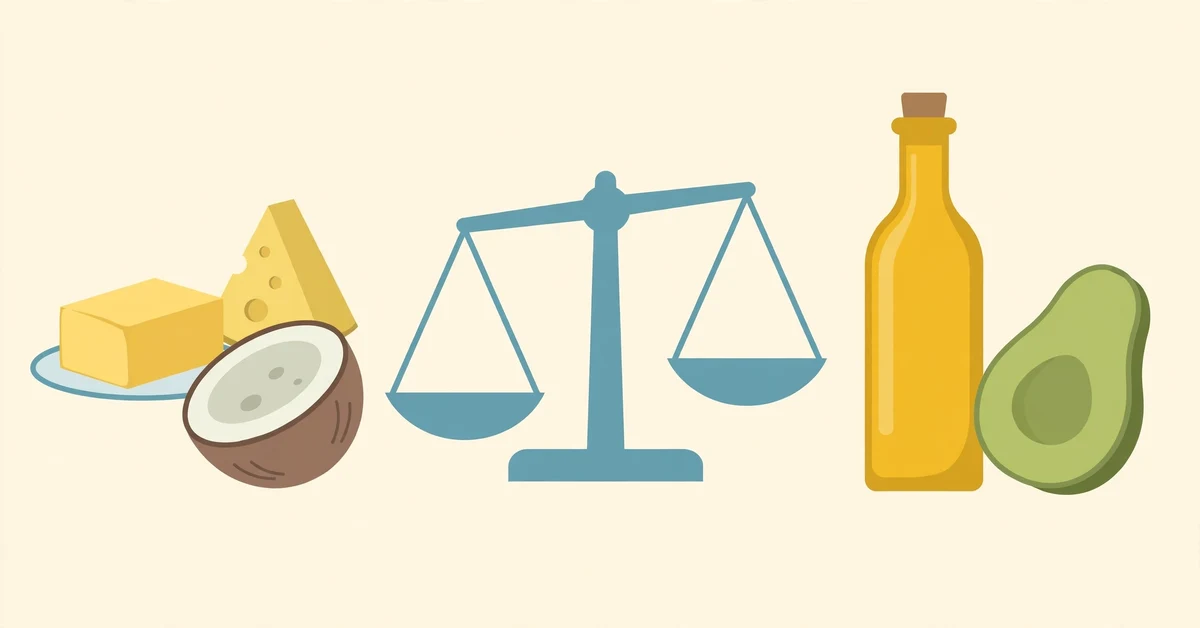
Saturated fat is a type of dietary fat that is usually solid at room temperature. It is the fat in butter that holds its shape on the counter, the white marbling in a steak, and the firm fat in cheese and coconut oil. The name comes from its chemistry: in a saturated fat, every carbon atom in the fatty acid chain is holding as many hydrogen atoms as it possibly can, so chemists say the chain is “saturated” with hydrogen. Eating some saturated fat is normal and hard to avoid. Eating a lot of it, day after day, is one of the most reliable ways to push your LDL (“bad”) cholesterol up, and that is why the American Heart Association and the Dietary Guidelines for Americans both set daily limits for it.
This guide explains saturated fat in plain English: what it is, where it hides, how much is reasonable in a day, how it compares with unsaturated and trans fats, and how to cut back without giving up food you enjoy.
What saturated fat is, in plain English
All dietary fats are built from fatty acids, which are chains of carbon atoms with hydrogen atoms attached. The differences between fat types come down to how those chains are put together:
- Saturated fatty acids have no double bonds. Every link between carbon atoms in the chain is a single bond, and each carbon carries the maximum possible number of hydrogen atoms. With nowhere to bend, the chain stays straight.
- Straight chains pack tightly together. Tightly packed fat molecules need more heat to pull apart, so saturated fats have a high melting point and stay solid or semi-solid at room temperature: butter, lard, beef tallow, the fat cap on a pork chop, and coconut oil in a cool pantry.
- Unsaturated fatty acids have one or more double bonds. Each double bond puts a kink in the chain, the molecules cannot pack as tightly, and the fat stays liquid, like olive oil or canola oil.
Saturated fats are not one single substance. They are a family of fatty acids of different chain lengths, and a few names are worth knowing because they behave slightly differently in the body. Palmitic acid (16 carbons) is the most common saturated fatty acid in meat, dairy, and palm oil. Stearic acid (18 carbons), found in beef and cocoa butter, has a much smaller effect on LDL cholesterol than the others. Myristic acid (14 carbons) in butter and other dairy fat raises LDL more strongly. Lauric acid (12 carbons) makes up about half of coconut oil and raises both LDL and HDL. Later in this guide we explain why those differences matter, and why they do not change the overall advice.
One more fact that surprises people: your body can make saturated fat on its own, so it is not an essential nutrient you must get from food. There is no deficiency disease from eating very little of it. The goal is not zero, though. It is keeping the amount in a range your heart can live with.

Where saturated fat comes from
Most saturated fat in the American diet comes from animal foods: fatty and processed meats, and full-fat dairy. A smaller share comes from plant sources, mainly the tropical oils (coconut, palm, and palm kernel) that food manufacturers use in baked goods, snacks, and coffee creamers because they are cheap and shelf-stable. Pizza, burgers, sandwiches, and desserts combine several of these sources at once, which is how the grams quietly add up.
The table below uses typical values from the USDA FoodData Central database, rounded to the nearest half gram. The last column shows what one serving does to the American Heart Association’s stricter budget of about 13 grams a day.
| Food and serving | Saturated fat | Share of a 13 g day |
|---|---|---|
| Coconut oil, 1 tablespoon | About 11 g | ~85% |
| New York strip steak, 8 oz cooked | About 14 g | ~108% |
| Cheeseburger, single patty with cheese | About 10 g | ~77% |
| Vanilla milkshake, small | About 10 g | ~77% |
| Ground beef, 80% lean, 3.5 oz cooked | About 8 g | ~62% |
| Butter, 1 tablespoon | About 7 g | ~54% |
| Beef tallow, 1 tablespoon | About 6 g | ~46% |
| Cheddar cheese, 1 oz (one slice) | About 6 g | ~46% |
| Pork sausage, 2 links | About 6 g | ~46% |
| Dark chocolate, 1 oz | About 5 g | ~38% |
| Whole milk, 1 cup | About 5 g | ~38% |
| Vanilla ice cream, 1/2 cup | About 4.5 g | ~35% |
| Bacon, 3 slices pan-fried | About 4.5 g | ~35% |
| Chicken breast with skin, 3.5 oz roasted | About 3 g | ~23% |
| Chicken breast, skinless, 3.5 oz roasted | About 1 g | ~8% |
| Olive oil, 1 tablespoon (for comparison) | About 2 g | ~15% |
Read the table as a budget lesson, not a ban list. A single steak can use the entire day’s allowance, and an ordinary fast-food lunch (cheeseburger, fries cooked in oil blends, and a shake) can pass 20 grams without any single item looking extreme. Skinless chicken, fish, beans, and liquid vegetable oils sit at the other end, which is why they anchor most heart-healthy eating patterns. If you want meal ideas built around that pattern, our heart-healthy low saturated fat recipes show how the swaps look on an actual plate.

How much saturated fat per day?
Two widely used benchmarks exist, and they are often confused:
- Dietary Guidelines for Americans: keep saturated fat under 10% of daily calories. On a 2,000-calorie diet that is 200 calories, or about 22 grams a day.
- American Heart Association: for the greatest benefit, especially if you are trying to lower LDL cholesterol, aim for about 5–6% of daily calories. On a 2,000-calorie diet that is about 120 calories, or roughly 13 grams a day.
Neither number is a toxicity threshold. They are pattern targets: diets that stay near them, and replace the remaining fat with unsaturated sources, produce lower LDL levels on average. Here is what both limits look like at different calorie levels (fat has 9 calories per gram):
| Daily calories | AHA target (about 6%) | Dietary Guidelines limit (under 10%) |
|---|---|---|
| 1,600 | About 11 g | About 18 g |
| 1,800 | About 12 g | About 20 g |
| 2,000 | About 13 g | About 22 g |
| 2,500 | About 17 g | About 28 g |
Most American adults currently eat more than both targets. That gap is mostly not caused by butter on toast. It comes from the pattern around it: processed meats, cheese melted into everything, fried foods, creamy sauces, and packaged snacks made with palm oil, eaten several times a day.
Saturated vs unsaturated vs trans fat
Saturated fat makes more sense next to the other fat families. All fats provide 9 calories per gram; what differs is their chemistry and what they do to your blood lipids.
| Saturated fat | Unsaturated fat (mono- and poly-) | Trans fat | |
|---|---|---|---|
| Structure | No double bonds; chain fully loaded with hydrogen | One double bond (monounsaturated) or several (polyunsaturated); chains bend | Mostly man-made: unsaturated oils partly hydrogenated so they act solid |
| At room temperature | Solid or semi-solid | Liquid | Solid |
| Typical sources | Butter, cheese, fatty and processed meat, whole milk, coconut and palm oils | Olive and canola oil, nuts, seeds, avocado, fatty fish | Old-style margarines and shortenings; small natural amounts in beef and dairy |
| Effect on cholesterol | Raises LDL cholesterol | Lowers LDL when it replaces saturated fat; omega-3 fats also lower triglycerides | Raises LDL and lowers HDL, the worst combination |
| Guidance | Limit: under 10% of calories, ideally about 5–6% | Make this most of your fat intake | Avoid artificial trans fat; the FDA removed partially hydrogenated oils from the food supply because they are not recognized as safe |
The practical takeaway used by the American Heart Association and Harvard Health alike: the healthiest move is rarely “eat less fat.” It is “change the fat,” swapping saturated sources for unsaturated ones while keeping total calories in check.
What saturated fat does to your cholesterol and heart
The strongest, most consistent finding in this field is that saturated fat raises LDL cholesterol. When you eat more saturated fat, the liver clears LDL particles from the blood less efficiently, LDL levels climb, and over years those particles contribute to plaque building up inside arteries (atherosclerosis). Higher LDL is a causal risk factor for heart attack and stroke, which is why every major guideline links high saturated fat intake with cardiovascular risk. Saturated fat can raise HDL (“good”) cholesterol slightly too, but that rise does not cancel out the LDL effect.
Two supporting points matter. First, what replaces saturated fat changes the outcome: controlled trials summarized by the American Heart Association find that replacing saturated fat with polyunsaturated fat lowers cardiovascular events, while replacing it with refined carbohydrates and sugar does little or nothing. Second, very high intakes travel with other risks: diets heavy in saturated fat are often calorie-dense and rich in processed meat, and are associated in research with weight gain, insulin resistance and fatty liver. If you are tracking your own numbers, our cholesterol levels chart by age shows the LDL ranges clinicians aim for, so you can see where a change in eating habits should show up.
Is all saturated fat equally bad?
This is where headlines get ahead of the science, in both directions. The honest answer is: saturated fats are not all identical, the food they arrive in matters, but the differences are smaller than the headlines suggest, and none of them turn a high intake into a healthy one.
- Different fatty acids, different LDL effects. Stearic acid (cocoa butter, beef) is roughly neutral for LDL. Palmitic and myristic acids, which dominate in palm oil, meat, butter, and cheese, raise LDL more. This is a real distinction, but most foods mix several fatty acids, so you cannot shop your way to “only the good ones.”
- The dairy matrix. Cheese and yogurt deliver saturated fat inside a package of protein, calcium, and, for fermented products, live cultures. Observational studies often find cheese and yogurt intake looks less harmful than the same amount of saturated fat from butter or processed meat. That may reflect the food matrix, and it may reflect the lifestyles of people who eat those foods. It is a reason not to panic about yogurt, not a license for unlimited cheese.
- The coconut oil debate. Coconut oil is about 82% saturated, higher than butter, and trials show it raises LDL compared with unsaturated oils, though it also raises HDL. “Plant-based” does not make it a health food, and major heart organizations still count it as a saturated fat to limit. Use it for flavor in small amounts rather than as a default cooking oil.
- Processed meat is the clearest problem. Bacon, sausage, salami, and hot dogs combine saturated fat with large amounts of sodium, nitrites, and the effects of processing, and they show the most consistent links to heart disease and colorectal cancer. If you change only one row of the food table, change this one.
So the balanced position is: judge saturated fat by dose and by source, favor whole foods over processed ones, and remember that even the “better” saturated fats still count toward the same daily total.

How to read a nutrition label for saturated fat
Packaged food is where saturated fat is easiest to measure, if you read the label in the right order:
- Start with serving size. Every number on the label describes one serving, and packages often contain two or three. A frozen meal labeled 6 grams of saturated fat per serving is 12 grams if you eat the whole box.
- Find “Saturated Fat” under Total Fat. This is the gram amount to add to your daily budget. A useful shortcut: 4 grams or less per serving is modest; 8 grams or more is a large bite of a 13–22 gram day.
- Use the % Daily Value. The label’s percentage is based on a Daily Value of 20 grams of saturated fat. As a rule of thumb, 5% DV or less is low and 20% DV or more is high.
- Scan the ingredients for the sources. Butter, cheese, whole milk, coconut oil, palm oil, and palm kernel oil near the top of the list mean saturated fat is a main ingredient, not a trace. This is also how tropical oils sneak into foods marketed as dairy-free, including many powdered and liquid coffee creamers; our guide to coffee creamer risks and alternatives breaks down that specific trap.
- Check trans fat and the fine print. Labels may legally show “0 g trans fat” when a serving has under 0.5 grams. If “partially hydrogenated oil” appears in the ingredients, some artificial trans fat is present; choose a product without it.
- Beware the low-fat swap. Products that remove fat often add sugar or starch to keep them tasty. A fat-free sweet can be a worse trade than a smaller portion of the original.
Restaurant and takeaway food has no label, so use the food table above as your estimator: creamy, cheesy, fried, and processed-meat dishes are the high rows; grilled, baked, bean-based, and fish dishes are the low ones.
Practical swaps that actually stick
Cutting saturated fat works better as substitution than as subtraction. These swaps keep the meal recognizable while moving the grams from the left column of the comparison table to the right:
| Instead of | Try | What it saves |
|---|---|---|
| Butter for frying and baking (7 g per tbsp) | Olive or canola oil (about 1–2 g per tbsp) | About 5–6 g per tablespoon, plus monounsaturated fat |
| Coconut oil as your everyday cooking oil | Canola or olive oil; keep coconut oil for occasional flavor | About 9 g per tablespoon |
| Whole milk in coffee and cereal (5 g per cup) | 2% or 1% milk, or skim | About 2–4 g per cup |
| 80% lean ground beef several times a week | 90–95% lean beef, ground turkey, or half beef and half lentils | Roughly half the saturated fat per serving |
| Bacon or sausage at breakfast most days | Eggs, Canadian bacon, or a smaller portion once or twice a week | Several grams a day, plus much less sodium |
| Cheese as the main event | Less of a sharper cheese (extra-sharp cheddar, Parmesan) so flavor stays high | Same taste, often half the cheese |
| Creamy dressings and sauces | Olive-oil vinaigrettes, yogurt-based dressings, salsa, mustard | Removes a hidden 3–6 g per serving |
| Chicken or turkey with the skin | The same meat, skin removed after cooking | About 2 g per serving |
Add two habits around the swaps: trim visible fat and choose lean cuts (sirloin over ribeye, loin over shoulder), and make fish, beans, lentils, nuts, and tofu regular protein anchors so red and processed meats become occasional rather than default. None of this requires a special diet. It is the standard Mediterranean-style pattern that heart guidelines keep arriving at from different directions.
The bottom line
Saturated fat is the family of fats whose fatty acid chains carry no double bonds, which is why they stay solid at room temperature and show up in butter, cheese, fatty meat, and tropical oils. They are not poison, and you do not need to reach zero. But they reliably raise LDL cholesterol, so keep them under 10% of your calories, and closer to 5–6% (about 13 grams on a 2,000-calorie diet) if your LDL is a concern. Judge foods by both dose and source: processed meat is the first thing to cut, coconut oil counts like any other saturated fat, and plain dairy foods sit somewhere in the middle. Read labels by serving size and grams, and rebuild everyday meals around unsaturated oils, fish, legumes, nuts, and lean proteins. That pattern, not any single forbidden food, is what protects your heart.
This article is general nutrition education based on guidance from the American Heart Association, the Dietary Guidelines for Americans, the National Institutes of Health, and USDA food composition data. It is not personal medical advice. If you have high cholesterol, heart disease, or diabetes, discuss your fat intake targets with your clinician or a registered dietitian.
Frequently Asked Questions
Saturated fat is a type of fat that is solid at room temperature, like butter, the fat on meat, and coconut oil. Its fatty acid chains have no double bonds and are fully loaded (“saturated”) with hydrogen atoms, which lets the molecules pack tightly and stay firm. It is found mainly in animal foods such as meat and full-fat dairy, plus coconut and palm oils.
The Dietary Guidelines for Americans set the limit at under 10% of daily calories, about 22 grams on a 2,000-calorie diet. The American Heart Association recommends a tighter target of about 5–6% of calories, roughly 13 grams a day, especially for people working to lower LDL cholesterol. Scale both numbers up or down with your calorie needs.
Not especially. Coconut oil is about 82% saturated fat, more than butter, and controlled trials show it raises LDL cholesterol compared with unsaturated oils like olive or canola oil, although it also raises HDL. It is fine as an occasional flavoring, but heart organizations classify it with other saturated fats to limit rather than as a health food.
Trans fat is worse. Artificial trans fat raises LDL cholesterol and lowers protective HDL cholesterol, and the FDA removed partially hydrogenated oils, its main source, from the food supply because they are not recognized as safe. Saturated fat mainly raises LDL, so it should be limited, but it does not carry the same no-safe-level status as artificial trans fat.
Not literally. Saturated fat does not travel from your plate into your arteries as grease. It raises the amount of LDL cholesterol circulating in your blood, and over years LDL particles enter artery walls and drive the plaque buildup called atherosclerosis. The effect is real but indirect, which is why replacing saturated fat with unsaturated fat, and keeping LDL low overall, matters more than any single meal.
No. One large egg has about 1.5 grams of saturated fat, a modest amount. Eggs are better known for dietary cholesterol (about 185 mg in the yolk), but for most people saturated fat intake has a larger effect on blood LDL than the cholesterol in an egg. Eggs fit comfortably in a heart-conscious pattern for most healthy adults; people with diabetes or established heart disease should follow their clinician’s advice.
No, and you probably could not if you tried, since small amounts occur in many nutritious foods. The evidence-based move is to bring intake down toward the American Heart Association range (about 5–6% of calories, roughly 13 grams a day) and replace the difference with unsaturated fats from oils, nuts, seeds, and fish rather than with sugar and refined starch. If LDL stays high, your clinician may add medication; diet and medication work on the same risk from different directions.
Read Next

Is It Possible to Encourage Facial Hair Growth?
Staph Infection Pictures: What Staph Looks Like and How to Tell It From Cellulitis

Stretches to Loosen Your Trapezius Muscles

Can Yoga Improve Hair Growth and Thickness?

Tick Bite Pictures: What Tick Bites and Lyme Rashes Actually Look Like
6 Best Protein Powders for Weight Gain in 2025
Related Posts

10 Ways to Stretch and Strengthen Your Lats
Sep 15, 2026 • 17 min read
I Tried It: Neutrogena Hydro Boost Water Gel Review
Oct 1, 2026 • 34 min read
All About Aristada
Oct 6, 2026 • 29 min read
4 Best CBD Gummies for Anxiety and Stress in 2025
Sep 27, 2026 • 12 min read
If You’re Transitioning, Breast Growth Is Possible — Here’s What You Need to Know
Oct 7, 2026 • 4 min read