Fordyce Spots: What They Are, Why You Have Them, and When to Worry

- What Are Fordyce Spots?
- Fordyce Spots on Your Lips
- Fordyce Spots on Your Genitals
- Fordyce Spots or Something Else?
- Can You Squeeze Fordyce Spots?
- Do Fordyce Spots Go Away on Their Own?
- Fordyce Spots Treatment: What Actually Works
- The Cancer Link You May Have Read About
- Living With Them: Everyday Lip Care
- When to See a Doctor
- Frequently Asked Questions
- Are Fordyce spots an STD?
- Are Fordyce spots contagious?
- Can you pop Fordyce spots?
- Do Fordyce spots go away?
- How do you get rid of Fordyce spots?
- Why do I suddenly have Fordyce spots?
- Are Fordyce spots on the lips normal?
- References
You’re brushing your teeth, half awake, when you catch them in the mirror. Tiny white dots along the edge of your upper lip. You stretch the skin and there they are again, a small cluster of pale yellow bumps you swear weren’t there last month. Or maybe they were, and you never looked that closely.
Your first thought is probably the same one most people have: is this something contagious? Something you caught? Something a partner will notice?
Almost certainly not. What you’re most likely looking at is Fordyce spots, enlarged oil glands that show up in 70 to 80 percent of adults, according to Cleveland Clinic. They’re harmless, and they’re not an infection. Below: what they are, what they look like on lips and genitals, how to tell them from the conditions people worry about, and what, if anything, is worth doing about them.
What Are Fordyce Spots?
Fordyce spots, also called Fordyce granules, are sebaceous glands, the same oil glands that keep the rest of your skin supple, sitting where they have no hair follicle to attach to. Most oil glands empty into a hair follicle; these ones open straight onto the surface of the skin, which is why they show up as visible dots.
They’ve been there since birth. You just don’t notice them until puberty, when hormones make the glands bigger and easier to see. Men develop them about twice as often as women, according to a 2015 case report by Leung and Barankin.
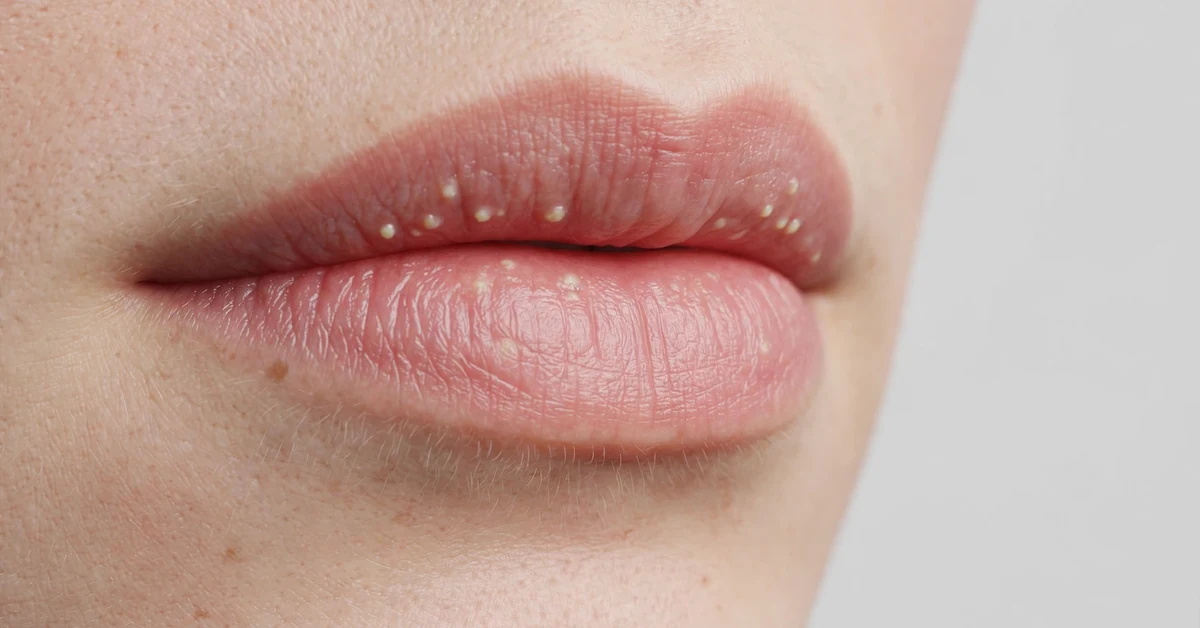
What do they look like? Small, slightly raised bumps, 1 to 3 millimeters across, about the size of a pinhead. White, pale yellow, or flesh-colored; on the genitals they can look a little redder. They often appear in clusters of 50 to 100, and stretching the skin makes them stand out more, according to DermNet. They don’t hurt, itch, or ooze.
They’re named after John Addison Fordyce, the American dermatologist who first described them in 1896. They aren’t a disease; DermNet calls them a normal variant.

Fordyce Spots on Your Lips
For most people, the lips are where the story starts. The spots gather along the vermilion border, the line where the pink of your lip meets the skin of your face, or just inside the lip and cheeks. They’re usually symmetrical, and you may only spot them when you stretch your lip or look in bright light.
Our guide to bumps on lips walks through the common causes one by one. Fordyce spots are the quietest entry on that list: no pain, no fluid, no crust.
Nothing about lip Fordyce spots needs treatment. They don’t turn into anything else, they don’t spread across your face, and they don’t mean your lips are unhealthy. They can look more obvious in winter, when dry lips stretch tight – that’s lighting and skin condition, not the spots changing.
Fordyce Spots on Your Genitals
Finding the same dots on your genitals is a different experience entirely, and the worry is different too. On the penis they appear on the shaft or the head, where the glands are sometimes called Tyson glands, and on the scrotum; on the labia in women. Same glands, same story.
The question everyone actually wants answered: can you have sex? Yes. Fordyce spots aren’t contagious, so a partner can’t catch them, and you can’t spread them to other parts of your own body. There’s nothing to disclose and nothing to treat before intimacy. If a partner asks, the honest answer is short: they’re oil glands, and most adults have them.
That said, the anxiety is real: genital bumps trigger a very specific fear, because the first thing most people think of is a sexually transmitted infection. The comparison table below exists for exactly that moment, and if doubt lingers, a clinician can settle it in one short visit, usually by look alone.
One exception is worth knowing: spots on the penis can occasionally bleed during intercourse, Healthline notes. It’s rare and it isn’t dangerous, but it’s better to hear it here than to be frightened by it in the moment.

Fordyce Spots or Something Else?
Several conditions can look like Fordyce spots at first glance, and the differences are small but decisive. Pain, itching, fluid, and change over time are the clues that matter most.
| Condition | Pain or itch? | Contagious? | What it looks like | What to do |
|---|---|---|---|---|
| Fordyce spots | No | No | Tiny pale yellow-white bumps, 1-3 mm, in clusters, unchanged for months | Nothing needed; cosmetic treatment only |
| Genital herpes | Yes, painful blisters | Yes | Painful blisters that break, crust, and return in outbreaks | See a doctor; antivirals help |
| Genital warts | Usually no, sometimes itchy | Yes, highly | Small cauliflower-like growths that grow and spread | See a doctor; caused by HPV, treatable |
| Milia | No | No | Hard white bumps, usually around the eyes and cheeks | Usually fade on their own; a dermatologist can remove them |
| Sebaceous hyperplasia | No | No | Soft yellowish bumps with a dent in the middle, usually in adults over 40 | Harmless; cosmetic removal only |
| Pearly penile papules | No | No | Tiny dome-shaped bumps in a row around the rim of the penis head | Nothing needed; also normal |
The pattern to remember is simple. Fordyce spots stay the same. Herpes and warts change: they appear suddenly, hurt or itch, blister or grow, and evolve over days or weeks. A bump that has looked identical for months and never hurt is very unlikely to be an infection.
For lip bumps specifically, the causes and care differ from the genital picture, and our guide to lip bump causes and care covers cold sores, canker sores, and allergic reactions alongside Fordyce spots.
Can You Squeeze Fordyce Spots?
They look like whiteheads. That’s the whole problem. The urge to squeeze them is almost automatic, so here is the fuller picture.
Squeezing won’t remove the gland. A whitehead is a clogged pore with something in it to push out. A Fordyce spot is the gland itself, sitting just under the surface. Pressing hard does nothing to the gland and plenty to the tissue around it: you can bruise the lip, break the skin, and invite bacteria into a spot that was clean before you touched it.
If you’ve already squeezed one and it’s now red or sore, leave it alone and keep it clean. A warm compress for a few minutes can calm it down. Don’t keep pressing it to “finish the job”: there’s nothing to finish. If it keeps hurting, swells, or starts oozing after a few days, get it looked at.
The urge usually fades once you know what they are. People squeeze things they’re afraid of; once you know the dots are just oil glands most adults carry, the mirror stops being a battleground.
Do Fordyce Spots Go Away on Their Own?
Healthline says they generally fade in time. The fuller answer is less tidy: they don’t reliably disappear, but they often become less noticeable with age as oil production drops.
New ones can still appear in your 30s, and that’s normal too. Hormonal shifts, oily skin, and sun exposure can all make them stand out more for a while. A sudden explosion of new spots overnight in an adult is different: get checked rather than assuming it’s Fordyce.
There’s no diet, supplement, or skin-care routine that makes them shrink. Anyone selling a cream that promises to dissolve them is selling a promise with no evidence behind it.
Fordyce Spots Treatment: What Actually Works
Here’s the part that needs saying plainly: Fordyce spots need no treatment at all. Every option below is cosmetic. No doctor will tell you that you must have them removed.
Micro-punch surgery. A dermatologist numbs the area and uses a tiny pen-like device to punch out individual glands. A 2013 study in the Journal of Plastic, Reconstructive and Aesthetic Surgery found no scarring and no recurrence a year later.
Laser treatment. A carbon dioxide (CO2) laser vaporizes the glands. It works, but Healthline notes it can leave scars, a real trade-off on the lips or genitals. A pulsed dye laser scars less but costs more. Expect more than one session either way.
Electrodessication. A fine electric current dries out the glands. It’s quick, but like the laser it can leave small marks, and it suits small numbers of spots better than large clusters.
Topical and oral medication. Tretinoin cream, bichloracetic acid, and in some cases oral isotretinoin can shrink the spots. The trade-off is irritation: redness, burning, and peeling are common, and oral isotretinoin carries serious side effects.
Results are often partial, spots can come back, and because removal is cosmetic, health insurance typically won’t cover it. Prices vary widely by clinic, so any article quoting a single number is guessing; get a quote in person and ask to see before-and-after photos of the exact procedure on your exact area.
And the home remedies? There is no scientific evidence that any of them help, Healthline says plainly: coconut oil, apple cider vinegar, garlic paste, toothpaste – none of these shrink a sebaceous gland.
The Cancer Link You May Have Read About
If you’ve gone down a search rabbit hole, you may have found something alarming: a 2014 study found that every member of certain families with an inherited form of colorectal cancer also had Fordyce spots in their mouths. The authors suggested the spots might help doctors identify families carrying Muir-Torre syndrome, a variant of Lynch syndrome. Another study linked large numbers of oral Fordyce spots with hyperlipidemia, high blood fats.
Here’s what that actually means for you. In families already known to carry that inherited cancer syndrome, Fordyce spots showed up so consistently that doctors wondered whether they could serve as an early clue. That’s a research observation about a small group of families with a known genetic condition, not a reason for a healthy person with lip spots to get screened. DermNet puts it bluntly: Fordyce spots are best regarded as a normal variant.
The hyperlipidemia link is the same kind of story: an association, not a cause. Having Fordyce spots doesn’t raise your cholesterol, and having high cholesterol doesn’t cause them. The two simply showed up together in one study population.
Living With Them: Everyday Lip Care
A plain lip balm keeps the lips from drying and cracking, which makes the spots less noticeable. Gentle exfoliation once or twice a week smooths flaky skin, but scrubbing hard won’t flatten the glands.
Makeup helps more than most people expect. A lip liner drawn along the vermilion border, or a lipstick with a little opacity, softens the contrast between the spots and the lip.
Sun protection matters for your lips in general, and a lip balm with SPF is an easy habit, even though it won’t change the spots.
What doesn’t help: picking at them, covering them with heavy concealer every day (it cakes and draws the eye), and checking them in magnifying mirrors – the spots look far bigger to you than to anyone else.
When to See a Doctor
Fordyce spots themselves never need a doctor’s visit. Get checked if:
- New bumps on your genitals appeared suddenly, especially after unprotected sex – early STIs can look like Fordyce spots
- The bumps hurt, itch, burn, or blister
- A bump is growing quickly, changing shape, or bleeding without stopping
- You have a sore that won’t heal, or a spot that keeps coming back in the same place
- You’ve squeezed a spot and it’s swollen, hot, or oozing after a few days
- The worry itself won’t leave you alone – a five-minute look from a doctor beats months of checking the mirror
Diagnosis is usually by appearance alone. A biopsy is rarely needed, DermNet notes.
Frequently Asked Questions
Are Fordyce spots an STD?
No. Fordyce spots are enlarged oil glands, not an infection, and they can’t be passed to a partner. Cleveland Clinic states this directly. If you’ve just noticed new genital bumps, get them checked once: early herpes and warts can look similar.
Are Fordyce spots contagious?
No. They’re part of your own anatomy, present since birth. You can’t catch them from anyone, give them to anyone, or spread them to other parts of your own body.
Can you pop Fordyce spots?
You can, but you shouldn’t. Squeezing won’t remove the gland, which sits under the skin, and it can cause bruising, infection, scarring, or bleeding. If a spot is sore after you’ve squeezed it, leave it alone and use a warm compress.
Do Fordyce spots go away?
They often fade and become less noticeable with age as oil production drops, but they don’t reliably disappear. There’s no cream, diet, or home remedy proven to make them go away.
How do you get rid of Fordyce spots?
The most effective options are micro-punch surgery, which a 2013 study found left no scars and no recurrence after a year, and CO2 or pulsed dye laser treatment. Topical tretinoin and oral isotretinoin can help but irritate the skin. All are cosmetic and usually not covered by insurance.
Why do I suddenly have Fordyce spots?
You probably don’t. They’ve been there since birth and become visible at puberty as hormones enlarge the glands. Most people only notice them one day in bright light or a close mirror and assume they appeared overnight. A genuinely sudden crop of new genital bumps is different and worth a doctor’s look.
Are Fordyce spots on the lips normal?
Yes, completely. They’re found in 70 to 80 percent of adults, according to Cleveland Clinic, and DermNet calls them a normal variant.
References
- Cleveland Clinic – Fordyce Spots: Symptoms, Causes, Treatment & On Lips: https://my.clevelandclinic.org/health/diseases/24140-fordyce-spots
- DermNet – Fordyce spots: https://dermnetnz.org/topics/fordyce-spots
- Healthline – Fordyce Spots: Identification, Treatment, and More: https://www.healthline.com/health/fordyce-spots
- Leung AKC, Barankin B (2015), Fordyce Spots, Clinical Case Reports and Reviews: https://www.researchgate.net/publication/283239393_Fordyce_Spots
- Wikipedia – Fordyce spots: https://en.wikipedia.org/wiki/Fordyce_spots






Related Posts

Condom Catheters: How and When to Use
Sep 24, 2026 • 28 min read
Pregnancy Yoga Stretches for Back, Hips, and Legs
Sep 15, 2026 • 12 min read
Folliculitis Pictures: What Infected Hair Follicles Look Like on Each Body Area
Nov 10, 2026 • 24 min read
Blood Sugar Level Chart: What Your Fasting, After-Meal and Random Readings Mean
Nov 10, 2026 • 17 min read
9 of the Best Keto-Friendly Protein Bars You Can Buy
Sep 17, 2026 • 8 min read