

When you need to replace one or more missing teeth, you have several choices, including dentures and dental implants.
Picking the appropriate option depends on multiple considerations, such as cost, personal preference, and the condition of your jawbone and remaining teeth.
Both dentures and implants have particular strengths and drawbacks, so it’s essential to review your options thoroughly with your dentist. It’s also useful to consider other alternatives beyond dentures and implants, like dental bridges.
Ultimately, dentures and implants aim to achieve the same goals. They:
- enable you to chew foods you might otherwise avoid
- support facial structure
- enhance speech
- boost confidence and reduce insecurity by restoring an attractive smile
That said, there are notable distinctions between the two approaches. Below are some pros and cons of each method to weigh before deciding.
How dentures and implants are placed
Implants
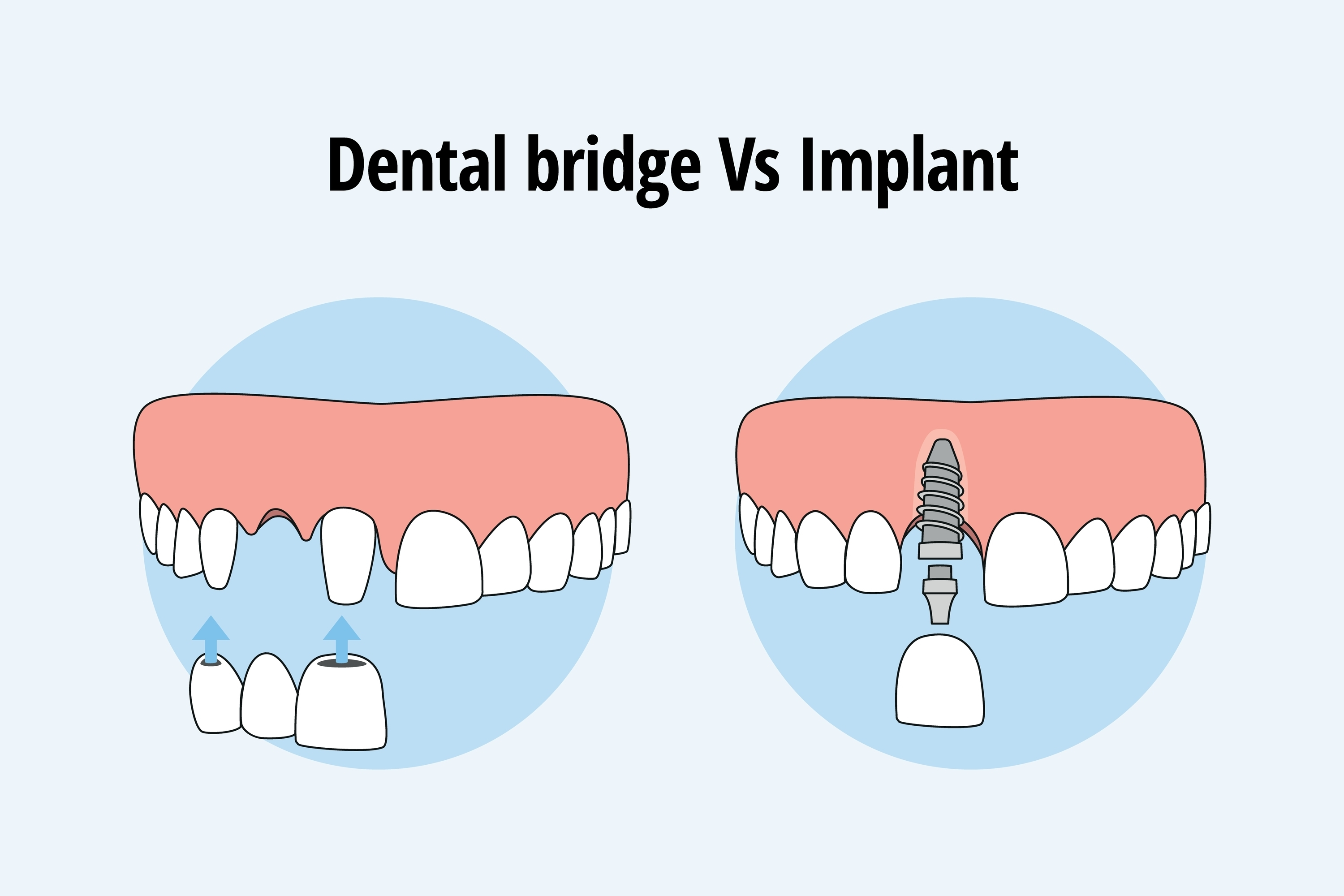
Implants need sufficient bone to accommodate screwlike posts that will be capped with crowns. They’ve become increasingly common in recent years, particularly among adults aged 55 to 64, according to a 2018 report.
A dental implant process starts with removing a damaged root if it’s present. Once the root is gone, or if it was previously extracted, a hole is prepared in the jawbone.
A metal replacement root, known as a post, is inserted deep into the bone. The top of that post will later receive a crown, but only after bone begins to grow around the post to anchor it securely.
It can take a few months before the post is ready for an abutment, the component to which the crown attaches. In some cases the abutment is placed at the same time as the post.
The last stage is affixing a crown — an artificial tooth crafted to match adjacent teeth — to the abutment.
Dentures
Dentures are removable artificial teeth that can be manufactured for your mouth regardless of the amount of jawbone available.
Dentures may be full sets to replace all teeth on the upper or lower jaws, or they can replace a small number of missing teeth; the latter are called partial dentures.
To make dentures, an impression of the upper or lower gums (or both, if you need a full set) is first taken.
Before producing the dentures, your dentist will evaluate your bite and the alignment of your upper and lower jaws to ensure the denture length supports optimal chewing and speech.
A preliminary denture set is fabricated in a lab and returned to your dentist. These trial dentures are placed in your mouth and any needed tweaks to alignment or tooth length are made before the final pair is produced.
Dentures are crafted to resemble natural teeth and gums and are held in place using a special adhesive that bonds them to your gums.
Cost comparison: dentures vs. implants
Dental implants are generally pricier than dentures and other options like bridges.
Although costs vary by location and other variables, the American Dental Association (ADA) indicates an implant may run about $1,600 to $2,200 per tooth.
The ADA notes that the average price for a complete set of upper dentures is just over $1,600, with lower-jaw complete dentures costing roughly the same.
Maintenance: what’s involved
Care for dental implants closely mirrors routine oral hygiene for natural teeth: brush at least twice daily with a soft brush, floss, and attend regular dental checkups.
However, dentures demand more daily upkeep to remain in good condition over time. For example, you shouldn’t wear them while sleeping; instead they should soak in water or a cleaning solution overnight.
To clean dentures (which should be done every day), remove them after meals and brush them. You may also need to remove any leftover adhesive from your gums.
Because your bite can shift with age, dentures will occasionally require refitting. Dental implants, by contrast, are permanent fixtures though they might need replacement crowns if the original crowns fracture or chip.
Potential complications
Dental implants are generally safe and effective for missing teeth but can involve various complications, such as infection and mechanical issues (loose posts, fractured crowns), according to research. Implant failures occur approximately 5 to 10 percent of the time.
The most frequent problems with dentures include:
- difficulty keeping dentures in place
- sores (ulcerations) developing on the gums
How to decide between dentures and implants
When it’s time to choose the best path for replacing your teeth, take these considerations into account:
Age
Since dental implants are more long-lasting, individuals in their 60s or younger may prefer implants because they can expect decades of use from their prosthetic teeth.
Older adults, especially those who wish to avoid the longer, more invasive implant procedures, might opt for dentures.
Bone density
Implants need a certain amount of jawbone to support the posts. If you’ve lost bone due to injury, aging, gum disease, or previous tooth loss, you may not be a suitable candidate for implants.
Bone grafting can increase jawbone volume, but it’s a more involved and costly procedure.
Function and comfort
Implants often provide greater comfort and improved chewing ability compared with dentures.
However, a 2019 study reported that people with implant-supported overdentures — a hybrid between dentures and implants — experienced greater satisfaction with comfort and chewing efficiency than those with traditional dentures.
Hygiene
If you are unlikely to maintain dentures properly, consider implants, which are lower maintenance though more costly.
Be realistic about your willingness and ability to perform the daily care needed for dentures.
Other options besides dentures and implants
Dentures and implants aren’t the only ways to replace missing teeth. Other alternatives to discuss with your dentist include:
Dental bridge
If you’re missing one or several teeth, a dental bridge can be an effective solution to fill the gap. Also called a fixed partial denture, a bridge anchors to adjacent teeth for support.
Research indicates a high proportion of people with dental bridges are satisfied with them, though better patient education about care and maintenance is needed.
Temporary partial denture
Known as a flipper, a temporary partial denture is a removable, retainer-like device that holds one or more prosthetic teeth. These teeth provide the look of a full smile but can be removed for straightforward cleaning.
Flippers are among the least expensive ways to replace teeth, but they are also the least durable.
They’re often used by patients waiting for implants or a fixed bridge, but can serve as long-term solutions for those who understand replacement flippers will likely be necessary over time.
Snap-in denture
A hybrid between dentures and implants, snap-in dentures don’t depend on adhesive to stay in position. Instead, snap-in dentures — also called overdentures — use implants to anchor them.
Rather than a post and abutment for each missing tooth, snap-in dentures may include a few snaps on the underside that attach to two to four posts per jaw. Snap-in dentures can be fixed or removable for cleaning.
Snap-in dentures are more stable than traditional dentures but also more costly. They carry similar potential complications to regular implants and require ongoing maintenance, per a 2015 study.
Takeaway
Choose between dentures and implants with care and in consultation with your dentist.
Although implants cost more up front, they can offer 20 or more years of function compared with dentures, which may need periodic adjustments or replacement over time.
By carefully reviewing all available options to replace missing teeth and considering your priorities and desired outcomes, you can reach a confident decision about the best solution for you.





















Leave a Reply
You must be logged in to post a comment.