

You should seek medical attention if you have severe pain or marked swelling in your pinky toe, can’t bear any weight on it, or notice it’s misaligned. Milder issues may be managed at home or with nonprescription remedies.
Although your pinky toe is small, an injury to it can produce significant discomfort.
Pain in the fifth toe is common and can stem from many sources, such as a fracture or sprain, tight shoes, a corn, a bone spur, or other problems.
Below we review the potential reasons for a sore pinky toe and how to address them.
Causes of a painful pinky toe
Your pinky toe is vulnerable to harm because of its position along the outside edge of the foot. The metatarsal bones that connect to the fifth toe are a frequent site of foot injuries, particularly among athletes.
If your toe is swollen and painful and home remedies aren’t effective, it’s wise to consult your physician.
Getting proper care early can help the toe mend correctly and prevent secondary complications.
Here’s a closer look at common reasons for pain in the small toe.
1. Broken toe
A severe stub or a direct impact from a heavy object can break your toe — a condition known as a fracture.
If you have an open fracture (where the skin is torn or there’s an open wound), get immediate medical care.
Symptoms
Typical signs of a fractured pinky toe include:
- a popping noise at the time of injury
- sharp, throbbing pain that often eases after a few hours
- difficulty bearing weight on the affected foot
- a pinky toe that looks out of place
- swelling and bruising
- a burning sensation
- a damaged toenail
Treatment
Your provider will likely order an X-ray to assess the fracture type. They’ll check for displacement, loose bone pieces, stress fractures, and involvement of the metatarsal bones attached to the fifth toe.
Treatment varies by fracture type:
- If the bones remain aligned, you may be fitted with a walking boot or cast to immobilize the area during healing.
- For a straightforward break, the doctor might “buddy tape” the pinky to the fourth toe to hold it steady while it heals.
- More severe breaks may require surgery to realign the bone.
- Doctors commonly recommend OTC pain relievers, rest, and home care measures.
2. Stress fracture
A stress fracture (hairline fracture) is a tiny crack or bone bruise that develops gradually, usually from repetitive actions like running or jumping in high-impact sports.
Symptoms
Pain is the hallmark symptom of a stress fracture and often worsens over time, particularly if you keep putting weight on the foot. Discomfort usually increases with activity and lessens with rest.
Other frequent signs include:
- swelling
- bruising
- tenderness
Treatment
If you suspect a stress fracture, follow the RICE approach until you can see a doctor:
- Rest: Avoid putting weight on the foot or toe.
- Ice: Apply a cold pack (ice wrapped in a damp cloth or towel) for 20 minutes several times daily.
- Compression: Wrap the area with a bandage.
- Elevation: Keep the foot elevated above chest level when resting.
OTC NSAIDs such as ibuprofen or aspirin can reduce pain and swelling.
Many stress fractures are treated similarly to simple breaks, depending on severity.
Other fractures
Two additional metatarsal fractures may cause pain along the outside of the foot, including the area of the pinky toe:
- Avulsion fracture: a tendon or ligament pulls off a small bone fragment from the metatarsal; often occurs in sports during sudden pivots.
- Jones fracture: a break at the base of the fifth metatarsal bone.
Common features of these fractures include:
- pain localized to the fracture site
- bruising and swelling
- pain when bearing weight on the injured foot
3. Dislocated toe
A forceful impact or bending the toe too far backward can separate the bones of the pinky toe, resulting in a dislocation.
Dislocations are relatively common in athletes and people over age 65.
All toes except the big toe have three bones, and dislocation can happen at any of these joints.
Dislocations may be partial (subluxation), where bones are not fully separated, or complete, where a bone is entirely out of position.
A dislocation can also occur alongside a fracture of another toe bone.
Symptoms
Typical signs of a dislocated pinky toe include:
- pain with movement
- a crooked or misaligned appearance
- swelling
- bruising
- numbness or tingling
Treatment
Your clinician will examine the toe and may obtain an X-ray to confirm the diagnosis.
Additional tests might be used to evaluate potential damage to blood vessels or nerves.
Often a doctor can manually realign the dislocated bone (closed reduction). A local anesthetic may be used to minimize pain during the procedure.
Depending on severity, you might need an elastic bandage, splint, cast, or walking boot to keep the toe aligned while it heals.
In some cases, surgery (open reduction) is required to reposition the bone.
4. Sprained toe
A sprain affects a ligament — the connective tissue joining bones — rather than the bone itself.
Ligaments connect bones to one another, while tendons attach muscles to bones.
Stubbing or overstretching a toe can sprain a ligament.
Although a sprained toe can be painful, walking is often still possible.
Symptoms
Common symptoms of a sprained pinky toe include:
- pain with movement
- a throbbing feeling
- tenderness to touch
- swelling
- bruising
- joint instability
Treatment
Management depends on the sprain grade:
- Grade I: minimal pain and little loss of function
- Grade II: moderate pain and difficulty bearing weight
- Grade III: severe pain and inability to bear weight
Grade I sprains often respond to rest, ice, and occasional buddy taping.
For grade II or III sprains, your doctor may suggest further measures such as a walking boot.
5. Tailor’s bunion
A tailor’s bunion (bunionette) is a bony protuberance on the outside base of the pinky toe and can produce significant discomfort.
This condition may result from an inherited foot structure where the metatarsal shifts outward while the pinky toe drifts inward.
Ill-fitting narrow shoes can also cause a tailor’s bunion.
In either case, repetitive rubbing from footwear irritates the bump.
Symptoms
Common signs include:
- a small bump at the toe base that enlarges over time
- pain at the site of the bump
- redness
- swelling
Treatment
Depending on pain severity, options may include:
- choosing shoes with a roomy toe box and avoiding high heels or pointed shoes
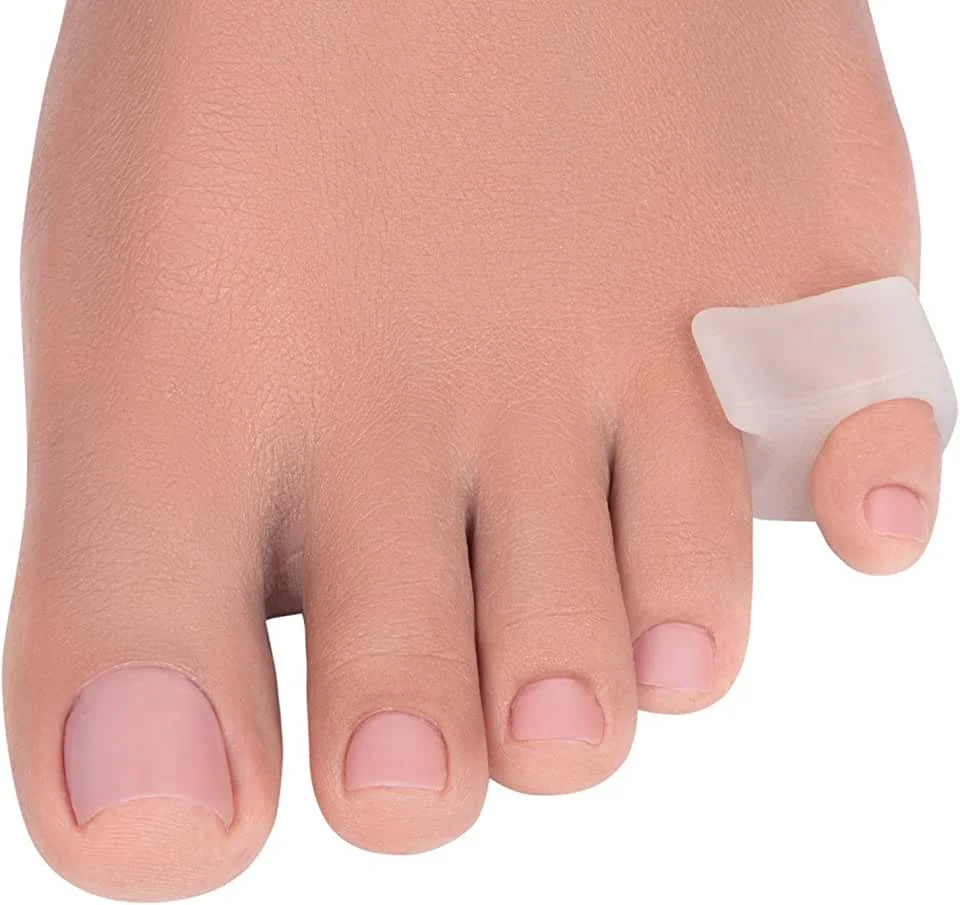
- using soft padding over the painful area
- custom orthotics to reduce pressure
- a corticosteroid injection to lower inflammation
If pain limits daily life or the bunion is severe, surgery may be recommended.
6. Corn
A corn is a localized thickening of skin that develops where friction and pressure occur, often from tight shoes.
A hard corn on the outside of the pinky toe can be painful, particularly when shoes rub against it. Deep corns can irritate a nerve or bursa (a fluid-filled sac near a joint).
Symptoms
Common corn symptoms include:
- a tough, rough, yellowish patch of skin
- skin that’s tender when touched
- pain when wearing shoes
Treatment
Your clinician may:
- pare down the corn or advise gentle filing after bathing
- recommend soft padding to reduce pressure
- suggest wider shoes or stretching the toe box of existing footwear
7. Toe abnormalities
Several structural toe issues can make the pinky toe sore, uncomfortable, or swollen.
Misshapen toes
Imbalances in posture or gait can place extra stress on the feet, leading to toe deformities such as hammer toe or claw toe.
- Hammer toe is when the toe bends downward rather than remaining straight. Causes include injury, arthritis, tight shoes, or a high arch. Some people are born with it.
- Claw toe is when the toe curls into a claw-like shape. It can be congenital or result from conditions like diabetes. Without treatment, toes can become fixed in this position.
Both deformities can be painful and promote corns, calluses, or blisters on the toes and adjacent toes due to altered pressure.
Treatment
- Doctors may recommend splints or taping to maintain proper toe alignment.
- For claw toe, exercises can help preserve flexibility.
- If conservative measures fail, surgery may be considered to correct persistent problems.
Overlapping pinky toe
Some individuals are born with a pinky toe that overlaps the fourth toe; this trait is believed to be heritable. It can be painful in some cases and appears bilaterally in roughly 20 to 30 percent of people.
Children with this condition sometimes self-correct as they begin walking.
About 50 percent of individuals with an overlapping fifth toe experience pain, including bursitis, calluses, or shoe-related issues.
Treatment
Initial treatment focuses on conservative methods to realign the pinky toe, such as taping, splinting, and corrective footwear.
If these approaches don’t relieve pain, surgical correction may be considered.
Home remedies for a painful pinky toe
Depending on the underlying cause, self-care measures may be sufficient to relieve pain in your little toe.
If the condition requires medical attention, you can use the following steps to manage symptoms until you see your provider.
To help lessen pinky toe pain:
- Rest the foot and toe as much as possible. Avoid bearing weight on the toe.
- Use crutches or a cane to move around without stressing the toe.
- Elevate your foot so it is above chest level when resting.
- Ice the area for 15–20 minutes several times per day during the first few days after injury. Use ice packs or frozen vegetables wrapped in a damp towel.
- Take an OTC pain reliever to help control pain and inflammation.
- Apply moleskin or padding to prevent direct shoe contact with the sore pinky toe.
Why do you have a pinky toe, anyway?
Your toes help maintain balance whether you’re barefoot or shod. The pinky, though small, contributes to your stability.
Think of your foot’s balance as a triangle formed by three points: the big toe, the pinky toe, and the heel. Damage to any of these points can disrupt your balance.
So an injured pinky toe can affect balance and change how you walk or move.
The bottom line
Seek medical care if you have severe pain or swelling in the pinky toe, can’t put pressure on it, or notice misalignment.
Structural deformities can often be fixed with medical intervention.
Milder injuries like minor sprains typically improve with home care and OTC treatments. Wearing properly fitting shoes with a roomy toe box can often resolve the factors that make the pinky toe painful.













Leave a Reply
You must be logged in to post a comment.