

Although health professionals typically advise against sharing a bed with your infant, there are measures you can take to lower the dangers if you opt to do so.
For new caregivers, the flood of recommendations and cautions about infant care can feel daunting. One topic that sparks a lot of debate is whether to let your baby sleep in the same bed as you.
While many societies view a family sleeping arrangement as customary from birth, several medical and scientific bodies in the United States discourage bed sharing (also known as co-sleeping), particularly for very young infants.
So, is it acceptable for your baby to sleep beside you? And if yes, what precautions should you implement to make their sleeping space as safe as possible?
What is the Safe Sleep Seven and who developed it?
The Safe Sleep Seven is a set of recommendations aimed at making bed-sharing safer for babies and their caregivers. The idea first appeared in 1999 in the book Sweet Sleep by Diane Wiessinger, Diana West, Linda J. Smith, and Teresa Pitman.
The main goal is to acknowledge and normalize bed sharing, especially for parents of newborns or for those nursing young infants. Early on, frequent night feedings and the fatigue that comes with them can make transferring the baby to and from a separate sleep space cumbersome.
Promoted often by La Leche League (LLL), Safe Sleep Seven is frequently recommended for breastfeeding parents, but its principles can also apply if you use formula.
The American Academy of Pediatrics (AAP) does not recommend having an infant sleep in an adult bed with parents or caregivers because of the risk of sudden infant death syndrome (SIDS) and accidental infant suffocation and strangulation. The AAP recommends sharing a room without sharing a bed.
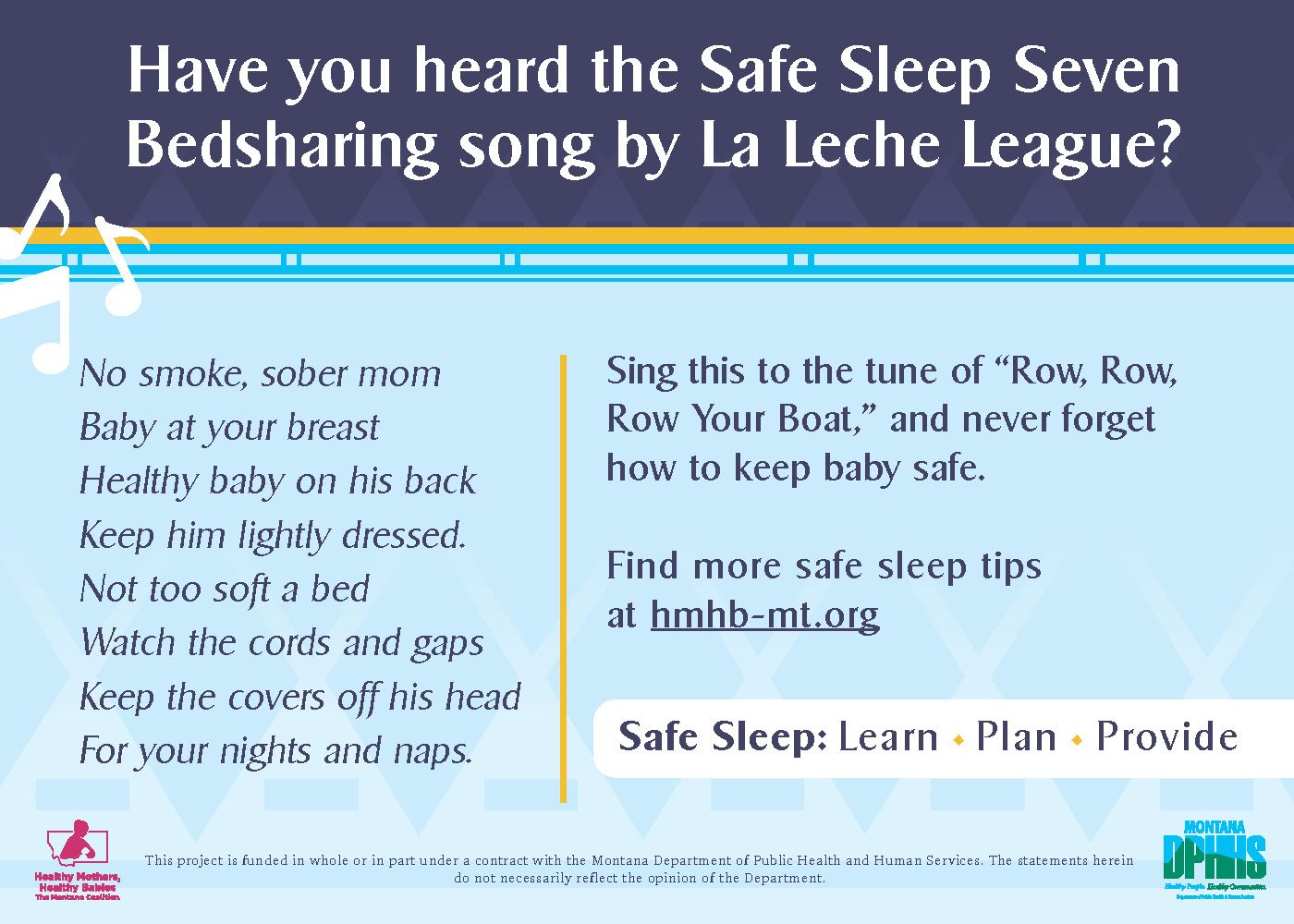
The Safe Sleep Seven song
Set up like a short rhyme and commonly sung to the melody of “Row, Row, Row Your Boat,” the Safe Sleep Seven highlights the primary precautions parents should focus on when bed sharing with infants.
Although many in the medical and scientific communities generally discourage bed sharing, several of the Safe Sleep Seven recommendations are backed by peer-reviewed studies.
Singing the Safe Sleep Seven song
Sung to the tune of “Row, Row, Row Your Boat,” here are the Safe Sleep Seven pointers for safer sleep:
- no smoke, sober mom
- baby at your breast
- healthy baby on his back
- keep him lightly dressed
- not too soft a bed
- watch the cords and gaps
- keep the covers off his head
- for your nights and naps
Additionally, the AAP notes that behaviors linked to an increased SIDS risk include some actions during and after pregnancy, such as cigarette use or consuming drugs or alcohol, as well as opting for formula feeding instead of breastfeeding.
Let’s go through each line of the rhyme and see how it aligns with scientific evidence.
No smoke, sober mom
Put simply: if you plan to bed-share with your infant, do not smoke and avoid alcohol before sleeping.
Research supports this guidance; many bed-sharing fatalities have involved parents who smoked or who went to bed after drinking alcohol or taking medications.
The AAP not only discourages bed sharing but also warns against smoking during pregnancy and exposing infants to secondhand smoke because it raises the risk of SIDS.
Baby at your breast
This line advises against propping the baby on pillows. The rhyme is aimed more at those who breastfeed or chestfeed; the idea is that the infant should have direct access to the breast or chest to make feeding easier.
Instead of placing the baby on pillows near your face, they should lie flat on the mattress with their face close to your breast or chest.
Studies indicate that those who breastfeed often instinctively adopt a protective position when nursing while recumbent.
Called the “cuddle curl,” this posture involves bending arms and legs to encircle the infant, making accidental rolling onto the child much less likely.
A 2019 study found that the cuddle curl is more prevalent among breastfeeding parents than those who formula-feed.
Keep in mind that formula-fed infants also shouldn’t be propped up on pillows, and bottles should never be propped to feed an infant unattended.
Healthy baby on his back
SIDS most often occurs in infants placed to sleep in positions other than supine (on their back). Whether you co-sleep or use a separate sleeping area, the back position is the safest.
All leading medical organizations, including the Centers for Disease Control and Prevention (CDC) and the National Health Service (NHS), recommend placing infants on their backs for naps and nighttime sleep.
Keep him lightly dressed
Babies can overheat easily, and overheating is another documented factor associated with SIDS.
Per the AAP, the recommended way to dress an infant for sleep is to use no more than one extra layer of clothing compared to what an adult would wear to be comfortable.
Not too soft a bed
Along with back sleeping, the sleeping surface should not be overly soft. This aligns with guidance from many health authorities. A firm mattress helps keep the infant’s airway open.
Avoid surrounding the baby with loose bedding or toys that pose a suffocation risk, but a fitted sheet on the mattress is acceptable. Never place your baby to sleep on a couch, armchair, recliner, or other unsupported surface where rolling or falling are likely.
Watch the cords and gaps
Cords present a strangulation risk for active sleepers. A bed positioned too near a wall or furniture can be hazardous if a baby rolls into a narrow gap.
Although most medical bodies advise against bed sharing, they emphasize the importance of evaluating your baby’s crib or sleep area. For cribs with slats, experts recommend slat spacing of no more than 2⅜ inches to prevent entrapment.
Keep the covers off his head
As with separate sleeping spaces, the Safe Sleep Seven echoes CDC and AAP guidance that a baby’s sleep area should be free of bedding and plush items that could cover the head.
The danger is that bedding pressed against an infant’s nose could cause suffocation if neither the baby nor an adult can quickly dislodge it.
The bottom line
Whether referred to as bed sharing or co-sleeping, bringing your baby into your bed is a personal decision. Most U.S.-based medical organizations remain firm in their recommendation against the practice.
Nevertheless, many people recognize that bed sharing—particularly for breastfeeding families—is common worldwide and offers bonding and potential health advantages for both infants and parents.
Consequently, ongoing research seeks to refine guidance to help parents who choose to bed share do so in the safest possible way.






















Leave a Reply
You must be logged in to post a comment.