
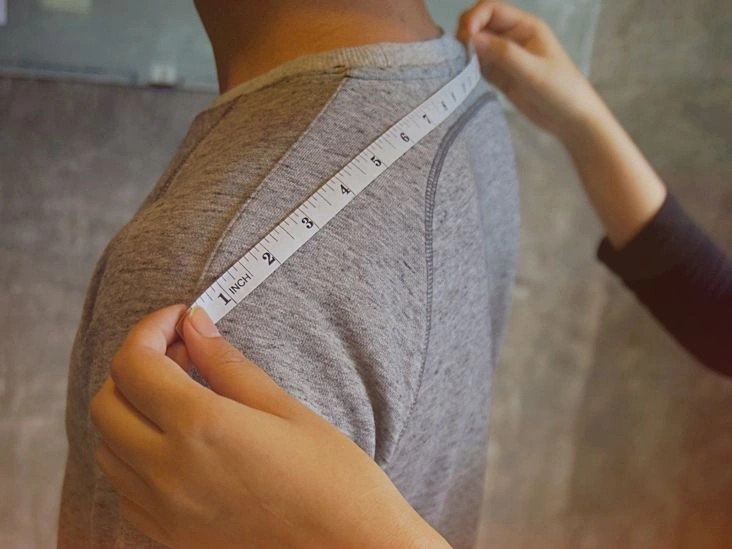
While it varies considerably, the typical shoulder width in the United States is roughly 16 inches (41 cm) for men and about 14 inches (36 cm) for women.
The distance across your shoulders depends on genetics, body weight, somatotype, and other influences. Specialists who study human proportions — anthropometrists — have developed standards and techniques for determining shoulder breadth.
The technical name for this measurement is “biacromial breadth” or “biacromial diameter.”
Read on to learn how shoulder width averages have shifted over time and how you can measure your own shoulder span.
What qualifies as an average shoulder width?
If the phrase “biacromial diameter” seems archaic, that’s understandable — it’s not as commonly used today. Partly this is because official U.S. shoulder width figures haven’t been released in over 30 years.
That gap makes it difficult to pinpoint contemporary average shoulder widths for American men and women. Much of what we rely on now is observational rather than freshly tabulated.
By contrast, the Centers for Disease Control and Prevention (CDC) still publish comprehensive data on height, weight, BMI, and other body dimensions by race, age, and stature.
Informal observations indicate shoulder widths differ by ethnicity, nutrition, physical activity, and heredity. Statistically, people are trending taller and broader in many regions. Here’s what historical data reveal:

Average U.S. shoulder width in the 1960s
Surveys from the early 1960s found that 3,581 American women aged 17 and older had an average shoulder breadth of 13.9 inches (35.3 cm). Men averaged 15.6 inches (39.6 cm), based on 3,091 participants. Things have shifted since then.
Average U.S. shoulder width 1988 to 1994
CDC data from 1988–1994 report biacromial measurements for 8,411 women aged 20 and over. Their average shoulder breadth was 14.4 inches (36.7 cm).
During the same period, shoulder measurements of 7,476 men aged 20 and older produced an average male shoulder width of 16.1 inches (41.1 cm) in the United States.
Average U.S. military forearm-to-forearm width in 1988
Some studies measure arm-to-arm breadth rather than strictly biacromial width. A 1988 survey of U.S. military personnel reported an average forearm-to-forearm span (tricep-to-tricep) for men of 21.5 inches (54.6 cm).

That study measured shoulder breadth for 1,774 males older than 19, all military recruits. The same research found 2,208 female participants had an average forearm-to-forearm span of 18.4 inches (46.8 cm).
Forearm-to-forearm breadth is typically larger than the conventional shoulder-blade-to-shoulder-blade (biacromial) measurement.
Average Swedish shoulder width in 2009
A 2009 Swedish study reported an average shoulder width of 15.5 inches for 105 men older than 18. Among 262 women measured, the average was 14 inches. Researchers concluded that average body dimensions in Sweden had increased over the previous four decades.
How to measure your shoulder width
If you want to compare yourself to historical norms, enlist a friend and a tape measure for the simplest approach to determining shoulder breadth.
The standard technique measures shoulder joint-to-joint from one shoulder tip to the other. This is easiest with your back toward a helper who holds the measuring tape.
Measuring with assistance
Ask your friend to place the tape end where your shoulder meets the top of your arm — the bony tip of the shoulder. Keeping the tape tight, they should extend it straight across to the tip of your opposite shoulder blade. That distance is your shoulder width.
Measuring by yourself
If you’re alone, stand with your back against a wall and your head level. Reach across your left shoulder with your right hand and make a small mark just above the shoulder joint.
Repeat on the other side using the opposite hand, then use a tape measure to record the distance between the two marks.
Measuring tricep-to-tricep breadth
This measurement is easiest with someone helping you.
Anthropometrists typically use large calipers to measure shoulder breadth including the arms. To approximate this yourself, face a partner and use a tape to measure across from the tops of your upper arms while they hang naturally at your sides.
Maintain an upright but relaxed posture. Depending on body shape, this measurement may be simpler or more accurate when taken across the back rather than the front.
Measuring with intent
Shoulder width alone is more informative when combined with other body measurements.
Researchers gather these dimensions for many purposes: to study growth trends and population health, and to inform the design of environments and products — from vehicles to furniture to assistive devices.
It’s also how clothing sizes are determined and how tailors achieve a better fit.
Shoulder width is an approximation away
Average shoulder breadth has shifted slightly over time, and without recent large-scale, diverse samples it’s difficult to know the current mean shoulder width precisely.
Nonetheless, drawing from past biacromial data and observed trends, it’s reasonable to estimate that average shoulder width in the United States is at least 16 inches (41 cm) for men and 14 inches (36 cm) for women.
How you measure shoulder width can vary depending on the intended use of the measurement.























Leave a Reply
You must be logged in to post a comment.