10 Back Exercises with Bands to Counteract Work-from-Home Posture

- Which muscles matter most for desk posture?
- Can resistance bands deliver an effective workout?
- Kinds of resistance bands
- Band moves to correct work‑from‑home posture
- Bent‑over row
- Reverse fly
- Lat pulldown
- Face pull
- Superman
- Deadlift
- Single‑arm row
- Standing Ys
- Pullover
- Assisted pull‑up
- Guidelines for banded back work
- Final thoughts
Remote work has plenty of advantages, but it also brings some downsides. One common issue is an inadequate workspace — hello, laptop on the couch — and that setup could be the reason for the discomfort you’re noticing.
Work-from-home posture — typically a rounded, compressed spine with hunched shoulders and a forward head — contributes to back pain and other problems.
Research indicates that forward head posture can reduce mid‑spine mobility, which then impairs breathing and has even been linked to higher mortality in older adults (1 , 2).
Building up postural and core musculature can help correct this. One study of college‑aged men showed that a posture‑focused exercise routine eased shoulder, mid‑back, and lower‑back pain (3).
So, where to begin?
Which muscles matter most for desk posture?
Good alignment relies on muscles from the neck down, but the core and back are especially important.
Prioritize strengthening the lats, traps, and rhomboids, along with the core muscles that stabilize the lower back — think obliques, erector spinae, multifidus, and quadratus lumborum. Also consider adding some lower trap exercises into your routine for a more balanced upper back.
Can resistance bands deliver an effective workout?
The short answer: absolutely.
Muscle growth depends on two things: tension (resistance) and progressive overload — steadily increasing that resistance. Bands provide both, and they generate a different resistance curve than free weights or machines: the farther you stretch a band, the more resistance it creates, which demands a unique recruitment pattern from your muscles.
Bands are also portable, budget‑friendly, and adaptable — all useful traits.
Kinds of resistance bands
Resistance bands generally fall into three categories:
- bands with handles — rubber tubing with a grip on each end
- superbands — large looped bands made from thick, heavy rubber
- mini bands — small, thin looped bands
They typically come in light, medium, and heavy resistances. You can modify a lighter band’s challenge by shortening the length you grip or by doubling up bands.
Band moves to correct work‑from‑home posture
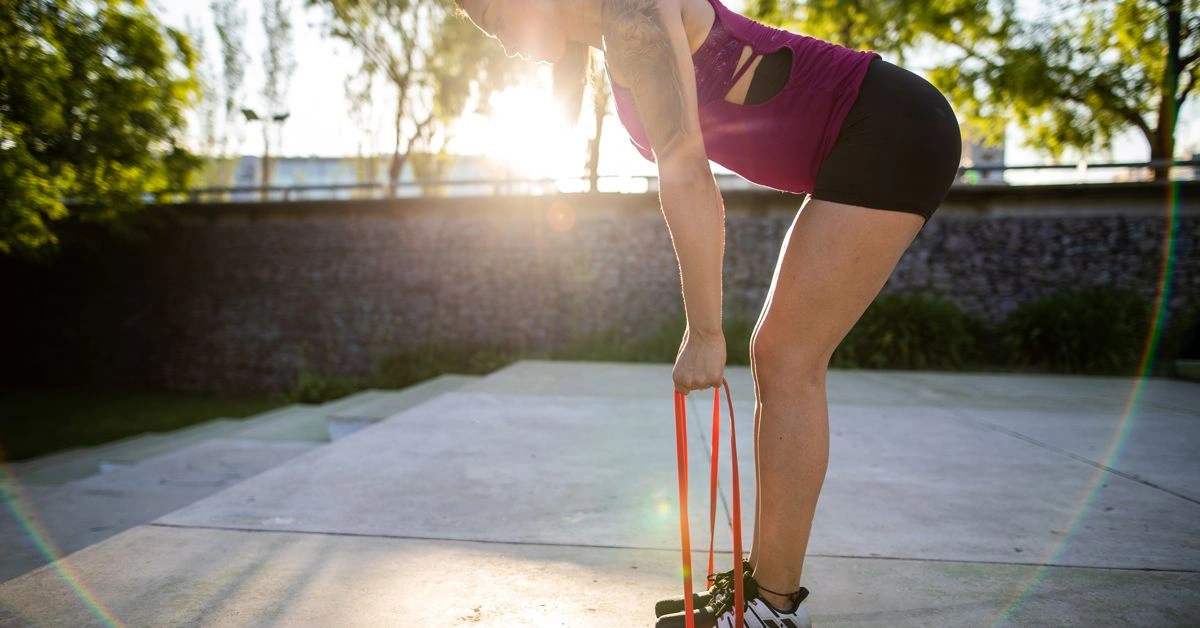
Bent‑over row
The bent‑over row is suitable for most fitness levels and works well with a band with handles. This movement targets the lats and traps and also engages smaller muscles like the rhomboids.
How to do it:
- Grasp the handles of your band, stand on the band with both feet, and cross the handles.
- Hinge at the hips about 45 degrees, keeping arms long and allowing a slight bend in the knees.
- With a neutral spine, pull your elbows up and back toward the wall behind you, letting the lats drive the action.
- Hold briefly at the top without excessively opening the chest, then return to the start.

Reverse fly
A reverse fly with a handled band targets the rhomboids. Resistance is easy to scale, making this a great option for beginners and for progressing over time.
How to do it:
- Stand with feet hip‑width apart, holding the band handles with your arms extended in front of you.
- Brace your core and pull the band apart, keeping arms straight and letting your upper‑mid back muscles lead the movement.
- When arms reach out to the sides, return to the starting position.

Lat pulldown
This motion is driven by the lats. Anchor a handled band overhead with the handles hanging down. Because you can adjust tension, it suits a wide range of abilities.
How to do it:
- Stand with feet shoulder‑width apart. Hold the band roughly 6 inches from each handle, arms extended.
- Raise your arms overhead, maintain a neutral pelvis, and engage the core.
- Pull the band down to your chest, bringing arms down to your sides until they’re parallel to the floor. Feel the lats leading the pull.
- Return to the start.

Face pull
Use a superband for face pulls to work the traps and rhomboids.
How to do it:
- Wrap a superband around a pole or sturdy anchor at eye level. Hold the free end with both hands, overhand, and step back until the band is taut. Stagger your stance or keep feet shoulder‑width apart.
- With elbows roughly parallel to the floor, pull the band toward your face, letting the upper back muscles perform the movement.
- Pause at the top, then return to the starting point.

Superman
Add a miniband around the ankles to make the classic superman harder and provide an extra challenge for more advanced exercisers.
How to do it:
- Lie prone with arms and legs extended and the miniband looped around your ankles.
- Engage the core, then raise your arms and legs simultaneously while keeping the neck neutral. Lift as high as you can comfortably go.
- Hold briefly at the top, then lower back slowly and with control.

Deadlift
A superband deadlift is an advanced alternative to the traditional deadlift and can be an interesting variation.
This challenges the traps and lower back — ensure your hamstrings initiate the movement to avoid undue stress on the lumbar spine.
How to do it:
- Lay a superband on the floor and step on it with feet about shoulder‑width apart.
- With a straight back, hinge at the hips, bend the knees, grasp the band with each hand, and stand up. At the top, retract and lower the shoulders slightly.
- Descend again by hinging at the hips with a small bend in the knees, keeping the spine neutral and the torso steady.
- Return to standing and repeat.

Single‑arm row
There are multiple ways to do a single‑arm row with bands; anchoring the band under your foot is an easy and effective method. Use a band with handles and give it a try.
How to do it:
- Stand on the band with both feet and hold one handle in your right hand, letting the other handle fall. Step your left foot back.
- Hinge at the hips and let the right arm hang long.
- Pull the working arm into a row, driving the bent elbow up and back with the lat.
- Lower the arm, then repeat. After your reps, switch sides.

Standing Ys
This miniband exercise hones in on upper‑back musculature and is appropriate for all ability levels.
How to do it:
- Stand with feet shoulder‑width apart and place the miniband around both hands, extending your arms overhead.
- Brace the core and pull the miniband apart, resisting its pull with your upper back.
- Return and repeat.

Pullover
A superband pullover trains the lats and core and is effective for exercisers across the spectrum.
How to do it:
- Anchor the band low around a pole or sturdy object.
- Lie on your back with arms extended so you can reach the band’s end with an overhand grip. Bend your knees and place your feet flat.
- Engage your core and pull the band from behind your head toward your knees, keeping arms straight the entire time.
- Return to the start with control.

Assisted pull‑up
Pull‑ups are a reliable way to develop back strength, though they’re challenging for many. A superband provides assistance so you can perform full reps with better form.
How to do it:
- Place a step stool beneath a pull‑up bar and loop a superband over the bar so it hangs down.
- Put one foot into the band loop, grip the bar slightly wider than shoulder‑width with palms forward, and let the other foot wrap around the banded leg for stability.
- Pull yourself up until your chin clears the bar, then lower slowly back to the start.

Guidelines for banded back work
As you strengthen your back, keep these recommendations in mind:
- Emphasize the mind‑muscle connection — think about the exact muscle contracting to improve activation and results.
- Shoot to perform three of these exercises twice weekly to notice changes within 1–2 months. Begin with 2 sets of 10 reps, progressing toward 3 sets of 12–15 reps.
- Check your posture regularly throughout the day. If your head drifts forward, reset — straighten the neck, pull the shoulders back, keep your spine neutral, and place your feet flat on the floor.
Final thoughts
Resistance bands are a flexible and effective option to fortify your back muscles and counteract poor work‑from‑home posture. Pair these movements with frequent postural resets during the day, and you’ll not only look better but, more importantly, feel better.
Frequently Asked Questions
Choose bands based on the exercise and your strength: handled bands for rows and pulldowns, superbands for heavy lifts and assisted pull-ups, and minibands for upper-back and activation drills.
Aim for two sessions per week focusing on back work, performing 2–3 sets of 10–15 reps per exercise and progressively increasing resistance as you get stronger.
Yes. Strengthening the lats, traps, rhomboids, and core with banded moves helps pull the shoulders back, stabilize the spine, and counteract forward-head and rounded-shoulder posture.
Many band exercises can be safe if performed with proper form and controlled load. Start with lighter resistance and hinge from the hips; consult a clinician if you have acute or severe back issues.
Progress by increasing band tension (heavier bands or shortening the band), adding reps or sets, reducing rest between sets, or combining banded moves into supersets for more challenge.
Read Next

Remedios naturales para colitis ulcerosa: Dieta, suplementos y más

What to Do When Your Shoes Are Too Tight

How to Remove and Prevent Moths in Your Home

What Is Sweet Annie and What Are the Benefits?

What Should I Do About a Molar Broken Off at the Gum Line

How Long Will I Have to Sit in the Dentist Chair During a Root Canal?
Related Posts

10 Potential Health Benefits of Bee Pollen
Sep 11, 2026 • 27 min read
What Causes Bleeding After Being Fingered?
Aug 14, 2026 • 26 min read
Understanding the FAST Scale for Dementia
Aug 29, 2026 • 26 min read
6 Natural Treatments for Shingles
Sep 8, 2026 • 7 min read
Smoker's Cough: Everything You Need to Know
Sep 13, 2026 • 9 min read