

Key Takeaways
- EFT tapping is grounded in the idea of meridian points, akin to acupuncture. It’s a method aimed at rebalancing the body’s energy to ease negative feelings and bodily pain.
- The method includes naming a problem, measuring its initial intensity, and creating a setup phrase that acknowledges and accepts the issue.
- A session involves tapping particular meridian points while repeating a reminder phrase, then reassessing the issue’s intensity to track changes.
- Research shows EFT tapping can be effective for PTSD in veterans and may help reduce anxiety and boost self-worth, although more studies are warranted.
EFT is an alternative approach for managing physical discomfort and emotional distress. It’s also known as tapping or psychological acupressure.
Advocates believe that tapping the body can restore balance to the energy system and alleviate pain. According to its creator, Gary Craig, disturbances in energy produce negative emotions and pain.
Although research continues, EFT tapping has been applied to people experiencing anxiety and those with post-traumatic stress disorder (PTSD).

How does EFT tapping work?
Like acupuncture, EFT centers on meridian points — or energy hotspots — to realign your body’s energy.
It’s thought that reestablishing this energy balance can ease symptoms caused by a distressing event or emotion.
Rooted in Chinese medicine, meridian points are locations on the body through which energy moves. These channels help regulate energy flow to support health. An imbalance can contribute to illness.
Acupuncture uses needles to stimulate these energy sites. EFT uses fingertip tapping to stimulate them.
Supporters say the tapping helps access the body’s energy and sends signals to brain areas that regulate stress.
They assert that activating meridian points via EFT tapping can lessen the stress or negative feeling tied to your issue, helping to rebalance disrupted energy.
EFT tapping: 5 steps to get started today
EFT tapping can be organized into five steps. If you have multiple concerns or fears, repeat this sequence for each to decrease or remove the intensity of your negative reactions.
1. Identify the issue
To use this technique effectively, first pinpoint the issue or fear you want to address. This will be your focus during tapping. Concentrating on a single problem at a time is said to improve results.
2. Test the initial intensity
Once you’ve identified the problem, set a baseline intensity level. Rate the intensity on a 0-to-10 scale, with 10 representing the most severe or distressing level.
The scale gauges the emotional or physical pain and discomfort stemming from your focal issue.
Having a baseline lets you measure progress after a full EFT sequence. For example, if your initial intensity was 10 and drops to 5 after tapping, you’ve achieved a 50% improvement.
3. The setup
Before tapping, craft a phrase that states what you’re working on. It should serve two key purposes:
- acknowledging the issue
- accepting yourself despite the problem
A typical setup phrase is: “Even though I have this [fear or problem], I deeply and completely accept myself.”
You may adapt this wording to suit your situation, but it should not focus on another person. For instance, avoid saying, “Even though my mother is sick, I deeply and completely accept myself.” Concentrate on how the situation affects you to relieve the distress it causes.
A better approach would be: “Even though I’m sad my mother is sick, I deeply and completely accept myself.”
4. EFT tapping sequence
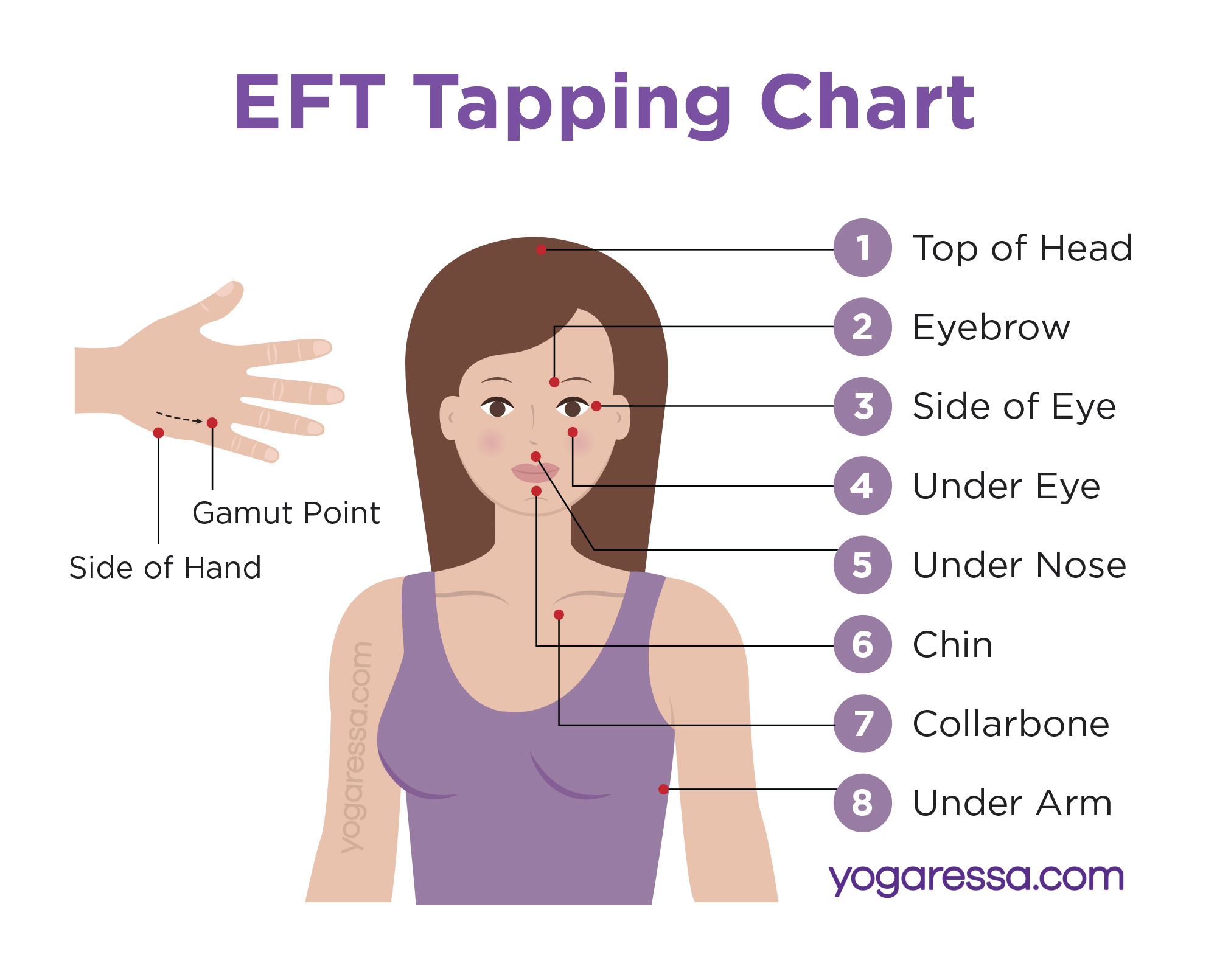
The EFT tapping routine is the structured tapping of nine meridian endpoints.
There are 12 major meridians that run along each side of the body and connect to internal organs. EFT mainly targets these nine:
- side of hand, often called the “karate chop” (KC): small intestine meridian
- top of head (TH): governing vessel
- eyebrow (EB): bladder meridian
- side of the eye (SE): gallbladder meridian
- under the eye (UE): stomach meridian
- under the nose (UN): governing vessel
- chin (Ch): central vessel
- beginning of the collarbone (CB): kidney meridian
- under the arm (UA): spleen meridian
Start by tapping the side-of-hand point while saying your setup phrase three times. Then tap each subsequent point seven times, moving down the body in this order:
- eyebrow
- side of the eye
- under the eye
- under the nose
- chin
- beginning of the collarbone
- under the arm
After tapping the underarm spot, complete the sequence at the top-of-head point.
While tapping the ascending points, repeat a short reminder phrase to keep attention on your issue. If your setup phrase is, “Even though I’m sad my mother is sick, I deeply and completely accept myself,” a reminder phrase could be, “The sadness I feel that my mother is sick.”
Say this reminder at each tapping point. Repeat the entire sequence two or three times.
5. Test the final intensity
When you finish the sequence, rate your intensity again on the 0-to-10 scale. Compare this to your initial rating. If you haven’t reached 0, continue repeating the process until you do.
What is EFT tapping used for?
EFT has been applied successfully to treat PTSD in military veterans and active service members. In a 2013 study, researchers compared EFT tapping’s effects on veterans with PTSD to those receiving standard care.
Within a month, participants who received EFT coaching experienced marked reductions in psychological stress. Additionally, more than half of the EFT group no longer met PTSD diagnostic criteria.
There are also anecdotal and study-based reports of people using EFT tapping to address anxiety.
A 2016 review evaluated EFT tapping versus standard treatments for anxiety symptoms.
A 2022 study showed EFT improved self-esteem among nurses. Another 2023 study reported that EFT reduced anxiety and stress for healthcare workers during the COVID-19 pandemic.
The research observed a meaningful decline in anxiety scores compared with those receiving other forms of care. Still, additional studies are needed to directly compare EFT with other cognitive therapies.
Frequently asked questions
Is EFT tapping similar to EMDR?
EFT requires tapping on particular body points while concentrating on a negative feeling. EMDR uses bilateral stimulation, such as eye movements, to help reprocess traumatic memories.
EMDR commonly zeroes in on a specific image or memory linked to the trauma.
EFT requires tapping on particular body points while concentrating on a negative feeling. EMDR uses bilateral stimulation, such as eye movements, to help reprocess traumatic memories.
EMDR commonly zeroes in on a specific image or memory linked to the trauma.
What are the side effects of EFT tapping?
The bulk of research suggests EFT tapping is a safe, noninvasive approach with no serious side effects.
Some people may experience a short-lived rise in emotional intensity, tingling, or mild discomfort during or after tapping, particularly when addressing deep-seated feelings.
The bulk of research suggests EFT tapping is a safe, noninvasive approach with no serious side effects.
Some people may experience a short-lived rise in emotional intensity, tingling, or mild discomfort during or after tapping, particularly when addressing deep-seated feelings.
Is it OK to cry after EFT tapping?
Yes — crying after EFT tapping is normal and can be considered a beneficial sign.
Tears often signal a release of stored emotions and can be part of healing, especially when processing traumatic material.
Yes — crying after EFT tapping is normal and can be considered a beneficial sign.
Tears often signal a release of stored emotions and can be part of healing, especially when processing traumatic material.
The bottom line
EFT tapping is an alternative acupressure method believed to rebalance disrupted energy.
It has been used as a validated therapy for veterans with PTSD, and it has shown potential benefits for anxiety, depression, physical pain, and sleep problems.
Although there are encouraging reports, researchers continue to study its effectiveness for additional conditions.
If you choose to try this alternative approach, consult a healthcare provider first to lower the risk of harm or worsening symptoms.






















Leave a Reply
You must be logged in to post a comment.