The Healthiest Oil to Fry Foods (and the Ones to Skip)

- What makes an oil good for frying
- Smoke-point and stability comparison
- Avocado oil: the top pick for high heat
- Olive oil: good for shallow frying, with a catch
- Peanut, sunflower, and canola: the workhorses
- Coconut oil and ghee: stable but heavy
- Oils to keep out of the fryer
- How to fry so the oil lasts
- Frying Oil Picker
- The bottom line
The pan is hot, the chicken is dredged, and you are standing in front of a shelf of oils wondering which bottle can take the heat without turning your dinner into a chemistry experiment. Most of us grab whatever is closest. That works fine until the oil starts smoking, the kitchen fills with a sharp smell, and the food comes out tasting bitter. Frying is the hardest job you can ask an oil to do, and not every oil is built for it.
A good frying oil needs two things: it has to stay stable at high heat, and it has to be reasonably good for you. Those two qualities do not always travel together. An oil can have a sky-high smoke point and still be a poor choice if it falls apart into harmful compounds when heated again and again. On the other hand, an oil packed with nutrients is no help if it starts smoking before your food is even in the pan.
This guide walks through the oils people actually fry with, compares them on smoke point and heat stability, and ends with a simple picker that matches an oil to the way you cook. The numbers below come from published smoke-point data and from the U.S. Food and Drug Administration and the American Heart Association, which both weigh in on the fats in these oils.
What makes an oil good for frying
Three things decide whether an oil belongs in a hot pan. The first is the smoke point, the temperature at which an oil starts to smoke and break down. Once oil passes its smoke point, it gives off acrid fumes, its flavour turns bitter, and it starts forming compounds you would rather not eat, including aldehydes and free radicals. The second is the fat profile. Oils rich in monounsaturated fat, like olive and avocado oil, hold up better under heat than oils loaded with polyunsaturated fat, which have more fragile double bonds that break apart when heated. Saturated fat is also stable under heat, which is why coconut oil and ghee do not smoke as fast as their reputations might suggest.
The third factor is refining. Refined oils have had their impurities stripped out, and those impurities are usually what smokes first, so a refined oil almost always has a higher smoke point than the unrefined version of the same oil. That is why extra virgin olive oil smokes around 190 to 210 degrees Celsius while refined olive oil can reach about 240 degrees. Refining also strips out some flavour and a few nutrients, so there is a trade-off, but for frying, the extra headroom matters.
One more point worth knowing: you do not fry at the smoke point, you fry below it. Shallow frying usually runs at 160 to 180 degrees Celsius, and deep frying at 175 to 190 degrees. An oil with a smoke point of 200 degrees gives you almost no margin for a hot pan or a second batch, while one that smokes at 230 degrees or above gives you room to breathe.

Smoke-point and stability comparison
The table below pulls together the figures that matter when you choose. Smoke points vary a little by brand and batch, so treat these as typical values for the refined versions unless stated otherwise.
| Oil | Smoke point | Main fat type | Best frying use | Watch out for |
|---|---|---|---|---|
| Avocado oil (refined) | 271°C / 520°F | Monounsaturated | Deep frying, searing, stir-frying | Pricey; mild grassy flavour |
| Ghee (clarified butter) | 252°C / 485°F | Saturated | Deep frying, Indian cooking | High in saturated fat; use in small amounts |
| Refined olive oil | 240°C / 465°F | Monounsaturated | Shallow frying, sautéing | Little olive flavour left after refining |
| Peanut oil (refined) | 232°C / 450°F | Monounsaturated | Deep frying, turkey, chips | Peanut allergy risk; high in omega-6 fats |
| Sunflower oil (refined, high-oleic) | 227°C / 440°F | Monounsaturated (high-oleic type) | Deep frying, everyday frying | Ordinary sunflower oil is high in omega-6 fats |
| Extra virgin olive oil | 190–210°C / 375–410°F | Monounsaturated | Shallow frying, eggs, fish | Smokes sooner; best for shorter frying |
| Canola oil (refined) | 204°C / 400°F | Monounsaturated | Shallow frying, sautéing | Lower margin for deep frying; heavily processed |
| Coconut oil (unrefined) | 177°C / 350°F | Saturated | Light sautéing, baking | Smokes early; strong coconut flavour; high in saturated fat |
Read the table with the frying temperature in mind. Deep frying at 180 degrees leaves extra virgin olive oil with only a thin safety margin, and a pan that runs a little hot will push it over the edge. Refined avocado oil, ghee, and refined peanut oil all clear the bar with room to spare.
Avocado oil: the top pick for high heat
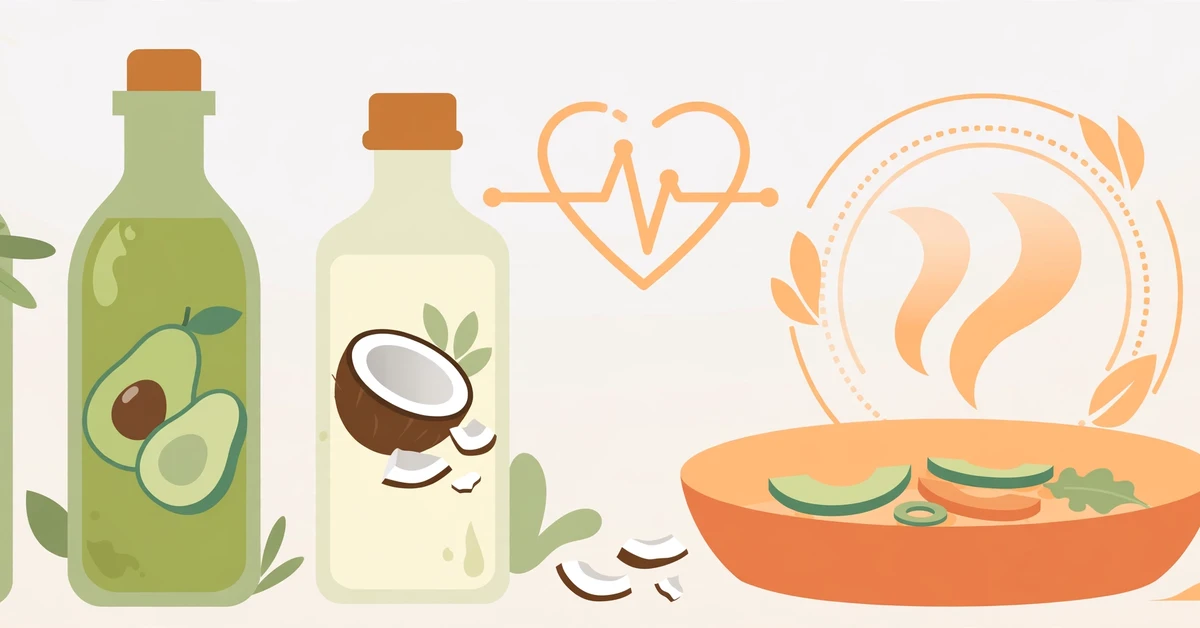
If you want one bottle that handles almost any frying job, refined avocado oil is the strongest all-round choice. Its smoke point of around 271 degrees Celsius is the highest of the common cooking oils, and it is mostly monounsaturated fat, the same heart-friendly fat that makes olive oil famous. The American Heart Association counts monounsaturated fats among the healthier fats when they replace saturated fat in the diet. Avocado oil also carries vitamin E and plant compounds called polyphenols, though frying is not the best way to preserve them.
The downsides are real: it costs several times more than canola or sunflower oil, and it can taste faintly grassy or nutty, which suits fish and vegetables but can feel out of place in a doughnut. Save it for deep frying and searing, where its stability earns its price, and use a cheaper oil for everyday sautéing.
Olive oil: good for shallow frying, with a catch
Olive oil confuses people because the answer depends on which bottle you hold. Extra virgin olive oil, the cloudy green stuff sold for salads, smokes between 190 and 210 degrees Celsius. That is fine for a quick shallow fry — eggs, fish fillets, a pan of vegetables — but it is too close to deep-frying temperatures for comfort. Research published in recent years has shown that extra virgin olive oil is actually more stable under heat than its smoke point suggests, because its antioxidants protect it, but once it smokes, its flavour turns harsh fast.
Refined olive oil, often sold as “light” or “pure” olive oil, smokes at about 240 degrees and is a solid, affordable frying oil, though it keeps little of the peppery flavour that makes extra virgin oil special. Our guide to the benefits of olive oil covers what makes the extra virgin kind worth keeping in the kitchen, just not necessarily in the fryer. If you fry with olive oil, keep the heat at medium, do not let the pan sit empty on a high flame, and throw the oil out once it darkens or smells off.
Peanut, sunflower, and canola: the workhorses
Refined peanut oil is the classic deep-frying oil for a reason. It smokes at about 232 degrees Celsius, tastes neutral, and gives fried chicken and chips a clean crunch. The catch is the allergy risk: never serve food fried in peanut oil without warning guests, and skip it entirely if anyone at the table has a peanut allergy. It is also very high in omega-6 fats and contains almost no omega-3 fats, so it is best as a sometimes oil rather than your daily bottle. Our earlier look at whether peanut oil is healthy goes deeper into that trade-off.
Sunflower oil is the one to read the label on. Ordinary sunflower oil is high in polyunsaturated fat, which oxidises more readily at high heat. High-oleic sunflower oil, bred to be mostly monounsaturated fat, is a different story: it smokes at about 227 degrees and holds up far better. If the bottle does not say “high-oleic”, assume it is the ordinary kind and keep it for medium-heat cooking.
Canola oil is the budget option, and it is not a bad one. It smokes at about 204 degrees, has a neutral flavour, and the American Heart Association lists it among the oils low in saturated fat. But 204 degrees leaves little room for deep frying, and canola is one of the most heavily refined oils on the shelf. Use it for sautéing and shallow frying, and reach for something with a higher smoke point when the oil needs to stay hot for a long time. Our comparison of canola versus olive oil covers the nutrition side in more detail.

Coconut oil and ghee: stable but heavy
Coconut oil is stable under heat because it is mostly saturated fat, but unrefined coconut oil smokes at only 177 degrees, which rules it out for anything beyond gentle sautéing. Refined coconut oil does better at 204 to 232 degrees, but it still carries a lot of saturated fat, and the American Heart Association advises keeping saturated fat low because it raises LDL cholesterol. A spoonful for flavour in a curry is one thing; a pan full of it for deep frying is another.
Ghee is the exception among saturated fats for frying. With the milk solids removed, it smokes at about 252 degrees, tastes rich and nutty, and is a staple for high-heat cooking in Indian kitchens. It is still high in saturated fat, so treat it as a flavouring and occasional frying fat rather than an everyday oil.
Oils to keep out of the fryer
Some oils should never meet a hot pan. Flaxseed oil, walnut oil, and unrefined sesame oil all smoke at low temperatures and break down quickly, producing bitter flavours and unwanted compounds. Butter, with milk solids intact, smokes at 150 degrees and burns before most foods are cooked. Save these for dressings, drizzling, and finishing, where their flavour shines and their fats stay intact. The same goes for any oil that smells rancid or looks cloudy and dark: rancid oil has already oxidised, and heating it only makes things worse.
How to fry so the oil lasts
Even the best oil will fail if you treat it badly. Heat the oil gradually and use a thermometer if you have one; most frying goes wrong because the pan is far hotter than the cook thinks. Do not crowd the pan, because a big load of cold food drops the oil temperature and the food soaks up grease instead of crisping. Fry in small batches and let the oil come back up to temperature between them.
Reuse oil sparingly. Strain it through a fine sieve or cheesecloth after it cools, store it in a sealed container away from light, and throw it out after one or two reuses for frying, or sooner if it smells sharp, looks dark, or foams when heated. Oil that has been heated past its smoke point is done: no amount of straining brings it back.
Finally, keep the bottle itself in mind. Buy oil in smaller bottles if you fry rarely, store it in a cool, dark cupboard rather than next to the stove, and check the date. An oil that has sat open for a year has already started to oxidise before it ever meets the pan.
Frying Oil Picker
Pick how you cook and what matters most, and the picker will suggest an oil.
The bottom line
For most home cooks, the honest answer is that one oil does not do every job. Refined avocado oil is the best all-round frying oil if the price does not bother you. Refined peanut oil and high-oleic sunflower oil are the best value picks for deep frying. Refined olive oil is the best everyday pan-frying oil, and extra virgin olive oil is lovely for quick shallow frying as long as you keep the heat in check. Canola oil is fine for sautéing and light frying on a budget. Coconut oil belongs in baking and light cooking, not in the deep fryer.
Whatever you choose, the habits matter as much as the bottle: fry below the smoke point, do not crowd the pan, strain and store oil properly, and throw out oil that has smoked, darkened, or turned sharp-smelling. Get those right and even a mid-priced oil will fry better than an expensive one treated badly.
Frequently Asked Questions
Refined avocado oil is the strongest all-round pick. It smokes near 271 degrees Celsius, the highest of the common cooking oils, and it is mostly monounsaturated fat, which holds up well under heat. Refined olive oil and high-oleic sunflower oil are good lower-cost options.
Yes, for quick shallow frying at medium heat. Extra virgin olive oil smokes between 190 and 210 degrees Celsius, so it suits eggs, fish, and vegetables, but it has too little margin for deep frying. Keep the heat at medium and stop before the oil smokes.
Refined avocado oil smokes at about 271 degrees Celsius (520 degrees Fahrenheit), the highest of the common cooking oils. Unrefined avocado oil smokes lower, near 200 degrees, so check the label when you buy it.
Canola oil is fine for sautéing and shallow frying. It smokes at about 204 degrees Celsius and has a neutral flavour, but that leaves little margin for deep frying, so pick an oil with a higher smoke point for long, hot frying.
Not for deep frying. Unrefined coconut oil smokes at only 177 degrees Celsius, and it is high in saturated fat. Refined coconut oil does better at 204 to 232 degrees, but it is still best kept for baking and light cooking.
Once or twice at most for frying. Strain it through a fine sieve after it cools, store it sealed and away from light, and throw it out if it smells sharp, looks dark, or foams when heated. Oil that has been heated past its smoke point is done.
Read Next
Agave Nectar: A Sweetener That’s Even Worse Than Sugar?

The Post-Lunch Crash Is Real — And It's Mostly About Blood Sugar
High Fiber Foods List: 40 Fiber-Rich Foods to Eat More Of
6 Best Protein Powders for Weight Gain in 2025
The 10 Best Low Carb and Keto-Friendly Protein Powders
Does My Chocolate Craving Mean Anything?
Related Posts
Low Sodium Frozen Meals: The Best Brands and 21 Dietitian-Approved Options
Sep 15, 2026 • 8 min read
Reviews of the Top Diabetes Cookbooks
Sep 26, 2026 • 7 min read
What Causes Love Handles and How To Get Rid of Them
Sep 20, 2026 • 8 min read
10 Potential Health Benefits of Bee Pollen
Sep 11, 2026 • 8 min read
Is Coconut Kefir the New Superfood?
Oct 2, 2026 • 4 min read