
Tooth loss is very widespread. Research suggests that 69 percent of adults aged 35 to 44 have lost at least one permanent tooth. By the time people reach 74, roughly one in four Americans have lost all their adult teeth.
Replacing a lost tooth is important to keep neighboring teeth from shifting. Replacement teeth also help maintain facial contours and prevent problems with chewing or speaking. Two of the most frequently chosen solutions are dental bridges and implants.
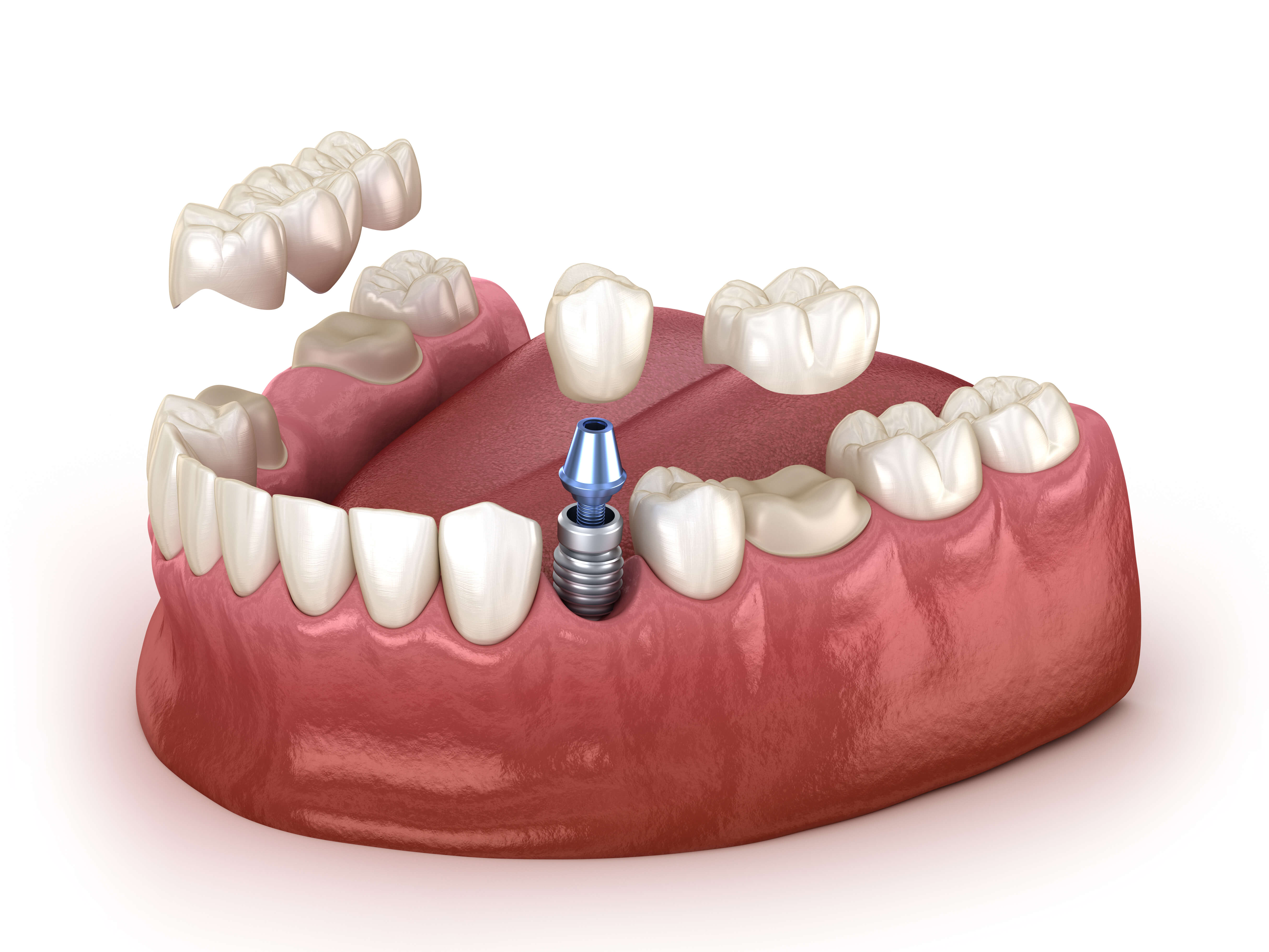
Dental bridges are prosthetic teeth anchored to the teeth adjacent to the gap. They’re typically fabricated from materials such as porcelain or resin to blend with your natural teeth. Bridges can replace one or multiple missing teeth in a row.
Dental implants act as artificial roots, commonly constructed from titanium. They’re placed into the jawbone with screws to support a crown or a bridge.
Below we’ll weigh the advantages and disadvantages of implants versus bridges and consider factors that can help you choose the best approach.
Dental implant vs. bridge
Both dental implants and bridges can produce a natural-looking outcome, but each has distinct pros and cons. Here’s a comparison of these two tooth-replacement choices.
Dental bridge pros
- more likely to be paid for by insurance
- avoids the need for bone grafts or invasive surgery
- generally lower initial expense than implants
- typically completed in two dental visits over a few weeks
Dental bridge cons
- usually needs replacement roughly every 5 to 7 years (though some last beyond a decade)
- may lose a lifelike look as time passes
- higher incidence of cavities and decay in adjacent teeth compared with implants
- can harm the healthy teeth next to the missing tooth
Dental implant pros
- can endure 15 years or longer and are among the most durable choices
- maintain a natural appearance longer than bridges
- do not compromise neighboring healthy teeth
- very strong long-term success; about 97 percent success at 10 years
Dental implant cons
- coverage by insurance is less common
- the process can take as long as 6 months
- higher upfront cost
- potential for surgical complications
Implant vs. bridge cost
Bridges usually have a lower initial price than implants, and insurers are more likely to help pay for them. Costs depend on:
- the specific type of bridge or implant chosen
- the materials used
- how involved the procedure is
- your geographic location
The American Dental Association notes a basic dental bridge can be about $500 per tooth at the low end, and up to $1,200 for higher-end options. This excludes the cost of the crown that secures the prosthetic to adjacent teeth, which can add another $500 to $2,500 per tooth.
Implants typically run around $3,000 to $4,500 per tooth. Insurance is less apt to cover implant costs.
Although implants require a larger initial outlay, they generally hold up better over time and need replacement far less often than bridges.
How to choose between an implant and a bridge
Your dentist can recommend the most suitable tooth-replacement option for your circumstances. The right choice depends on your budget, how many teeth are missing, and your overall medical status.
Cost
If you have dental coverage, it’s more likely to pay for a bridge than for an implant. If neither option is affordable, discuss alternatives such as partial dentures with your dentist.
Number of missing teeth
When multiple adjacent teeth are missing, a bridge is often more practical than individual implants. Installing an implant for each missing tooth requires separate surgery for every tooth, which can be costly and impractical.
Overall health
Implants involve surgery, so they may not be suitable for people with conditions that impair healing, like diabetes or leukemia.
Ideal implant candidates are in good general health and have a jawbone free of disease that can support the implant.
Time
Getting a dental implant can span several months, whereas a bridge can typically be fitted in two visits across a few weeks.
For an implant, an oral surgeon drills into the jawbone and places the implant root. A temporary prosthesis may be used while the bone heals.
You’ll often wait anywhere from 2 to 6 months for bone healing before a permanent crown is attached.
Other options instead of bridges or implants
Bridges and implants aren’t the only choices for tooth replacement. Partial dentures and space maintainers are additional alternatives.
Partial dentures
Partial dentures typically combine plastic and metal and fill gaps left by one or several missing teeth.
They often mimic natural teeth and clip onto remaining teeth to stay secure. Dentists may suggest a denture when adjacent teeth aren’t strong enough to support a bridge.
Although usually less costly than bridges or implants, partial dentures tend to be less comfortable and stable. They may affect chewing or speech and require daily cleaning.
Space maintainers
Space maintainers can be a temporary solution if you can’t replace a tooth immediately. They’re often metal devices that stop neighboring teeth from drifting into the open space.
Space maintainers are commonly used in children to preserve room for adult teeth to come in without obstruction.
An orthodontic retainer can also preserve the space left by missing teeth, preventing surrounding teeth from tilting into the gap.
Takeaway
Dental implants and bridges are two ways to replace a missing tooth. Bridges are more likely to be covered by insurance and have a lower initial cost.
If cost is not a barrier and you’re in good health, implants may be preferable because they last longer and don’t harm adjacent teeth. Consult a dentist to decide which solution fits your needs best.






















Leave a Reply
You must be logged in to post a comment.