Psoas Muscle: What It Is, Why It Gets Tight, and How to Fix It

- What Is the Psoas Muscle?
- What Does the Psoas Muscle Do?
- Tight or Weak? How to Tell Which One You Have
- Why Sitting All Day Tightens Your Psoas
- A Short Daily Psoas Stretch Routine
- Strengthen It Too: 3 Simple Exercises
- Psoas Pain vs Sciatica vs Hip Arthritis
- What Is Psoas Syndrome?
- Why Psoas Pain Can Tingle Down Your Thigh
- Red Flags: When to See a Doctor
- Frequently Asked Questions
- Where is the psoas muscle?
- What causes a tight psoas muscle?
- How do I know if my psoas is tight or weak?
- What is the best stretch for the psoas muscle?
- What is psoas syndrome?
- When should I see a doctor for psoas pain?
- References
You’ve been at your desk for three hours straight. Then you push your chair back and stand up – and something deep in the front of your hip catches. Not a sharp stab. A dull, heavy ache, somewhere between your belly and your thigh, like a rope pulled too tight inside you. A few slow steps and it eases. By the time you reach the kitchen, it’s gone.
That rope is probably your psoas muscle. Most people have never heard of it, yet it works every time you walk, climb stairs, or sit up in bed. It’s the only muscle that joins your spine directly to your legs, and when it gets tight or weak, it can ache in the low back, the groin, or the front of the thigh. Below: what it is, a two-minute test, a short daily routine, and the warning signs that mean it’s time to see a doctor.
What Is the Psoas Muscle?
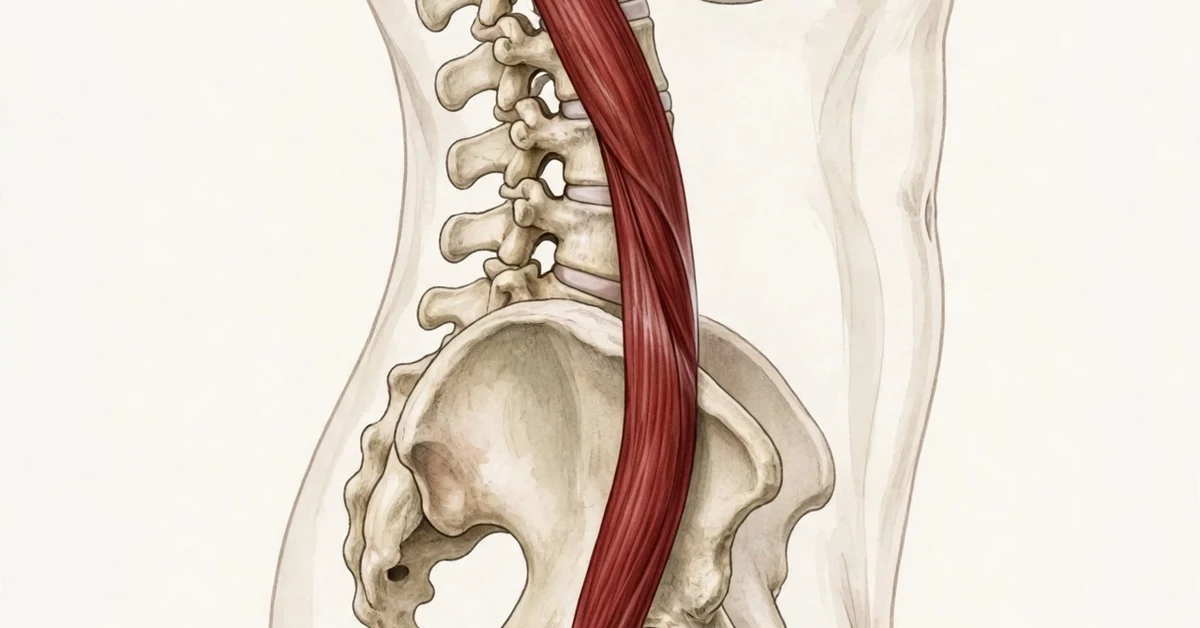
The psoas major is a long, ribbon-shaped muscle, about 16 inches long in most adults, running deep inside your body on each side of the spine. It starts on the lower spine, sweeps past the pelvis, joins the iliacus to form the iliopsoas, and anchors to the lesser trochanter on the thigh bone. Cleveland Clinic calls it the bridge between the upper and lower halves – no other muscle connects the spine to the legs. A thinner psoas minor sits in front of it in fewer than half of people.

Its nerve supply comes from the spine at levels L1 to L3, according to StatPearls – which is why psoas trouble can tingle down the front of the thigh, as covered below.
What Does the Psoas Muscle Do?
Its main job is hip flexion: lifting the thigh toward the chest. Every step uses it – walking upstairs, kicking a ball, running, getting out of a car – and both sides together pull your trunk up from lying down, which is why sit-ups work it hard. Its second job is posture: attached to the spine itself, it helps hold you upright without you thinking about it. A tight one pulls the lower spine forward and tips the pelvis, so people with a short psoas often stand with an arched low back and a belly that sticks out, which Wikipedia notes as a classic clue to a hypertonic psoas. Its third job is balance: standing on one leg, the psoas keeps your pelvis level, so weakness shows up as a wobble.
Tight or Weak? How to Tell Which One You Have
People talk about a “tight psoas” as if tightness were the whole story. It’s not: a psoas can be tight, weak, or both – tight from sitting all day, weak from never being asked to work. Stretching helps a tight psoas and does almost nothing for a weak one, and stretching a strained muscle can make it worse – so find out which problem you have before you start a routine.
The simplest check is the knee-to-chest test, described by the International Sports Sciences Association (ISSA) as a 30-second strength test.
Step 1. Lie on your back, legs straight, then pull one knee toward your chest with both hands, keeping the other leg flat.
Step 2. Now hold that knee up using only your hip flexor muscles – let go with your hands and keep the knee tucked for 30 seconds, without holding your breath.
Step 3. Notice two things: can you hold the knee up for the full 30 seconds without it sinking? If it drops before 10 seconds, that side is weak. Does the straight leg lift off the floor? If it pops up, that side is tight.
Test both sides – most people find one worse. If the test hurts sharply, stop and see a doctor.
Why Sitting All Day Tightens Your Psoas
When you sit, your hips stay bent at about 90 degrees, which holds the psoas in its shortest position. Hold any muscle short for hours and blood flow drops, it stiffens, and it complains when you ask it to lengthen – that’s why the first steps after a long sit hurt most.
Over weeks and months, a shortened psoas pulls the pelvis forward and loads the low back. Wikipedia notes that a tight psoas can compress the lumbar discs and trigger low back pain or spasm, and that chain – sit, shorten, pull, ache – is a common reason desk workers end up with a sore back no scan can explain. Sitting feeds low back pain in more ways than one, as we cover in our guide to back pain from sitting all day.
Two small changes break the chain: stand up every 30 to 45 minutes, even if only to walk to the kitchen and back, and check your chair height – your hips should sit level with your knees or a touch higher, not lower. When you stand, stretch your arms overhead and take three slow breaths first, so the psoas lengthens gently instead of being yanked open by your first stride.
A Short Daily Psoas Stretch Routine
Do this once a day, after a short walk when the muscles are warm. Hold each stretch 30 to 45 seconds per side and never bounce: it should feel like a firm pull, not pain, so back off if it hurts.
1. Half-kneeling hip flexor stretch. Kneel on one knee, other foot flat in front. Tuck your pelvis slightly and shift forward until you feel a stretch deep in the front of the back hip. Hold 45 seconds, then switch sides.
2. Couch stretch. Face away from a couch, place the top of one foot on the seat behind you, and kneel on that knee. Squeeze the glute on the kneeling side and hold 45 seconds per side – it’s the deepest stretch here, so go gently the first week.
Finish with 20 slow marching steps, lifting each knee to hip height, five or six days a week for three weeks before you judge it. If the stretches make the ache worse, stop and get checked: a strained psoas needs rest first, not stretching.
Strengthen It Too: 3 Simple Exercises
Stretching alone leaves a weak psoas weak, so add these two or three times a week, after the stretches, when the muscle is warm. Dead bugs: lie on your back, arms up, hips and knees bent at 90 degrees. Slowly lower one arm and the opposite leg toward the floor, then return, keeping your low back pressed into the floor. Two sets of 8 per side. Standing knee lifts: hold a chair back lightly, lift one knee to hip height, hold two seconds, and lower slowly. Two sets of 10 per side. Glute bridges: knees bent, feet flat, push through your heels to lift your hips into a straight line from shoulders to knees. Hold two seconds, lower slowly, two sets of 12. Strong glutes take load off the psoas – which is why Hinge Health lists bridges as a psoas exercise.
Psoas Pain vs Sciatica vs Hip Arthritis
Psoas pain gets blamed on the wrong cause all the time, because the low back, the hip, and the front of the thigh sit close together. This table separates the three most common look-alikes – and if you’re unsure where your pain sits, our hip pain location chart can help you map it.
| Feature | Psoas pain | Sciatica | Hip arthritis |
|---|---|---|---|
| Where it hurts | Deep in the front of the hip or groin, sometimes the low back | Buttock and back of the thigh, shooting down the leg | Deep in the groin, worse with weight-bearing |
| What makes it worse | Standing up after sitting, walking uphill, lifting the knee | Coughing, sneezing, sitting a long time | Walking, stairs, getting up from a low chair |
The most useful question is where the pain lives: front of the hip or groin points toward the psoas, the back of the leg shooting downward points toward a nerve, and deep groin pain that grinds when you walk points toward the joint. Treat this as a guide for your doctor visit, not a diagnosis.
What Is Psoas Syndrome?
Psoas syndrome is what doctors call it when the psoas itself becomes the source of pain – irritated, inflamed, or in spasm – rather than just a tight muscle complaining after a long sit. Cleveland Clinic is clear that it’s rare, and it often has no known cause. Symptoms are a deep ache in the low back, groin, or pelvis, pain that can radiate down the leg, and stiffness that makes it hard to stand up straight. Because those symptoms overlap with arthritis and disc problems, doctors usually diagnose it by ruling the others out: exam first, MRI if the picture stays unclear.
Keep it separate from a psoas strain: a tear in the muscle fibers, usually from a sudden sprint, kick, or heavy lift, with a clear starting moment. If your pain began that way, read our guide to hip flexor strain, which covers grades, rest times, and return to activity. Psoas syndrome creeps in slowly instead, with no single incident to point at. Treatment is rest, physical therapy, and anti-inflammatory medication when a doctor advises it; most cases settle over weeks, not days.
Why Psoas Pain Can Tingle Down Your Thigh
One of the strangest things about psoas trouble is that the pain doesn’t always stay where the muscle is. Some people feel heat, tingling, or a sensation like water running down the front of the thigh, and that’s not imagination: several nerves run through or beside the psoas, including the genitofemoral nerve, which forms inside the muscle itself, as described in StatPearls. When the psoas is inflamed, it irritates those nerves, and the brain reads the irritation as coming from the skin of the thigh rather than the muscle deep inside.

Red Flags: When to See a Doctor
Most psoas aches are boring and fixable. A few are not – see a doctor promptly if any of these show up:
- Fever with deep groin or back pain. A psoas abscess – infection in or around the muscle – is uncommon but serious, and fever plus deep pain is its calling card.
- Pain that wakes you at night and does not ease with rest: muscle pain usually calms down when you lie still, so pain that ignores rest deserves a scan.
- Unexplained weight loss, or a history of cancer, with new back or hip pain: this always earns imaging first and exercise second.
- Numbness, weakness, or foot drop: your foot slaps the ground, or you cannot lift your toes, which points to nerve involvement.
- Bowel or bladder changes, such as new incontinence or saddle numbness: emergency symptoms. Do not wait; get urgent care.
- Pain that does not improve after about a week of rest and the routine above. Cleveland Clinic gives the same one-week line: if it’s not getting better, it needs a proper exam.
That exam is straightforward: history, pressure on the hip and belly, and tests of hip strength and range of motion. An MRI can show the psoas and the tissues around it; an ultrasound or EMG may help in some cases.
For most people, the story ends more simply: stand up more, stretch a little, strengthen a little, and the rope inside the hip loosens.
Frequently Asked Questions
Where is the psoas muscle?
The psoas major runs on each side of your lower spine, from the twelfth thoracic vertebra through the lumbar vertebrae, down to the lesser trochanter on the thigh bone. It joins the iliacus to form the iliopsoas and sits too deep to see or easily touch.
What causes a tight psoas muscle?
Prolonged sitting is the most common cause: the hips stay bent, the muscle stays short, blood flow drops, and it stiffens. Running, heavy lifting, and sleeping curled up can tighten it too, and a tight psoas pulls the pelvis forward, causing groin, hip, or low back pain.
How do I know if my psoas is tight or weak?
Try the knee-to-chest test: lie on your back, pull one knee to your chest, and try to hold it there with muscle power alone for 30 seconds. If the knee sinks quickly, that side is weak; if the straight leg lifts off the floor, that side is tight. Test both sides and compare.
What is the best stretch for the psoas muscle?
The half-kneeling hip flexor stretch: kneel on one knee, tuck your pelvis slightly, and shift forward until you feel a deep pull in the front of the back hip. Hold 30 to 45 seconds per side, once a day.
What is psoas syndrome?
Psoas syndrome is irritation or spasm of the psoas causing deep pain in the low back, groin, or pelvis, sometimes radiating down the leg. It is rare, often has no known cause, and mimics arthritis and disc problems. Treatment is rest, physical therapy, and anti-inflammatory medication when advised.
When should I see a doctor for psoas pain?
See a doctor if the pain does not improve after about a week, if it wakes you at night, or if you have a fever with deep groin pain, numbness or weakness down the leg, or bowel or bladder changes. Sudden bowel or bladder problems need urgent care the same day.
References
- Cleveland Clinic – Psoas Muscle: What It Is, Where It Is and Anatomy: https://my.clevelandclinic.org/health/body/psoas-muscle
- StatPearls (NCBI Bookshelf) – Anatomy, Bony Pelvis and Lower Limb: Psoas Major: https://www.ncbi.nlm.nih.gov/books/NBK535418/
- Hinge Health – Psoas Muscle: Definition, Syndrome Symptoms and More: https://www.hingehealth.com/resources/glossary/psoas-muscle
- ISSA – How to Stretch and Strengthen the Psoas: https://www.issaonline.com/blogs/training-tips/how-to-stretch-and-strengthen-the-psoas
- Mayo Clinic – Back pain: https://www.mayoclinic.org/diseases-conditions/back-pain/symptoms-causes/syc-20369906
- NHS – Back pain: https://www.nhs.uk/conditions/back-pain/
- Wikipedia – Psoas major muscle: https://en.m.wikipedia.org/wiki/Psoas_muscle
Read Next
Back Pain From Sitting All Day: What Helps, What Doesn't
6 Foam Roller Exercises for Your Back
Knee Replacement Recovery Timeline: What to Expect Week by Week

Long Work Hours and Heart Health: What 55 Hours a Week Does to Your Body

Natural Treatment for Seborrheic Dermatitis: What Works?

The 8 Best Cooling Pillow Cases
Related Posts

Pregnancy Rib Pain: Causes, Prevention, Remedies
Sep 19, 2026 • 14 min read
Stretches and Exercises to Help Ease SI (Sacroiliac) Joint Pain
Oct 5, 2026 • 28 min read
12 Spinal Decompression Exercises for All Skill Levels
Sep 21, 2026 • 25 min read
Low Back Pain ICD-10 Codes: M54.50, M54.16 & Sciatica Codes
Nov 18, 2026 • 5 min read
10 Back Exercises with Bands to Counteract Work-from-Home Posture
Sep 14, 2026 • 16 min read