Long Work Hours and Heart Health: What 55 Hours a Week Does to Your Body

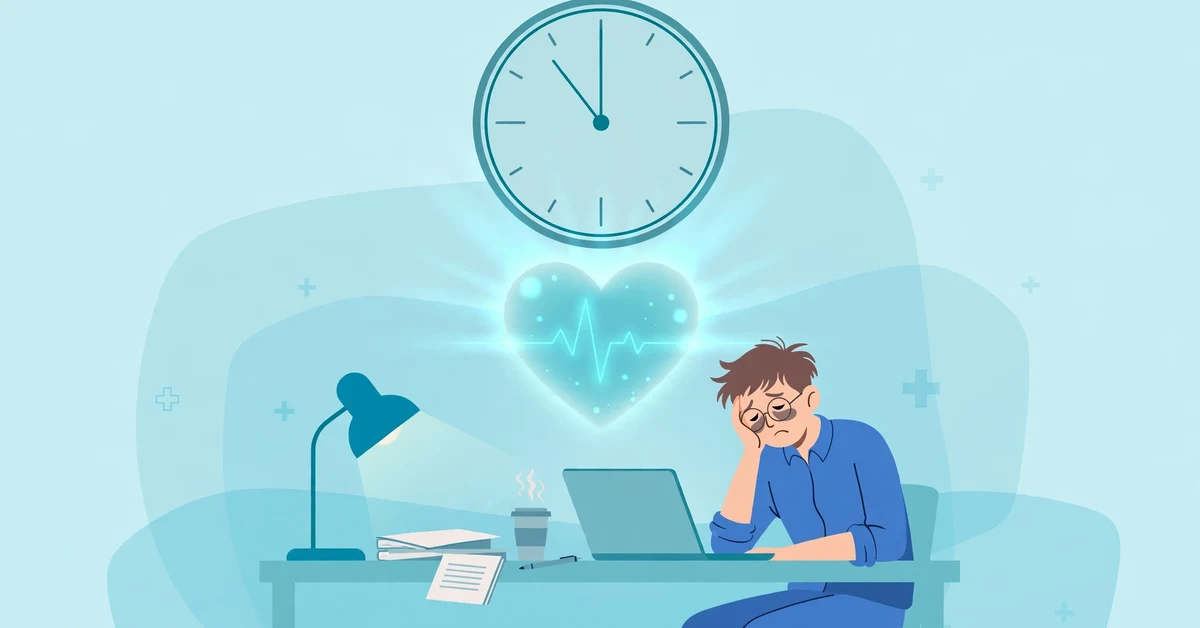
Long work hours are usually treated as a sign of commitment. Occupational health research treats them as an exposure, in the same way it treats noise or shift work, and the evidence on the heart is now strong enough that it deserves a plain explanation. If you regularly work 55 hours a week or more, this is what the research says is happening, and what you can do about it before your body forces the issue.
I work with executives, founders, physicians and attorneys, and very few of them think of their schedule as a health risk. They think of it as the price of the role. The numbers below are worth knowing precisely because the schedule feels normal from the inside.
What the research found about 55-hour weeks
In 2021 the World Health Organization and the International Labour Organization published the first global estimates of the health burden linked to long working hours. Their analysis attributed 745,194 deaths from ischemic heart disease and stroke in 2016 to working 55 or more hours a week, and estimated that 488 million people, about 8.9 percent of the global population, were exposed to hours at that level.
Compared with a standard 35 to 40 hour week, working 55 hours or more was associated with:
- An estimated 35 percent higher risk of stroke
- An estimated 17 percent higher risk of dying from ischemic heart disease
The WHO also reported that deaths from heart disease linked to long hours rose by 42 percent and deaths from stroke by 19 percent between 2000 and 2016. These are population estimates, not predictions for any one person, but the threshold matters: 55 hours sits well below what many professionals consider an ordinary week.
Why long hours affect the heart
Researchers describe two broad pathways. The first is biological. Sustained work stress keeps the body’s stress response switched on, which over time is linked to higher blood pressure and changes in how the cardiovascular system regulates itself. The second is behavioral. Long hours crowd out the things that protect the heart: sleep, physical activity, regular meals and time to recover.
In my experience the behavioral pathway is the one people underestimate. Nobody decides to stop exercising or to sleep five and a half hours a night. The schedule simply absorbs those hours first, because they are the easiest to give up without anyone noticing.
It is not only the hours: job strain
How work feels matters as well as how long it lasts. Researchers use the term job strain for a specific combination: high demands paired with low control over how the work gets done. A large pooled analysis published in The Lancet in 2012, which combined data from 197,473 people across 13 European cohort studies followed for an average of 7.5 years, found that job strain was associated with a 23 percent higher risk of a first coronary heart disease event.
This is useful for anyone in a senior role to understand. Seniority often brings more demands without bringing more real control. A chief financial officer reporting on a plan someone else wrote, or a partner carrying targets set by a committee, can sit squarely in that high-demand, low-control zone even with an impressive title.
The mental health side of long hours
The heart is not the only concern. In the Whitehall II study, which followed 2,960 full-time British civil servants for five years, working more than 55 hours a week predicted new symptoms of depression and anxiety. The authors were careful to note that the clearer effect appeared in women, and that is how the finding should be read.
Sleep sits underneath all of this. Research on sleep loss shows consistent effects on attention and alertness, while the effects on higher-level thinking are less consistent across studies. Even so, the people I see who are working the longest hours are almost always the ones who have quietly accepted short sleep as permanent.
Who is most exposed
Long hours are common in medicine, law, finance and company leadership, and in these fields they tend to be treated as a credential rather than a risk. A 2026 report from CEREVITY, The Private Equity Leadership Strain Report, noted that no peer-reviewed study has yet measured the health of the people in that industry directly, even though the hours many of them describe sit well above the 55-hour threshold. The same gap exists in many high-pressure professions: the exposure is well documented, but the people carrying it are rarely studied.
Signs your schedule is already costing you
The early signals are easy to dismiss because none of them look dramatic on their own:
- A weekend or a vacation no longer leaves you feeling rested
- You rely on caffeine to start the day and alcohol or screens to wind down
- Exercise has dropped from a habit to an intention
- Your patience at home is shorter than your patience at work
- Routine medical appointments keep getting postponed
Any one of these is common. Several together usually mean the load has outgrown your recovery.
Practical steps that lower the risk
You do not have to change careers to reduce the exposure. The goal is to bring the load back within a range your body can recover from.
- Track your real hours for two weeks. Most people underestimate them. Knowing the true number is the first step to changing it.
- Protect sleep before anything else. Treat a consistent bedtime as a fixed appointment rather than the first thing to move.
- Build in recovery, not just time off. A day that leaves you just as tense as before is not recovery. Notice which activities actually reset you.
- Look at control, not only volume. Ask where you can gain more say over how and when your work gets done. Small gains in control reduce strain even when hours stay high.
- Keep up routine health checks. Blood pressure, cholesterol and blood sugar are worth knowing, especially if your schedule has pushed regular care aside.
When to talk to someone
See a physician promptly if you notice chest pain, shortness of breath, palpitations, or sudden numbness, weakness or confusion; these need medical attention, not a schedule change. It is also worth speaking with a mental health professional if work stress is affecting your sleep, mood or relationships for weeks at a time. Long hours rarely change on their own. They change when someone treats them as the health issue the research says they are.






Related Posts

Does Medicare Cover Echocardiograms (ECG)?
Sep 11, 2026 • 12 min read
Does Having High Blood Pressure Cause Nosebleeds?
Sep 12, 2026 • 24 min read
Everything You Should Know About Health Benefits of Ginger Oil
Aug 29, 2026 • 10 min read
Why You Get Hiccups When Drinking (And How to Stop Them)
Sep 23, 2026 • 15 min read
How to Use a Sled Push to Build Power, Speed, and Endurance
Sep 28, 2026 • 5 min read