Toddler Mouth Sores in Pictures: How to Tell HFMD, Herpangina, Herpes, Thrush and Canker Sores Apart

- Quick comparison: match what you see
- 1. Hand, foot and mouth disease (HFMD)
- 2. Herpangina — sores at the back of the throat
- 3. Primary herpes — swollen, bleeding gums plus many sores
- 4. Canker sore (aphthous ulcer) — one sore, white base, red rim
- 5. Oral thrush — white patches that scrape off
- 6. A bite or injury — the sore with a story
- How to care for a sore toddler mouth at home
- When to book the doctor even without red flags
- The bottom line
A mouth sore in a 1- to 3-year-old can look alarming, and a photo is often the fastest way to work out what you are probably dealing with. This guide is built around pictures for exactly that reason: one condition at a time, with a real clinical photo, where in the mouth it shows up, and what else you should be able to see — because the location of the sores and what comes with them (fever, a rash, swollen gums, white patches) usually tell you more than the sore itself.
One honest note before the photos. We only use clinical images from Wikimedia Commons whose licences we have checked, and each caption describes exactly what is in that picture. For a couple of conditions below — a bitten cheek, for example — we could not find a properly licensed real photo of a toddler, so we say so instead of swapping in a picture of something else or a stock image. Photos can help you recognise a pattern, but they cannot diagnose your child; when in doubt, your paediatrician’s examination always wins.
Red flags — get medical help the same day, or urgently, if you see any of these:
- Your toddler cannot drink, or shows signs of dehydration: far fewer wet nappies than usual, no tears when crying, a dry mouth, unusual sleepiness.
- A high fever that will not come down, or any fever lasting more than about 3 days.
- A sore that has not healed after 2 weeks.
- Swelling of the lips, face or around the eye that is spreading quickly, or any trouble breathing or swallowing.
- Any fever in a baby under 3 months old — this always needs prompt medical assessment, whatever the mouth looks like.
Quick comparison: match what you see
| Condition | Where the sores are | What it looks like | What comes with it |
|---|---|---|---|
| Hand, foot and mouth disease | Tongue, gums, inside of cheeks — plus skin | Small red spots that become shallow, painful ulcers | Rash or blisters on palms, soles and buttocks; mild fever first |
| Herpangina | Back of the mouth only: soft palate, tonsils, uvula | A few tiny blisters that burst into small ulcers | Sudden high fever, sore throat, refusal to swallow |
| Primary herpes (gingivostomatitis) | Gums at the front, lips, tongue, front of mouth | Many small ulcers; gums swollen, red and bleeding easily | High fever, drooling, bad breath, very sore mouth |
| Canker sore (aphthous ulcer) | Inside of lip or cheek, side of tongue | One round sore, white or yellow centre, red rim | No fever, child otherwise well |
| Oral thrush (Candida) | Tongue, inner cheeks, roof of mouth | Creamy white patches that scrape off, leaving red skin | Usually no fever; may follow antibiotics |
| Bite or injury | Exactly where the teeth meet the cheek or lip | One sore with an uneven edge, sometimes a flap of skin | Started right after a fall, a bite, or hard food |
If the pattern you see closely matches a row in this table, read that condition’s section below and compare with the photo. For a broader overview of mouth ulcers in younger babies, see our guide to ulcers in a baby’s mouth.
1. Hand, foot and mouth disease (HFMD)

Where to look: the tongue, gums and inside of the cheeks — and then, crucially, outside the mouth. HFMD is the one diagnosis you confirm with your hands as much as your eyes: check your toddler’s palms, the soles of the feet, and the nappy area around the buttocks for flat red spots or small grey blisters. A mouth full of small ulcers plus that rash is HFMD until proven otherwise.
What you see: the illness usually starts with a day or two of mild fever and a sore throat. Small red spots then appear in the mouth and quickly become shallow, painful ulcers. The skin spots follow. HFMD is caused by enteroviruses such as coxsackievirus A16 and spreads easily in nurseries; it is most common in children under 5, which makes the toddler years peak season. Most children are better within 7 to 10 days, and the main job at home is pain relief and fluids, because sore mouths refuse drinks. The NHS overview of hand, foot and mouth disease covers the typical course and when to seek advice.
2. Herpangina — sores at the back of the throat

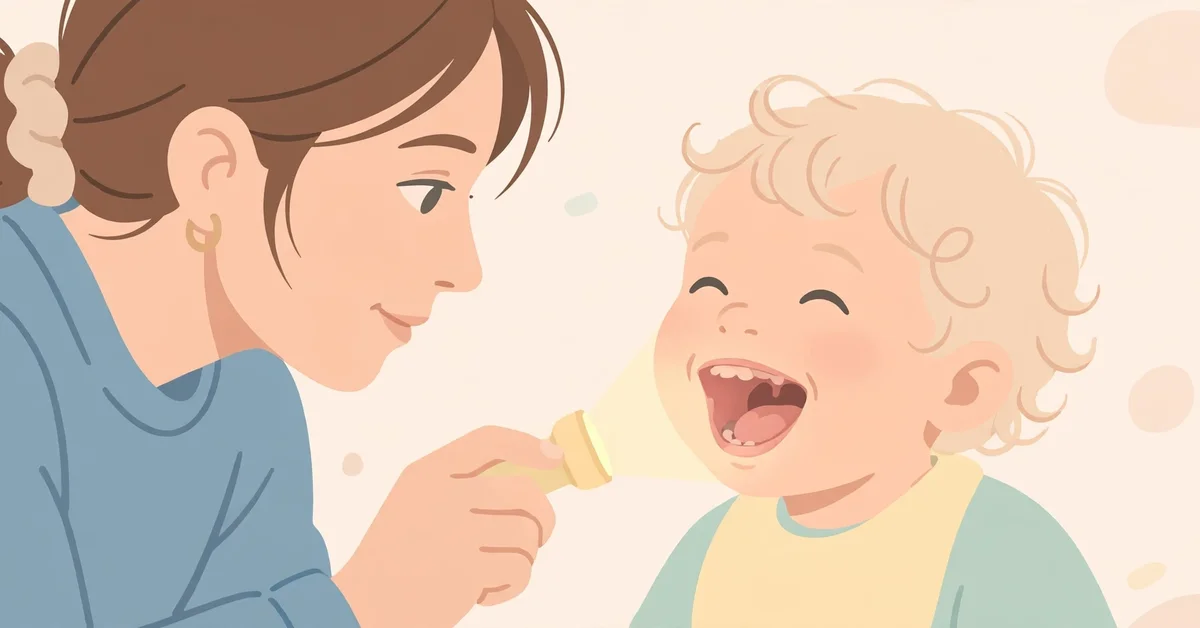
Where to look: right at the back — the soft palate, the tonsils and the little dangling uvula. If you open your toddler’s mouth and the front looks normal but they are miserable, this is why: herpangina hides where a quick glance misses it. You may need a torch and a moment when your child opens wide or cries.
What you see: a sudden high fever — sometimes the first and only sign for a day — followed by a small number (often just two to six) of tiny blisters at the back of the throat that burst into small grey-white ulcers with a red edge. Herpangina is caused by the same enterovirus family as HFMD, but there is no rash on the hands and feet, and the front of the mouth and gums look normal. That “back of the throat only, high fever, no hand rash” pattern is the classic way clinicians separate herpangina from HFMD on one side and from herpes on the other. It usually settles in about a week; again, fluids and fever control matter most.
3. Primary herpes — swollen, bleeding gums plus many sores

Where to look: the gums, especially at the front of the mouth. In primary herpetic gingivostomatitis — a young child’s first encounter with herpes simplex virus type 1 — the gums themselves are the headline: swollen, deep red, and bleeding at the lightest touch, with crops of small ulcers across the gums, tongue, lips and inner cheeks.
What you see: this is usually the most dramatic of the common causes. Fever is often high, the breath can smell, drooling increases because swallowing hurts, and toddlers may refuse all food and drink for several days. The first infection most often strikes between about 6 months and 5 years of age. Because the gums are so involved and the sores so numerous, this is the condition parents most often mistake for “teething plus ulcers” — our guide to natural teething remedies can help you judge what teething alone does and does not explain, and our overview of cold sore triggers covers the same virus in its later, milder form. Call your doctor early for this one: the biggest risk is dehydration, and antiviral medicine is sometimes considered when started very early in severe cases.
4. Canker sore (aphthous ulcer) — one sore, white base, red rim

Where to look: the loose, movable lining of the mouth — the inside of the lower lip or cheek, or the side or underside of the tongue. A canker sore stands alone: typically one sore, occasionally two or three.
What you see: a round or oval sore with a white or yellow-grey base and a clean red rim, usually smaller than a pea. Your toddler is otherwise well — no fever, no rash, normally drinking once you work around the sore spot. True canker sores are actually less common in the 1- to 3-year age group than in older children (HealthyChildren.org, the American Academy of Pediatrics’ parent site, notes canker sores are the main cause of one or two mouth ulcers mainly after age 5), so a single sore in a toddler is at least as likely to be a bite injury as a true aphthous ulcer. The NHS page on mouth ulcers describes the typical appearance and healing time: most heal on their own within 1 to 2 weeks. Sores that keep coming back, are unusually large, or arrive with fever or tummy symptoms deserve a doctor’s look.
5. Oral thrush — white patches that scrape off

Where to look: the tongue first, then the inner cheeks, gums and roof of the mouth. Thrush — an overgrowth of the yeast Candida — forms creamy white, slightly raised patches that look like cottage cheese or milk curds stuck to the surface.
The test that separates thrush from milk: this is the distinction parents ask about most, and you can do it at home. Milk residue wipes away easily with a clean, damp cloth and leaves normal pink skin underneath. Thrush does not wipe away cleanly — if you gently rub with a soft damp cloth or gauze, the patch may come off only with effort, leaving a red, sometimes slightly bleeding surface behind. That “scrapes off, leaves red” behaviour is the signature. Thrush is common after a course of antibiotics and in babies and toddlers; the NHS page on oral thrush explains treatment, which for toddlers usually means an antifungal gel or liquid prescribed or recommended by a clinician or pharmacist — not a home remedy.
6. A bite or injury — the sore with a story
Where to look: wherever the teeth can reach — along the bite line of the inner cheek, or on the lower lip after a fall onto the face. Toddlers fall constantly, bite their cheek while eating or during the numb, clumsy phase of learning to chew, and chew on hard toys and cutlery.
What you see: usually a single sore with an irregular, ragged edge rather than the neat circle of a canker sore, sometimes with a small torn flap of skin or a bruise next to it, starting within a day of the knock or bite. Over a few days it can develop the same white-yellow surface as any ulcer while it heals, which is where the confusion with canker sores starts. About the missing photo: we looked for a properly licensed clinical photograph of a traumatic bite ulcer in a toddler and did not find one we could verify and legally reuse, so this section deliberately has no picture rather than a misleading one. Most bite sores heal within a week to ten days; a sore in the exact same spot that keeps recurring, or any sore still present after 2 weeks, should be checked — occasionally a sharp tooth edge is the cause and a dentist can smooth it.
How to care for a sore toddler mouth at home
- Keep fluids going, little and often. This matters more than anything else. Offer water frequently; cold drinks, ice lollies made from water or diluted juice for older toddlers, and yoghurt or custard can all be easier than a big drink. Watch the nappy count — fewer wet nappies is your earliest dehydration warning.
- Go soft, cool and bland. Mashed banana, porridge cooled down, scrambled egg, pasta in sauce, yoghurt. Skip citrus, tomato, salty crisps, spicy food and anything hot or crunchy until the sores settle.
- Pain relief by weight, by the label. Children’s paracetamol (acetaminophen) or ibuprofen can be used for mouth pain and fever in toddlers — the correct amount depends on your child’s weight and the exact product’s concentration, so follow the dosing table on the product’s own label or your pharmacist’s calculation for your child rather than any number from a website, give doses with the supplied syringe or spoon, and never exceed the stated maximum in 24 hours. If you are unsure of your child’s weight-based amount, ask a pharmacist — it takes one minute and removes all guesswork.
- Never give aspirin to a child. Aspirin must not be given to children and teenagers because of the risk of Reye’s syndrome, a rare but life-threatening condition.
- Avoid benzocaine teething and mouth gels in young children. The U.S. Food and Drug Administration (FDA) has warned that over-the-counter benzocaine oral products should not be used in children younger than 2 years: benzocaine can cause methaemoglobinaemia, a serious condition that reduces how much oxygen the blood can carry, and the FDA asked manufacturers to stop marketing these products for teething. Many paediatric sources advise avoiding them in toddlers generally unless a clinician specifically directs it. Homeopathic teething products are also not recommended.
- Keep up gentle mouth hygiene. Brush teeth softly twice a day if your toddler tolerates it; for babies, a clean damp cloth over the gums is enough. Do not apply adult mouth ulcer gels, honey, alcohol-based rinses or home remedies inside a toddler’s mouth unless a clinician advises them.
The American Academy of Pediatrics’ parent site, HealthyChildren.org — Mouth Ulcers, gives a useful age-by-age symptom guide, including when a child’s age alone means you should call.
When to book the doctor even without red flags
See your paediatrician, GP or dentist if sores keep coming back month after month, if there are more sores than you can count, if your toddler also has ongoing diarrhoea, poor growth or mouth sores together with repeated fevers, or if you simply cannot match what you see to anything in this guide. Recurrent or unusual sores can occasionally point to things a photo guide cannot cover — iron or vitamin deficiency, coeliac disease, or inflammatory conditions — and a clinician can examine, swab or test as needed. Trust the mismatch: a sore that does not fit the pictures is itself useful information.
The bottom line
For toddler mouth sores, location is the loudest clue: rash on hands and feet means HFMD, sores only at the back of the throat with a high fever means herpangina, swollen bleeding gums with many sores mean a first herpes infection, one neat white-based sore means a canker sore or a bite, and white patches that scrape off to leave red skin mean thrush. Use the photos to narrow it down, keep drinks going, dose pain relief by weight and label, keep aspirin and benzocaine away from young children — and treat the red-flag list at the top of this page as your override: if any of those appear, skip the photo comparison and get help.
Disclaimer: This article is for general information only and is not medical advice. Photographs show typical presentations; your child’s sores may look different. If you are worried about your child’s breathing, hydration, fever or pain, seek medical care promptly.
Frequently Asked Questions
Look outside the mouth. Hand, foot and mouth disease causes mouth ulcers plus red spots or blisters on the palms, soles and often the buttocks. Herpangina causes a sudden high fever and a few small ulcers only at the very back of the throat — the soft palate, tonsils and uvula — with no hand or foot rash.
Milk residue wipes away easily with a clean damp cloth and leaves normal pink skin. Thrush patches resist wiping; when they do come off with gentle rubbing, they leave a red, sometimes slightly bleeding surface. That scrape test is the most reliable home distinction.
A first herpes infection (primary herpetic gingivostomatitis) typically causes many small ulcers plus the giveaway sign: gums that are swollen, deep red and bleed easily, usually with a high fever, drooling and refusal to eat or drink. It most often affects children between about 6 months and 5 years.
Avoid benzocaine gels in young children. The FDA has warned that over-the-counter benzocaine oral products should not be used in children younger than 2 years because they can cause methaemoglobinaemia, a serious blood condition, and advised they offer little benefit. Ask your pharmacist about safer options for your child’s age.
Most viral mouth sores and single canker or bite sores heal on their own within about 7 to 14 days. A sore that is still present after 2 weeks, keeps returning in the same spot, or is getting worse instead of better should be examined by a doctor or dentist.
Worry early. Signs include far fewer wet nappies than usual, crying with few or no tears, a dry mouth, unusual drowsiness, and refusing all drinks. A toddler who cannot or will not drink because of mouth pain needs same-day medical advice.



Related Posts

What Exactly Is a Tooth Piercing?
Sep 11, 2026 • 24 min read
How Does Drinking Soda Affect Your Dental Health?
Aug 26, 2026 • 29 min read
How Long Will I Have to Sit in the Dentist Chair During a Root Canal?
Aug 19, 2026 • 19 min read
Veneers vs. Lumineers: What’s the Difference?
Sep 11, 2026 • 31 min read
The 9 Best Mouthwashes For Whitening, Cavities, Gums, Breath, and More
Sep 16, 2026 • 7 min read