Hysterectomy Recovery: A Week-by-Week Timeline of What to Expect

- How the type of surgery changes your timeline
- Hysterectomy recovery timeline, week by week
- In hospital: the first 24–48 hours
- Week 1: the first days at home
- Weeks 2–3: stronger — but beware the “false summit”
- Weeks 4–5: turning the corner
- Week 6: the check-up milestone
- Weeks 7–8 and beyond: rebuilding
- Activity milestones: when can you…?
- What is normal: pain, fatigue, bleeding and your bowels
- Looking after your incisions and the vaginal cuff
- Warning signs: when to call, and when to go to the emergency room
- Emotions and hormones after a hysterectomy
- The bottom line
- Sources
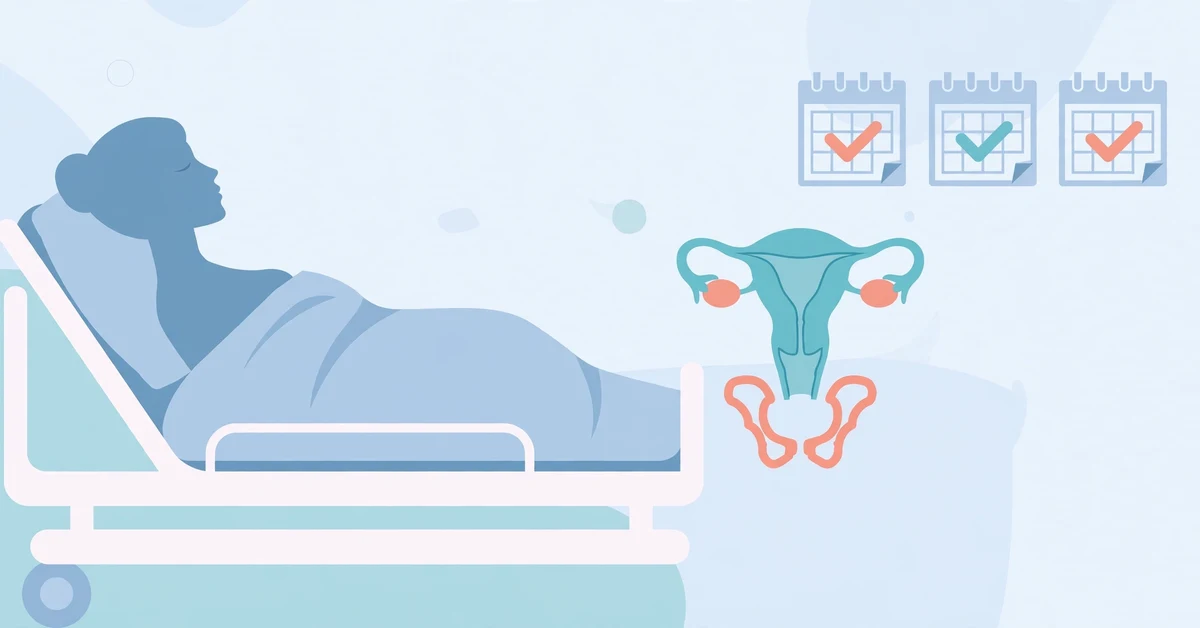
A hysterectomy is major surgery, and recovery is measured in weeks, not days. Most women are back to light daily routines within 2 to 4 weeks after a vaginal or laparoscopic (keyhole) hysterectomy, and within 4 to 6 weeks after an abdominal (open) hysterectomy. Full recovery — incisions healed, restrictions lifted, normal activities resumed — typically takes about 3 to 4 weeks for vaginal surgery, 4 to 6 weeks for laparoscopic or robotic surgery, and 6 to 8 weeks for abdominal surgery, according to guidance from Mayo Clinic, Cleveland Clinic and the NHS. Feeling fully energetic again can take longer, often up to three months.
One idea helps make sense of the whole timeline: your body heals on three different clocks. The skin incisions heal fastest, the internal tissues — including the vaginal cuff — heal more slowly, and your energy and stamina heal slowest of all. That is why you can look “back to normal” at three weeks and still need a nap after a short shopping trip. The week-by-week guide below follows the usual arc. Your surgeon’s instructions always override any general timeline, and if you are still deciding about the operation itself, our comparison of endometrial ablation vs hysterectomy covers a less invasive alternative for heavy bleeding.
How the type of surgery changes your timeline
The single biggest factor in your recovery is how the uterus was removed. A total hysterectomy removes the uterus and cervix; a partial (supracervical) hysterectomy leaves the cervix in place; a radical hysterectomy, done for cancer, removes surrounding tissue as well and takes the longest to recover from (Johns Hopkins Medicine). Whatever is removed, the route it comes out changes your weeks:
| Approach | Typical hospital stay | Light routines | Full recovery |
|---|---|---|---|
| Abdominal (open) — one larger incision in the lower belly | 1–3 days (occasionally up to 5) | 4–6 weeks | 6–8 weeks |
| Vaginal — uterus removed through the vagina, no skin incision | Same day to 1 day | 2–3 weeks | 3–4 weeks |
| Laparoscopic or robotic — several small “keyhole” incisions | Same day to 1 day | About 2 weeks | 4–6 weeks |
The American College of Obstetricians and Gynecologists (ACOG) recommends the vaginal approach whenever it is feasible for non-cancer conditions, because it carries fewer complications, a shorter hospital stay and a faster recovery than open surgery. A Cochrane review of surgical approaches found that women returned to normal activities roughly 10–14 days sooner after laparoscopic or vaginal hysterectomy than after open surgery. As a rule of thumb, if you had abdominal surgery, expect to run about two weeks behind the milestones below.

Hysterectomy recovery timeline, week by week
In hospital: the first 24–48 hours
You will wake up groggy from the anaesthetic, with a urinary catheter and sometimes a small drain. Pain is controlled first with IV medication, then tablets. The care team will get you sitting up and walking — often the same day — because moving lowers the risk of blood clots and helps your bowels and bladder wake up; you may also wear compression stockings or receive blood-thinning injections (NHS). Most women eat and drink again within a day. After keyhole or vaginal surgery many go home the same day or after one night; after open surgery the stay is usually one to three days.
Week 1: the first days at home
Fatigue dominates the first week — often more than pain. A shower can feel like a workout, and naps are part of the treatment, not laziness. Expect moderate soreness that should slowly ease day by day, light vaginal bleeding or discharge, and some constipation. The rhythm that works: short walks around the house several times a day, plenty of fluids, a stool softener if your team advised one, and a small pillow held against your abdomen when you cough, laugh or get out of bed. Lift nothing heavier than a full kettle — roughly 10 pounds (4.5 kg) is the ceiling Cleveland Clinic advises for at least the first 4–6 weeks. Someone else should handle cooking, laundry and childcare this week if at all possible.
Weeks 2–3: stronger — but beware the “false summit”
Pain usually drops noticeably in week 2, walks get longer, and many women start light desk work toward the end of this window after minimally invasive surgery. This is also the stage that catches people out: you feel so much better that you vacuum, lift a toddler or do a big shop — and spend the next two days back on the sofa with renewed pain and spotting. Feeling better is not the same as being healed; the internal stitches are still doing their main work. Vaginal discharge may briefly increase or change as the cuff stitches dissolve — that is expected. A first follow-up, by phone or in person to check wounds and pathology results, often happens around week 1–2.

Weeks 4–5: turning the corner
By weeks 4–5, most women who had vaginal or laparoscopic surgery are close to their normal routine: longer walks, light housework, cooking, and full workdays for desk jobs. Energy still comes in bursts — a good morning followed by a wiped-out afternoon is normal. Abdominal-surgery patients are usually a stage behind, still protecting the incision and building up more slowly. Gentle pelvic floor (Kegel) exercises are often fine to begin or build up around now, but only if your surgeon agrees — ask rather than assuming, because advice differs by procedure.
Week 6: the check-up milestone
Around six weeks most women have a post-operative check, where the surgeon examines the vaginal cuff to confirm it has healed. This visit is the usual moment when restrictions are lifted: sex, baths and swimming, and more vigorous exercise are commonly cleared here. Treat the appointment as a milestone, not a finish line — clearance means the initial healing phase is complete, not that every tissue is back to full strength. And do not measure yourself against the calendar: in Dutch studies, the median actual return to work was about eight weeks — later than the six weeks clinics often quote — so needing longer is well within the range of normal.
Weeks 7–8 and beyond: rebuilding
From week 7 onward, the task is rebuilding strength and stamina gradually: longer walks, then low-impact exercise, then weights and core work as tolerated. Scar tissue keeps maturing for months, and occasional twinges, incision numbness or itching can persist without meaning anything is wrong. Most women feel genuinely themselves again by about three months, though a small minority — particularly after open surgery — take longer. The arc is similar after other major abdominal operations; our guide to quality of life after a right hemicolectomy describes the same slow return of energy from the patient’s side.
Activity milestones: when can you…?
Exact dates vary by approach and surgeon, but these are the commonly advised windows (Cleveland Clinic, Mayo Clinic, NHS):
| Activity | Typical timing | The rule behind it |
|---|---|---|
| Walking | From day 1, building up daily | Encouraged immediately — prevents clots, eases gas and constipation |
| Lifting | Nothing over ~10 lb (4.5 kg) for 4–6 weeks; often 6 weeks after open surgery | A gallon of milk is about the limit; toddlers, laundry baskets and pet-food bags all exceed it |
| Driving | Often 2–4 weeks (keyhole/vaginal), 4–6+ weeks (abdominal); NHS range 3–8 weeks | Only when off strong painkillers, able to wear a seatbelt comfortably and perform an emergency stop without pain |
| Desk work | 2–4 weeks (minimally invasive); 4–6 weeks (abdominal) | Fatigue, not the wound, is usually the limiting factor — phased returns help |
| Physical jobs | 6–8 weeks | Jobs involving lifting, standing all day or driving need the longer window |
| Exercise | Walking straight away; structured exercise from 4–6 weeks, building gradually | No strenuous exercise, heavy weights or core strain until cleared at the post-op check |
| Baths and swimming | Usually around 4–6 weeks | Showers are fine early; wait until incisions are healed and discharge has stopped before soaking or swimming |
| Sex | Usually after the ~6-week check confirms the cuff has healed; some teams advise up to 8 weeks | Nothing in the vagina at all — no sex, tampons or douching — until cleared (ACOG: nothing in the vagina for the first 6 weeks) |
| Housework | Light tasks from weeks 2–3; vacuuming and heavy cleaning after ~6 weeks | Vacuuming pushes and pulls with the abdominal wall — it counts as heavy work |
What is normal: pain, fatigue, bleeding and your bowels
Pain. After abdominal surgery, most pain sits at the incision. After laparoscopic surgery the surprise culprit is often gas: the carbon dioxide used to inflate the abdomen causes bloating and shoulder-tip pain for 24–72 hours, eased by walking and warm drinks. Pain of any kind should trend downward week by week; pain that improves and then sharply worsens is a reason to call your team (see warning signs below).
Bleeding and discharge. Light vaginal bleeding or pink-brown discharge is normal for up to about six weeks, because the internal stitches at the vaginal cuff dissolve as it heals (NHS). It should be lighter than a period and gradually fade. Use pads, not tampons, until your surgeon says otherwise.
Bowels and bladder. Constipation is very common in the first days — anaesthesia, pain medication and reduced movement all slow the gut. Fluids, fibre, walking and a stool softener if advised are the fix; what matters most is not straining, because pushing raises pressure on the healing cuff. Temporary bladder hesitancy is also common. If you cannot pass urine at all, that needs same-day medical attention.
Fatigue. Expect it, and expect it to outlast the visible healing. Anaesthesia, blood loss, tissue repair and broken sleep combine into a heaviness that commonly takes six weeks to lift substantially and up to three months to disappear completely. Rest is a genuine part of the prescription.
Looking after your incisions and the vaginal cuff
If your cervix was removed (a total hysterectomy), the top of the vagina is stitched closed — this is the vaginal cuff. It is the most important internal healing site you have, and most early restrictions exist to protect it. The rules are simple: keep the “pelvic rest” — nothing inside the vagina for about six weeks — so the cuff is never stretched or exposed to bacteria while it knits; and report any sign of it struggling (below) immediately. If you kept your cervix (supracervical hysterectomy), there is no cuff and some of these restrictions may be shorter — your surgeon will confirm.
For skin incisions: keep them clean and dry, shower rather than soak, pat dry, and let any steri-strips fall off on their own. Small amounts of bruising, numbness or itching around the scar are normal. Increasing redness, warmth, swelling, oozing or the edges opening are not — call your team the same day.
Warning signs: when to call, and when to go to the emergency room
Most recoveries are uneventful, but complications announce themselves. Call your surgical team or doctor the same day if you notice:
- Fever of 100.4°F (38°C) or higher, or chills
- Pain that is getting worse after first getting better
- An incision that becomes red, warm, swollen, oozing or starts to open
- Foul-smelling vaginal discharge
- Burning when you urinate, or feeling you cannot empty your bladder
- Pain or swelling in one calf
- Constipation that does not respond to the measures above, or persistent vomiting
Go to the emergency room or call 911 now for:
- Vaginal bleeding that soaks a pad within an hour, or large clots
- A sudden gush of clear fluid or fresh red blood from the vagina
- A feeling of pressure or something protruding at the vaginal opening
- Severe abdominal or pelvic pain
- Chest pain, or new shortness of breath
- Fainting
Three of those emergency signs — a sudden gush of fluid or blood, a pressure/protrusion sensation, and severe pelvic pain — are the classic presentation of a vaginal cuff tear (dehiscence), a rare but serious complication in which the cuff stitches give way, most often after sex before the cuff has healed. It needs emergency surgery, so treat those signs as a 911 call, not a wait-and-see. Our dedicated guide to vaginal cuff tear symptoms explains what it feels like and why minutes matter.
Emotions and hormones after a hysterectomy
Physical healing is only half the recovery. If your ovaries were kept, your periods stop but your hormones keep working — you will not go into menopause immediately, though menopause may arrive somewhat earlier than it otherwise would have. If both ovaries were removed before natural menopause, menopause starts immediately and abruptly: hot flashes, night sweats, mood and sleep changes can begin within days. ACOG notes that hormone therapy can relieve these symptoms and may help protect bone health, so raise it with your doctor early rather than enduring in silence. Our guide to menopause after hysterectomy covers what to expect and what helps.
Emotionally, mixed feelings are the norm, not the exception — relief from years of pain or bleeding alongside grief about fertility, or a changed sense of identity. ACOG puts it plainly: it is OK to have mixed feelings. Low mood that persists beyond the first couple of weeks, loss of interest in everything, or anxiety that does not settle deserves the same prompt attention as a physical symptom — mention it at your follow-up or sooner.
The bottom line
Hysterectomy recovery is a two-to-eight-week project depending on the surgical route, with energy trailing behind for up to three months. Walk from day one, lift almost nothing for the first month or more, protect the vaginal cuff with strict pelvic rest until your six-week check, and treat the warning signs above — especially any sudden gush of fluid or blood — as emergencies. Recovery is rarely a straight line; a slow week is not a failed recovery. Your surgeon’s instructions, written for your operation and your body, always come first.
This article is general health information from the HealthEH Team and is not medical advice. It does not replace the guidance of your surgeon or doctor, who knows your procedure and medical history. If you have symptoms that worry you, contact your care team or seek urgent care.
Sources
- American College of Obstetricians and Gynecologists (ACOG) — 7 Things You Didn’t Know About Hysterectomy and ACOG patient FAQ on hysterectomy (recovery restrictions, route selection, hormone therapy after ovary removal)
- Cleveland Clinic — Hysterectomy (recovery 2–4 weeks for vaginal/laparoscopic and up to ~6 weeks for abdominal; lifting limit of 10 lb for at least 4–6 weeks)
- Mayo Clinic — Abdominal hysterectomy and Vaginal hysterectomy (full recovery 3–4 weeks for the vaginal route; hospital stay and activity guidance)
- NHS — Hysterectomy: recovering from the operation (full recovery 6–8 weeks after abdominal surgery; driving, work and lifting guidance) and NHS hospital recovery leaflets
- Johns Hopkins Medicine — Hysterectomy (types of hysterectomy; recovery ranges by approach)
- Cochrane review of surgical approaches to hysterectomy (return to normal activities ~10–14 days sooner with minimally invasive routes) and Dutch cohort studies on actual return-to-work timing (~8-week median)
Frequently Asked Questions
It depends mainly on the surgical approach. Full recovery typically takes about 3 to 4 weeks after a vaginal hysterectomy, 4 to 6 weeks after a laparoscopic or robotic hysterectomy, and 6 to 8 weeks after an abdominal (open) hysterectomy, according to Mayo Clinic, Cleveland Clinic and the NHS. Light daily routines usually resume well before that — around 2 weeks for keyhole surgery — but tiredness can linger for up to three months even after the incisions have healed.
For a desk job, many women return after 2 to 4 weeks following vaginal or laparoscopic surgery, and after 4 to 6 weeks following abdominal surgery. Jobs that involve lifting, standing all day or driving usually need 6 to 8 weeks. Studies of women who actually had the surgery found the median return to work was closer to eight weeks than the six often quoted, so needing longer than the standard estimate is common and normal.
You can drive when three conditions are met: you are no longer taking strong (opioid) painkillers, you can wear a seatbelt comfortably, and you can perform an emergency stop without pain or hesitation. For many women that is 2 to 4 weeks after keyhole or vaginal surgery and 4 to 6 weeks or more after abdominal surgery; NHS guidance gives an overall range of about 3 to 8 weeks. Check your insurance terms as well, as some policies have their own conditions.
Very little at first. Cleveland Clinic advises lifting nothing heavier than about 10 pounds (4.5 kg) — roughly a full kettle or a gallon of milk — for at least 4 to 6 weeks, and many surgeons extend the restriction to six weeks after open surgery. Toddlers, full laundry baskets, shopping bags and pet-food sacks all exceed the limit. Straining against a heavy load raises pressure inside the abdomen and stresses the healing vaginal cuff and incisions.
Not until your surgeon confirms the vaginal cuff has healed, which is usually at the check-up around six weeks after surgery; some teams advise waiting up to eight weeks. ACOG’s rule is simple: put nothing in the vagina — no intercourse, tampons or douching — during the first six weeks. Resuming too early is one of the most common triggers of a vaginal cuff tear, so this is not a restriction to test.
Yes. Light vaginal bleeding or pink-brown discharge is expected and can continue, on and off, for up to about six weeks while the stitches at the top of the vagina dissolve. It should be lighter than a period and gradually fade; a brief increase around weeks 2 to 3 as stitches dissolve is common. Use pads rather than tampons. Bleeding that soaks a pad within an hour, large clots, or a sudden gush of fluid or fresh blood is not normal — seek emergency care.
A vaginal cuff tear (dehiscence) is rare but is a surgical emergency. The classic signs are a sudden gush of clear fluid or fresh blood from the vagina, a feeling of pelvic pressure or of something protruding at the vaginal opening, and severe abdominal or pelvic pain. It happens most often when intercourse resumes before the cuff has fully healed. If you notice these signs, go to the emergency room or call 911 immediately — do not wait to see if it settles.
Only if your ovaries are removed. If the ovaries are kept, your periods stop permanently but hormone production continues, so you will not enter menopause straight away — although it may arrive somewhat earlier than it otherwise would have. If both ovaries are removed before natural menopause, menopause begins immediately (surgical menopause), with symptoms such as hot flashes starting within days. Hormone therapy can help and is worth discussing with your doctor early.






Related Posts

If You’re Transitioning, Breast Growth Is Possible — Here’s What You Need to Know
Oct 7, 2026 • 28 min read
8 Alternatives to Leg Curls
Sep 14, 2026 • 23 min read
Natural Treatment for Seborrheic Dermatitis: What Works?
Sep 28, 2026 • 15 min read
What Exactly Is a Tooth Piercing?
Sep 11, 2026 • 26 min read
The 9 Best Mouthwashes For Whitening, Cavities, Gums, Breath, and More
Sep 16, 2026 • 20 min read