
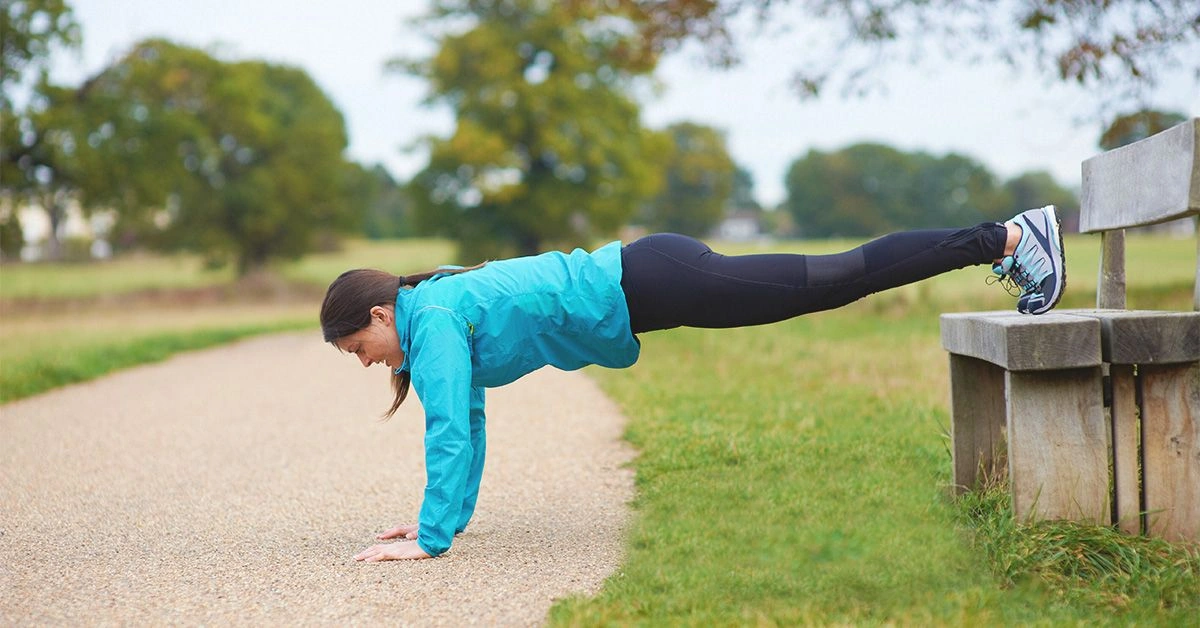
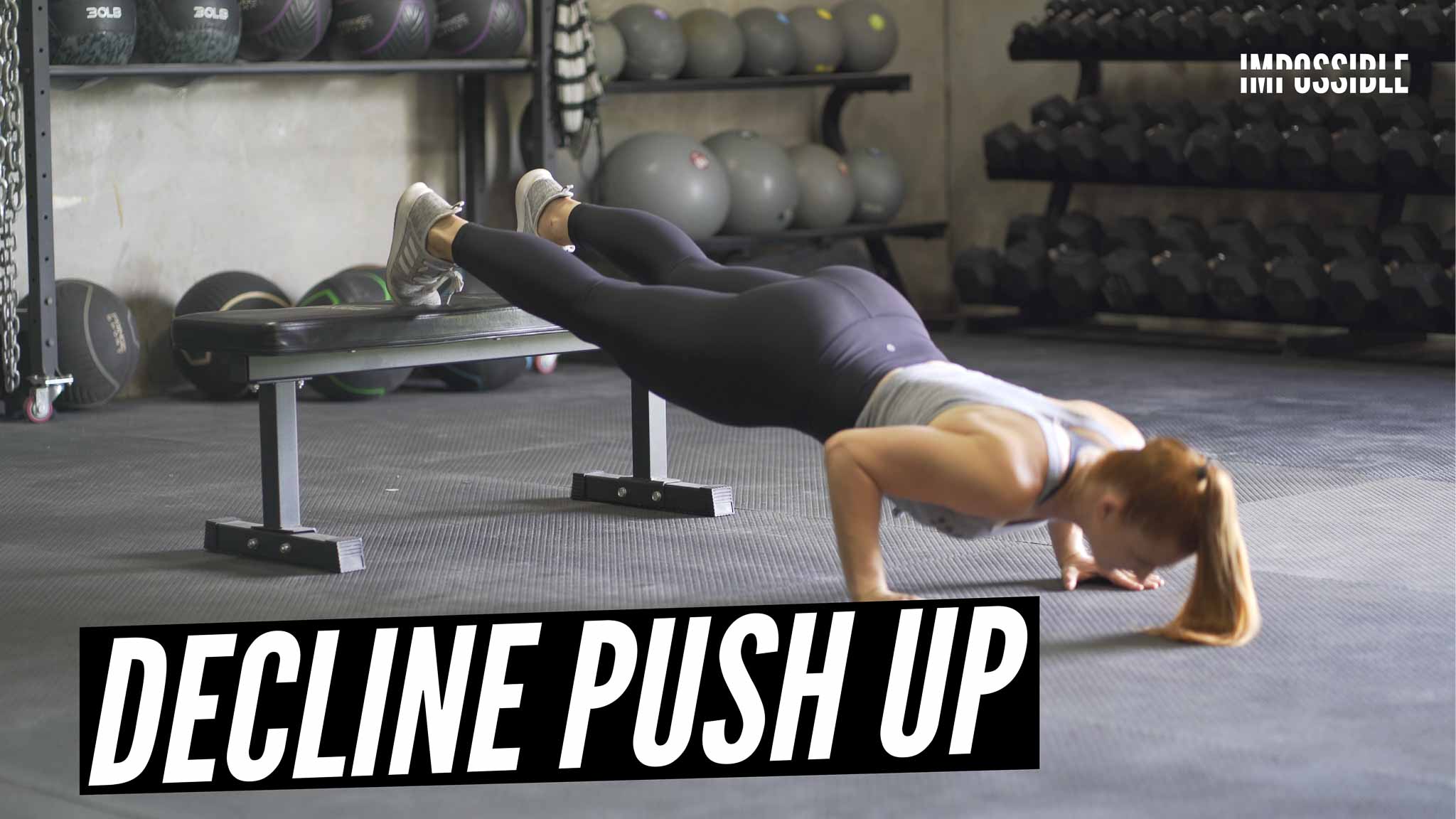
The decline pushup is a variation of the standard pushup performed with your feet elevated on a raised surface, creating a downward slope that places greater demand on the shoulders and chest.
Executing pushups from this angle emphasizes the upper portion of the pectoral muscles and the front of the shoulders.
Decline vs. incline and basic pushups
| Incline pushup | Basic pushup | Decline pushup | |
|---|---|---|---|
| Position | Hands rest on an elevated surface so the upper body is raised higher off the ground than the feet. | Hands and feet are on a flat surface; the top position resembles a plank. | Feet are placed on an elevated platform while hands are on a lower surface or the floor. |
| Best for | targeting the lower chest | overall chest, shoulders, arms, and core conditioning | targeting the shoulders and upper chest |
How to
Step-by-step instructions
You’ll need an elevated surface such as a bench, box, or sturdy chair to perform decline pushups.
The greater the height, the more difficult the movement becomes. If you’re just beginning, use a low platform like a curb or step and work up to higher elevations over time.
- Kneel with your back facing the bench. Place your hands on the floor with shoulders over wrists and elbows at about 45 degrees. Set your feet on top of the bench.
- Brace your core, glutes, and quads. Bend your elbows and lower your chest toward the floor while maintaining a straight spine and neck.
- Press into the floor to extend your elbows and return to the starting position.
- Aim for 2 to 4 sets of 8 to 20 reps.
Discontinue the exercise if you experience pain in the wrists, elbows, or shoulders.
Tips on technique
As with any movement, decline pushups require correct form to effectively target the intended muscles.
Good technique also reduces the risk of discomfort and injury.
Keep your spine neutral throughout the exercise. To prevent excessive arching, tilt your pelvis slightly backward and engage your core and glutes to stabilize the torso.
Look down rather than up to maintain a neutral neck and keep your head aligned with your spine.
Protect your shoulders by avoiding flared elbows; keep them at roughly a 45-degree angle from the body.
Decline pushup benefits
The primary advantage of decline pushups is strengthening the upper chest.
Because your arms press upward and away from the torso in this position, the upper pectorals and shoulder muscles receive greater activation.
Performed consistently, decline pushups can boost overall upper-body strength, which supports daily tasks like lifting groceries or carrying a backpack.
Decline pushup modifications
Decline pushups can be adjusted to suit your fitness level, preferences, and aims.
Varying the movement also helps keep your routine engaging.
The following variations allow you to reap the benefits of decline pushups in different ways.
Make it easier
Use a low bench or step to reduce difficulty; a surface an inch or two off the ground is gentler on the body.
If decline pushups are challenging, develop regular pushups first. Once you’re comfortable with the standard version, progress to the decline variation.
Make it harder
Increase difficulty by placing your feet on a higher surface, or perform the movement with your feet on a wall for an advanced wall decline.
Wearing a weighted belt or vest adds resistance and makes the exercise more demanding.
Other ways to up the challenge include:
- One-leg pushups. Keep one leg elevated during each rep, switching legs to complete the set.
- One-arm pushups. Tuck one arm behind your back and push with the other.
- Stability ball pushups. Place your hands on a stability ball instead of the floor and engage your core to maintain balance.
- Knee tap pushups. After each rep, bring a knee toward the corresponding elbow and alternate sides between repetitions.
- Dumbbell pushup rows. Rest each hand on a dumbbell; after a pushup, row one dumbbell up, then switch sides.
- Clap pushups. Explosively push up, clap while airborne, and land softly in a straight-body position.
These are advanced variations, so practice them after gaining proficiency with basic pushups. Consult a trainer for hands-on guidance if needed.
Focus on different muscles
Altering hand and arm placement shifts emphasis to different muscle groups.
Examples include:
- Triceps. A narrow pushup with hands close together increases triceps engagement.
- Chest and shoulders. A wider hand placement targets the chest and deltoids more intensely.
- Biceps. Rotating the wrists so fingers point backward can enhance biceps involvement, though this can be hard on the wrists and should be attempted with caution.
These variations may feel unusual at first; working with a qualified trainer can help prevent injury.
Other moves and benefits
Decline pushups aren’t the only way to train the upper chest and shoulders. The incline bench press also targets similar muscles.
In the incline bench press, you lie on a slanted bench and push a weight away from your chest.
Because of the incline, the arms press upward and away from the torso—similar to the movement pattern of a decline pushup.
To create balance in your routine, pair decline pushups with pullups.
While pushups emphasize the chest and triceps, pullups activate the back and biceps.
Combining both movements promotes balanced development of the upper torso and arms.
Pushup muscles
The basic pushup is an excellent bodyweight exercise for building upper-body strength.
Muscles worked include:
- pectoral muscles (chest)
- anterior and medial deltoids (shoulders)
- triceps brachii (back of the arms)
- abdominals (core)
- serratus anterior (beneath the armpit)
Decline pushups add variety to your routine.
Incline pushups are generally easier than standard pushups; decline pushups are more challenging. The downward angle increases the proportion of bodyweight you must lift.
After mastering incline and regular pushups, try decline pushups to further challenge your upper chest and shoulder strength.
The takeaway
As an intermediate-level movement, decline pushups require practice to perform well. It’s wise to be confident with incline and standard pushups before attempting declines.
If you’re new to pushups or recovering from an injury, seek advice from a personal trainer who can demonstrate modifications and help you train safely.



















Leave a Reply
You must be logged in to post a comment.