
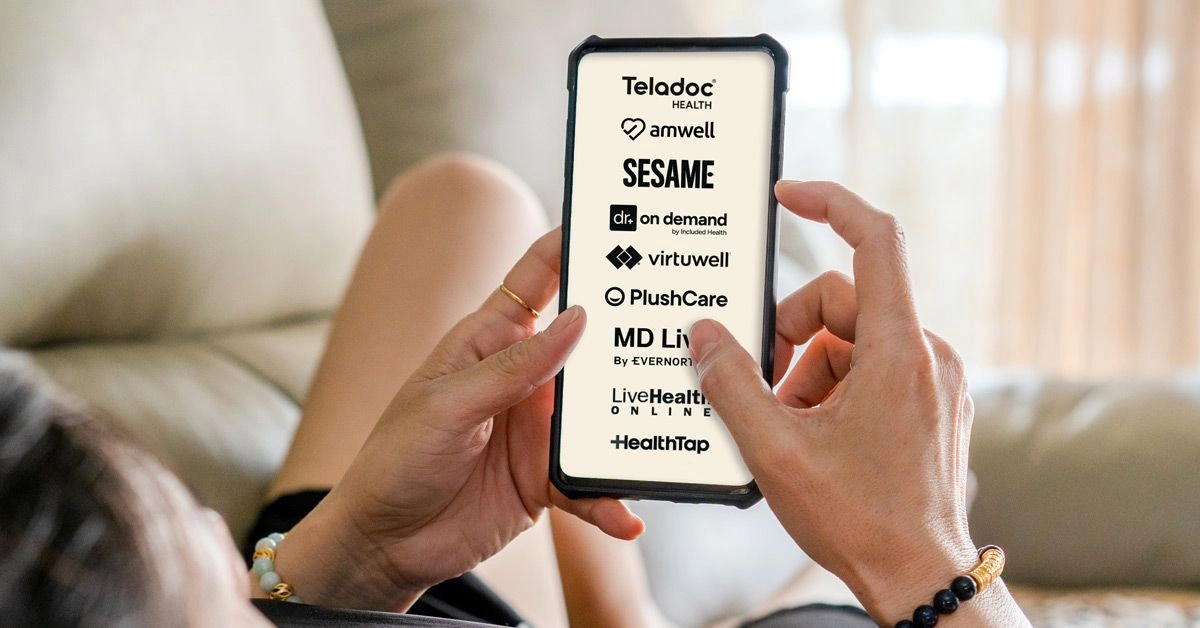
The Fast Facts
- Telemedicine providers deliver live care via video or chat, asynchronous care through secure messaging or email, and remote patient monitoring.
- For specialty services like weight management or prescription programs, telehealth clinicians often combine medical treatment with behavior-change coaching and lifestyle guidance as well as medications.
- Sesame Care is our selection for best overall.
Quick look at the best telehealth companies
Amazon One Medical
- Specialties:primary care, urgent care, sexual health, chronic disease management, mental health, hair loss, acne treatment
- Prescribes medication:yes
- Accepts insurance:yes
Telehealth — sometimes called telemedicine — is intended to make healthcare more reachable and far more convenient. You don’t need to take time off work, wait weeks for an appointment, or hunt for parking.

It lets you consult a clinician about a health concern, speak with a therapist about personal issues, and in many cases receive treatments, including prescriptions, from your home.
These services can be more economical if you lack insurance and may reduce barriers to seeking medical or mental health care if you’re uncomfortable visiting in person.
Below is a list of telehealth providers we rate highly for different needs.
HealthEH’s picks for the best telehealth companies
Best telehealth company
Sesame Care Telehealth
- Specialties:comprehensive care, mental health, dental symptom checks, dermatology, sexual health, and more
- Prescriptions:yes
- Insurance coverage:doesn’t accept insurance
HealthEH’s review
Price: varies by specialty and provider; begins at $37
Sesame Care includes services such as:
- urgent care
- skin care
- dental symptom assessment
- mental health
- wellness and preventive care
- chronic condition management
- women’s health
- pediatrics
- sexual health
In many states Sesame can also arrange referrals for labs, imaging, or specialists.
You can typically schedule an initial visit the same day. Pricing depends on location, and user reviews generally describe costs as reasonable.
Sesame Care clinicians often charge less than a standard insurance copay. Depending on your plan, you might be able to submit claims for reimbursement when seeing out-of-network providers.
If a prescription is filled at a local pharmacy, you can use your insurance for the medication, paying only applicable copays or deductible amounts.
Sesame offers a membership called Sesame Plus with a $99 annual fee (or $10.99 monthly) that may lower visit and service costs.
Pros & cons
- option for same-day visits
- budget-friendly pricing
- possible long wait times
- some documentation may not be provided
Product details
- Service delivery :video
- Subscription required :optional
Best for sexual health
PlushCare Telehealth
- Specialties:primary care services
- Prescriptions:yes
- Insurance coverage:yes
HealthEH’s review
Price: membership $19.99 per month plus copay, or $129 per visit without insurance
PlushCare provides broad medical care including services for men, women, and children; preventive care; therapy; urgent care; and more.
It offers a range of sexual health options, such as screenings and STI testing, some STI medications, and HIV prevention and treatment services.
Appointments can be booked via video on the website or app, either in advance or, when needed, same-day.
PlushCare can refill many routine prescriptions and send them to local pharmacies; controlled substances are excluded.
PlushCare is in-network with multiple insurers. If your plan is accepted, you’ll pay the estimated cost plus your copay. Without insurance, the visit fee is a relatively affordable $129. Insurance is not required to access PlushCare.
Pros & cons
- accepts many insurance plans
- schedules same-day visits
- ability to see the same clinician again if available
- some users report communication issues
- cannot prescribe certain medications
Product details
- Service delivery :video
- Subscription required :yes
Best for weight management
LifeMD
- Specialties:primary and urgent care via video or chat, same-day prescriptions, third-party lab testing
- Prescriptions:yes
- Insurance coverage:some plans accepted for some services
HealthEH’s review
Price:$19 a month
LifeMD provides telehealth for primary care, men’s and women’s health, mental health support, lab testing, and more.
A membership gives 24/7 access to clinicians, video visits within an hour, and discounts on certain tests.
The weight management program includes medical visits, nutrition guidance, prescription weight-loss medications (including GLP-1 treatments like Ozempic and Wegovy), and ongoing support. Pricing starts at $79 a month, medication costs separate.
Read our full brand review for more detail.
Pros & cons
- combines primary care and focused weight-loss services
- reasonable monthly subscription cost
- medication costs are not included in the subscription fee
- insurance acceptance is expanding but may be more limited compared with others
Product details
- Service delivery :video
- Subscription required :yes
Most treatment variety
MDLIVE Telehealth
- Specialties:nonurgent medical care, dermatology, therapy, psychiatry
- Prescriptions:yes
- Insurance coverage:yes
HealthEH’s review
Price: starts at $89 or less depending on insurance
MDLIVE earns the top spot for treatment variety because it addresses urgent care, primary care, dermatology, and behavioral health — covering conditions like allergies, UTIs, and rashes.
MDLIVE is transparent about what it cannot treat and which drugs it won’t prescribe. For instance, it can diagnose COVID-19 but won’t supply antivirals.
To use MDLIVE you create a free account, choose from licensed physicians, and then connect with a clinician by phone or online to establish a plan, which may include prescriptions.
Typical urgent care telehealth visits are about $89, dermatology about $95, and counseling $108. An initial psychiatric appointment is roughly $284, with follow-ups at $108. Insurance may lower these rates.
Pros & cons
- offers psychiatry and therapy for children 10 and older
- appointments available year-round, 24/7
- therapist availability may be limited
- cannot prescribe certain medications
Product details
- Service delivery :phone, video
- Subscription required :no
Best for insurance coverage
Teladoc Telehealth
- Specialties:primary care, smoking cessation, dermatology, mental health
- Prescriptions:yes
- Insurance coverage:yes
HealthEH’s review
Price: general visits can be as low as $0 with insurance or $89 without insurance.
Teladoc can provide:
- pediatric care
- nonemergency medical consultations
- dermatology evaluations
- mental health care for conditions like depression or substance use disorders
- sexual health services
Teladoc clinicians can order prescriptions to be sent to your pharmacy or review lab results. Your primary care provider can arrange lab work, imaging, immunizations, and referrals.
One of the earliest telehealth companies in the U.S., Teladoc maintains strong approval from clinicians and patients and is accepted by many major insurers.
The service can link you to in-network labs or facilities and uploads results to your account for clinician review.
Costs vary by insurance plan and care needed; contact Teladoc for specifics.
Pros & cons
- addresses a broad range of health concerns
- can review lab results and send prescriptions
- some users report technical issues with the app
- account setup can be time-consuming
Product details
- Service delivery :phone, video
- Subscription required :no
Best for mental health
Amwell Telehealth
- Specialties:urgent care, general medical care, therapy, psychiatry, women’s health, pediatrics
- Prescriptions:yes
- Insurance coverage:yes
HealthEH’s review
Price: varies; urgent care from $69 pre-insurance; online therapy about $109, psychologist visits cost more
Alongside urgent and general medical care, Amwell provides mental health services like CBT, couples therapy, and more.
Available services include:
- renowned therapy options
- psychiatry
- breastfeeding support
- nutrition counseling
- pediatrics
- women’s health
- second opinions
Founded by two physician brothers, Amwell aims to make basic care more affordable and remove obstacles such as distance and time.
The Amwell app (iOS and Android) connects you with in-state doctors. The company continually partners with new health plans; some urgent virtual visits may be covered in full depending on your insurer.
Before joining a call you’ll pay your copay or $69.
What our tester says
Tester Steven Rowe used Amwell’s online therapy in spring 2024 and found the booking process straightforward.
“After creating an Amwell account, within a few clicks I saw a list of therapists (15 nearby) with bios and schedules. I had three to four therapists I liked and could have chosen any.”
He wished more psychologists were available sooner — most were booked about six weeks out.
Steven said his sessions met expectations.
“My therapist understood my cultural context as a husband and father and asked insightful questions that helped me explore topics deeply,” he said.
He appreciated having the freedom to discuss anything without feeling interrupted or judged, and found the app easy to use for messaging and video sessions.
Steven noted the online format may not suit someone in a severe crisis or needing highly specialized care, but for a parent seeking help with daily life conflicts, it was a positive experience.
Pros & cons
- simple sign-up
- many therapists to choose from
- some appointments available within 1–3 days
- low-pressure therapy format
- covered by select insurers only
- out-of-pocket weekly cost may be high for some
Product details
- Service delivery :video
- Subscription required :no
Most budget-friendly
HealthTap Telehealth
- Specialties:urgent care, general medical care, and building a primary care relationship
- Prescriptions:yes
- Insurance coverage:yes
HealthEH’s review
Price:$44 per video visit with membership (membership $55 for 3 months or $180 annually); otherwise $129 per visit without insurance
HealthTap claims a network of 90,000 U.S.-licensed doctors who can answer questions, offer prescriptions, and manage chronic conditions like asthma, hypertension, and type 2 diabetes. You can chat with urgent care clinicians 24/7.
A membership (3 months for $55 or a year for $180) lowers visit costs to $44 and includes texting a dedicated clinician for follow-ups.
Nonmember visits outside business hours cost around $59.
Certain insurance plans may allow use without membership.
Pros & cons
- cost-effective for uninsured users
- option for a free account
- ability to see the same clinician for continuity
- response times can be slow
- may provide only general consultations for some issues
Product details
- Service delivery :video, phone, and text
- Subscription required :yes
Best for choosing a doctor
Doctor on Demand Telehealth
- Specialties:urgent care, preventive health, chronic condition management, therapy, psychiatry
- Prescriptions:no
- Insurance coverage:yes
HealthEH’s review
Price: from $99 per visit; varies by insurer
Doctor on Demand, part of Included Health, employs many board-certified clinicians rather than relying primarily on contractors, making it a top choice if you want to pick a specific doctor.
Along with primary and urgent care, it offers mental health and chat-based coaching for habits, sleep, and workplace stress. Prices depend on your insurance.
Without insurance, a 15-minute doctor visit starts at $99. Mental health initial psychiatric visits can cost up to $299 for 45 minutes; follow-ups are about $129. Some video visits may be covered by Medicare Part B under specific conditions.
Medicare telehealth rules vary; in most cases you must be in a designated facility in a rural area for coverage, though exceptions exist for certain services like dialysis, stroke follow-up, substance use disorder treatment, behavioral health, diabetes education, and nutrition therapy.
Pros & cons
- choose a therapist or psychiatrist by specialty and credentials
- access to a multidisciplinary clinician team
- out-of-pocket cost for brief teletherapy may be high if uninsured
- appointments might take several days to schedule
Product details
- Service delivery :video
- Subscription required :no
Best for customized treatments
LiveHealth Online Telehealth
- Specialties:nonurgent medical care, allergy care, therapy, psychiatry
- Prescriptions:yes
- Insurance coverage:yes
HealthEH’s review
Price: from $55; varies with insurance
LiveHealth Online lets you browse available doctors in your state and request video visits. Providers are available 24/7 and treat issues like flu, rashes, conjunctivitis, colds, and skin infections, sometimes prescribing medication as part of a treatment plan. Allergy visits are also offered.
Major insurers cover LiveHealth visits in many cases; self-pay visits begin at $55.
Pros & cons
- option to select your own doctor
- can refill prescriptions early
- some reports of long waits
- appointments may be canceled or rescheduled
Product details
- Service delivery :video
- Subscription required :no
Best for quick responses
Virtuwell Telehealth
- Specialties:nonurgent care, dermatology, sexual health, allergies, and more
- Prescriptions:yes
- Insurance coverage:yes
HealthEH’s review
Price: begins at $79; varies by insurer
Virtuwell uses an online symptom interview to triage your issue. A board-certified nurse practitioner reviews the responses, may request images of visible symptoms, and creates a treatment plan that can include prescriptions.
Conditions eligible include sinus/cough/allergy, women’s health, eye and ear problems, pediatric issues, some STIs, and other minor nonemergency problems.
Virtuwell files insurance claims for you; the self-pay price is listed as $79 without insurance.
Pros & cons
- guidance for many common conditions
- straightforward platform
- staffed primarily by nurse practitioners who have limits compared with physicians
- you must complete a questionnaire before a clinician reviews your case
Product details
- Service delivery :online form
- Subscription required :no
How telehealth companies compare
How we chose the best telehealth options
We selected these telemedicine providers based on:
- Ratings: We reviewed customer feedback to understand real-world experiences with these services.
- Types of services offered: We looked for platforms that handle a broad spectrum of medical needs, including labs and mental health care.
- Pricing: We prioritized options that offer flexible payment choices for different budgets.
- Accessibility: We evaluated how care is delivered — phone, video, apps — and whether 24/7 access is available.
- Vetting: These companies were vetted to align with HealthEH’s standards for integrity and approach to wellness.
How telehealth works
Telehealth lets you receive medical services online through a computer or smartphone app. Communication may occur via audio or video calls, email, or chat.
It supports care that doesn’t require an immediate physical exam, such as prescription renewals, symptom evaluations, and initial consultations.
Although it doesn’t fully replace in-person care, telehealth helps determine when an in-person visit is necessary and expands access to mental health services and specialists.
Telehealth benefits include:
- Convenience: Appointments fit into busy schedules and can be done from home or work.
- Accessibility: Telehealth opens doors to specialists who may be otherwise out of reach and reduces barriers for people with mobility issues.
- Safety: Fewer trips to clinics reduce infection risk for immunocompromised or chronically ill patients.
Drawbacks include the need for reliable internet and a private space, and potential privacy concerns if sessions occur in public areas.
Who is telehealth best for?
Telehealth can reduce barriers for many, and it’s especially helpful for people living in:
- rural or remote locations with limited local healthcare access
- those reluctant to seek in-person care
- individuals without insurance or whose plans don’t cover certain services
It’s particularly useful for:
- routine check-ins for ongoing conditions
- care for infectious illnesses like colds, flu, or COVID-19
- minor issues such as coughs, allergies, mild back pain, sprains, or strains
- mental health services including counseling and medication management
- monitoring new medications
- discussing test results ordered by your clinician
- consulting with specialists outside your area
Telehealth doesn’t replace in-person doctors’ appointments
Providers on telemedicine platforms can’t perform hands-on tests like drawing blood, taking urine samples, listening to your heart, or measuring blood pressure — procedures typically done in person.
While telemedicine is a practical tool, you’ll still need in-person care for many diagnostic tests.
If you’re facing a medical emergency, don’t use telemedicine — go to an emergency room or call 911 or local emergency services.
How to choose the right telehealth service for your needs
Selecting a telemedicine provider depends on your health needs, budget, and how quickly you need care. Steps to find the right one:
- Identify key features: Decide which features matter most — specialist availability, scheduling ease, or service breadth.
- Healthcare professionals: Check whether the platform offers a wide selection of clinicians so you can find someone who fits your needs.
- Cost and accessibility: Match services to your budget and consider appointment wait times for prompt care.
- Specialized care: If you have a specific condition, choose a service with clinicians experienced in that area and a communication style you prefer.
- Additional services: Confirm whether the platform can order labs or prescribe medications if needed.
- Payment options: Decide how you want to pay, whether you need receipts for insurance reimbursement, or prefer card payments.
Free and low cost health services
- The U.S. Health Resources and Services Administration’s Find a Health Center lists clinics that operate on a sliding scale for people without insurance.
- Planned Parenthood provides discounted or free services for pregnancy testing, birth control, and sexual health care.
- The Substance Abuse and Mental Health Services Administration (SAMHSA) offers a confidential, free helpline for substance use and mental health support.
Frequently asked questions about telehealth services
Is telehealth and telemedicine the same?
Broadly speaking, yes.
Historically, telehealth referred to the shift from exclusively in-person care to using technology (computers, video, phones, and messaging) to access healthcare.
Telemedicine referred more specifically to companies and services delivering care via technology.
Today the terms “telehealth” and “telemedicine” are often used interchangeably; we use both here.
Who is the leading telehealth company?
Teladoc Health is the largest telemedicine provider, with more than $1 billion in revenue and a sizable workforce.
Which telemedicine company is best?
There isn’t a single “best” telemedicine company for everyone. The right choice depends on your preferences, health needs, and budget.
The companies listed here are all known for quality and reliability and are good options depending on your priorities. Our top pick is Sesame Care for its affordable membership, broad service offering, and positive insurance options.
What is the best telemedicine service without insurance?
The best option for uninsured people depends on needs and budget. For affordability and broad coverage, Sesame Care stands out thanks to Sesame Plus.
Sesame Plus helps make care predictable and economical: membership is $10.99 per month or $99 per year, with visits available starting around $29.
What are the three types of telehealth?
The three commonly referenced types of telehealth are:
- synchronous
- asynchronous
- remote monitoring
Synchronous care is real-time interaction with a clinician (video or phone). Asynchronous care involves collecting and sending health information for later review. Remote monitoring means a clinician continuously or routinely reviews your health data and follows up as needed.
Takeaway
Telemedicine makes it simpler to access medical advice and care and can be a cost-effective option for those without insurance. For many people it’s an excellent complement to in-person care, improving convenience, reach, and access to specialists. If you’re comparing telehealth options, consider services’ specialties, pricing, insurance acceptance, and whether they offer the features you need — and for device or equipment needs, you might also want to check out recommendations for best stethoscopes.























Leave a Reply
You must be logged in to post a comment.