

The biceps and triceps are two major muscle groups of the arm that play an important role in moving the upper limbs.
Well-developed biceps and triceps are popular goals for bodybuilders and recreational lifters alike.
Some people may know where they sit and what they do, while others might be curious about their differences.
This piece explains the biceps and triceps, covering their anatomy, effective exercises to target them, and frequent injuries.
Physiology
The biceps and triceps are distinct muscles with notable differences in structure and purpose.
Biceps
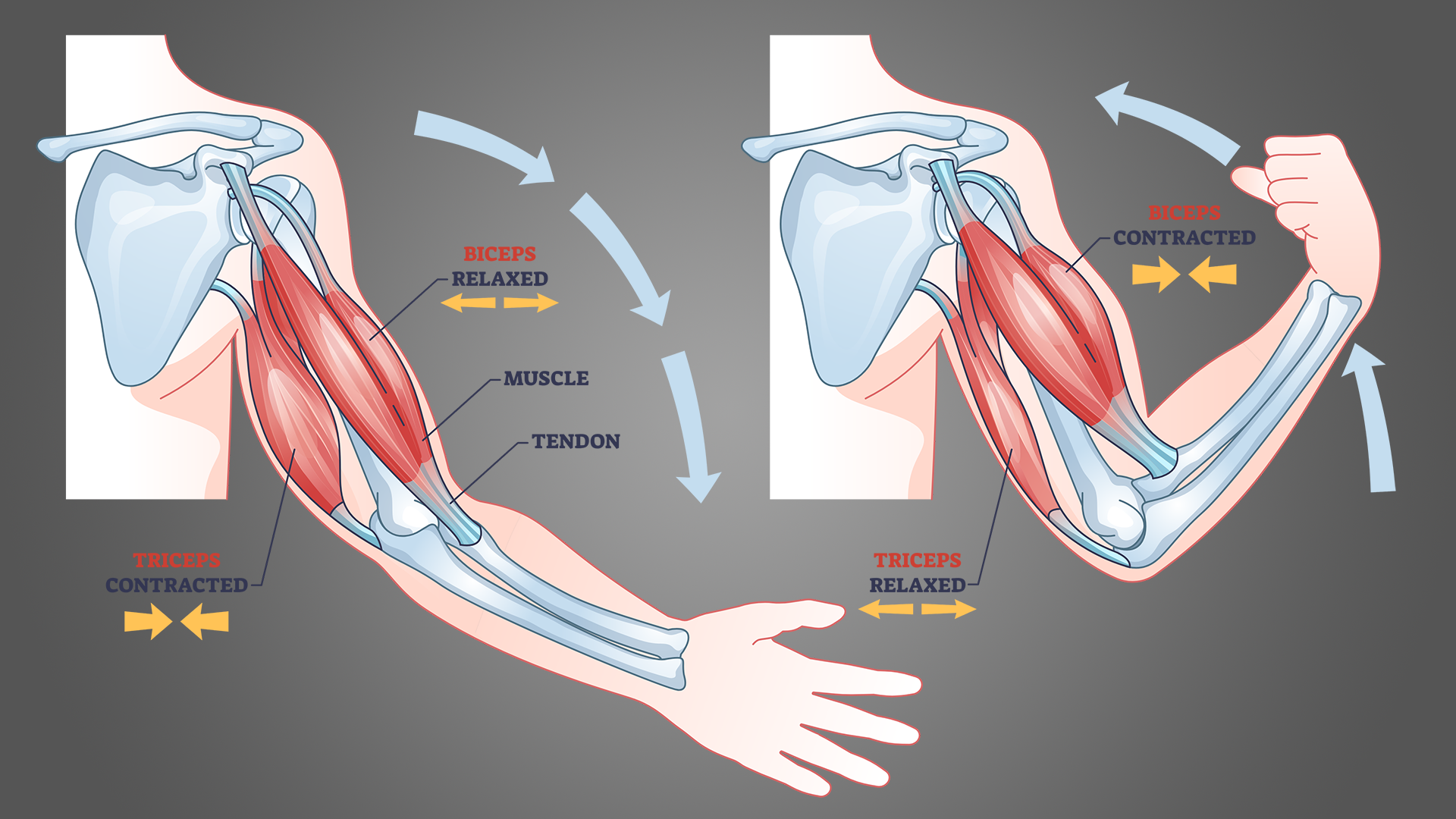
The biceps, formally called the biceps brachii, is positioned on the anterior portion of the upper arm.
It’s named ‘bi’ because it has two separate heads — a long head and a short head.
Both heads take origin from the scapula (shoulder blade) and attach at the radial tuberosity, a small bony bump just past the elbow.
The biceps perform several actions (1):
- Elbow flexion. Bringing the forearm toward the torso.
- Forearm supination. Rotating the palm so it faces upward.
- Shoulder flexion. Raising the arm forward.
Overall, the biceps are the smaller of the two major upper-arm muscles, trailing the triceps in size.
Triceps
The triceps, or triceps brachii, sits on the posterior side of the upper arm.
It’s called ‘tri’ because it comprises three heads — the medial, lateral, and long head.
The long head originates from the back of the scapula, while the lateral and medial heads start from the posterior and lateral aspects of the humerus (upper arm bone).
All three heads converge to insert on the rear of the elbow at a bony prominence known as the olecranon process.
The triceps are responsible for (2, 3):
- Elbow extension. Moving the forearm away from the body.
- Shoulder stabilization. For instance, when holding objects overhead.
- Shoulder extension. Moving the arm backward.
The triceps function as the antagonist to the biceps.
Typically, the triceps are larger than the biceps.
Summary: The biceps and triceps differ in composition and role: the biceps has two heads and mainly flexes the arm, while the triceps has three heads and primarily extends the arm.
Training principles for each
There are numerous exercises designed to build and strengthen the biceps and triceps.
Biceps training
Like other muscles, the biceps respond well to a range of rep schemes. For most people, 6–12 repetitions per set is an effective starting range.
Beginners might begin with 2–3 working sets per session, while intermediate and advanced lifters often require 4–6 sets to progress.
Because they’re a relatively small muscle group that can recover quickly, training them at least twice weekly tends to produce better results (4).
Although compound pulling movements like the lat pulldown engage the biceps, these movements alone usually aren’t sufficient for maximal growth, especially in more experienced trainees.
Here are 10 effective biceps exercises:
- Barbell curl
- Alternating dumbbell curl
- Cable curl
- Machine preacher curl
- Incline dumbbell curl
- EZ bar curl
- Dumbbell hammer curl
- Dumbbell spider curl
- Drag curl
- Resistance band curl
Triceps training
The triceps should similarly be trained across varied rep ranges; 6–12 reps per set is commonly used.
For novice lifters, 2–3 sets per session can be adequate, while those more experienced will typically need additional volume.
As a relatively small muscle, the triceps recover quickly, which is why training them at least twice per week is recommended to optimize growth (4).
Compound pushing movements like the bench press also involve the triceps, but alone they’re often not enough to fully stimulate hypertrophy.
Here are 10 effective triceps exercises:
- Barbell skull crusher
- Machine triceps extension
- Dips
- Dumbbell kickbacks
- Resistance band pushdowns
- Cable pushdown
- Cable overhead extension
- Dumbbell skull crusher
- Resistance band extensions
- Seated EZ bar triceps extension
Summary: The biceps and triceps share similar training needs, generally requiring at least two sessions weekly to maximize growth. Triceps respond best to pressing and extension movements, whereas the biceps are optimized by curling actions.
Which is easier to train?
There’s no definitive research stating which muscle is simpler to develop, but many lifters claim the biceps are slightly easier because of the many curling options available.
However, this advantage disappears if you have access to varied equipment and training methods.
The biceps have two heads that most curl variations will engage.
The triceps have three heads, and adequately stimulating each one requires deliberate exercise selection. Pushdowns and overhead extensions generally cover them well.
Specifically, the medial and lateral heads respond best to pressing and pushdown movements, while the long head is emphasized by overhead extension exercises.
Regarding raw strength, it’s hard to say which is stronger since it varies by person. Given their larger size, the triceps often allow heavier loads for many individuals.
Summary: The biceps might be somewhat easier to train due to the abundance of curling variations, although a well-stocked gym neutralizes this difference.
Common injuries
Because of their anatomy and modest size, both the biceps and triceps can be susceptible to injury from sudden trauma or chronic overuse.
Biceps
Frequent biceps injuries include (5, 6):
- Biceps tendinopathy. Often due to overuse, this involves microtears in the tendon at either attachment — near the elbow or at the shoulder — and can present as a dull ache or sharp discomfort depending on severity.
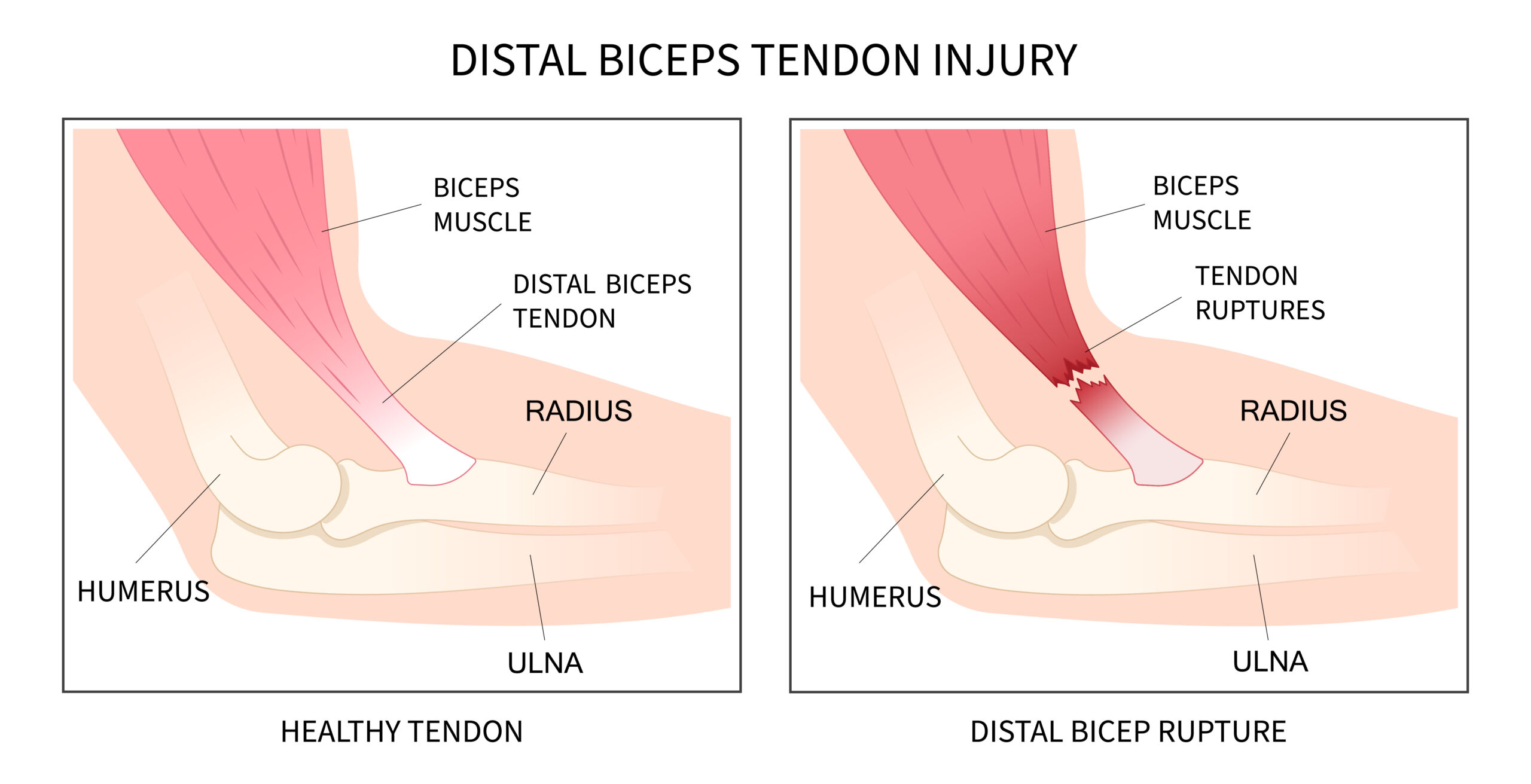
- Biceps rupture. Usually resulting from an acute overload, this can be a partial or complete tear within the muscle or at an attachment point. Recovery varies with severity and may require surgery.
Triceps
Common triceps injuries include (5, 7):
- Triceps tendinopathy. Typically from overuse, most often affecting the distal tendon near the elbow and causing aching pain that wors with activity. It usually improves with rest.
- Triceps rupture. Similar to a biceps tear, this can be partial or full and may involve surgical repair.
- “Snapping” triceps. A snapping sensation during movement often stems from tendon subluxation. It can be painless but may be uncomfortable.
To lower injury risk, begin with lighter loads and progressively increase intensity as your strength and technique improve.
Summary: Both the biceps and triceps are somewhat prone to injury due to their size and structure. Common issues include tendinopathy and partial or full muscle/tendon tears.
The bottom line
The biceps and triceps make up the bulk of your arm musculature.
The biceps sit on the front of the upper arm and enable elbow flexion, while the triceps lie on the back of the arm and produce elbow extension.
Both muscles can be effectively targeted with a wide range of exercises, some requiring gym equipment and others doable at home.
Because they’re relatively small, they’re susceptible to injury, so it’s wise to begin with lighter weights and gradually increase load as strength and form improve.
For a balanced program that includes biceps and triceps work, consider consulting a certified trainer for individualized guidance.






















Leave a Reply
You must be logged in to post a comment.