What Problems Are Possible with Breast Implants Placed Under the Muscle?


- Slower outcomes and extended recovery
- Animation deformity or dynamic distortion
- Flattening
- Indentation
- Waterfall deformity
- Frequently asked questions
- How long do submuscular breast implants last?
- Can implants under the muscle sag?
- How frequent is capsular contracture with submuscular placement?
- How can you tell if your implants are causing problems?
- The bottom line
Placing breast implants beneath the muscle offers several advantages, yet it also brings potential complications like delayed recovery, implant displacement or shape changes, and the waterfall deformity.
Below, plastic surgeons outline the possible disadvantages associated with submuscular breast implants.
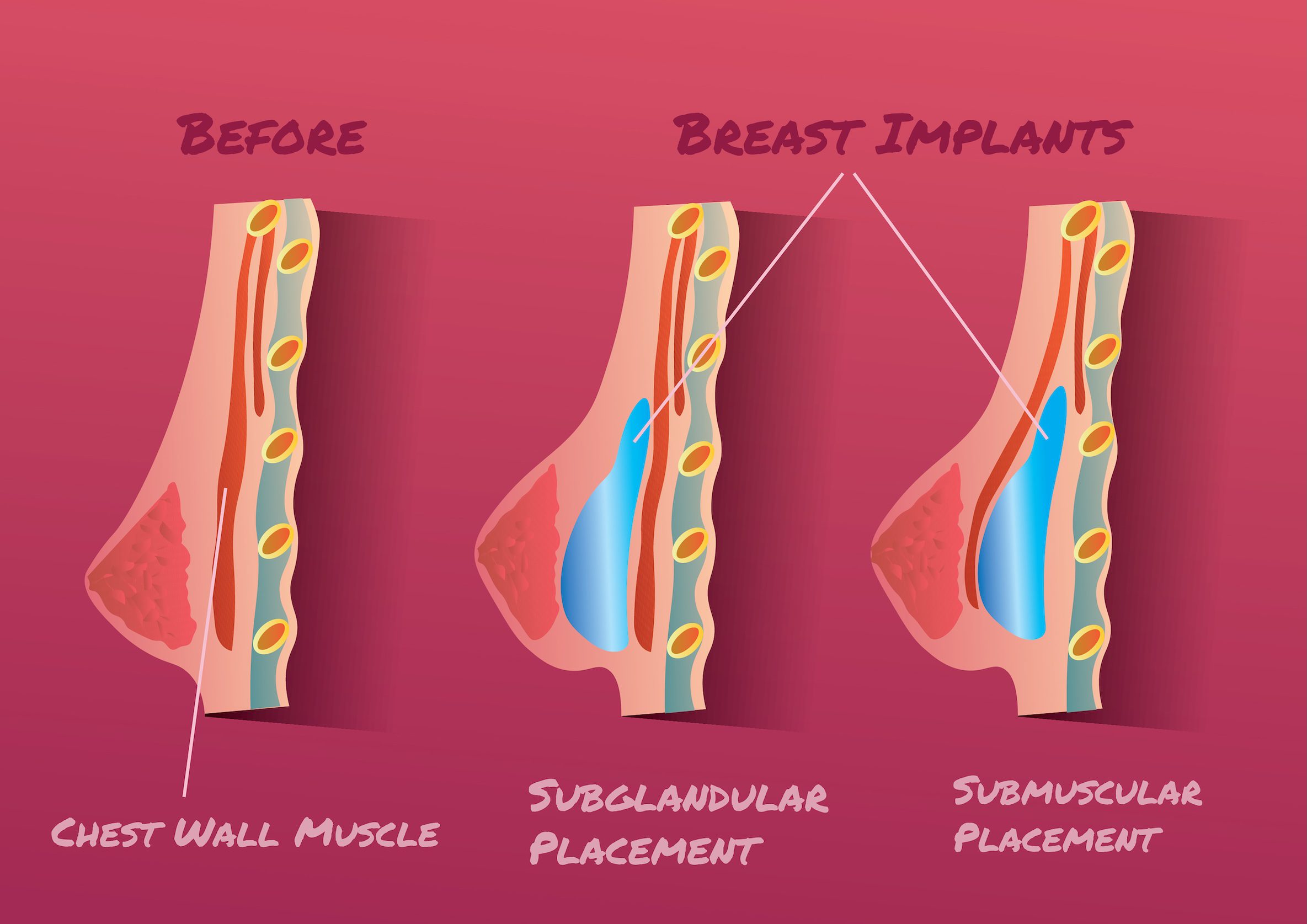
Slower outcomes and extended recovery
Although many patients start to feel improved 2 to 4 weeks after surgery, full healing typically requires about 6 to 8 weeks on average, explains Constance M. Chen, MD, a board-certified plastic surgeon and breast reconstruction specialist practicing in New York City.
For comparison, recovery after a breast augmentation using fat transfer usually takes around 1 to 2 weeks.
Initially, scar tissue needs to form around the capsule. “After that, adjacent tissues fuse together,” she says.
Resuming strenuous activity too soon can interrupt this fusion process.
“If someone with submuscular implants begins upper-body exercise before the tissues are fully healed, they could push the implants toward the armpits or into abnormal positions because the tissues haven’t yet fused,” Chen warns.
“You can also prolong healing by neglecting adequate nutrition, smoking, using steroids, or otherwise not prioritizing overall health and recovery,” she adds.
Healthgrades is owned by RVO Health. By clicking on this link, we may receive a commission. Learn more.
Animation deformity or dynamic distortion
Dynamic distortion, sometimes called animation deformity, refers to movement or shape change of the implant during muscle activation.
Distortion happens specifically when the chest muscles contract and engage, notes Alexander Zuriarrain, MD , a quadruple board-certified plastic surgeon at Zuri Plastic Surgery in Miami, Florida.
People who experience dynamic distortion often report the implant appears:
- protruding
- compressed
- wrinkled
- rippled
- bulging
Some people might also experience pain alongside visible distortion.
“When the breast muscle contracts it may temporarily compress the implant and cause a slight change in shape, which typically resolves when the muscle relaxes,” says Glenn Vallecillos, MD, a board-certified plastic surgeon in Beverly Hills, California.
“It’s generally not a permanent problem,” he notes. Still, the only way to eliminate even temporary animation deformity is via surgery, typically one of the two options described next.
Prepectoral revision removes the implant from beneath the muscle and repositions a new implant above the muscle.
Explant with autologous reconstruction also involves removal of the implant, but replaces it with the patient’s own tissue graft.
Healthgrades is owned by RVO Health. By clicking on this link, we may receive a commission. Learn more.
Flattening
Contemporary breast implants are generally composed of cohesive silicone gel and maintain their shape over time, says Vallecillos.
However, the implant can appear temporarily flattened when the pectoral muscle contracts.
When chest muscles tighten, they compress structures beneath them, which can alter the breast’s contour and appearance for the duration of the muscle contraction.
Although flattening doesn’t pose health risks, it may be a cosmetic concern for athletes or bodybuilders who might pursue remedies.
For instance, wearing a padded sports bra or a looser workout top can help conceal temporary flattening.
The primary surgical corrections are prepectoral revision, explant, and autologous reconstruction.
Indentation
Submuscular implants usually do not produce permanent indentations, says Zuriarrain.
That said, when some people flex their chest muscles, they notice an indentation where the muscle ends.
This effect is typically only visible during muscle contraction. Those bothered by it may consider prepectoral revision or explant with autologous reconstruction as corrective options.
Waterfall deformity
Waterfall deformity happens when the implant remains fixed while the surrounding breast tissue changes shape or descends due to gravity.
If the natural breast tissue begins to sag, the implant can appear as a firm, bulbous mass that the remaining tissue hangs over or spills off.
It tends to develop many years after the initial augmentation, Chen says.
To address it, surgeons can replace and reposition the implant, remove the implant and perform a fat transfer, or perform a breast lift.
Frequently asked questions
How long do submuscular breast implants last?
Implants generally have a lifespan of about 10 years, whether they are placed above or below the muscle.
Implants generally have a lifespan of about 10 years, whether they are placed above or below the muscle.
Can implants under the muscle sag?
The implant itself rarely sags. However, over time the breast tissue can descend over the implant and capsule, producing the waterfall deformity. Surgeons can correct this with procedures.
The implant itself rarely sags. However, over time the breast tissue can descend over the implant and capsule, producing the waterfall deformity. Surgeons can correct this with procedures.
How frequent is capsular contracture with submuscular placement?
Capsular contracture is the most common implant-related complication. It is considerably less frequent with submuscular implants — 1.9% of patients with submuscular placement versus 9.6% with subglandular placement.
Capsular contracture is the most common implant-related complication. It is considerably less frequent with submuscular implants — 1.9% of patients with submuscular placement versus 9.6% with subglandular placement.
How can you tell if your implants are causing problems?
Reach out to your surgeon if implants seem to be migrating toward the armpit or if your breast suddenly enlarges or shrinks. Seek prompt medical care if you develop high fever or chills, or if your breast becomes hot, red, or painful.
Reach out to your surgeon if implants seem to be migrating toward the armpit or if your breast suddenly enlarges or shrinks. Seek prompt medical care if you develop high fever or chills, or if your breast becomes hot, red, or painful.
The bottom line
If you’re weighing different breast augmentation approaches, it helps to understand the potential complications.
However, the probability of each issue varies according to factors such as breast and implant size, age, overall health, and more. Always consult a qualified medical professional before deciding for or against any procedure.
If you have implants and notice changes in shape, texture, size, or temperature of your breast, contact your surgeon or another healthcare provider promptly.
Frequently Asked Questions
Implants typically last about 10 years, though some may last longer. Regular follow-up with your surgeon helps spot issues that might require earlier revision.
The implant itself rarely sags, but natural breast tissue can descend over the implant over time, causing a “waterfall” appearance that may need surgical correction.
Capsular contracture is less common with submuscular placement; studies report rates around 1.9% for submuscular versus higher rates for subglandular placement.
Animation deformity is shape change or movement of the implant when the chest muscle contracts. It can be addressed surgically by moving the implant above the muscle or converting to autologous reconstruction.
Contact your surgeon if implants shift toward the armpit, if a breast suddenly enlarges or shrinks, or if you have signs of infection such as fever, redness, heat, or severe pain.
Read Next

If You’re Transitioning, Breast Growth Is Possible — Here’s What You Need to Know

Fragile X Syndrome and Autism: What Is the Link?
Ultrasounds Aren't Typically Used to Detect Cervical Cancer: Learn Why

Can You Overdose on Xanax?

What Are the Best Alternatives to Pushups?

Does Medicare Cover Echocardiograms (ECG)?
Related Posts

Hiya Vitamins Review By a Mom Who Is a Dietitian
Sep 25, 2026 • 11 min read
What’s the Difference Between THC Lotion and CBD Lotion?
Aug 13, 2026 • 27 min read
Hyperdontia: Do I Need to Have My Extra Teeth Removed?
Aug 1, 2026 • 23 min read
What Should I Do About a Molar Broken Off at the Gum Line
Aug 8, 2026 • 29 min read
Carbohydrates in Brown, White, and Wild Rice: Whole vs. Refined Carbs
Aug 5, 2026 • 11 min read