
Some claim humans now possess an attention span similar to a goldfish — roughly 8 seconds — though not everyone concurs.
Either way, it’s reasonable to say that people often seek more calm and concentration.
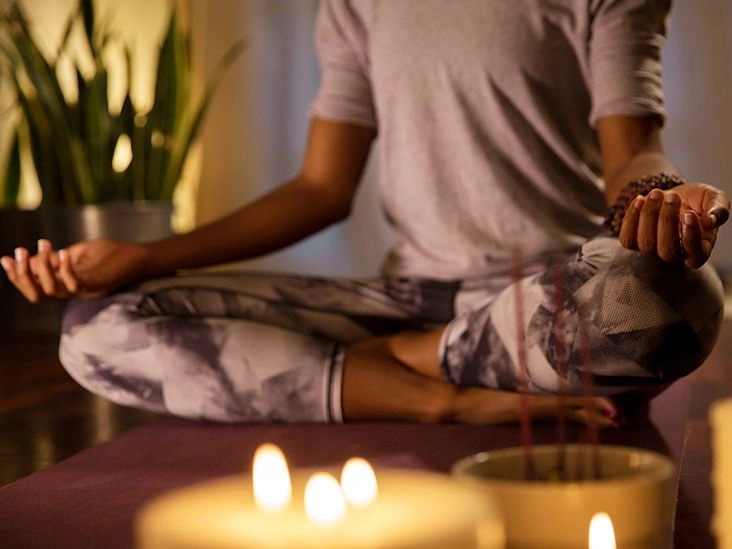
Could you calm your thoughts and soothe anxiousness by concentrating on one object, namely a candle? According to the ancient practice of candle gazing, the answer could be yes.
Practitioners and some studies suggest that candle gazing meditation can support cognitive abilities, emotional well-being, and spiritual awareness.
But what mechanisms are involved? And is staring at a flame safe for your eyes? Keep reading to learn more.

What is candle gazing meditation?
Candle gazing meditation is commonly called trataka, or yogic gazing. In Sanskrit, an ancient language from South Asia, “trataka” translates to look or gaze.
“People are so distracted,” says Nisha Saini, a board-certified holistic health practitioner, Panchakarma specialist, and founder and CEO of New York Ayurveda & Panchakarma Center. “Many have forgotten how to unwind.”
Saini notes everything from technology to the COVID-19 pandemic has made it harder for people to steady their minds and discover calm.
“When you fixate on a single object, it supports focus and…clearing the mind,” she says.
That’s the premise behind candle meditation.
History and cultural context
Candle gazing originates in ancient Indian yoga traditions. Trataka appears in early texts such as the Hatha Yoga Pradipika, a 15th-century Sanskrit guide to yoga.
The manual instructs practitioners to remain composed and “gaze steadily at a small mark, till eyes are filled with tears,” as noted in a 2018 research article. The authors believed this could assist with eye ailments. The Gheranda Samhita describes the practice similarly.
Researchers reviewing yogic visual concentration’s impact on cognition in 2016 observed that the Hatha Yoga Pradipika lists trataka among six cleansing techniques intended to purify body and mind and prepare one for:
- yoga
- breath control, or pranayama
- meditation
- spiritual experiences
In Ayurveda
Ayurveda, traditional Indian medicine, uses the five-element framework, a concept also central to traditional Chinese medicine (TCM).
Ayurvedic teachings list the five elements as:
- akasha (space)
- vayu (air)
- agni (fire)
- jala (water)
- prithivi (earth)
Ayurveda outlines three primary combinations of these elements, called doshas, which influence an individual’s physical and mental balance, says Pierre Couvillion, founder and director of Santosha School, a yoga and Ayurveda center in Indianapolis.
The doshas are:
- Vata (space and air). Governs movement and is tied to prana (vital energy).
- Pitta (fire and water). Governs transformation and centers on tejas (vital spark or discernment).
- Kapha (water and earth). Provides structure and lubrication, linked to ojas (vital essence).
“Fire, among the elements, supports focus and cognition,” Couvillion says. “It’s connected to brain gray matter and processing ability.”
He explains that candle meditation can evoke the fire element, which refines tejas and sharpens attention, thinking, and clarity.
Benefits of candle meditation
Advocates claim candle meditation may offer:
- enhanced cognitive performance and concentration
- better memory and spatial attention
- improved mental well-being
- better sleep
- possible benefits for eye health
Below are details from experts and studies about these potential benefits.
Increased performance and focus
Saini notes she observes constant eye motion in people who struggle to concentrate.
“That signals an unsettled mind,” she says. “Candle gazing trains focus.” It can be a practice to cultivate and strengthen attention, she adds.
A 2021 narrative review of 37 papers found evidence that trataka improved cognition. A small 2021 study of 41 participants indicated enhancements in working memory, spatial memory, and spatial attention.
A 2016 study suggested trataka could strengthen selective attention, cognitive flexibility, and response inhibition.
A 2014 study in older adults proposed that trataka might boost cognition in aging populations.
Mental health
Meditation has long been used to relieve stress and promote relaxation.
The 2021 narrative review found trataka may offer comparable mental health benefits. A 2020 study in adolescents suggested it could ease anxiety.
“Trataka gives the eyes and mind a task,” Couvillion says. “Your senses aren’t on constant alert. The mind has a straightforward duty.”
Saini explains candle gazing moves us beyond the physical by engaging the third eye chakra, or inner intuitive eye, which can be soothing. Located in the center of the forehead between the eyebrows, the third eye is linked to perception and spirituality.
Candlelight practice can also bring tears, which some see as purifying.
“When practiced until the eyes water, it can cleanse not only the eye’s surface debris but also clear mental debris,” says Cristina Kuhn, a YogaMedicine instructor, reiki master, and Ayurvedic health counselor.
Saini adds that the benefits extend beyond each session.
“Candle meditation is more than restful pause. It builds inner resilience,” she says. “With inner strength, you handle daily life better… You don’t react impulsively once you learn these tools.”
Sleep quality
Saini says that because trataka fosters relaxation, it may also aid sleep.
A small 2020 study of 29 people with insomnia found that practicing trataka 45 minutes a day for 10 days could reduce insomnia severity and improve sleep quality.
Eye health
The Hatha Yoga Pradipika suggests candle gazing might prevent and assist treatment of eye conditions.
Modern scientific findings are mixed:
- The 2021 narrative review suggested trataka did not benefit eye disorders.
- A 2018 study reported trataka exercises might reduce intraocular pressure (IOP) in glaucoma patients.
- A 2021 randomized controlled trial found potential IOP improvements in people with type 2 diabetes.
- A 2014 study of 60 individuals aged 8 to 30 evaluated therapies for myopia and reported no notable changes in visual acuity for those who practiced yoga therapy, including trataka.
- A 2018 study likewise indicated trataka was not effective for treating myopia.
Is candle gazing meditation safe?
Although evidence is mixed on whether candle meditation benefits vision, it’s broadly regarded as safe for most people. Still, some precautions apply.
Trataka is not recommended if you:
- have used alcohol or recreational drugs
- are susceptible to seizures
- have myopia, glaucoma, or severe eye conditions
- have a psychotic mental health disorder, such as schizophrenia
Couvillion warns never to leave candles unattended or where children or pets can reach them. Always consult your healthcare provider before beginning any new practice.
How to do candle gazing meditation
To practice candle meditation, Couvillion suggests these steps:
- Choose the best time of day for you.
- Find a dark, quiet place without interruptions.
- Sit upright with the candle at eye level to avoid strain, Saini advises.
- Take several deep breaths and focus your intention.
- Start with a 1-minute timer.
- Follow the candle flame’s movements with your eyes.
- Notice thoughts as they arise, then gently release them without judgment.
- Try to blink as little as possible.
- Develop a feeling that your eyes unite into a single inner eye, engaging the third eye chakra.
- End with gratitude and an intention to return.
Couvillion recommends practicing trataka first thing in the morning, especially when beginning.
“New habits are tougher to start at night when you’re tired,” he says.
But Kuhn advises not excluding evening practice, especially if you have difficulty sleeping. Session length can vary.
“Three to five minutes is enough, but if you feel called to lengthen the practice, you can prolong how long you visualize the flame in your mind’s eye,” Kuhn says.
Couvillion recommends beginners keep sessions short — no more than 5 minutes — for the most successful experience.
“Begin with something realistic,” he says. “Otherwise you may reinforce the idea that change is too difficult.”
Intrusive thoughts like a to-do list may arise no matter your experience level.
“Just place them into the flame,” Couvillion suggests. “Trust that anything worth remembering will become clearer after your practice.”
He adds you may notice a connection with the third eye during practice.
“Some feel a tingling or subtle sensation traveling up the spine, through the neck and brainstem, into the center of the brain and to the spot between the eyebrows,” he explains.
Still, avoid expecting a specific outcome; remain open to whatever arises.
Couvillion also notes trataka works best when it becomes a ritual, deepening your relationship with yourself.
Candle meditation sample script
Susanna Barkataki, founder and director of education at Ignite Yoga and Wellness Institute, provided the following script. You might record it and play it back during practice.
Try it
Settle into a comfortable posture. Let your gaze rest gently on the focal point.
If your eyes remain open, you may choose to gaze without blinking, which can cause watering, or to blink normally. You may also close your eyes and contemplate the inner light and intention you wish to invite.
Perhaps you aim to feel grounded, cultivate compassion, or welcome inspiration and gratitude. Whatever your focus, it is meaningful and valid. It’s yours.
If you’re unsure what to concentrate on, allow the practice to be a space of gentle curiosity. Quiet the mind and open space for inquisitive reflection or to add energy to your meditation and yoga.
Pause and slow down to dwell in your sacred space and its light. Spending a few minutes or more in this space of reverence can enliven and root your yoga and meditation practice.
When you’re ready, cup your hands over your eyes and close them. Or, if you prefer, open your eyes and gaze into the darkness of your cupped hands. Give yourself a tender eye massage.
Express gratitude for taking time to connect with the outer and inner light. Thank your candle and blow it out if it’s lit. Your session is complete.
What you need for trataka
Experts say trataka requires little equipment, making it accessible. Saini lists essentials as:
- a light source or flame, typically a candle
- a steady, safe surface for the candle
- a comfortable place to sit
- a dark, quiet room
Barkataki suggests experimenting to engage the senses and incorporate elements into your space. Suggestions include:
- natural items like branches or leaves
- water
- stones
- flowers
- a journal or inspirational book
- images of sacred figures, teachers, loved ones, and communities you cherish
Light source
Although trataka is commonly practiced with a candle, Couvillion notes you can also use the sun during the first five minutes of sunrise or the last five minutes of sunset.
Saini suggests using a scented candle with lavender, sandalwood, or rose for aromatherapy, though scented candles aren’t necessary and should be avoided if fragrances bother you.
White candles are often chosen for meditation because they symbolize clarity and simplicity.
Environment
Saini says the room temperature should be comfortable — not too warm or cold.
The space should be dark and quiet. She recommends avoiding music so your attention can be directed inward, though soft, calming music is fine if it helps you concentrate.
She discourages practicing from a recliner or swivel chair; instead choose seating that supports an upright posture, such as a dining chair or sitting cross-legged on a mat.
A meditation cushion can increase comfort without compromising alignment.
Frequently asked questions
Need more clarity? See the FAQs below.
Is candle meditation bad for your eyes?
Evidence about whether candle meditation harms the eyes is limited. Experts generally consider it safe for people without pre-existing eye conditions or a history of psychosis.
While classical Ayurvedic texts claim it can treat eye ailments, contemporary research presents mixed results.
Experts recommend consulting a physician before practicing trataka if you have serious eye conditions, myopia, or glaucoma.
How long should you do it?
There’s no single recommended duration for trataka; experiences vary. Session length depends on experience, schedule, and preference. Couvillion suggests beginning with a manageable interval, such as 1 to 5 minutes.
Choosing a realistic duration is key because the practice demands sustained focus.
What are the spiritual benefits?
Trataka fits into a holistic model of well-being that includes mind, body, and spirit. Kuhn says the spiritual benefits may include:
- reducing excess rajas (restlessness and action)
- increasing sattva (clarity and balance)
- enhancing intuitive or spiritual sight
However, these spiritual claims lack solid scientific proof.
What should you expect from candle gazing meditation?
Individual experiences vary. Typically, practitioners begin by gazing at a light source for 1 to 3 minutes.
Sooner or later your eyes will water and you’ll need to blink. Candle gazing may leave you calmer and more focused. It might improve attention and memory and possibly sleep quality.
Others may notice little or no change; consistent practice increases the likelihood of benefits.
What chakra is related to candle meditation?
Candle meditation is associated with the Ajna chakra, or third eye. This chakra — the intuitive eye — is said to enable seeing beyond the physical world and is tied to spirituality, perception, intuition, and connectedness.
Takeaway
Candle gazing meditation, or trataka, has been part of Ayurvedic and yogic teachings for centuries. The practice involves focusing on a single object, usually a candle, for several minutes to cultivate calm and concentration.
Candle gazing may support attention, cognition, mental health, sleep, and spiritual awareness, although more research is necessary to confirm these effects.
Experts advise consulting a healthcare provider before beginning if you have an eye disorder. People with seizure risk or certain psychiatric conditions should also seek medical guidance before trying trataka.























Leave a Reply
You must be logged in to post a comment.