
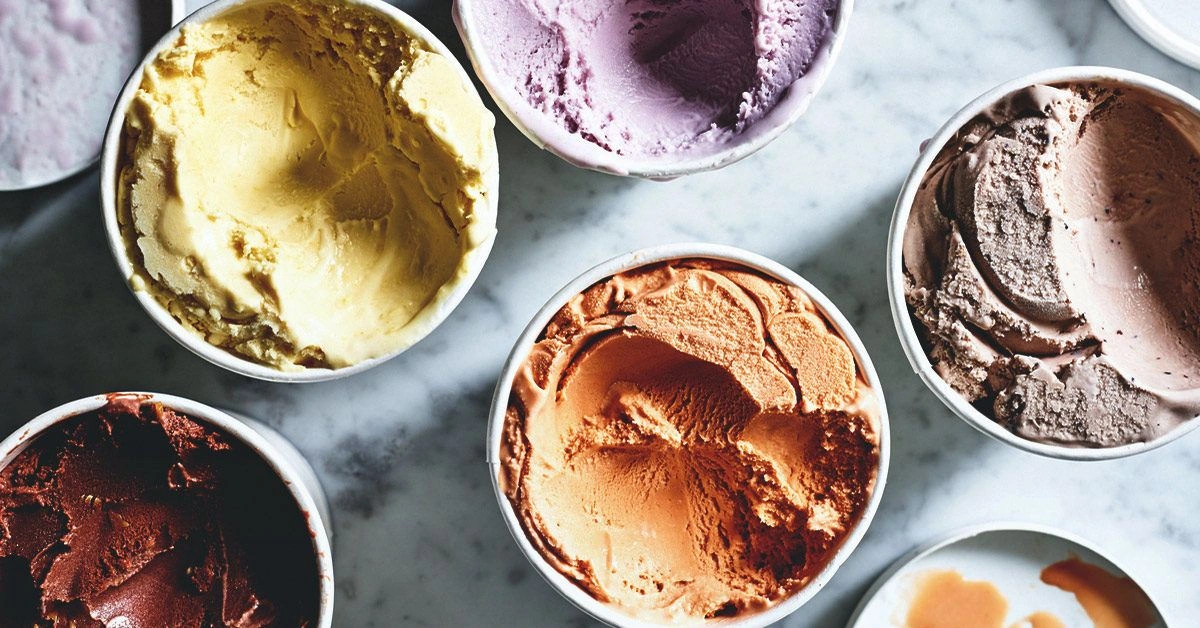
Ice cream tends to be lighter in texture and higher in fat, while gelato is creamier and more intensely flavored. Both are high in sugar, though gelato is traditionally made with less fat.
On a hot summer day in the city, it’s common to see people digging into a cold, creamy confection.
From a distance they may look similar, but ice cream and gelato are distinct creations.
This article outlines where ice cream and gelato come from, how they differ, and which one might be the healthier option.
Both are beloved frozen sweets
Gelato and ice cream are frozen, creamy treats made from basic components like dairy and sugar.
Origins of ice cream and gelato
Although the inventor of ice cream is unknown, early forms can be traced to ancient China. Historical accounts describe a blend of buffalo milk, flour, and ice enjoyed by King Tang of Shang (1, 2).
Later preparations involved fruit, juice, or honey spooned over fresh mountain snow (2).
Over time ice cream incorporated cow’s milk and eventually egg yolks, becoming a luxury enjoyed by the wealthy. Known as cream ice, it appeared on the dessert menu for Charles I and his guests in the 1600s (2).
Ice cream only became widespread in the 19th century, when innovations in dairy processing and refrigeration allowed mass production and distribution at lower cost.
The first ice cream machine emerged in the mid-1800s (2).
Gelato originated in Italy, though precisely where is debated — some point to Sicily, others to Florence.
How they’re made
Both gelato and ice cream are built from three primary elements — dairy, sugar, and air — but the ratios differ (2, 3).
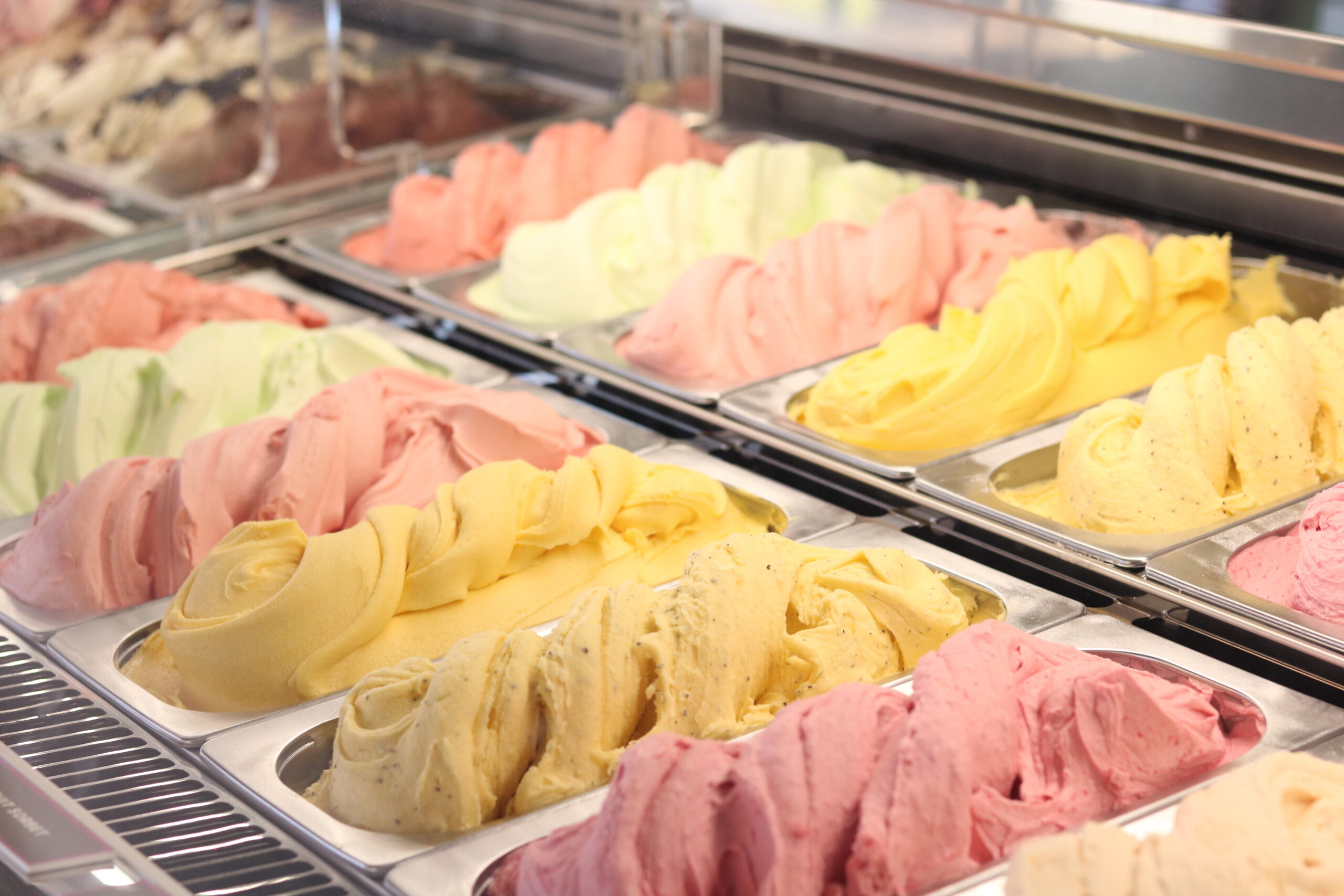
Milk and/or cream are blended with sugar, homogenized, and pasteurized. Flavors, natural or artificial, are folded in next. Finally, the mixture is churned to incorporate air before freezing (2, 3).
The term overrun refers to how much air gets whipped into the product. Gelato has a low overrun, while ice cream typically has a high overrun (2).
Ice cream is churned quickly, introducing substantial air and increasing its volume significantly during production (2).
Besides containing more air than gelato, ice cream usually contains more cream, resulting in higher fat. Ice cream also commonly includes egg yolks, whereas gelato generally relies more on milk (1).
Egg yolks add fat and function as stabilizers. Commercial ice cream may also use other stabilizing agents like guar gum to help bind water and fat in the mix (1).
Stabilizers also prevent the formation of large ice crystals, which can be unpleasant to eat (1).
Summary: Both treats have varied origin tales. Ice cream contains more air and fat, whereas gelato contains less air and more milk.
Differences between ice cream and gelato
Production methods vary slightly between gelato and ice cream, and these differences show up in their nutritional makeup.
Nutritional profile
The U.S. Food and Drug Administration (FDA) classifies ice cream as a dairy product with at least 10% of its calories from fat. In practice, up to about 25% of the calories in a typical ice cream carton may come from fat (1, 4).
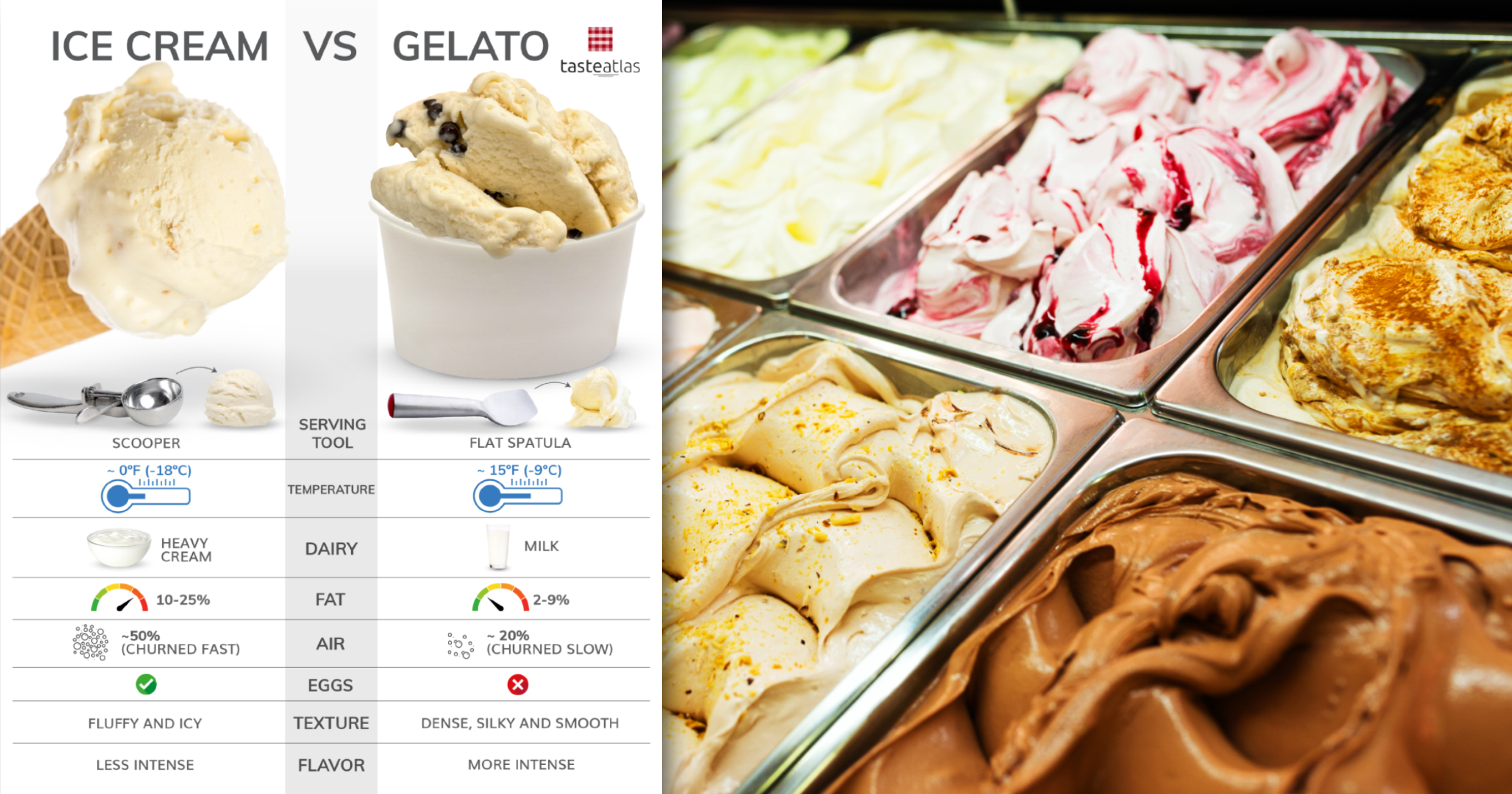
Gelato generally has a lower fat percentage, roughly 4–9%, but it can contain more sugar than ice cream (1, 3).
It’s important to note that both are high in sugar. A half-cup (78-gram) serving of vanilla ice cream can deliver about 210 calories and 16 grams of sugar (5).
An equivalent portion of gelato (88 grams) has roughly 160 calories and around 17 grams of sugar (6).
Because both are calorie- and sugar-dense, they’re best enjoyed occasionally.
Texture and flavor
Gelato is silkier and somewhat denser than ice cream, which helps it deliver more concentrated flavor. Gelato flavors are often drawn from natural ingredients (3).
Ice cream’s higher air content makes it lighter and softer. Even though it contains more butterfat, it may not taste as intense because the fat coats the tongue and delays flavor perception (3).
Serving style and uses
Gelato is traditionally kept and presented about 10–15°F (6–8°C) warmer than ice cream. Serving it at this warmer temperature helps the flavors be more noticeable, since the tongue is less numb than when eating ice cream (3).
It’s typically served with a flat spatula called a spade, which helps to soften and shape the dessert.
Ice cream is usually scooped with a deep, rounded tool, and its higher fat content allows it to hold firmer, rounded scoops.
Summary: Both gelato and ice cream contain considerable sugar. Ice cream often has 10–25% fat, while gelato usually ranges from 4–9% fat. Both should be treated as occasional indulgences.
Which should you pick?
If you like a colder, firmer treat with a richer, buttery mouthfeel, ice cream will likely appeal to you.
If you prefer a creamier, silkier dessert with a stronger flavor punch and lower fat, choose gelato.
No matter which you favor, both gelato and ice cream should be eaten in moderation because of their sugar and calorie content.
Consuming excess calories and added sugars can raise the risk of conditions such as heart disease, obesity, dental cavities, and diabetes (7, 8, 9).
Still, enjoying ice cream or gelato occasionally can fit within a balanced diet.
Summary: Because they’re high in calories and sugar, limit how often you eat ice cream and gelato.
The bottom line
Ice cream and gelato are both well-loved frozen desserts.
Ice cream tends to be airier with a higher fat level, while gelato is denser and more flavor-forward. Both are rich in sugar, but gelato is typically prepared with less fat.
Either can be included in a healthy eating pattern when consumed infrequently and in moderation. As with any high-sugar, calorie-dense food, keeping intake in check is best for overall health.





















Leave a Reply
You must be logged in to post a comment.