


- The Medicare open enrollment period runs from October 15 to December 7, allowing older adults to enroll in or modify their current health insurance coverage.
- There will be slightly fewer Medicare Advantage plans offered nationwide, though the average premium is projected to decline.
- The annual cap on out-of-pocket prescription drug costs will increase modestly, while Medicare officials continue negotiating lower drug prices with pharmaceutical companies.
- An ongoing government shutdown could temporarily delay access to certain Medicare services.
The open enrollment period for Medicare began on October 15 and continues through December 7.
This annual enrollment window is designed for adults age 65 and older who want to enroll in the federally funded health insurance program or adjust their existing coverage. It’s also an important time to review anticipated changes for the coming year, including updates related to the Medicare Part B deductible 2026 and other cost-sharing adjustments.
Approximately 69 million people in the United States receive health coverage through Medicare, making it one of the nation’s largest public insurance programs.
Original Medicare consists of Part A and Part B.

Part A provides coverage for inpatient hospital stays, critical access hospitals, and skilled nursing facilities. It also contributes to hospice care and limited home healthcare services.
Part B pays for medically necessary services such as ambulance transportation, physician visits, outpatient care, and preventive services like screenings and vaccinations. Premiums are typically deducted directly from a beneficiary’s monthly Social Security payment. In addition to premiums, beneficiaries should stay informed about the Medicare Part B deductible 2026, which affects when coverage begins for outpatient services.
Roughly 51% of Medicare beneficiaries carry supplemental health insurance, such as a Medicare Advantage plan.
In addition, about 81% of enrollees participate in Part D, which helps cover prescription drug costs.
According to Medicare officials, much of the system will function similarly in 2026 as it did in 2025. However, beneficiaries should pay close attention to several notable updates, including changes in prescription drug coverage, adjustments in premiums, and potential shifts in the Medicare Part B deductible 2026.
“Open enrollment is your opportunity to reassess your existing plan and decide whether to add or remove benefits,” said Kanwar Kelley, MD, a specialist in otolaryngology head and neck surgery, obesity medicine, and lifestyle medicine, and co-founder and chief executive officer of Side Health in Orinda, CA.
“Because plans can change each year, reviewing your coverage ensures it continues to meet your medical and financial needs. If it no longer fits, you can make changes so you feel confident in your benefits,” Kelley told HealthEH.
Whitney Stidom, vice president of consumer enablement at eHealth, echoed that advice.
“Medicare beneficiaries should take a proactive approach during this year’s annual enrollment period, as major changes to plan costs and benefits are expected for 2026,” she told HealthEH. “Comparing Medicare Advantage plans may help individuals find coverage that better matches their healthcare needs and budget priorities, potentially saving them over $1,800 annually in out-of-pocket expenses while maintaining access to quality care.”
Here’s what you should understand about Medicare changes for 2026.
Lower costs, fewer choices for Medicare recipients
The Centers for Medicare & Medicaid Services (CMS) estimates there will be around 5,600 Medicare Advantage plans available nationwide in 2026.
That figure is similar to 2025, when the total number of plans declined compared to previous years. Availability varies significantly by state and county, meaning some beneficiaries may see more limited options than others.
Some Medicare Advantage insurers have also indicated they could reduce service areas or trim certain coverage offerings.
Experts note that fewer plan choices can influence consumer decision-making.
“Fewer Medicare Advantage plans can translate to reduced overall choice,” Kelley said. “Limited options may increase costs if there are fewer competitive alternatives. It can also mean less flexibility and potentially narrower provider networks.”
He added that consolidation may sometimes improve overall quality, as insurers streamline benefits and focus on more comprehensive offerings.
The annual out-of-pocket maximum for in-network services under Medicare Advantage will decline slightly from $9,350 in 2025 to $9,250 in 2026.
The average monthly premium for Medicare Advantage plans that include prescription drug coverage is expected to drop from $16 in 2025 to $14 in 2026.
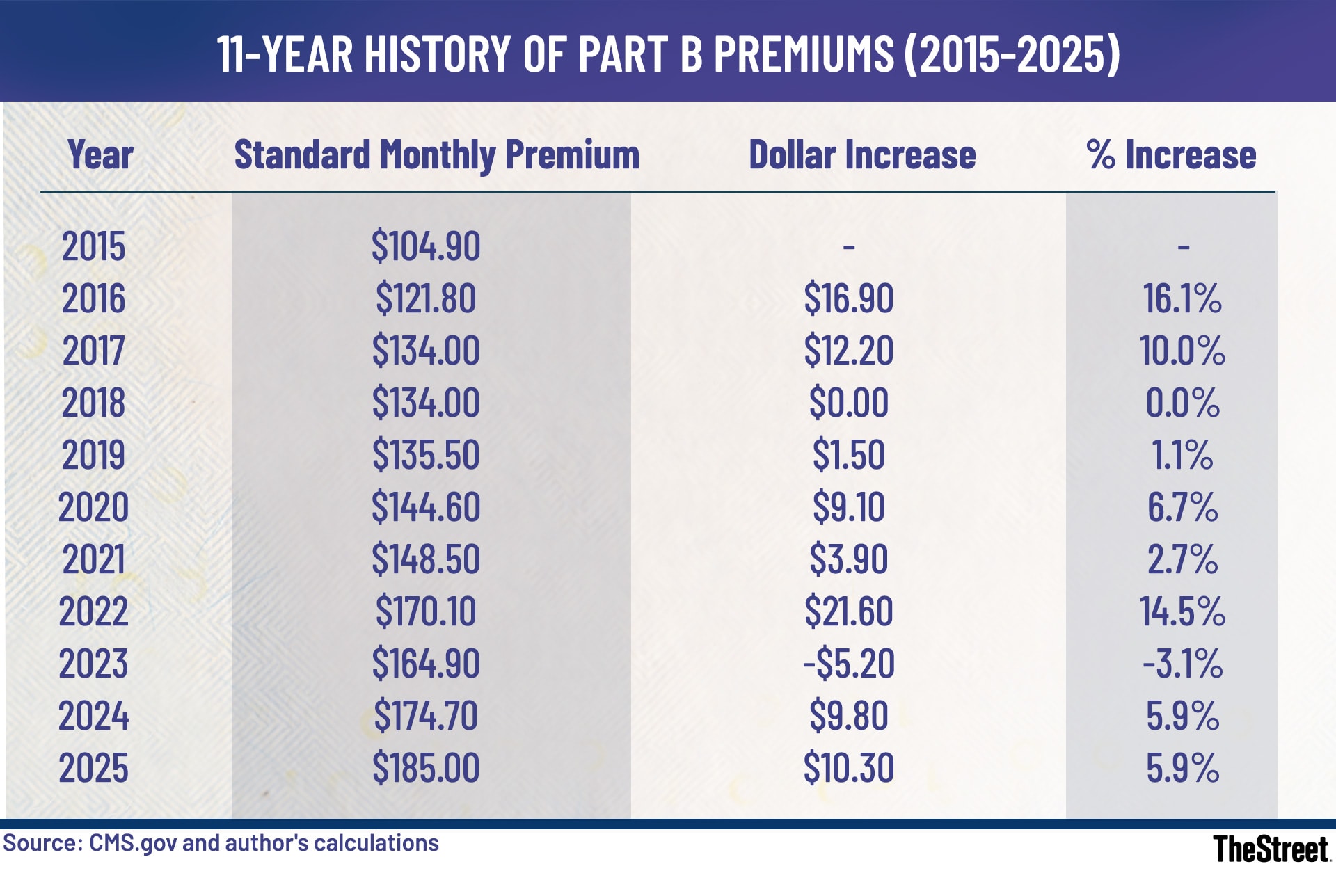
However, the average Part B premium is projected to increase from $257 in 2025 to $288 in 2026. Beneficiaries should review both the Medicare Part B premium 2026 updates and the Medicare Part B deductible 2026, as these combined expenses directly affect total outpatient healthcare costs. For a detailed breakdown by income level, the Medicare part b premium 2026 chart can provide additional clarity.
Prescription drug costs will decrease
The number of stand-alone Part D plans is projected to fall from 464 in 2025 to 360 in 2026. Even so, many of these plans are expected to offer slightly reduced premiums.
CMS estimates that monthly premiums for stand-alone Part D plans will decrease from $38 in 2025 to $34 in 2026. For Part D coverage included within Medicare Advantage plans, premiums are forecasted to dip from $13 to $11 per month.
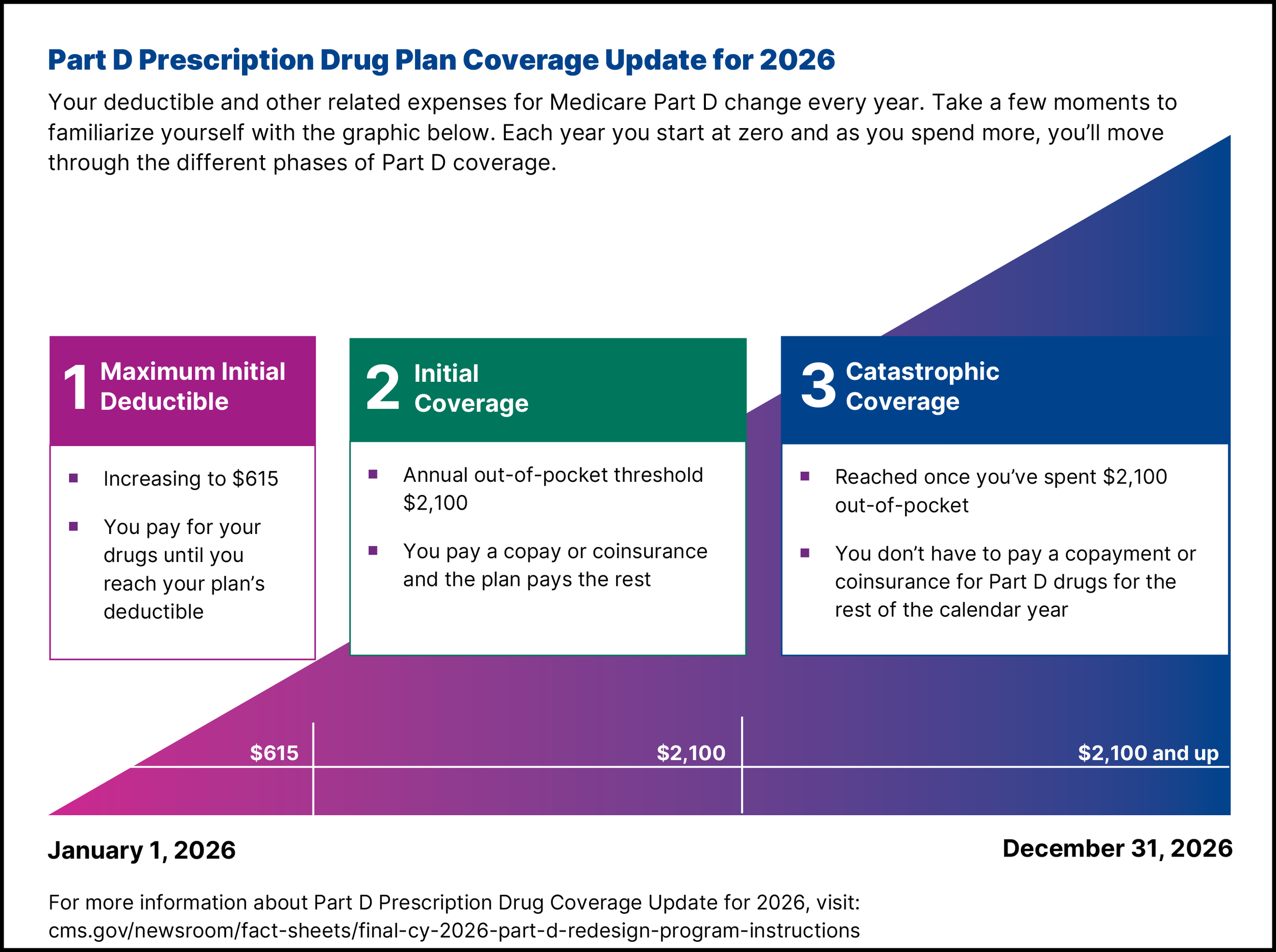
The annual cap on out-of-pocket spending for Part D medications will rise modestly from $2,000 in 2025 to $2,100 in 2026.
“The out-of-pocket cap for prescriptions is especially helpful for people taking high-cost medications,” Kelley said. “Once beneficiaries reach that threshold, they no longer pay additional out-of-pocket costs for covered drugs, which can be critical for those managing chronic diseases.”
The monthly out-of-pocket cost for insulin will remain capped at $35, and most vaccines will continue to be covered under Part D.
Earlier this year, the Trump administration decided against allowing Medicare to cover GLP-1 weight-loss drugs such as Ozempic.
Annual deductibles for Part D plans are also expected to increase. Although amounts differ by plan, the maximum deductible will rise from $590 in 2025 to $615 in 2026.
Medicare officials will continue negotiating prices for medications covered under Part D, a strategy aimed at lowering costs for beneficiaries.
The Medicare Drug Price Negotiation Program has identified 10 prescription drugs that will have reduced prices beginning January 1. These negotiated reductions are projected to save Medicare enrollees $1.5 billion in 2026. The medications include:
- Eliquis — for blood clot prevention and treatment
- Enbrel — for rheumatoid arthritis, psoriasis and psoriatic arthritis
- Entresto — for heart failure
- Farxiga — for diabetes, heart failure and chronic kidney disease
- Fiasp and NovoLog — types of insulin for diabetes
- Imbruvica — for blood cancers
- Januvia — for diabetes
- Jardiance — for diabetes, heart failure and chronic kidney disease
- Stelara — for psoriasis, psoriatic arthritis, Crohn’s disease and ulcerative colitis
- Xarelto — for blood clot prevention and treatment
Beneficiaries with Part D plans may continue using an automatic prescription payment plan that distributes drug expenses evenly throughout the year. Current participants will be automatically re-enrolled for 2026 unless they opt out.
“Spreading payments across the year makes medication costs more predictable and manageable,” Kelley said. “It may reduce the likelihood that individuals ration medications due to financial strain, which can help prevent complications and hospitalizations.”
Other changes in Medicare coverage
CMS officials report that new website enhancements are designed to simplify plan comparisons for beneficiaries.
An artificial intelligence tool has also been introduced to assist users in comparing prescription drug prices across different pharmacies, helping patients identify cost-saving options.
Additionally, CMS has implemented new limits regarding the types of programs that may be covered by Medicare Advantage plans.
Six states — New Jersey, Ohio, Oklahoma, Texas, Arizona, and Washington — will begin using an AI-assisted program to approve or deny coverage for medical services provided to beneficiaries enrolled in Medicare plans without a Medicare Advantage supplement.
Trump’s changes to Medicare may include cuts
Medicare programs were not directly modified by the “One Big Beautiful Bill Act,” which Congress passed and President Donald Trump signed into law in July.
However, the Congressional Budget Office (CBO) reports that the legislation could increase the national debt by more than $3 trillion by 2034.
If deficits rise as projected, automatic spending reductions could be triggered under “pay as you go” rules, which mandate cuts when certain deficit thresholds are exceeded.
CBO officials estimate that without congressional intervention, these “sequester cliff” reductions could total $45 billion in Medicare spending in fiscal year 2026 and $536 billion by 2034.
Government shutdown may impact Medicare
If the federal government shutdown that began on October 1 continues for a prolonged period, there may be uncertainty surrounding certain Medicare operations.
Claims processing and provider payments could experience delays, particularly for administrative services.
“If the shutdown continues, beneficiaries may notice longer processing times for non-urgent inquiries,” Stidom said. “Those enrolled in Medicare Advantage, Medicare Supplement, and Medicare Part D plans should remain unaffected as long as they work directly with private insurers or licensed agents.”
Telehealth services may also face disruption. Several telehealth flexibilities expired on October 1, and Congress has not renewed them. As a result, telehealth coverage may once again be limited primarily to rural areas or regions with healthcare professional shortages.
“Patients may temporarily lose access to telemedicine services until new legislation is enacted,” Kelley said. “Administrative delays are also possible while staff are furloughed.”
Expert advice for Medicare recipients
Stidom emphasized that most beneficiaries should have received an annual notice of changes from their insurer outlining any updates to benefits, provider networks, premiums, or deductibles — including adjustments that could affect the Medicare Part B deductible 2026.
“Medicare Advantage and Part D enrollees need to understand how their existing coverage is changing before evaluating new options for 2026,” she said. “Many beneficiaries will encounter meaningful shifts in benefits, higher costs, or modifications to provider networks.”
She noted that individuals whose plans are being discontinued must carefully evaluate their next steps.
“Beneficiaries whose Medicare Advantage plans are ending in 2026 will face unique challenges,” Stidom said.
“They must select a new Medicare Advantage plan or return to Original Medicare. Without additional coverage, they could face significant gaps, including no prescription drug benefit, unless they enroll in Medicare Supplement and a stand-alone Part D plan — options that may involve higher overall costs.”























Leave a Reply
You must be logged in to post a comment.