
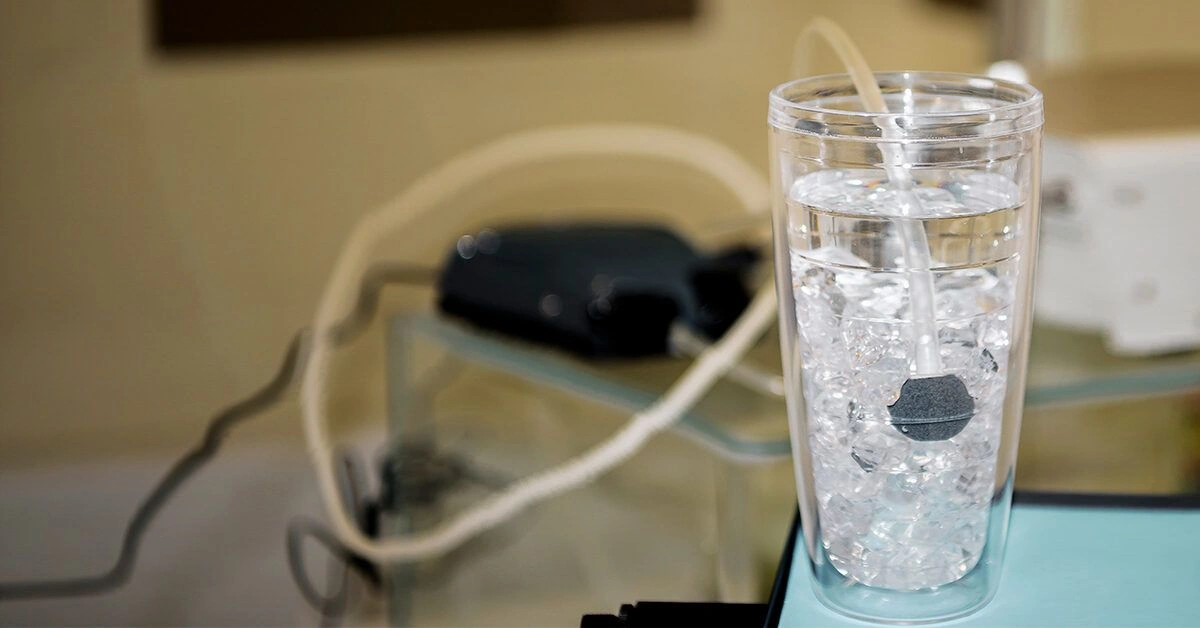
Ozonated water is simply water that has been exposed to ozone gas.

Advocates suggest it may provide advantages in both healthcare and industrial applications — from anticancer and free-radical–neutralizing effects in the body to roles in dental care and food preservation.
That said, contemporary research on many of these claims is limited, making it hard to fully verify all purported benefits of ozonated water.
This piece examines the available evidence about ozonated water, covering how it’s produced, its applications, possible benefits, and potential drawbacks.
What is ozonated water?
Ozone is a colorless gas made up of three oxygen atoms. As a gas it is unstable and can harm the lungs if inhaled (1).
When ozone is dissolved into water, the result is called ozonated water, which is thought to carry therapeutic actions such as antioxidant and antimicrobial effects and has been explored for dental use, cancer-related applications, and food-safety processes (2).
Many studies on ozonated water are older, so updated investigations are necessary.
Summary: Ozone dissolved in water produces ozonated water. It is believed to have therapeutic uses ranging from anticancer applications to helping preserve food.
How it’s made
Producing ozonated water typically entails filling a vessel with purified water and passing a stream of ozone-containing gas through it continuously for at least 5 minutes until saturation is reached, allowing the ozone to dissolve fully into the water (3).
In gaseous form, ozone can damage the respiratory tract. Ozonated water is easier to manage than ozone gas and holds promise for both industrial and therapeutic uses (4, 5,6).
Historically, ozone was applied to treat a variety of conditions. While many early uses were anecdotal rather than evidence-based, some have been subjected to scientific scrutiny (5, 7).
Summary: Ozonated water is produced by bubbling ozone gas through purified water until dissolved. Although ozone gas can harm the lungs, ozonated water shows potential therapeutic applications.
Benefits of ozonated water
Over the last 20 years, a number of investigations have examined the health-related effects of ozonated water.
Below are some of the possible benefits associated with ozonated water.
Cancer treatment and prevention
Treating cancer is often complicated; standard approaches such as chemotherapy and radiation don’t always reach tumors effectively (8).
Research from the early 2000s reported that ozonated water might boost the tumor-targeting effectiveness of some chemotherapy agents. Those results came from experiments in rats, and human trials have not yet been conducted (8).
Another early-2000s study compared bladder cancer risk among adults who drank ozonated water versus those who drank chlorinated water; both methods are used to disinfect water and limit pathogenic microbes (9).
The study suggested a reduced bladder cancer risk in people consuming ozonated water (9).
Nevertheless, more up-to-date and long-term research is required to confirm these observations.
Dental therapy
Recent studies indicate ozone can be useful in dentistry — for example, in reducing harmful oral bacteria and aiding oral wound healing (10, 11).
One trial compared ozonated water to a chlorhexidine mouthwash for tooth-decay control. It involved 23 adults and measured salivary bacteria at 7 and 14 days of ongoing ozonated-water use (12).
The results revealed a significant drop in Mutans Streptococci, a tooth-associated bacterium linked to cavities (12).
Another investigation reported that applying ozonated water to an oral wound accelerated healing by promoting cell turnover (11).
Antioxidant and antimicrobial
Ozone is an oxidizing agent that can form free radicals; it’s an unstable molecule capable of damaging cells.
Exposure to ozone gas may provoke a biological stress response that upregulates antioxidant production, helping to clear free radicals (13).
A case report described a 62-year-old woman who received ozonated water alongside antibiotics for a urinary tract infection (UTI). Ozonated water was instilled into the urinary tract three times across one week (14).
The patient recovered and experienced no recurrence through a 4-month follow-up (14).
However, that report involved a single patient who was also taking antibiotics, so broader studies are necessary.
Contact with ozonated water may accelerate tissue repair, reduce bacterial burden, and alleviate UTI symptoms (14).
Besides potential antioxidant effects, ozonated water may make microbes more susceptible to antibiotic therapy (15).
Food safety and water purification
Ozone’s antimicrobial action and capacity to remove industrial contaminants have positioned it as a possible substitute for chlorine (7, 15).
In 1901, a German city and a French city were among the first to employ ozone for drinking-water purification. Today, more than 3,000 cities use ozone to treat their drinking water (7).
In 1995, the U.S. Food and Drug Administration (FDA) classified ozone as “generally recognized as safe” for bottled water and food-contact uses (15).
Both older and newer research suggests ozonated water can be used to wash fresh produce to lower surface bacteria and extend shelf life, though such applications should be performed in controlled settings (15, 16).
Potential downsides
Ozone gas is classified as an air pollutant and can provoke airway inflammation and injury when inhaled (17).
Even brief exposure can worsen respiratory symptoms in adults and children (17).
Older studies also suggest ozone exposure during the second or third trimester might be linked to low birth weight (18, 19).
However, contemporary research is needed to confirm these associations and to clarify any underlying mechanisms.
Most investigations have focused on ozone gas rather than ozonated water; currently there’s no clear evidence directly connecting ozonated water to respiratory problems or low birth weight.
Ozone gas can be hazardous if mishandled, but those risks are not fully characterized.
Summary: Ozonated water exhibits antibacterial and antioxidant-stimulating properties. When used safely, it may help reduce tooth decay risk, lower bladder cancer risk, purify drinking water, and potentially improve some cancer therapies’ effectiveness.
The bottom line
Although ozone gas carries certain health hazards, ozonated water continues to show therapeutic promise.
The FDA regards ozone as safe for bottled water and for contact with food.
In regulated contexts, such as municipal water-treatment facilities or under medical oversight, evidence suggests ozonated water can be safe for drinking and for select medical uses.
Still, additional research is necessary to confirm the safety and benefits of ingesting ozonated water.
Just one thing
Try this today: If you want a change from plain water, consider sparkling water or experiment with fruit-infused water for variety.





















Leave a Reply
You must be logged in to post a comment.