Strep Throat Pictures: A Visual Guide to What Strep Looks Like

- What strep throat looks like at a glance
- How we chose the pictures in this guide
- Where to look: four landmarks in the back of your throat
- Picture 1: white exudate on red, swollen tonsils
- Picture 2: tiny red spots on the soft palate
- Strep throat vs viral sore throat at a glance
- Score it like a doctor: the Centor criteria
- Why pictures can mislead you
- How doctors confirm strep: rapid test vs throat culture
- Treatment, recovery, and how long you’re contagious
- Strep throat in children vs adults
- When to see a doctor — and when to go urgently
- How to check your own throat — and take a photo a doctor can use
- The bottom line
Open your mouth in front of a bathroom mirror, phone flashlight in hand, and compare what you see with the photos online. Red tonsils. A few white spots. Is it strep? That is the question behind almost every search for strep throat pictures — and the honest answer is that pictures can point you in the right direction, but they cannot diagnose you. This guide shows you exactly what strep throat looks like, photo by photo, how it differs from a viral sore throat, and how doctors decide whether to test you.
What strep throat looks like at a glance
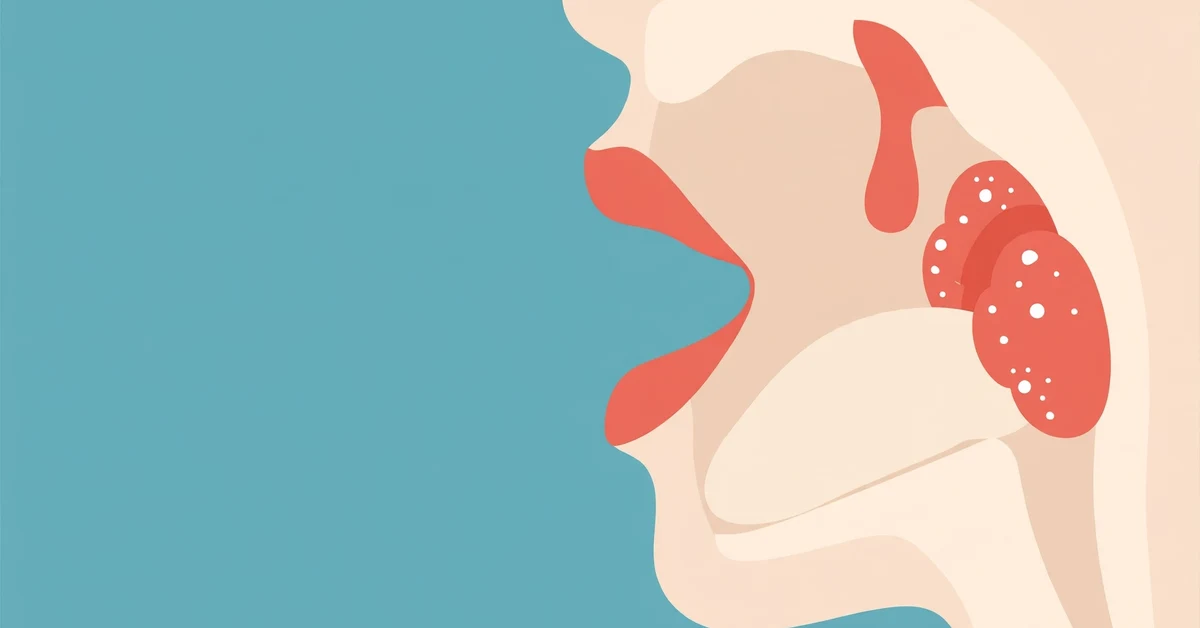
In a typical case of strep throat, the back of the throat looks intensely red and swollen. The tonsils are enlarged and often coated with white or yellow patches of pus called exudate. You may also see tiny red spots, known as petechiae, on the soft palate, and the uvula — the small piece of tissue hanging at the back — can look swollen. Fever, pain when swallowing, and tender lymph nodes in the front of the neck usually come with it. What you usually do not see with strep: a cough, a runny nose, or hoarseness. Those point toward a virus.
Three things matter more than any single photo. First, the pattern: strep tends to show several signs at once — fever plus exudate plus tender neck glands — while a virus usually shows fewer. Second, the timing: strep pain often arrives suddenly and feels severe from the start. Third, what is missing: the absence of cough is one of the strongest clues doctors use. As the Cleveland Clinic notes, you cannot know for sure that you have strep throat based on symptoms alone — but these three things tell you whether a test is worth getting. Keep them in mind as you look at the pictures below, because no single white spot settles the question.
How we chose the pictures in this guide
Every photo in this guide is a real clinical photograph from Wikimedia Commons: public-domain images from the U.S. Centers for Disease Control and Prevention (CDC), or physician photographs shared under a Creative Commons licence. We did not use stock photos, which show actors pretending to be sick, or uncredited images taken from other health sites.
We picked images that each show one sign clearly, and we labelled what you are looking at in every caption. We also left out two candidate photos whose licences we could not positively verify. A photo is a single moment in one person’s illness — lighting, camera angle and the stage of infection all change what you see — so treat these as a reference atlas, not a home test.
Where to look: four landmarks in the back of your throat
Before comparing photos, it helps to know the four landmarks doctors check. The tonsils are the two oval pads of tissue on either side of the back of the throat. The soft palate is the fleshy rear part of the roof of your mouth. The uvula is the small finger of tissue hanging down from the soft palate. And the tongue — especially in children — can turn bright red with a bumpy surface, the so-called strawberry tongue of scarlet fever.

When you look at a throat photo, check each landmark in turn. Healthy tonsils are pink and roughly the same size on both sides. In strep throat they turn beefy red, swell, and may nearly meet in the middle. The soft palate may show pinpoint red dots. The uvula may be swollen and pushed to one side. None of these signs alone proves strep — but together, they build the picture.
Picture 1: white exudate on red, swollen tonsils

This is the classic strep throat photo: tonsils that are bright red and swollen, coated with white or yellowish patches. Those patches are exudate — pus made of white blood cells, bacteria and debris. In strep throat the exudate usually sits in streaks or blotches on the tonsils, sometimes spreading onto the back wall of the throat.
Exudate is the single most photographed sign of strep, and also the most misunderstood. White patches do not automatically mean bacteria: some viral infections, including mononucleosis, can produce them too. And the reverse is also true — you can have strep throat with no white patches at all, just a dark, raw-looking throat. What makes exudate more convincing for strep is the company it keeps: high fever, tender neck glands, and no cough. If you see white patches but feel otherwise well and have no fever, the cause is more likely something else — hard, chalky nuggets tucked into the tonsil crypts, for example, are usually tonsil stones, not infection.
Picture 2: tiny red spots on the soft palate

Look at the roof of the mouth in this photo: the soft palate is covered in tiny, pinpoint red dots. Doctors call these petechiae — small spots where tiny blood vessels have leaked. They are one of the most specific visual signs of strep throat. The CDC photo record for this image notes the redness and swelling of the oropharynx together with petechiae on the soft palate in a patient diagnosed with strep throat.
Petechiae are easy to miss because they are small and sit far back. Shine a light straight at the soft palate and look for dots that look like someone flicked a red pen across it. They can also appear with mononucleosis, so they raise the odds of a bacterial infection without proving it. But combined with white exudate and a high fever, they make strep much more likely — and they are a good reason to get tested rather than wait it out.
Strep throat vs viral sore throat at a glance
Most sore throats are viral. The table below is the fastest way to tell which side your symptoms fall on — but remember it is a guide, not a diagnosis.
| Feature | Strep throat | Viral sore throat |
|---|---|---|
| Onset | Sudden; pain often severe from the start | Gradual; builds over a day or two |
| Fever | Often 101°F (38.3°C) or higher | Low-grade or absent |
| Tonsils | Red, swollen, often with white exudate | Red and swollen, usually no exudate |
| Soft palate | Petechiae (tiny red spots) common | Rarely any spots |
| Cough | Usually absent | Often present |
| Runny nose / congestion | Usually absent | Often present |
| Neck glands | Tender and swollen, front of the neck | Mildly swollen or normal |
| Pain when swallowing | Severe | Scratchy or mild |
| Most common ages | 5 to 15 years | Any age |
| Course without treatment | Can linger; risk of complications | Usually resolves in a few days |
If your symptoms read like the left column on most lines, get tested. If they read like the right column — sore throat plus cough, runny nose and hoarseness — a virus is the likelier cause, and antibiotics will not help. Our visual guide to tonsillitis pictures covers the same landmarks in more detail, because strep throat and tonsillitis overlap so much that their photos often look identical.
Score it like a doctor: the Centor criteria
Doctors do not diagnose strep from a photo. They use a scoring system called the Centor criteria, which turns four yes-or-no questions into a score from 0 to 4. Each “yes” is worth one point:
| Centor criterion | Points |
|---|---|
| Fever above 100.4°F (38°C) | +1 |
| Tonsillar exudate or swelling | +1 |
| Tender, swollen lymph nodes in the front of the neck | +1 |
| Absence of cough | +1 |
A worked example: a 10-year-old with a fever of 102°F, white patches on the tonsils and no cough scores 3 points — and 4 if the neck glands are also tender. What the score means: 0–1 points is low risk, and testing is usually unnecessary; 2–3 points is intermediate risk, and a rapid strep test is recommended; 4 points is high risk, and testing is recommended, with antibiotics sometimes started while the result is pending. A related system, the McIsaac (modified Centor) score, adds one point for ages 3 to 14 and subtracts one point for age over 45. In published data, the chance of a positive strep test rises with the McIsaac score: about 8% at 0 points, 14% at 1, 23% at 2, 37% at 3, and 55% at 4.

Two caveats matter. First, the score guides testing — it does not diagnose. The Infectious Diseases Society of America notes that strep throat cannot be diagnosed from history and examination alone; a test is needed, as summarised in the StatPearls review of streptococcal pharyngitis. Second, the score is less reliable in children under 3, in whom strep is uncommon, and in adults over 45. If your symptoms score high, the next step is a swab, not a prescription based on a photo.
One more thing the score captures: if you do have a cough, that single fact argues against strep. A cough with a sore throat is usually a virus — our guide on how to stop a tickly cough instantly covers the viral side of that picture.
Why pictures can mislead you
Photos are a starting point, not a finish line. Here are the five traps that catch people most often.
Mononucleosis is the great imitator. Mono, caused by the Epstein-Barr virus, can produce tonsils covered in a thick, greyish-white coating that looks identical to — sometimes worse than — strep. The clues that point to mono instead are extreme fatigue, swollen glands at the back of the neck as well as the front, and sometimes a swollen spleen. Antibiotics do nothing for mono, which is why a test matters.
Tonsil stones look like white spots but are not infection. Tonsil stones (tonsilloliths) are hard, chalky lumps of food and debris that sit in the small pockets of the tonsils. They are white, they look strange, and they can cause bad breath — but they come with no fever and no throat pain. If the white stuff looks like a solid nugget rather than a flat patch, it is probably a stone.
Carriers test positive without being sick. Some people carry group A streptococcus in their throats without any symptoms. If a carrier catches a viral sore throat and gets swabbed, the test comes back positive even though a virus is causing the illness. This is one reason doctors treat the patient, not the test result alone.
Strep can look mild, and viruses can look dramatic. Some people have a raging strep infection with almost no visible pus — just a bright red throat. Others have a viral infection that looks like a war zone. The visual severity of a throat photo does not track the severity of the illness.
Lighting lies. A phone flash washes out redness; a dim room hides white patches; the angle decides whether you can see the soft palate at all. Two photos of the same throat taken minutes apart can look like two different illnesses.
How doctors confirm strep: rapid test vs throat culture
Confirmation needs a swab. The rapid antigen test is done in the office: a swab is wiped across the back of the throat and tonsils, and the result comes back in minutes. It is fast and specific, but it can miss infections — a negative rapid test does not always rule out strep. The throat culture is the reference standard: the same swab is sent to a lab, where bacteria are grown and identified. Results take 1 to 2 days, but the culture catches cases the rapid test misses.
In practice, many clinicians do both: a rapid test first, and a culture if the rapid test is negative but strep is still suspected — especially in children. A positive result means antibiotics are warranted. A negative culture after a negative rapid test means the sore throat is almost certainly viral, and antibiotics will not help. As MedlinePlus notes, a sore throat should only be treated with antibiotics if the strep test is positive.
Treatment, recovery, and how long you’re contagious
Penicillin or amoxicillin are the usual first choices for strep throat, taken for 10 days — and the full course matters even if you feel better after two or three days. Other antibiotics, such as cephalosporins or azithromycin, are used when penicillin is not an option. Antibiotics shorten the illness, reduce spread, and prevent rare complications such as rheumatic fever.
Fever usually breaks within 24 to 48 hours of starting antibiotics. Most people stop being contagious after 24 to 48 hours on antibiotics, and should stay home from school, daycare or work until they have been on antibiotics for at least a day. For pain and fever, acetaminophen or ibuprofen help; aspirin should not be given to children or teenagers because of the risk of Reye’s syndrome. Warm liquids, salt-water gargles, throat lozenges and a cool-mist humidifier ease the soreness while the antibiotics work.
Two small habits help prevent a repeat round. Get a new toothbrush after two or three days on antibiotics — bacteria can live on the old one and reinfect you. And if strep keeps coming back in the same household, ask about carriers: someone in the family may be carrying the bacteria without symptoms, and treating the carrier can break the cycle.
Strep throat in children vs adults
Strep throat is most common in children aged 5 to 15, and it looks somewhat different across ages. Children more often have stomach pain, nausea and vomiting, headache, and a higher fever. They are also the ones who get scarlet fever: the same strep bacteria produce a sandpaper-like rash that starts on the neck and chest and spreads over the body, sometimes with a bright red, bumpy “strawberry” tongue.
Adults get strep less often, and the picture is usually less textbook — milder exudate, or a sore throat that looks viral at first glance. Adults over 45 are the least likely to have strep, which is why the McIsaac score subtracts a point for that age group. Whatever the age, the decision rule is the same: a high Centor score or a positive test, not the photo alone. If you want the symptom-by-symptom picture, our guide to tonsillitis symptoms covers the overlap between strep and tonsillitis in detail.
When to see a doctor — and when to go urgently
Book a prompt appointment if you have a fever above 101°F (38.3°C), visible white patches, a sore throat that is not improving after three to four days, or episodes that keep coming back. Contact your clinician again if symptoms do not get better within 24 to 48 hours of starting antibiotics.
Go urgently — urgent care or the emergency department — for trouble breathing, drooling or being unable to swallow saliva, difficulty opening the mouth, swelling on one side of the throat with the uvula pushed off-center, a muffled “hot potato” voice, a stiff neck, or signs of dehydration. One-sided swelling can signal a peritonsillar abscess, a pocket of pus behind the tonsil that needs drainage. Persistent ear pain or hearing trouble after a throat infection should also be checked promptly — and if cost is a barrier, our guide to hearing aids covered by Medicaid explains what the program pays for.
How to check your own throat — and take a photo a doctor can use
Good light matters more than a good camera. Stand in front of a mirror in a bright room, or have someone hold a flashlight aimed at the back of your throat from the side — direct flash from the phone washes out the redness. Open your mouth wide, press the tongue down gently with the handle of a clean spoon, and say “ahh” to lift the soft palate into view.
Take the photo from straight on, not from below, and capture both tonsils, the soft palate and the uvula in one frame. Take two or three shots — one will usually be sharper than the rest. Note the date, your temperature, and whether you have a cough: that context is what lets a doctor use the photo at all. Send it through your clinician’s portal or messaging system rather than posting it publicly, and do not try to treat yourself based on the image alone.
The bottom line
Strep throat has a recognizable look — bright red, swollen tonsils with white exudate, tiny red spots on the soft palate, and no cough — but the look alone is never the whole story. Mono can mimic it, tonsil stones can fake the white spots, and some real strep throats show almost nothing at all. Use the photos in this guide to decide whether you fit the pattern, score yourself with the Centor criteria, and then get a swab. A rapid test takes minutes, antibiotics work fast, and you stop being contagious a day or two after starting them.
Disclaimer: This article is for education only and is not a substitute for medical advice, diagnosis, or treatment. If you think you may have strep throat, contact a healthcare professional — only a test can confirm it.
Frequently asked questions
Yes. Some people with confirmed strep throat have no white patches at all — just a very red, raw-looking throat, sometimes with tiny red spots on the palate. The absence of exudate lowers the odds but does not rule strep out, which is why doctors use the full Centor score and a swab rather than a single photo.
Yes, and the reverse is also true. Early strep can look like an ordinary viral sore throat, and some viral infections — especially mononucleosis — can produce white patches that look exactly like strep. The features that tip the balance toward strep are sudden severe pain, high fever, tender neck glands, and the absence of cough or runny nose.
No. White spots usually mean exudate (pus), which appears in strep throat but also in viral infections such as mono. Hard, chalky white nuggets are more likely tonsil stones, which are harmless debris rather than infection. White spots with fever, severe pain and no cough deserve a strep test; white spots alone, with no other symptoms, usually do not.
Not very accurate on their own. Pictures can show you whether your throat matches the classic pattern, but even doctors cannot diagnose strep from appearance alone — a rapid antigen test or throat culture is required. Treat photos as a reason to get tested, not as a diagnosis.
Symptoms most often improve in about a week, but without antibiotics you stay contagious much longer — up to three weeks — and you carry a small but real risk of complications such as rheumatic fever or kidney inflammation. Antibiotics shorten the illness and cut the contagious period to 24 to 48 hours.
Adults can get strep throat, but it is most common in children aged 5 to 15. In adults the picture is often less textbook — milder exudate, or a sore throat that looks viral at first. Adults over 45 are the least likely to have strep, which is why the McIsaac score subtracts a point for that age group.
After at least 24 hours on antibiotics, with the fever gone — most guidance says 24 to 48 hours on antibiotics before returning to school or daycare. Without antibiotics, a child can spread strep for up to three weeks, so the return date depends on treatment, not on how the throat looks.
Yes, if the strep test is positive. Antibiotics speed recovery and prevent rare but serious complications such as rheumatic fever. A sore throat should only be treated with antibiotics if the strep test is positive — most sore throats are viral, and antibiotics do not help those. Always finish the full 10-day course, even if you feel better after a few days.
Read Next

7 Best Knee Pillows for Back and Side Sleepers in 2025

Back Pain Location Chart: What Pain in Each Area of Your Back Means

6 Ways to Ease Piriformis Syndrome Pain with Self-Massage and Stretches
Proper Dosage for Botox Treatment on the Forehead, Eyes, and Glabella

10 Ways to Boost Serotonin Naturally and Without Medication

What Is Squid Ink, and Should You Eat It?
Related Posts

What Should I Do If I Get Poked in the Eye?
Aug 22, 2026 • 3 min read
The 9 Best Mouthwashes For Whitening, Cavities, Gums, Breath, and More
Sep 16, 2026 • 32 min read
How Does Drinking Soda Affect Your Dental Health?
Aug 26, 2026 • 20 min read
Does My Chocolate Craving Mean Anything?
Oct 8, 2026 • 5 min read
Natural Treatment for Seborrheic Dermatitis: What Works?
Sep 28, 2026 • 19 min read