Tonsillitis Symptoms: What They Look and Feel Like

- The 12 most common tonsillitis symptoms
- Tonsillitis symptoms in children vs adults
- What tonsillitis looks like
- Viral vs bacterial tonsillitis: how the symptoms differ
- Tonsillitis or something else? Similar conditions
- Tonsillitis symptoms day by day: what to expect
- How we reviewed the evidence
- What helps each symptom
- Is tonsillitis contagious?
- Red flags: get medical care now
- When tonsillitis keeps coming back
- The bottom line
Tonsillitis is inflammation of the tonsils — the two oval pads of tissue at the back of your throat, one on each side. When they become infected, usually by a virus and less often by bacteria, they swell, turn red, and hurt. The result is a sore throat that can make swallowing feel like work, often with fever and tender glands in the neck.
The most common tonsillitis symptoms are a sore throat, painful swallowing, red and swollen tonsils, white or yellow spots on the tonsils, fever, and swollen lymph nodes in the neck. Less obvious ones include bad breath, headache, stomachache (especially in children), earache, and a muffled or scratchy voice.
Most cases are viral and start to improve within 3 to 4 days, clearing up in about a week without antibiotics. Bacterial tonsillitis — most often strep throat — tends to come on harder and faster, with higher fever and visible pus on the tonsils, and it does need antibiotics. This guide walks through all 12 common symptoms, how they differ between children and adults, how to tell a viral case from a bacterial one, what to expect day by day, and the red flags that mean you should get medical care now.
The 12 most common tonsillitis symptoms
Symptoms usually come on suddenly, often overnight. A sore throat is usually the first sign. The table below lists the 12 symptoms doctors see most often, what each one feels like, and how typical it is.
| Symptom | What it feels like | How typical |
|---|---|---|
| Sore throat | Raw, scratchy, or burning pain that gets worse when you swallow or talk | Nearly everyone; often the first symptom |
| Painful or difficult swallowing | Food and even water hurt going down; swallowing saliva can sting | Very common |
| Red, swollen tonsils | Tonsils look bright red and enlarged, sometimes nearly touching | Very common; the defining sign |
| White or yellow spots or coating | White or yellow patches, streaks, or a film on the tonsils | Common, especially in bacterial cases |
| Fever | Temperature above 100.4°F (38°C); higher fevers point more toward bacterial infection | Very common |
| Swollen, tender lymph nodes | Tender lumps on the sides of the neck, under the jaw, or below the ears | Very common |
| Bad breath | Foul-smelling breath from bacteria and debris collecting on the tonsils | Common |
| Headache | Dull or throbbing head pain, often worse with fever | Common |
| Stomachache or vomiting | Tummy pain, nausea, or vomiting — much more common in younger children | Common in children, uncommon in adults |
| Earache | Aching in one or both ears, even though the ear itself is usually fine | Common |
| Neck pain or stiffness | Aching or stiffness in the neck, sometimes with pain when turning the head | Fairly common |
| Scratchy, muffled, or throaty voice | Voice sounds hoarse, muffled, or nasal; speaking can hurt | Common |
Not everyone gets all 12. The combination matters more than any single symptom: a sore throat plus fever plus white spots plus tender neck glands points much more strongly toward tonsillitis than a sore throat alone. Two symptoms deserve special attention. Drooling in young children means swallowing has become too painful, and snoring or mouth breathing at night means swollen tonsils are narrowing the airway — both are worth mentioning to a doctor.
Tonsillitis symptoms in children vs adults
Tonsillitis most commonly affects children between preschool age and the mid-teens, but adults get it too — and the symptom mix is not identical.
| Pattern | Children | Adults |
|---|---|---|
| Sore throat and fever | Both are typical; fever can run high | Both are typical |
| Stomachache, nausea, vomiting | Common — sometimes the first complaint | Uncommon |
| Drooling, refusing food or drink | Common in younger children; a warning sign | Rare |
| Fussiness, extreme tiredness | Common; children may seem unusually weak or irritable | Fatigue is common, fussiness is not the pattern |
| Neck pain and stiffness | Less often reported | More often reported |
| Earache | Common | Common |
For parents, the practical signs to watch are a child who stops eating or drinking, drools because swallowing hurts, or becomes unusually weak, tired, or fussy — get medical advice the same day if any of those appear. Adults should watch for neck pain and stiffness, worsening pain on one side, or symptoms that keep getting worse instead of better. Earache is common in both groups, and the pain is usually referred from the throat rather than an ear infection itself. Our guide to earache and sore throat causes explains how to tell the difference.
What tonsillitis looks like
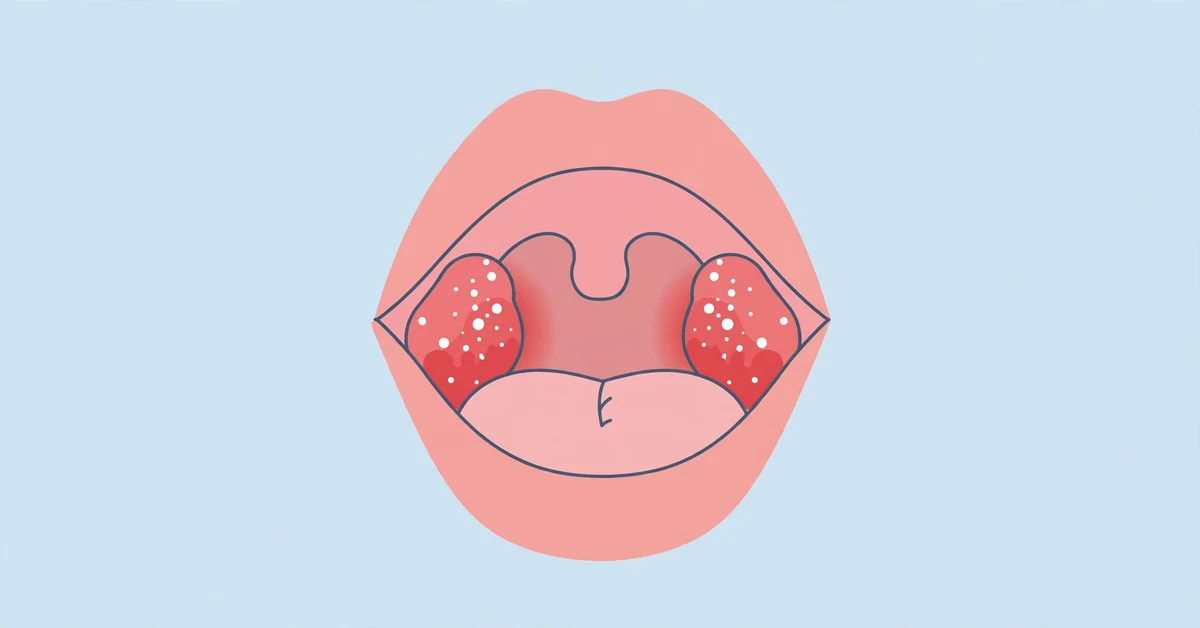
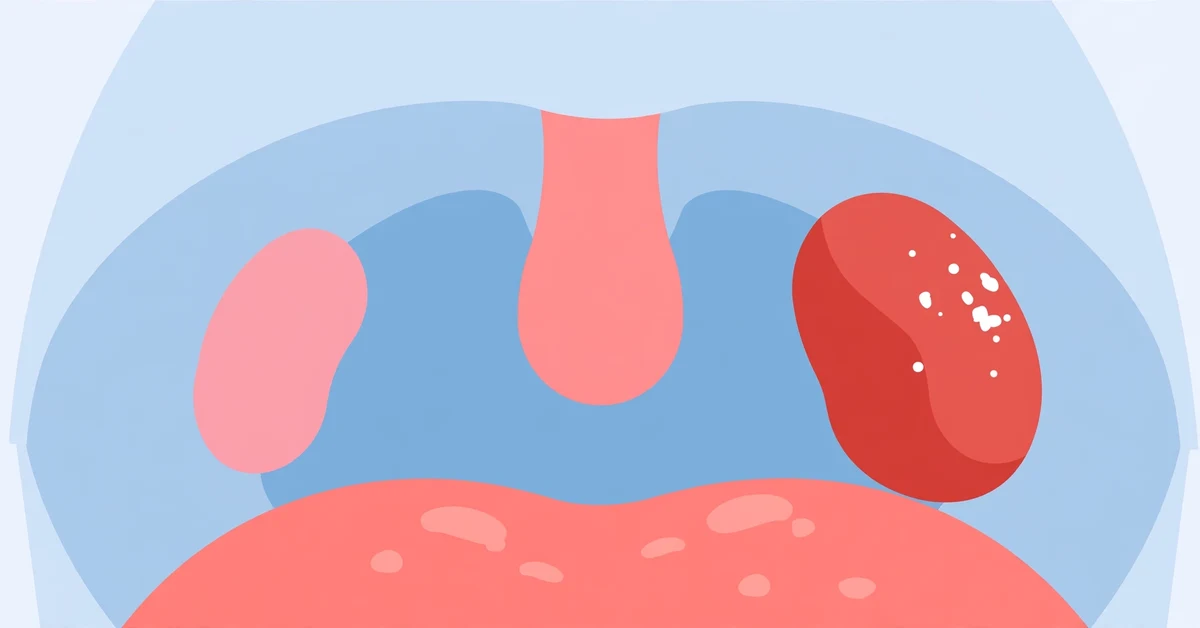
Healthy tonsils are pink, roughly the same size, and sit quietly at the sides of the throat. Infected tonsils look different: they turn bright red, swell up, and may be coated with white or yellow patches. The throat around them — including the soft palate and the uvula, the small flap hanging in the middle — often looks red and inflamed too.

How to check your own throat: stand in bright light, open your mouth wide, stick out your tongue, and look at the back of your throat in a mirror. Look for tonsils that are redder and larger than usual, white or yellow spots, a coating on the tonsils, and redness spreading to the soft palate. A phone flashlight helps. If you see white spots or a coating along with a sore throat and fever, that combination is worth a doctor’s visit — it often (though not always) means a bacterial infection.
White spots vs coating vs tonsil stones: white spots are usually small patches of pus sitting in the tonsil’s crevices, while a coating is a thin film spread across the tonsil’s surface — both suggest infection. Tonsil stones are different: small, hard, white or yellow lumps that come and go, often with bad breath but usually without fever or severe pain. If you have stones without other symptoms, that is a separate issue from acute tonsillitis. For more photos of each appearance, see our visual guide to tonsillitis pictures.
Viral vs bacterial tonsillitis: how the symptoms differ
Most tonsillitis is caused by viruses — the same ones that cause colds and flu — while bacteria cause a smaller share, roughly 5 to 40% of cases depending on age and season. The most common bacterium is group A Streptococcus, the germ behind strep throat. The two types feel different, and the table below shows how.
| Feature | Viral tonsillitis | Bacterial tonsillitis (strep throat) |
|---|---|---|
| Onset | Gradual, often after a cold | Sudden, often overnight |
| Fever | Low-grade or none | High, often above 101°F (38.3°C) |
| Tonsil appearance | Red and swollen, usually no pus | Red and swollen with white or yellow pus |
| Cough and runny nose | Common | Usually absent |
| Neck glands | Mildly tender | Enlarged and very tender |
| Stomachache, vomiting | Less common | More common, especially in children |
| Course | Improves on its own in 3–4 days | Persists or worsens without antibiotics |
Doctors often use a simple 4-point checklist called the Centor criteria: fever, white exudate on the tonsils, tender lymph nodes in the front of the neck, and no cough. The more points, the more likely strep is the cause — but it is a clinician’s tool, not a home diagnosis. Only a rapid strep test or a throat culture can confirm it, and that test matters: bacterial tonsillitis needs antibiotics, viral tonsillitis does not.


Tonsillitis or something else? Similar conditions
A sore throat with swollen tonsils is not always tonsillitis. Several conditions look similar at first, and the pattern of symptoms usually tells them apart:
| Condition | How it differs from tonsillitis |
|---|---|
| Strep throat | This is bacterial tonsillitis itself — high fever, pus on the tonsils, no cough. A rapid strep test confirms it. |
| Viral sore throat (pharyngitis) | Cough, runny nose, and hoarseness dominate; tonsils are less swollen and there is usually no pus or high fever. |
| Infectious mononucleosis (mono) | Extreme fatigue, swollen glands throughout the body, and a thick white coating on the tonsils that can look like pus; often lasts 2–4 weeks. |
| Scarlet fever | A strep infection plus a sandpaper-like rash, a strawberry-red tongue, and high fever — needs antibiotics promptly. |
| Peritonsillar abscess (quinsy) | Severe pain on one side only, muffled voice, drooling, trouble opening the mouth — needs same-day care (see the red flags below). |
When in doubt, the pattern helps: cough and cold symptoms point away from strep; extreme fatigue points toward mono; a rash points toward scarlet fever; one-sided agony points toward an abscess.
Tonsillitis symptoms day by day: what to expect
Knowing the usual course helps you judge whether you are on track or need care. This is the typical pattern for viral tonsillitis; bacterial cases follow a different course without treatment.
| When | What usually happens |
|---|---|
| Day 1 | Scratchy throat, mild fever, tonsils start to redden; you may feel tired |
| Days 2–3 | Symptoms peak — worst sore throat, highest fever, most swelling, hardest swallowing |
| Days 3–4 | Viral cases start to improve; fever eases and swallowing gets easier |
| Days 5–7 | Most viral cases are largely resolved; mild soreness may linger a few more days |
| Beyond day 7, or getting worse | See a doctor — this is no longer the usual viral course |
Bacterial tonsillitis without antibiotics often does not follow this curve: fever and pain persist or get worse after day 3 or 4 instead of easing. With antibiotics, strep symptoms usually start improving within 24 to 48 hours. If your symptoms improve and then suddenly get worse again, that is also a reason to get checked — it can mean a second infection or a complication.
How we reviewed the evidence
We compared the symptom lists and guidance from the Mayo Clinic, NHS Inform Scotland, Cleveland Clinic, WebMD, Healthgrades, and Ada, then added the coverage none of them puts in one place: the age split, the day-by-day timeline, the viral-versus-bacterial table, the mirror self-check, the per-symptom home-care table, and the red-flag checklist. Medical facts in this article are cited to those sources throughout, and the symptom lists match the ones those sources publish.
What helps each symptom
There is no drug that cures viral tonsillitis — care is about easing symptoms while the infection runs its course. Match the remedy to the symptom:
| Symptom | What helps |
|---|---|
| Sore throat | Warm salt-water gargles, throat lozenges, honey in warm tea (adults and children over 1 year), ice pops and cold foods |
| Fever and pain | Paracetamol or ibuprofen as directed on the label; plenty of fluids; rest |
| Painful swallowing | Soft foods, plenty of fluids, cold drinks; avoid acidic, spicy, or hard and scratchy foods |
| Swollen glands | Usually ease as the infection clears; a warm compress on the neck can soothe them |
| Bad breath | Gentle brushing, salt-water rinses; it clears as the infection clears |
| Cough | Fluids and rest; see our guide on how to stop a tickly cough for more options |
What not to do: do not give aspirin to children or teenagers with a viral illness — it is linked to Reye syndrome, a rare but serious condition affecting the liver and brain. Do not take antibiotics for viral tonsillitis — they do not help viruses and contribute to antibiotic resistance. Do not use leftover antibiotics from a previous illness, and avoid smoke, strong fumes, and alcohol-based mouthwashes, which irritate an already sore throat.
Is tonsillitis contagious?
Tonsillitis itself is not contagious, but the viruses and bacteria that cause it are. They spread in droplets when someone coughs or sneezes, and through shared cups, utensils, and toothbrushes. Strep throat stays contagious until about 24 hours after starting antibiotics (and being fever-free); viral tonsillitis is contagious while symptoms last. As a rule of thumb, you can return to school or work once you have been fever-free for 24 hours without fever-reducing medicine and can eat and drink normally. Washing hands often, not sharing cups or utensils, and replacing a toothbrush after a strep infection are sensible steps while you recover.
Red flags: get medical care now
Most tonsillitis gets better on its own, but some symptoms mean you should get medical care promptly — and a few mean emergency care. Check yourself against this list:
- Trouble breathing or noisy, labored breathing
- Cannot swallow saliva, drooling, or cannot open the mouth fully
- Severe pain on one side of the throat with a muffled, “hot potato” voice — a possible peritonsillar abscess (quinsy), a pocket of pus beside the tonsil
- Signs of dehydration: very little urine, dizziness, dry mouth, or a child who has stopped drinking
- Fever above 101°F (38.3°C) that does not come down, or symptoms that are not improving after 4 days
- Symptoms that improve and then suddenly get worse
- Severe headache with a stiff neck
- Episodes that keep coming back, several times a year
A peritonsillar abscess is the most common serious complication of tonsillitis. It usually develops a few days into the illness, almost always on one side, and needs same-day medical care — it can make breathing and swallowing difficult and does not clear up on its own.
When tonsillitis keeps coming back
Recurrent tonsillitis means repeated episodes. Doctors often use the Paradise criteria: 7 or more episodes in one year, 5 or more a year for 2 years, or 3 or more a year for 3 years. If you reach those numbers, an ear, nose, and throat (ENT) specialist may discuss removing the tonsils (tonsillectomy). Surgery used to be routine; today it is mainly reserved for frequent, severe, or complicated cases. Between episodes, the tonsils look and feel normal, and many people with recurrent tonsillitis have no symptoms at all between flare-ups.
The bottom line
Tonsillitis symptoms — sore throat, painful swallowing, fever, red swollen tonsils with white spots, and tender neck glands — usually peak in 2 to 3 days and ease within a week when the cause is viral. High fever, visible pus, no cough, and very tender glands point more toward bacterial strep, which needs a test and antibiotics. Watch the red flags — trouble breathing or swallowing, one-sided severe pain with a muffled voice, drooling, dehydration, or no improvement after 4 days — and get care promptly if any of them appear.
This article is for general information only and is not medical advice. It cannot diagnose or treat any condition. If you or your child has severe or worsening symptoms, or you are unsure what is causing them, contact a healthcare professional. Sources: Mayo Clinic , NHS Inform Scotland, Cleveland Clinic , WebMD , Healthgrades, Ada.
Frequently asked questions
Most viral tonsillitis starts to improve within 3 to 4 days and clears up in about a week. Bacterial tonsillitis (strep throat) usually does not improve on its own — with antibiotics, symptoms typically start easing within 24 to 48 hours. If symptoms are not improving after 4 days, or they get worse, see a doctor.
It is rare. A sore throat is the most common symptom and is present in nearly every case. Mild or chronic tonsillitis can sometimes show up mainly as swollen tonsils, bad breath, or tonsil stones with only a slight sore throat — but a completely pain-free case is unusual.
Clues help but cannot confirm it: a cough and runny nose point toward viral, while high fever, white pus on the tonsils, very tender neck glands, and no cough point toward bacterial strep. Doctors use the Centor criteria and confirm with a rapid strep test or throat culture — that test is the only reliable way to tell.
Tonsillitis itself is not contagious, but the viruses and bacteria that cause it are, spreading through coughs, sneezes, and shared cups or utensils. Strep throat stays contagious until about 24 hours after starting antibiotics. You can usually return to school or work once you have been fever-free for 24 hours without fever-reducing medicine.
Call a doctor if your child has a sore throat with fever, a sore throat that does not go away within 24 to 48 hours, painful or difficult swallowing, or extreme weakness, tiredness, or fussiness. Get care right away if your child has trouble breathing, cannot swallow saliva or drool, or cannot open their mouth fully.
No. White spots can also appear with viral infections, infectious mononucleosis (mono), and tonsil stones. Pus plus high fever plus no cough makes strep more likely, but only a strep test can confirm it — and some viral cases also show white spots.
Drink plenty of fluids and stick to soft, cool foods: soups, yogurt, mashed potatoes, smoothies, and ice pops. Cold foods and drinks often soothe the throat. Avoid acidic foods like citrus and tomato, spicy foods, and hard or scratchy foods until swallowing stops hurting.
It is rare. After the tonsils are removed, true tonsillitis cannot come back, although small remnants of tonsil tissue can occasionally become infected. Sore throats after a tonsillectomy are usually pharyngitis — inflammation of the throat itself — rather than tonsillitis.
Read Next

Shea Butter for Your Face: Benefits and Uses

Proteolytic Enzymes: How They Work, Benefits and Sources

This Is What You Should Do After Unprotected Sex or Condom Failure

Virectin Review: Does It Really Work?

Stretches and Exercises to Help Ease SI (Sacroiliac) Joint Pain

Is There a Relationship Between Menopause and Body Odor?
Related Posts
Tonsillitis Pictures: A Visual Guide to Swollen and Infected Tonsils
Nov 11, 2026 • 10 min read
8 Alternatives to Leg Curls
Sep 14, 2026 • 14 min read
Which Is Better — Using Free Weights or Machines?
Sep 15, 2026 • 32 min read
6 Resistance Band Exercises for Shoulders
Sep 19, 2026 • 33 min read
All About Xarelto
Oct 5, 2026 • 5 min read