

Vitamin K describes a family of fat-soluble vitamins that share a common chemical framework. Phylloquinone (vitamin K1) is primarily present in plant-based foods, whereas vitamin K2 is more common in fermented products and animal-derived foods.
Most people associate vitamin K with its role in blood coagulation.
However, the term actually covers multiple related vitamins that offer health advantages extending beyond clotting.
Here, we’ll compare the two main dietary forms of vitamin K — K1 and K2.
You’ll also discover which foods supply these vitamins and what health benefits their consumption may bring.
:max_bytes(150000):strip_icc()/foods-high-in-vitamin-k-5114127-FINAL-2c0783a2c2c643988571c6010f352ac7.png)
What Is Vitamin K?
Vitamin K was identified accidentally in the 1920s and 1930s when limited diets in animals produced excessive hemorrhaging (1).
Although multiple forms exist, the two most relevant to human nutrition are vitamin K1 and vitamin K2.
Vitamin K1, or phylloquinone, is synthesized by plants and is abundant in leafy green vegetables. It constitutes roughly 75–90% of dietary vitamin K intake (2).
Vitamin K2 occurs in fermented foods and animal products and is also produced by intestinal bacteria. Its variants are called menaquinones (MKs), designated by the length of their side chain, ranging from MK-4 through MK-13.
Summary: Vitamin K is a group of related vitamins. The primary dietary forms are K1 and K2.
Food Sources of Vitamin K1
Plants produce vitamin K1, which is the dominant form of vitamin K in the typical diet.
Below are examples of foods rich in vitamin K1, with values representing the amount of K1 in one cup of the cooked vegetable (3).
- Kale: 1,062 mcg
- Collard greens: 1,059 mcg
- Spinach: 889 mcg
- Turnip greens: 529 mcg
- Broccoli: 220 mcg
- Brussels sprouts: 218 mcg
Summary: Vitamin K1 is the chief dietary vitamin K and is most commonly sourced from leafy green vegetables.
Food Sources of Vitamin K2
Sources of vitamin K2 differ depending on the specific subtype.
MK-4, one subtype, is present in certain animal-derived foods and is unique among K2 forms in not being produced by bacteria. Good MK-4 sources include chicken, egg yolks and butter.
MK-5 through MK-15 have longer side chains, are bacterial products, and are commonly found in fermented foods.
Natto — a traditional Japanese fermented soybean dish — is especially rich in MK-7.
Certain cheeses, both hard and soft, supply vitamin K2 as MK-8 and MK-9. A recent analysis also found several pork products contain MK-10 and MK-11 (4).
The table below lists vitamin K2 content for 3.5 ounces (100 grams) of several foods (4, 5, 6).
- Natto: 1,062 mcg
- Pork sausage: 383 mcg
- Hard cheeses: 76 mcg
- Pork chop (with bone): 75 mcg
- Chicken (leg/thigh): 60 mcg
- Soft cheeses: 57 mcg
- Egg yolk: 32 mcg
Summary: Vitamin K2 sources depend on the subtype but commonly include fermented foods and specific animal products.
Differences Between K1 and K2 in the Body
All forms of vitamin K primarily function to activate proteins that are important for blood clotting, cardiovascular health and bone metabolism.
Yet differences in how they’re absorbed and distributed in the body mean K1 and K2 may have distinct physiological impacts.
Generally, plant-derived K1 is not well absorbed. One study estimated that under 10% of plant K1 is taken up by the body (7).
Less is known about K2 absorption, but because K2-rich foods often contain fat, experts think K2 may be better absorbed than K1 (2).
Vitamin K is fat-soluble, so dietary fat enhances its uptake.
Moreover, the longer side chain of many K2 forms enables them to remain in circulation longer than K1. Whereas K1 may clear from blood within hours, some K2 variants can persist for days (8).
Some scientists propose that K2’s extended circulation allows it to be more available to tissues throughout the body, while K1 is mainly transported to and used by the liver (9).
These distinctions are important for understanding the different roles K1 and K2 may play in health. The sections that follow examine this in more detail.
Summary: Variations in absorption and distribution of vitamin K1 and K2 may cause different health effects.
Health Benefits of Vitamin K1 and K2
Research exploring vitamin K’s benefits suggests it supports clotting, bone integrity and cardiovascular health.
Vitamin K and Blood Clotting
Several clotting proteins rely on vitamin K to function properly. While clotting can sometimes be harmful, without it minor injuries could cause catastrophic bleeding.
People with clotting disorders often take warfarin to inhibit excessive clotting. If you use warfarin, it’s important to keep vitamin K intake steady because of its strong influence on coagulation.
Although guidance tends to focus on vitamin K1 in foods, monitoring K2 intake is also relevant.
One study found that a single serving of natto (rich in K2) affected clotting measures for up to four days, a much larger effect than foods high in K1 (10).
Therefore, if you’re taking warfarin, it’s wise to be consistent with both K1- and K2-containing foods.
Vitamin K and Bone Health
Many researchers think vitamin K activates proteins essential for bone formation and remodeling (2).
Observational studies have linked low levels of both K1 and K2 to higher fracture risk, though these studies cannot prove causation as effectively as randomized trials (11).
Most randomized trials investigating K1 supplements have been inconclusive and shown minimal benefit (12).
Conversely, a review of controlled trials found MK-4 supplementation reduced fracture risk, but subsequent large trials have reported no effect (13, 14).
Overall, evidence is mixed, yet the European Food Safety Authority recognized vitamin K as directly involved in maintaining normal bone health (15).
More rigorous, well-designed trials are needed to clarify the effects of K1 and K2 on bone and whether one is superior to the other.
Vitamin K and Heart Health
Beyond coagulation and bones, vitamin K appears to help protect against heart disease.
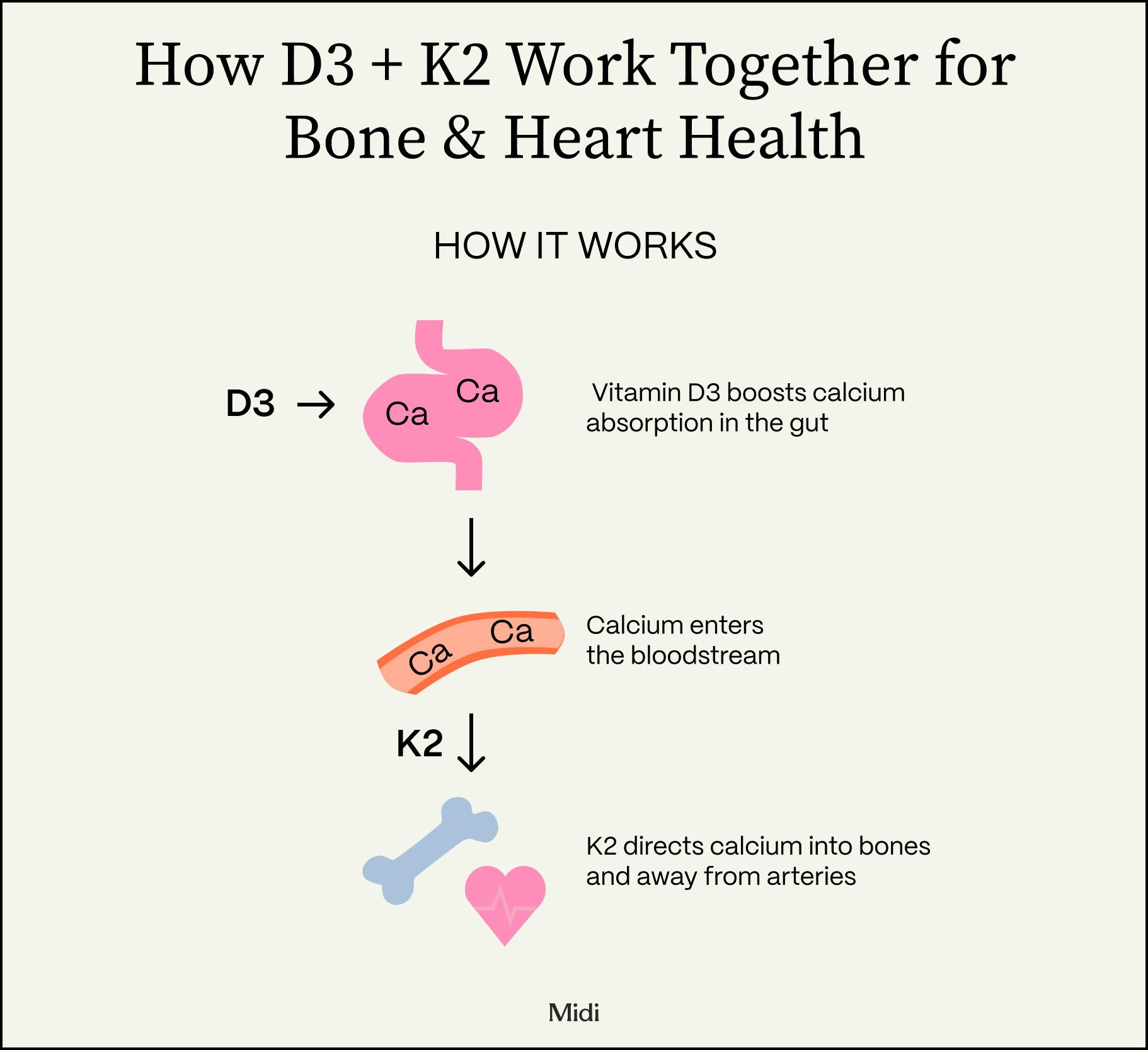
Vitamin K activates a protein that prevents calcium from accumulating in arterial walls. Such calcium build-up promotes plaque formation and strongly predicts cardiovascular disease (16, 17).
Several observational studies indicate vitamin K2 may be more effective than K1 at reducing arterial calcification and lowering heart disease risk (18, 19, 20).
However, higher-quality controlled trials have shown that supplements of both K1 and K2 (notably MK-7) can improve some cardiovascular markers (16, 21).
Still, more research is needed to confirm whether vitamin K supplementation directly causes heart benefits and whether K2 truly outperforms K1 for cardiovascular protection.
Summary: Both K1 and K2 are important for clotting, bones and possibly heart health. Additional research is required to determine whether K2 is superior to K1 in any of these roles.
Vitamin K Deficiency
Severe vitamin K deficiency is uncommon in healthy adults. It usually occurs in cases of extreme malnutrition, impaired absorption, or in some individuals taking warfarin.
Deficiency signs include persistent bleeding that’s difficult to stop, though this symptom can stem from multiple causes and should be assessed by a healthcare professional.
Even if you aren’t deficient, you still might not be consuming enough vitamin K to optimally protect against cardiovascular disease and bone conditions like osteoporosis.
For this reason, getting an adequate amount of vitamin K is important.
Summary: True vitamin K deficiency — marked by excessive bleeding — is rare in adults. However, adequate intake is still important for optimal health.
How to Get Enough Vitamin K
Recommended adequate intakes are based on vitamin K1 and are set at 90 mcg/day for adult women and 120 mcg/day for adult men (22).
This is easy to meet by adding a cup of spinach to an omelet or salad, or by serving a half-cup of broccoli or Brussels sprouts at dinner.
Eating these vegetables with a source of fat, such as egg yolks or olive oil, improves absorption of vitamin K.
No official intake recommendation exists specifically for vitamin K2. Aim to include a variety of K2-rich foods in your meals.
Here are practical suggestions:
- Try natto: This fermented soybean dish is exceptionally high in vitamin K2. It has a strong flavor that some people dislike, but it’s one of the most concentrated K2 foods.
- Eat more eggs: Egg yolks are convenient sources of vitamin K2 and can be incorporated into daily breakfasts.
- Choose certain cheeses: Fermented cheeses like Jarlsberg, Edam, Gouda, cheddar and blue cheese contain K2 produced by fermentation bacteria.
- Include dark chicken meat: Dark cuts like legs and thighs provide moderate amounts of vitamin K2 and may offer better absorption than breast meat.
Both vitamin K1 and K2 are available as supplements and are sometimes taken in large amounts. Although no clear toxicities have been established, more research is needed before definitive supplementation guidelines can be given.
Summary: Incorporate a range of K1- and K2-containing foods into your diet to reap the health advantages these vitamins provide.
The Bottom Line
Vitamin K1 is mainly found in leafy green vegetables, while vitamin K2 is most abundant in fermented foods and certain animal products.
Vitamin K2 may be more readily absorbed and some of its forms may remain in circulation longer than K1. These differences might lead to distinct effects on health.
Vitamin K supports blood clotting and appears to promote heart and bone health. Some evidence suggests K2 might outperform K1 in certain functions, but further research is required to confirm this.
For overall health, focus on consuming foods rich in both vitamin K1 and K2. Aim for at least one green vegetable daily and include fermented foods and K2-containing animal products in your diet.

















Leave a Reply
You must be logged in to post a comment.