

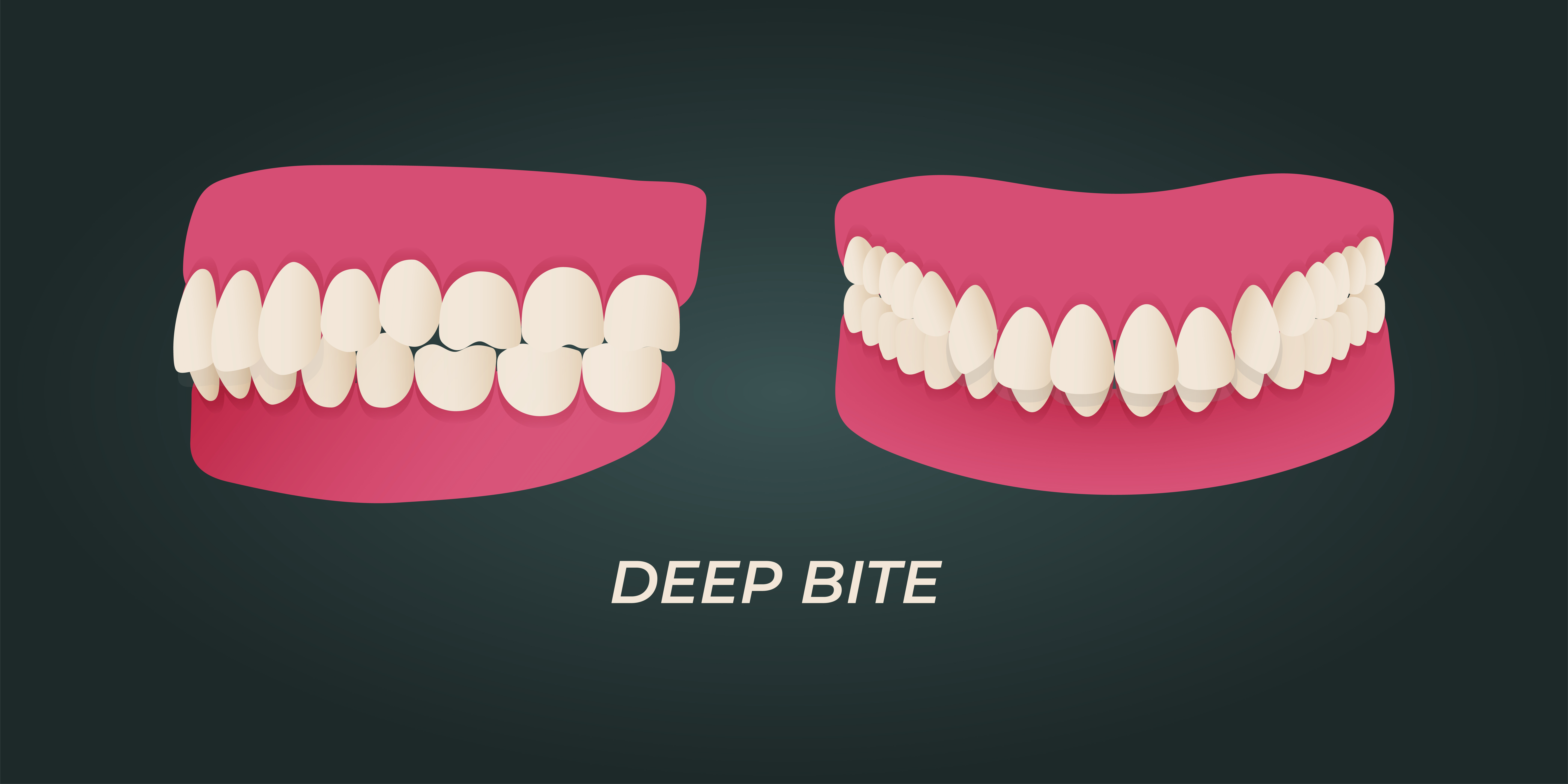
A deep bite is a frequently seen dental issue involving the alignment of your upper and lower front teeth.
If your top front teeth extend too far down over your lower front teeth when you close your jaw, that’s considered a malocclusion.
It’s normal for a few millimeters of the lower front teeth to be visible, but when the top teeth overlap the bottoms by more than about 4 mm, it’s typically classified as a deep bite.
Seeking care for a deep bite is important because it can lead to more serious oral health problems, such as sores on the roof of the mouth and excessive wear on teeth.
There are multiple treatment approaches available to correct a deep bite.
Continue reading to find out how deep bites are managed and what complications may arise if left unaddressed.
What is a deep bite?
A deep bite is a form of malocclusion — the dental term for misalignment between the upper and lower teeth, including the posterior molars.
Deep bites occur when the upper front teeth descend excessively over the lower front teeth upon jaw closure. If only a few millimeters of the lower teeth are visible or less, this is considered a deep bite.
What causes a deep bite?
A deep bite can develop for several reasons, including one or more of the following:
- hereditary factors
- missing teeth
- trauma to the jaw
- a small jawbone
- a powerful bite from chronic teeth grinding or jaw clenching
- insufficient space in the mouth for permanent teeth
A deep bite can affect anyone, from children to adults.
Deep bites impact 15 to 20 percent of Americans. The American Association of Orthodontists reports that one in four people seeking orthodontic care is an adult.
How are deep bites treated?
There are multiple strategies for treating a deep bite. You’ll likely consult an orthodontist or dentist to review suitable options for your situation.
Each deep bite case is unique. You may have associated conditions that need attention during treatment, and your age can influence the recommended plan.
Below are several methods your clinician may propose to address a deep bite.
Tooth removal
Your provider might advise removing certain teeth to facilitate realignment of the bite. This can include extraction of teeth toward the back of the mouth.
Children undergoing treatment may have baby teeth or permanent teeth removed to help achieve proper alignment.
Dental appliances
Various dental devices can help correct a deep bite.
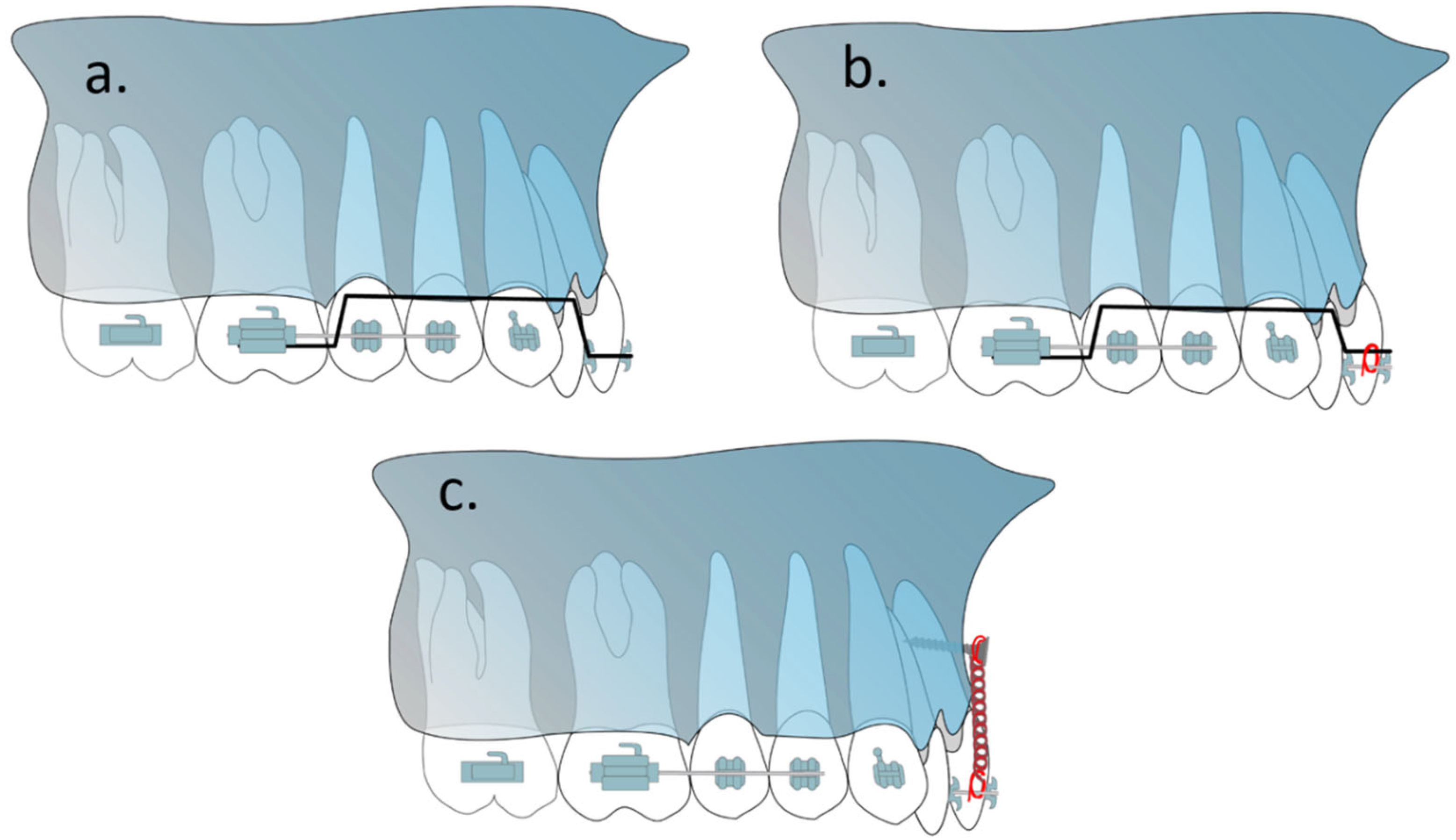
- Braces: brackets attached to teeth and joined by wires that are periodically tightened throughout treatment.
- Retainers: removable devices made of wires and plastic that can be taken out when necessary, though they typically need to be worn most of the day.
- Clear aligner trays: transparent trays that gradually move teeth into position, serving as an alternative to traditional braces.
Some appliances are off-the-shelf, while others are custom-fabricated to fit your mouth.
One 2019 study found that prefabricated appliances may reduce overbite but are generally less effective than custom-made devices and are used less often.
Depending on the severity, you might need to wear a dental appliance for months or years to correct the deep bite and related orthodontic issues.
Teeth repair
Your clinician may determine that restoring or rebuilding certain teeth will improve your bite. This could involve dental implants or restoring worn teeth with bonding to enhance alignment.
Additional procedures may be recommended to comprehensively address the deep bite.
Surgery
If the deep bite stems from skeletal issues, jaw surgery may be recommended, particularly for older adolescents or adults who have finished growing.
Surgical treatment often includes wearing braces or another appliance both before and after the operation. The procedure may require a hospital stay, general anesthesia, and several weeks of recovery time.
Optum Now is operated by RVO Health. By clicking on this link, we may receive a commission. Learn more.
What are the complications of a deep bite if left untreated?
Correcting a deep bite helps prevent the problems that can follow from this condition. While many people pursue treatment for cosmetic reasons, there are important functional reasons to address it as well.
Possible complications from an untreated deep bite include:
- excessive wear of lower teeth that undermines tooth structure and may require restorative care
- sores or ulcers forming on the roof of the mouth
- crooked or crowded teeth that cannot be fully corrected until the deep bite is addressed
- development of temporomandibular joint (TMJ) disorders
- difficulties with eating or swallowing
- increased risk of gum disease
Treating a deep bite can help prevent these issues and also resolve cosmetic concerns related to the condition.
Delaying treatment or failing to comply with the full treatment plan — for example, stopping use of an appliance sooner than recommended — can worsen the problem.
Consequently, more invasive and costly treatments may be required later.
Takeaway
A deep bite is a common dental condition. You might notice signs and want treatment for aesthetic reasons.
Beyond appearance, there are many important reasons to correct a deep bite. Early intervention can help prevent more serious oral health problems from developing.
A dentist can evaluate your situation and recommend a treatment plan that may include extractions, appliances, or other dental procedures to correct the deep bite.






















Leave a Reply
You must be logged in to post a comment.